Pacific Shipping And
pp. 101-109 · Read in the full issue
Cruising Yachts
Japanese Tourist Rush To Pacific May Begin Soon
The Japanese may begin a tourist rush to the Pacific soon ollowing the Japanese Government’s removal of currency
estrictions on ordinary citizens in April.
IE lifting of the restrictions means that the Japanese can now el freely abroad, and they are ex ed to do so in increasingly large ibers. Pacific tourist centres are »ng the places they are likely to 1 for. he managing director of the Toyo en Company, of Tokyo, Mr, mo Hishida, said in Suva on May that his company proposed to d a liner of up to 50,000 tons the trade between Japan, Austra and the United States following lifting of the currency restrictions, [r. Hishida, whose company owns cruise liner Oriental Queen, which makes regular calls at Austra- New Zealand, and South Pacific s, said draught and other factors litting, the new liner might call
regularly at Suva and Tahiti. He hoped the ship would be in service by the end of 1967.
Mr. Hishida added that the names of Fiji and Tahiti, as well as Aus tralia, New Zealand and Hawaii were becoming increasingly familiar in Japan.
More Echoes Of "Kadavulevu"
Disaster
Official probes into the Kadavulevu disaster, in which nearly 90 people lost their lives in Fiji waters on Easter Sunday, are now over. After a preliminary inquiry by the Fiji Marine Board, the matter went to a formal court, which delivered its findings late in May.
But there will be echoes of the dis
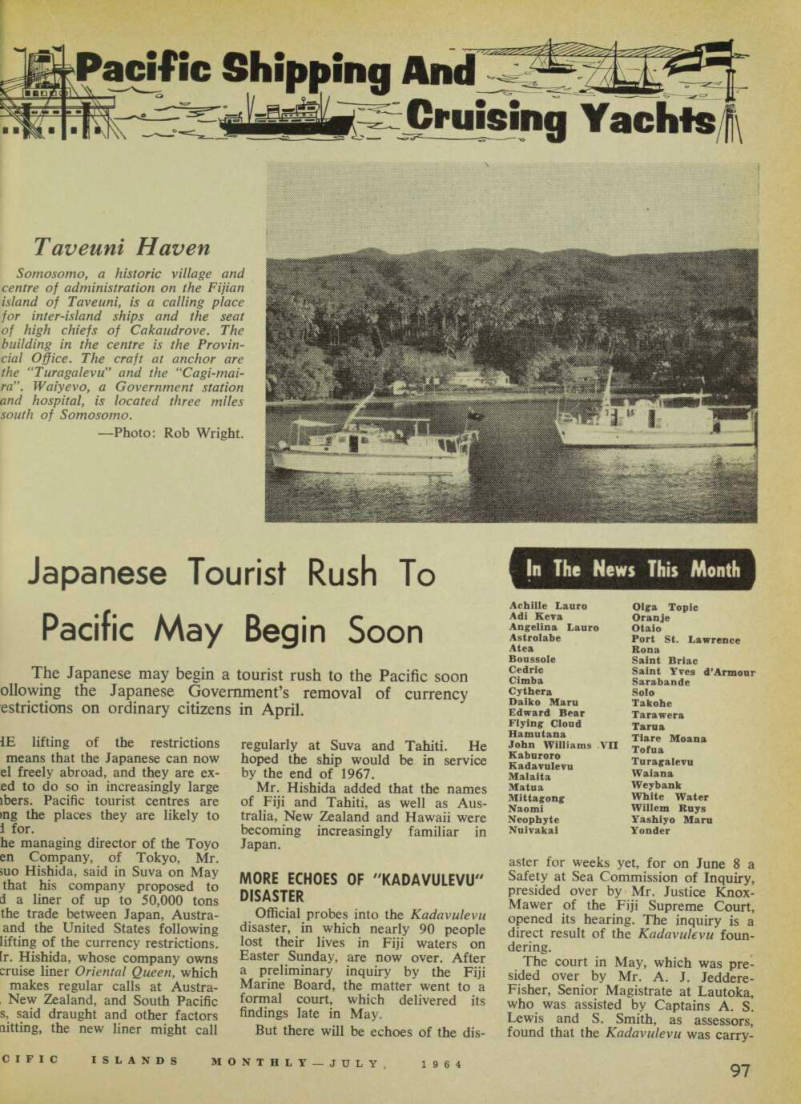
Taveuni Haven
Somosomo, a historic village and centre of administration on the Fijian island of Taveuni, is a calling place for inter-island ships and the seat of high chiefs of Cakaudrove. The building in the centre is the Provin cial Office. The craft at anchor are the “Turagalevu” and the “Cagi-mai ra”. Waiyevo, a Government station and hospital, is located three miles south of Somosomo. —Photo: Rob Wright.
g a greater number of crew and issengers than specified in her sea ling certificate, both at the time she Ft Suva on March 26 for Waitoga, airai, in the Lomaiviti Group, and len she left Waitoga on Sunday, arch 29, to return to Suva.
There was evidence that the master the Kadavulevu timed his depar re from Nairai to arrive at Suva in e early hours of March 30 when ere would be no one about to see s overloaded ship.
The Kadavulevu held current sur y and seagoing certificates from the ji Marine Board authorising her to rry 22 passengers and seven crew, it without any deck load. The idavulevu was seaworthy on the itward voyage and on the return P- Stating that the cause of the foun ring could not be definitely ascer ined, the court gave four probable asons for the tragedy: • The number of persons carried; • The rough sea and strong wind erating on the beam; • Heavy rolling when the engine )pped just before the capsize; • Top weight caused by the posi in of some of the excess persons, gravated by the ballast having been moved several years previously so at she could carry more cargo.
The court said that police in liries revealed that 76 passengers d nine crew were lost. It was pos )le that a further two passengers ;re on board, who were also lost.
The court found that the loss of 2 Kadavulevu was contributed to the wrongful acts of the owner, mson Lee, and the master, Filimoni umaki (both of whom perished in b disaster) in that they carried ex ss persons and deck load, and they : t Suva on the outward trip before b time of clearance.
Ercy Visits To
Tcairn Island
The doctor of the New Zealand lipping Company’s vessel Otaio, en ute from London, went ashore to amine Pitcairn Island’s radio offi r, Tom Christian, when the ship lied at Pitcairn Island on April 2, )m had been sick for some time.
Eight days later the doctor of the trt St. Lawrence, which was head g for Panama from Sydney, offered examine any of the islanders who eded medical attention.
Several islanders took the oppor nity of obtaining checks and advice iring the ship’s two-hour stay. It is the first time the Port St. Law nce had called at Pitcairn.
That Submarine Volcano
Playing Up Again
Solomon Islanders at Wana Wana Lagoon, New Georgia, have reported seeing three columns of steam rising from the sea south-west of Munda on May 25.
The BSIP Geological Survey De partment says this is believed to be the area of the submarine volcano discovered by HMS Cook on the night of December 14, 1963, at lati tude 8 deg. 24.9 min. south, and longitude 157; deg. 06 min. east. {PIM, Mar. p. 95.) Nearly three weeks later—on January 3 —this point was the focus of a severe earth quake of magnitude 5.5 and at a depth of about 30 km. The latest re ports are the third manifestation of activity at this location, which is about seven miles distant from Munda Airfield and the local head quarters of the Methodist Mission.
Inter-Island Trader
To Be Scrapped
The Fiji inter-island motor ship, Adi Keva, owned by Morris Hed strom Ltd., is to be scrapped because it was found during a recent annual overhaul that repairs that needed doing would be uneconomical.
The owners are undecided what to do with her, but it is likely that she will be cut up for scrap.
The Adi Keva is the third ship to bear that name for Morris Hed stroms, who bought her at Vila in 1953. The original Adi Keva was built many years ago by the Fiji Shipping Co. at Ucuinasoki, a site on which the Pacific Biscuit Com
pany now stands in Rodwell Road, Suva.
Morris Hedstrom’s built the second Adi Keva at Suva, and that one was destroyed by fire.
The company has no definite plans yet about a replacement and in the meantime is looking for a “temporary replacement overseas”. The company does have a tentative plan to build new ships.
The other ships in the Morris Hed strom fleet are the Tuvalu, Altair and Tui Cakau. (Over)
W Landing Barge
R Solomons
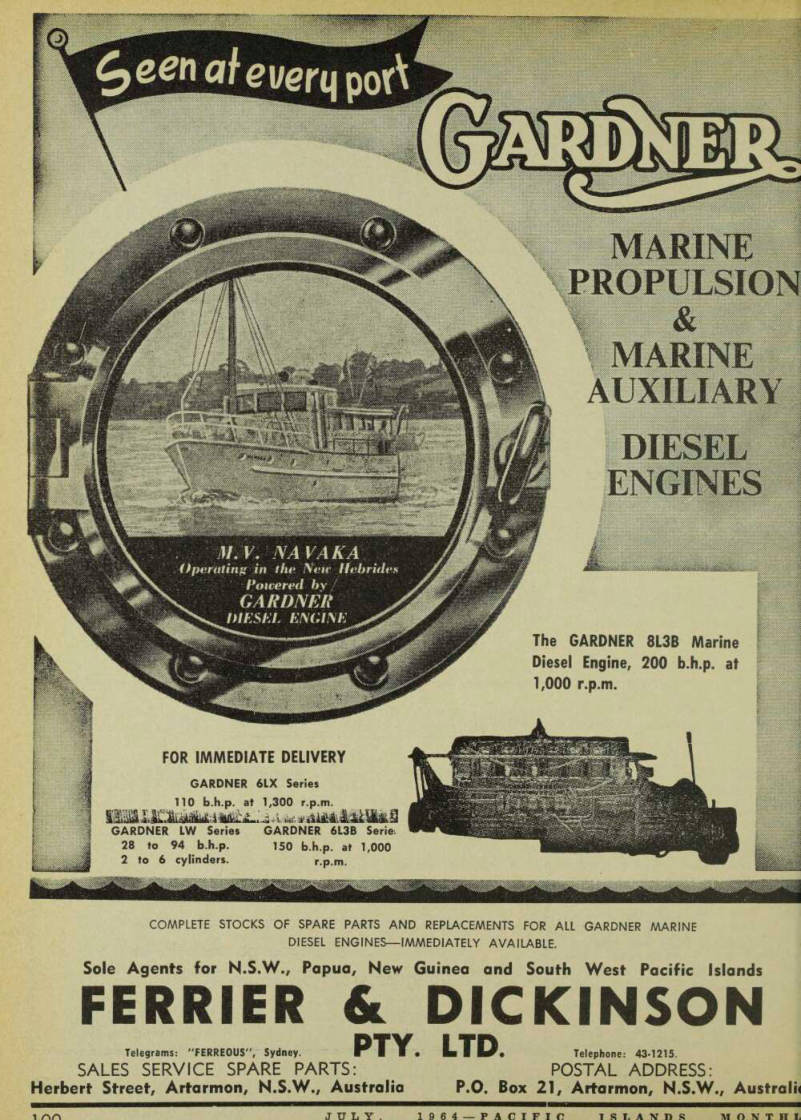
A new landing barge for the BSIP wine Department was expected to ■ive at Tulagi by the MV Weybank June 15. The barge, which will be npleted at Tulagi’s marine base irkshops, was built at the Thames unch Works at Twickenham, Eng id, and is powered by two Gardner sel engines.
It is equipped with a two-ton Tick and a winch, and the elec :al installation includes a search lit, navigation equipment and odlight.
The barge will make its first page to Auki and Kira Kira.
7 Strain On Lautoka
Rt Facilities
The cargo handling facilities at utoka, Fiji, were under heavy ain at the end of May and during i first few days of June.
Between May 25 and June 23, re than 5,000 tons of cargo were loaded at the port, and on June 3 ir overseas ships were tied up at same time. The four ships were Olga Topic, Rona, Daiko Maru i Waiana.
Fhe Olga Topic was loading 12,600 is of sugar for the United States; Rona was topping up a cargo of 00 tons of molasses for Australia; 1 the Daiko Maru, a Japanese ighter and the Union Steamship mpany’s Waiana were discharging cargoes. 3ther ships that had discharged go during the previous few days re the Tar aw era, Cedric and ivakai, 3y June 3, the cargo was packed tightly in the Customs shed that was impossible to use fork lifts I the cargo was being moved by id barrows.
Provement In Bsip
Rts Authority Operation
The annual report of the BSIP ts Authority for the year ended tember 30, 1963, shows that >orts handled during the year ounted to 16,300 tons, and exports ched about 12,500 tons. The t rate of handling general cargo » achieved in June when 603 tons e discharged from the MV laita in one day. 7 otal net profit was £19,750, and lough the volume of cargo idled during the period under re-
view increased by 11.6 per cent., the Authority’s operating costs were re duced by almost £1,500.
Working capital at the close of the financial year amounted to about £103,200.
The report states that by next October the Authority should be able to contribute over £lOO,OOO from its own resources towards the cost of the new deep-water wharf.
The report adds that when the reclamation of land at Point Cruz is completed (about this month), an application will then be made to vest the reclaimed land in the Ports Authority.
Missionary Ship's First
Visit To Suva
The John Williams VII, the 120ton ship of the London Missionary Society, paid her first visit to Suva on June 1, when she arrived with a missionary who had to go urgently to Sydney.
The ship was launched in London last year by Princess Margaret and is based at Tarawa, GEIC. Her skip per is Captain J. McK. Arnot, who was previously master of the John Williams VI for five years. Captain McK. Arnot plans to retire to live in England about the end of August after 12 years in the Pacific.
The captain, who comes from
Manchester, has spent 43 years at sea. He came to the Pacific in 1952 in his own yacht, and was later captain of the Morris Hedstrom ships Altair and Ai Sokula before joining the LMS ship John Williams VI.
He went to London last year to take delivery of the John Williams VII with a crew of eight Gilbert and Ellice Islanders.
The ship now has a crew of 12 in cluding an Icelander, Mr. George Johnsson, who is chief engineer.
Ship's Last Visit To
Pitcairn For Dutch Line
The passenger ship Willem Ruys, which has been a welcome visitor to Pitcairn Island in recent years, paid her last visit to that island on April 26 for the Lloyd Rotterdam Line.
The Willem Ruys, with her sister ship Oranje, has been sold to the Italian Flotta Lauro Line.
Both ships are to be completely re novated (increasing passenger accom modation and reducing the size of the crew), renamed, and used on the Europe-Australia run.
The Oranje (20,565 tons) will be renamed Achille Lauro and the Wil lem Ruys (23,112 tons) will sail as the Angelina Lauro.
One vessel will sail to Australia from Europe by way of the Suez Canal and return via Panama, and
SOLOMONS REPAIR CENTRE: Tulagi, once the capital and pride of the Solomons, is now the marine maintenance station for the Protectorate. A slipway was com pleted in 1962, and this now takes Government vessels including the "Coral Princess" and the "Coral Queen". Photo shows "Coral Princess" on the slipway and the "Coral Queen" alongside the jetty. The buildings are workshops.
Photo: Rob Wright.
i other will sail to Australia ough the Panama Canal and re n by the Suez route, which is more less what they have been doing for ir Dutch owners.
Pitcairners are hopeful that, under ir new owners, the ships may be n at Pitcairn again.
Glorious End For
C War "Hero"
message from Tarawa, GEIC, in y said that the hull of the 30 ft ich Kaburoro, which played a aic part in an early episode in the ific War, was up for sale for 'he Kaburoro carried 19 refugees iping from the Japanese invasion 1941 from Tarawa to Nonouti, ire they boarded the Fiji coaster jei for a safe journey south ds. he Kaburoro, captained by »rge Brechtefeldt, later carried a v Zealand coastwatcher to in igate a murder at Onotoa. he Tarawa message said the ship travelled hundreds of miles on 3 sea voyages, and had given -nificent service over more than years before coming to her ent, inglorious fate.
Nese Fishermen Caught
Aching At Aneityum
Chinese fishing boat from mosa was arrested at Aneityum, southernmost island in the New rides, on May 27, for trochus :hing on the island’s reefs, he French District Agent for the ;hern District and a detachment the Condominium Constabulary rted the vessel to Lenakel, Tanna. t Tanna, the captain of the vessel severely admonished by the ich Resident Commissioner, Mr. irice Delauney, in the name of Condominium Government. A days later the vessel was allowed ut to sea again.
Anese Fishing Vessel
Ches Fire At Sea
tie Japanese fishing vessel Yashiyo u was completely gutted by fire pt in the bow area in late May leaving Pago Pago on a fishing ige. The vessel reached land at lufi, 18 miles east of Apia, about hours after the fire broke out. chief engineer, Motoichi Konno, later admitted to Apia hospital bad burns to the face, arms and le fire broke out, apparently in refrigeration plant, about 200 5 from Pago. It spread so kly that there was no time to
send a distress message before abandoning ship.
The crew waited astern of the burning vessel for 18 hours on an inflatable raft, only venturing on board to salvage some food. By then, the fire had died down sufficiently for them to return on board and try to put it out with cans and buckets.
A makeshift sail was lashed to the foremast, and the crew drifted where the elements took them. On reaching the coast of Upolu, four flares were lit which brought the people of Lufi lufi to the vessel’s assistance.
The ship, which is virtually a write off, is owned by the Nitchiri Com pany of Japan, and was working for Van Camp of Pago Pago.
Voyage Of "Matua" Cancelled
The Union Steam Ship Co. Ltd., has had to cancel a scheduled voyage of the passenger freighter Matua be cause the vessel’s refit was more ex tensive than was expected.
The Matua began her four-yearly survey on May 16 and was scheduled to begin service again on June 23, but as she could not be got ready before July 1, this put her out of timetable for the Islands run.
As a result, the next voyage from Auckland of the Tofua, the com pany’s other ship on the Islands run,
5 advanced a week to begin on ic 29. deanwhile, instead of having the tua idle in Auckland while waiting pick up her timetable, she will ke a trip to Melbourne to load first of the season’s oranges for ton and Auckland. The ship is sduled to be back in Auckland July 6 and to leave for the Pacific nds on July 22.
V Boat Has Many
’Ligations
l new type of pleasure-come kboat which could prove useful to nds people was recently launched W. Kopsen and Co. Pty. Ltd., of oey. he new boat, called Finness, is a ble-ender, of traditional Scandi ian design, fitted with a 6 h.p. i marine engine giving a maxi n speed of six knots, inness was built in Australia by idinavian craftsmen. Its dimen s are: Overall length 16 ft. 10 in.; all beam, 6 ft. 3 in.; maximum ight, 20 in. The minimum 22 in. freeboard ensures a dry boat ible of carrying half a ton of ellaneous cargo, plus crewmen, boat has stem and stern lockers.
Seating, at present arranged for fish ing, may be varied to suit service con ditions.
The builders claim that Finness is admirably suited for use as a pleasure craft, fishing boat, yacht club tender or general workboat.