Spending Money Came Easy
pp. 83-85 · Read in the full issue
To Fiji's First Ministers 90 Years Ago
From Captain Stan Brown in Suva
briefed by Cakobau’s secretary, had agreed to adopt its constitution, based on that of the Kingdom of Hawaii.
Cakobau was crowned King of Bau on May 2, 1867. Ministers had been appointed to the kingdom, and 297 chiefs from the leeward islands swore allegiance to Cakobau.
Ministers Withdrew But after the government was formed, those of its Ministers who were British were warned by the British Consul that they would lose their right of protection by the British Government; and many withdrew from office immediately.
Over in the windward islands of the group, the regional government, Tovata ko Tokelau kei Viti, or the Confederacy of North and East Fiji, was governed by a chiefly assembly, Tui Bua from western Vanua Levu, Tui Cakau from Cakaudrove and Ma’afu, the Tongan prince, represent ing the Lau group.
The Tovata ran smoothly, mainly because of the competency of the chiefs and their advisers. But a big
factor, also, was that the government had the support of the many hard' working settlers and planters in the area.
Bau, on the other hand, had the problem of controlling all the wasters and beachcombers, drunkards and “blackbirders” who frequented or visited Levuka. This lawless element, in contrast to many worthy citizens of the town, opposed any form of government that might restrict their illegal activities. Later, these men were to cause the same problem to Cakobau’s national government.
Ratu Cakobau had other worries in his kingdom. During the govern ment’s existence, he was forced to sign away some of the islands of Lomaiviti as a guarantee to pay compensation claims of the American Government, made on behalf of various US citizens. The claims were backed by the appearance of a war ship, whose captain threatened to bombard Levuka.
Although at the time many people thought the Tovata held the better cards, Cakobau played better poker
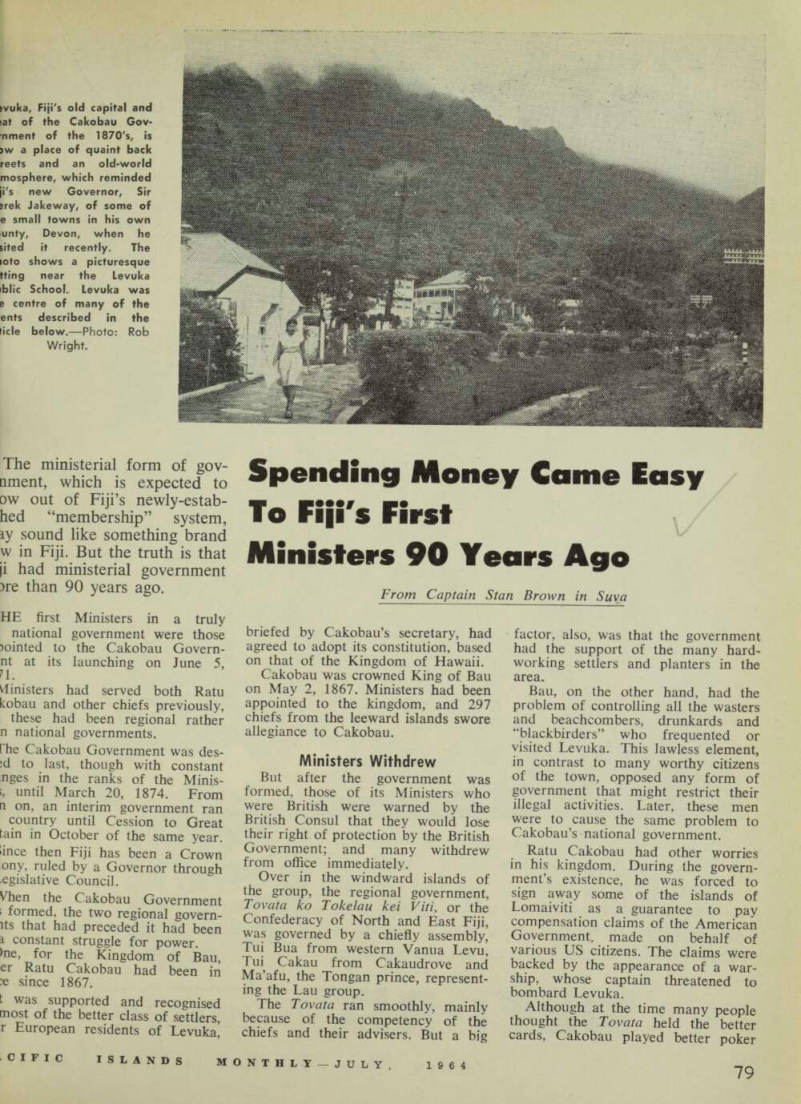
[?]vuka, Fiji's old capital and [?]at of the Cakobau Gov nment of the 1870's, is [>]w a place of quaint back reets and an old-world mosphere, which reminded ji's new Governor, Sir srek Jakeway, of some of e small towns in his own unty, Devon, when he sited it recently. The loto shows a picturesque tting near the Levuka [?]blic School. Levuka was e centre of many of the ents described in the [?]icle below. — Photo: Rob Wright.
i the struggle for power. When his rovernment was formed he was de lared King of Fiji.
Ma’afu, the most powerful member f the confederacy, came to Levuka, ad to the surprise of many swore llegiance to the new king. He agreed ) serve the Government as eutenant-governor of Lau, where reviously he had ruled as absolute lief. Later Tui Cakau also swore ilegience.
The money so necessary to form a rovernment was obtained by un wal, but profitable means. The man army had just defeated its >rmer allies, the hill men of Lovoni, J ter a long siege.
In Cakobau’s younger days, the ctory would have been the prelude i a cannibal feast. But Cakobau was iw a Christian. But fortunately his jw religion had no laws against the :quisition of wealth.
Marched Into Town The emaciated survivors of the ;ge—men, women and children— ere marched into the town of evuka escorted by the victorious man warriors. There, they were Id as plantation labourers. Cutting ross the business of those engaged bringing in labourers from the ew Hebrides and Solomons, it was sort of blackbirders’ black market.
The money received from the sale ts used to launch the new Govern ing Provision had been made for I the planters to continue to pay a arly hire for the labourers they had ought”, and this became one of the iv sure sources of revenue.
Although supported by Fijian iefs and many of the planters, the ikobau Government was implacably posed by the lawless ones, who inted no form of law or disci ne.
Surprisingly, these, including the im of Levuka waterfront, were pported by the British consul, arch.
The consul was also instrumental forming these men into a branch the Ku Klux Klan, whose aim was lite domination.
Into this turbulent world of vio ice and rancour, emerged the fledg g Ministers, all untrained, and in ne cases completely unfitted for the k ahead.
They were immediately the target all the ire and derision of the remely vocal group opposing the wernment. 3ne of them, the Prime Minister, Jney C. Burt, had previously been nmercial agent to Cakobau.
He was not a success in the Gov-
ernment. Able but hated for his dic tatorial attitude, he was finally forced to resign.
As if in revenge, he later became one of the most violent critics of the Government, as an Opposition mem ber of the Legislative Assembly.
George Austin Woods, an ex-naval surveyor, succeeded Burt as Prime Minister. He had been brought to Levuka to survey the port area, and was offered the post of harbourmaster after the successful completion of his contract.
Woods felt that Fiji had much more to offer him, and he was right, for a time. He held several different Ministries at different times besides the Prime Ministership, and was finally removed from office when the Cakobau Government was replaced by the interim government.
Shady Merchant
Cobham Smith, another Minister, was a shady Levuka merchant. He just managed to escape the sobriquet “blackbirder” by being the owner rather than the captain of the ship Nukulau, then engaged in the un savoury labour traffic.
But all the Ministers were not villains, neither were they incom petent.
John Temple Sagar, was a well educated planter, held in high regard.
He later opposed the Government,
mainly on the question of expendi ture.
Ratu Naulivou and Ratu Timoci, son of Cakobau, both served as Min isters.
One of the most competent Minis ters was John Bates Thurston, who joined the Government at Cakobau’s request while representing Wairiki in the Legislative Assembly.
He had previously been acting British consul, a planter and mate of a mission schooner.
He was one of the most able men ever to serve Fiji, and went on to hold many of the higher posts in the Government after Fiji became a Crown Colony. From 1889, he was Governor of Fiji and High Commis sioner for the Western Pacific until his death in 1897. Thurston was a personal friend and adviser to Ratu Cakobau and enjoyed the love and respect of all Fijians.
Except for Thurston, all the Minis ters took office without previous poli tical experience, and immediately had to assume great responsibilities.
They had no choice but to make their decisions and mistakes, and take the consequences.
Their lack of knowledge and ex perience was at the bottom of most of the Government’s troubles.
£12,000 Spent
None of the Ministers had any difficulty in spending the funds allo cated to his department. But where these funds were to come from, no one, it seems, bothered to inquire.
At the end of the first financial year, the Government had achieved the dubious distinction of spending £12,000 out of an estimated income of £7*ooo, and less than half the estimated income had been collected.
A proposal was made to recoup the Government losses by a heavy tax on those great money-earning com modities, liquor and arms. (As a re sult of new high prices, liquor was distilled in many a Levuka backyard, and as gun barrels were used in these home-made stills, the resultant fiery potion was named “gun barrel rum”.) The tax on arms, affecting the trade of the merchants brought a vote of “no confidence” in the Gov ernment. Ministers resigned or were removed from office as their indivi dual popularity decreased.
But there were many others willing to try their hand at running a Gov ernment, and one Ministry or another limped along under unskilled guidance.
Only when Thurston was in charge was some measure of stability achieved, but by then, arrangements for Cession were well under way.
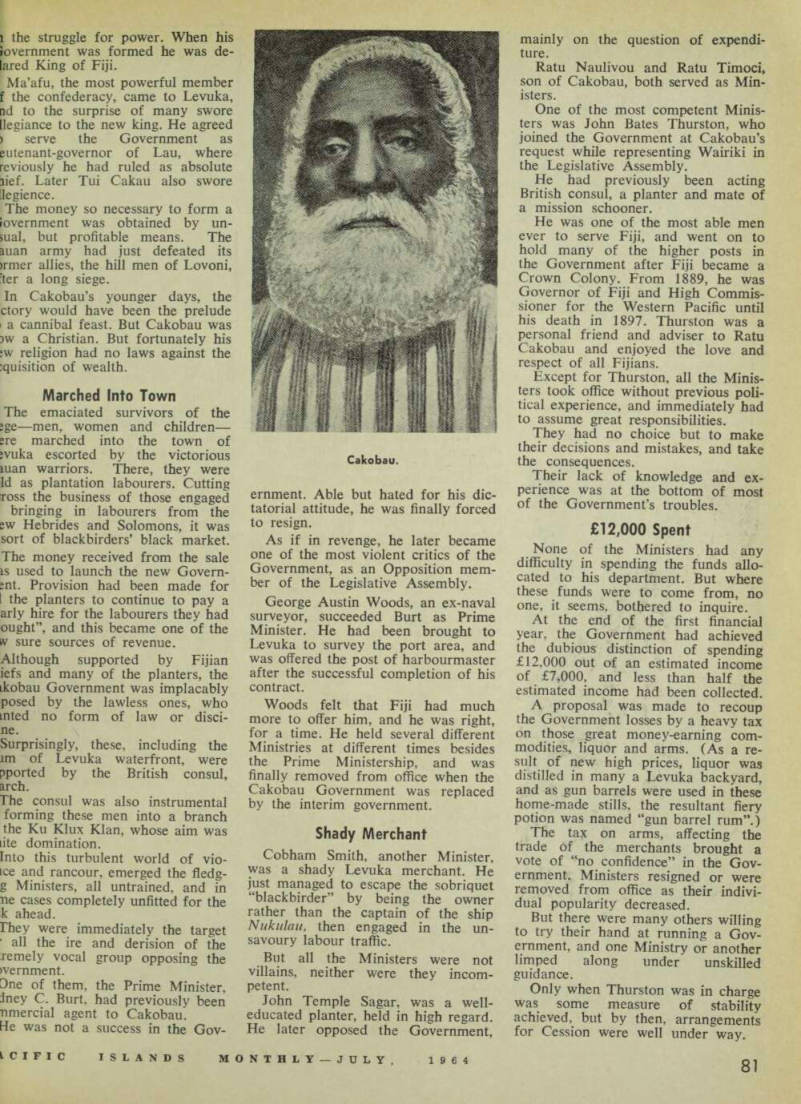
Cakobau.