New Hanover Cargo Cult
pp. 14-15 · Read in the full issue
P-Ng's New Politicians Speak Their Minds
Quick Action Wanted On New Hanover Cargo Cult
From Stuart Inder in Port Moresby Easily the most surprising and most interesting develop ment in the inaugural session of Papua-New Guinea’s un expectedly vocal House of Assembly was the way in which the Administration accepted a debate on cargo cult activities as giving it a mandate to take sterner action against the cult.
THE Administration announced that since most speakers in the debate obviously wanted some quick action against a “Lyndon Johnson cult” in New Ireland, then that was just what they would get.
The Administration said it would move in on the cult leaders as soon as the House got up.
The Administration attitude impressed most of the new members, and even the old hands praised it as a shrewd move, for the outcome was exactly what the Administration had hoped for.
The Government had believed for weeks that only strong action would settle the New Ireland trouble, but remembering the Navunaram riots (when natives were killed) and the Buka cult outbreak (when hundreds were gaoled), they were loath to start any action that might rebound in the UN.
Once armed with support from the first elected Assembly, they felt on strong ground should anything go wrong when they moved against the Johnson cultists.
Political Dynamite
This method of getting the majority to share the responsibility for political dynamite obviously has a future, as valuable to the officials as to the Territory itself.
The Johnson Cult is currently in control of about 2,000 of the 6,000 people of New Hanover, a small island off the tip of New Ireland.
It was noticed in February when several hundred people in that area informed electoral officers for the House of Assembly elections that they wanted to vote for “President Johnson bilong America”, who, un fortunately, was not among the six local candidates.
Attempts to reason with them
failed, and, as a result, only about 28 per cent, of the people voted.
Later in February, field staff visited Materanken where the cult had been originated (reputedly by Bosamalik, a youth of about 20) to try to reason with the men, but the cultists demanded that the Australians leave and the Americans come in.
False Alarm Further talks, in March, seemed to quieten things down and the field staff considered they had persuaded the cultists to abandon their ideas and return the money they had collected among followers to pay President Johnson’s fare over.
But it was a false alarm, and the situation became worse.
The cultists became more truculent and threatened patrols, regarding any effort to reason with them as Admini stration weakness. Nicholas Brokam, the member for New Ireland, was unable to land in the area to talk to them because of the cultists’ threats.
Brokam, who is Under-Secretary for the Assistant Administrator (Economic Affairs), brought the matter up in the House by way of an urgency motion.
Both Brokam and New Ireland planter Jim Grose (New Guinea Islands) had discussed bringing up the matter of the cult even while they were still in New Ireland, and they learned that the Administration would, in fact, welcome a debate.
Brokam told the House that he feared there would be breaches of peace, and that the cult would spread to New Ireland proper, unless it were stopped now. He said there should be a law against cults and the police should arrest the New Hanover cultists.
In the ensuing debate, there hardly
seemed to be a member who did i have something sound to say.
To the public gallery, it appeal as if the whole of the Territory v breaking out in cargo cult activi as member after member told ab( his own experiences and suggest with confidence, how the cult probl( should be solved.
First Rate Debate There must have been at least different solutions (gaol the educate them, cut off their suppli show them factories abroad, bu them factories at home, etc.), 1 there was one clear message go through the entire debate; Whate’ the final solution was, the N Hanover cult had to be wiped < now, because no man should allowed to cock a snook at law i order.
Not for the first time in the sess did observers ponder at the way which inexperienced, backwc politicians managed to confine the
ves to the question in hand, and ;h an economy of words.
Only rarely did Speaker Niall (who /e loose and welcome rein to the ?ate) have to explain to a member t cargo cults, not village pumps, re the items under discussion, iven Paliau Maloat (Manus) nanded action—a plea which was lost on those who knew that iau was a former cult leader him- E, and was once gaoled for his own ivities.
At. J. K. McCarthy, Director of tive Affairs and one of the 10 cial members, replied that where pie had little knowledge of the lised ways of life, it was plain nanity to treat these cults with ipathy and he was proud to say was Administration policy.
'he Government had never set out crush such movements, but to made people that their beliefs Id lead to disaster, levertheless, this particular cult destroyed law and order in its i, and the Administration was now )ared to restore it—with the full ?ort of the House of Assembly, ince there was already a big ce detachment in the New Ireland i as Mr. McCarthy was speaking, Mr, McCarthy himself promised go over as soon as the House >hed the session, New Guinea ited the sequel with interest. ootnote: It was reported from ; Moresby on June 24 that 2,000 don Johnson cultists on New over had agreed in principle to council taxes “on the eve of a to the island” by Mr. McCarthy.
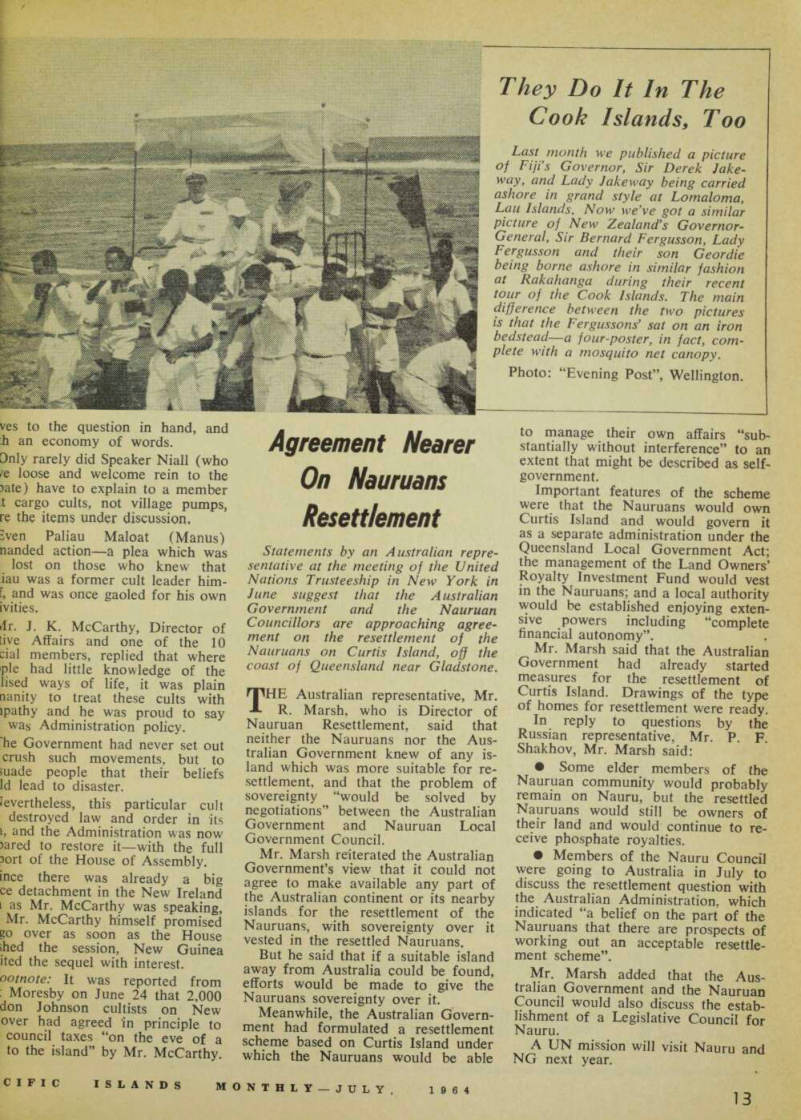
They Do It In The
Cook Islands, Too
Last month we published a picture of Fiji’s Governor, Sir Derek Jake way, and Lady Jakeway being carried ashore in grand style at Lomaloma, Lau Islands. Now we’ve got a similar picture of New Zealand’s Governor- General, Sir Bernard Fergusson, Lady Fergusson and their son Geordie being borne ashore in similar fashion at Rakahanga during their recent tour of the Cook Islands. The main difference between the two pictures is that the Fergussons’ sat on an iron bedstead—a four-poster, in fact, com plete with a mosquito net canopy.
Photo: “Evening Post”, Wellington.