Defensive Duchessing
pp. 9-10 · Read in the full issue
For Australia's NG Border Areas
Money, the magic that can cure almost any ill in New Guinea, is at last pouring into the border areas along the eastern side of the 141st meridian, that, until two years ago, was left to the Dutch or entirely neglected.
In the last couple of years, Australia has gone a long way to filling the power vacuum created in the remote areas of central New Guinea by the withdrawal of the Dutch. Young Australian patrol officers and lieutenants at the head of native troops are regularly walking the paths to villages, that, as recently as three years ago, saw only the occasional Dutch “controleur” or Dutch missionary.
NETWORK of airstrips has spread over country where tance has traditionally been :asured in weeks of walking or loeing; schools are open for the lettered; aid posts are going up for s sick; and advice is to be had anyone who wants to know how grow better crops, build better uses, start new lives.
Miy P-NG Native Affairs officer o has sweated out a posting in Sepik District of New Guinea, or Western District of Papua in irs gone by, will testify to the ennial frustration of budgets that r er brought funds, or fighting for igress against mud and apathy.
Changed Policy
n those years, and they lasted il 1962, a transfer to Daru was sntence to the salt mine of Papua; be sent to the Green River in the ik was to be sent to a sort of gle Coventry, for there was |ody else there to talk to you. oday the conditions haven’t nged much (who could change Sepik?) but policy has. Today e are funds for roads, vehicles, pols, houses, boats, airstrips, ios, and more and more men. : Australian Administration, after mg peacefully through the Dutch- Jnesian conflict for 13 years, has last awakened to the need to ite a human buffer against tration in country where a border :e can never be built. .nd the 30,000 scattered folk, who in hamlets and nomadic impments in the few reasonably Itable areas of the border line,
are at last getting their lick at the lolly of progress.
In some places, the Australians had to start from well behind scratch.
In the featureless country of swamps and plains a hundred miles from the northern coastline, several thousand people were living under the flag of the Netherlands.
Most of the huts had tattered pictures of Queen Juliana, not Elizabeth, fastened to their walls; and Port Moresby, by tacit agreement, left their pacification, their schooling and their ailments to Hollandia.
The local language was Malay, not Pidgin, and Australian Patrol- Officers could not converse there.
Waris and Jafe, the village centres of the area that leapt into the news m 1962, as the New Guinea “enclaves”, were drawn on all Dutch maps as west of the international boundary line.
Now these people are administered from a new sub-district headquarters established at Amanab, in the Sepik District of Australian New Guinea, and there is a patrol post nearby at Imonda.
Crops previously unknown to the nomadic border folk—sweet potatoes, yams, pineapples, peanuts and Euro pean vegetables—flourish in demon stration gardens at Amanab, and cuttings are supplied to the villagers.
There are poultry runs, too. From Wutong, on the coast, there is a
chain of little airfields—Pagei, Imonda, Edam and Green River.
Schools have sprung up at Wutong, Pagei, Amanab and Kamberatoro.
In April, a Local Government Council was proclaimed, centred on Pagei. Eighteen councillors represent 3,000 people of some 30 village groups, who speak half a dozen different languages. Administration subsidies will carry the Council
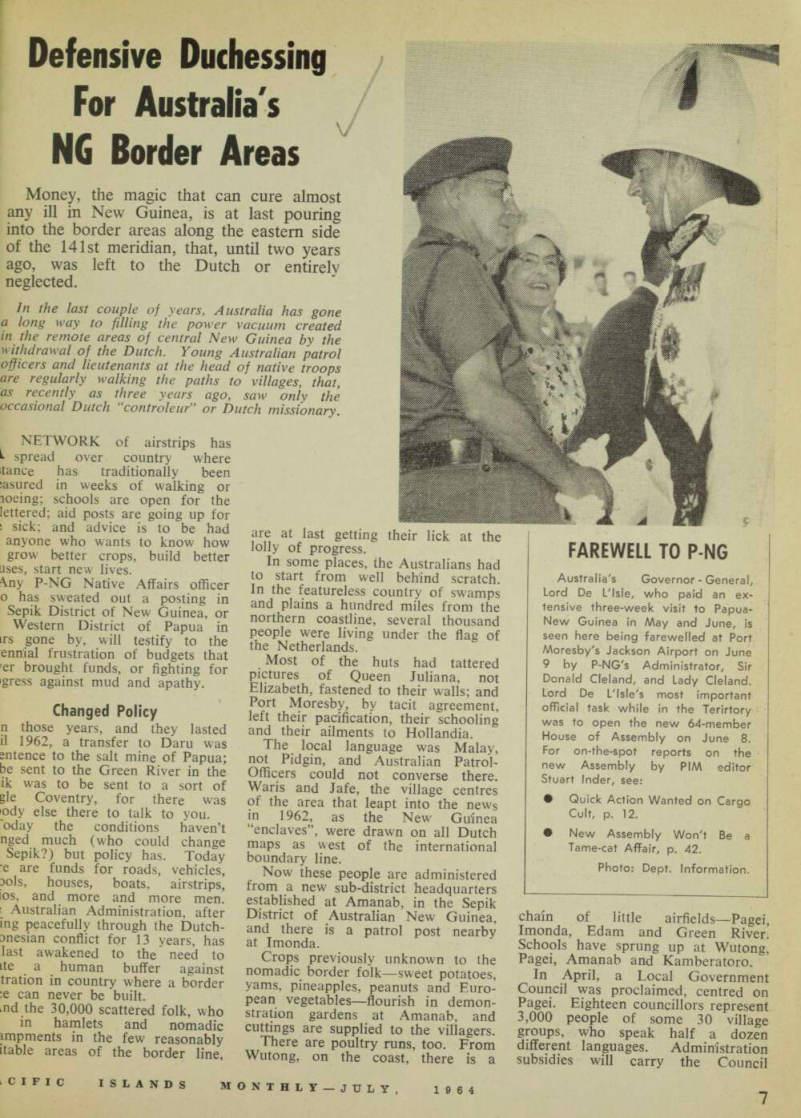
Farewell To P-Ng
Australia's Governor - General, Lord De L'lsle, who paid an ex tensive three-week visit to Papua- New Guinea in May and June, is seen here being farewelled at Port Moresby's Jackson Airport on June 9 by P-NG's Administrator, Sir Donald Cleland, and Lady Cleland.
Lord De L'lsle's most important official task while in the Terirtory was to open the new 64-member House of Assembly on June 8.
For on-the-spot reports on the new Assembly by PIM editor Stuart Inder, see: • Quick Action Wanted on Cargo Cult, p. 12. • New Assembly Won't Be a Tame-cat Affair, p. 42.
Photo: Dept. Information.
through until economic development makes taxation revenue possible. In the fifties, a council in such an area would not have been thought possible, but trials in the Southern Highlands proved that primitives could grasp the principle of helping to run their own affairs, and despite economic handicaps, could make good, in time.
Men and women from this and other border areas, have been taken to the townships of the Sepik Coast for adult education classes which teach everything from the rudiments of hygiene to how an electric torch works. Capsule courses in civilisa tion.
Missions, too, are playing a greater part than they were a few years ago.
The handful of children from the “enclave” area who were studying at continuation schools in Hollandia have been passed to the Franciscans at Aitape for further schooling.
There is a strong Catholic mission centre at Amanab. Protestant or ganisations, such as the Christian Mission to Many Lands, are pushing into the Green River and other once forgotten or forbidden parts.
South of the massive limestone ranges in the centre of the island, the story is much the same, but the population is sparser. The main focal point of effort is along the More head River, not so very far from Torres Strait.
There, a patrol post at Weam, supplied for many months by air drops, now has its own airstrip, capable of taking Cessnas.
It also has ground transport.
Big Improvement
This is a marked improvement on the situation late in 1963, about the time that survey parties were encountering armed Indonesian patrols mounted in scout vehicles.
At that stage, the District Officer at Daru was frantically asking Gov ernment Stores for delivery of the bicycles that had been promised for border patrolling! And Government Stores, safe in Port Moresby, was insisting that the D/O must wait for the machines specially indented from overseas, because local purchase was too expensive!
A recent top-level investigation charted the course for future planned border development. The Depart ments of Native Affairs, Education, Health and Agriculture all have their parts to play in this programme, and indications are that they will not lack the funds they’ll need.
Australian authorities are con cerned to see that an effective border barrier is established against the possible spread of animal and plant
diseases. One authority has stated that there are nearly 60 human, animal and plant diseases found in Indonesia that do not occur in Papua, New Guinea, or Australia.
So far there is no knowledge of any of them spreading to Indonesian West New Guinea, but even the most optimistic see the problem as one of “when” and not “if’. But then, the guard must be well up.
Foot and mouth disease, one of the main animal disease worries, could decimate the Territory’s stock population of a million pigs and 30,000 cattle. Spreading to Aus tralia, it could cut export earnings down almost overnight.
P-NG has established a radio monitoring station at Mt. Hagen to keep an ear open for possible radio propaganda from across the border.
The Territory Administration has prepared a master plan for emergency action against foot and mouth disease, should it enter Papua or New Guinea, and every Agri culture officer, veterinarian and Patrol Officer in western regions has seen a graphic English colour film which teaches how to recognise the disease in cattle, sheep or pigs.
Army platoons now patrol in border areas of Papua-New Guinea, and there are several airstrips where Hercules transports could land troops in a national emergency. But the New Guinea Administration is aiming to create a more subtle, more necessary defence line.
It hopes, in whatever time it may have left, to weave the primitive border people into the fabric of the emerging nation of Papua-New Guinea, so that there will be aware and loyal communities as the surest defence against aggression by subversion.
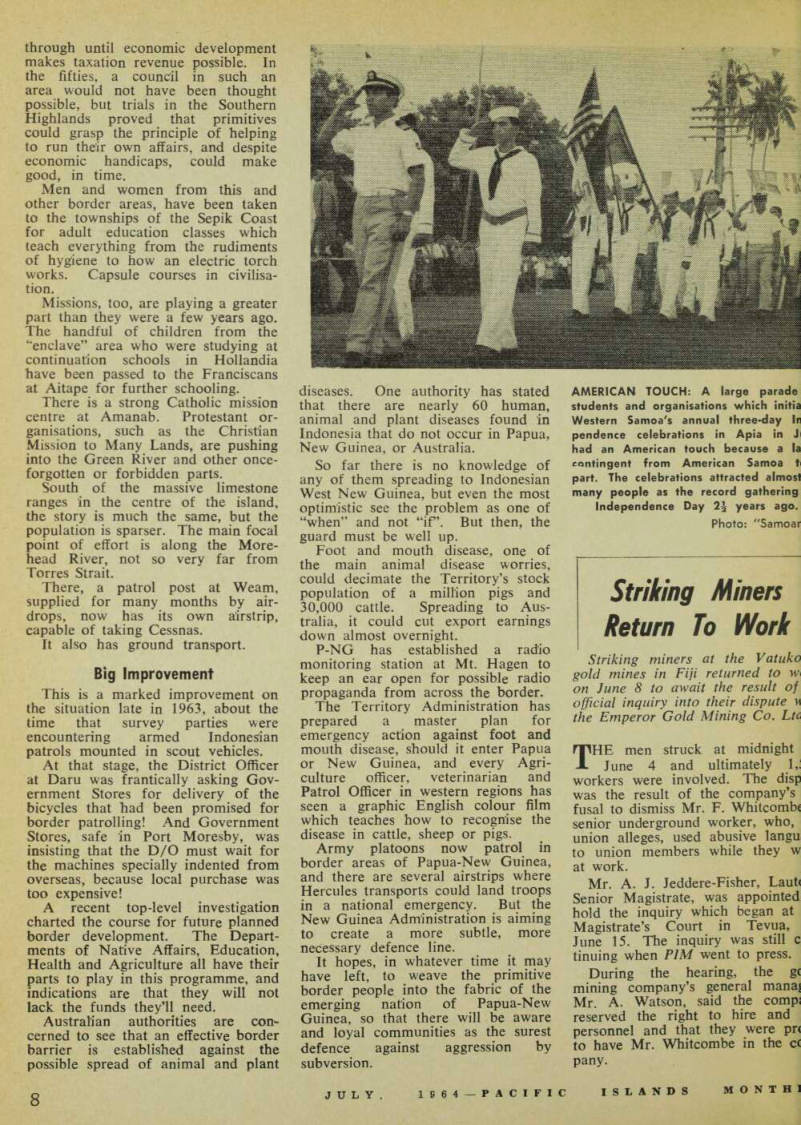
AMERICAN TOUCH: A large parade students and organisations which initia Western Samoa's annual three-day In pendence celebrations in Apia in J[?] had an American touch because a la contingent from American Samoa ti part. The celebrations attracted almost many people as the record gathering
Independence Day 2½ years ago.
Photo: "Samoa[?]