Pacific Commerce and Produce
pp. 121-124 · Read in the full issue
Australia-Ng
Corporation
Directors
The largest interest held any investor in the newly rme d Australian New
dnea Corporation is no
ire than five to seven per tt., according to the Cor
ratioris chairman, Sydney
sinessman, Mr. Steven ch.
IMATION of the Corporation
vas announced on May 11, in >y. It is a consortium of Aus n businessmen, banks and in ce companies joined together to in the development of the com al and industrial potential of a-New Guinea. e company will provide invest and development facilities. De of its plans are in the news t on p. 11. ;sent directors are Mr. Rich, M. T. Hansen, the Hon. F. M. tt, MLC, Sir James Kirby and lon. F. M. Osborne. Secretary is N. F. Stevens. Sir John Craw- Director of the Research School acific Studies of the Australian mal University, will act as al adviser. e board is to be progressively ged to eight. e company’s authorised capital )0,000 ordinary shares of 10/fully paid, totalling £250,000. rther 500,000 ordinary shares of are held in reserve for future though the directors do not in to apply immediately for Stock ange listing some of the shares in reserve may be allotted by Jirectors to expand the share re ir “when listing appears desir ’. The directors will not make forecasts on divided payments. ;low are the directorships of the il five members of the Corpora- Their industries will give a to the kind of development the >oration will probably concen on, certainly initially: S. Rich (Corporation Chairman), tiairman of Pacific Islands Timbers
(Holding) Ltd. and Tasman Pacific Pty.
Ltd.; Deputy Chairman, Hunter Douglas Limited; Director, Huvei Plantation Limited and a member of the Manu facturing Industries Advisory Council.
Mr. M. T. Hansen is Chairman of Realty Development & Mortgage Co. Ltd.; Deputy Chairman, PGH Industries Ltd.; Director, Development Finance Corp. Ltd.; Duncan Holdings Ltd.; Kauri Holdings Ltd.; Martin Place Holdings Pty. Ltd.; Pacific Islands Timbers (Holding) Ltd.
Hon.. F. M. Hewitt, MLC, is Chairman of Huvei Plantation Ltd.; F. M. Hewitt Pty. Ltd., and Director, Pacific Islands Timbers (Holding) Ltd.; Associated Plywood Pty. Ltd.
Sir James Kirby is Chairman of the Manufacturing Industries Advisory Council; the James N> Kirby Group of Companies; Champion Spark Plug Co. (Aust.) Pty. Ltd.; International Products Ltd.; Wales Superannuation Fund Ltd.; Wales Unit Investment Ltd.; Vice- Chairman of Conveyancer Fork Trucks (Aust.) Pty. Ltd.; Director, Beneficial Finance Corporation Ltd.; CSRC/Dow Pty. Ltd.; Qantas Empire Airways Ltd.; Re-Insurance Co. of Australia Ltd.; The British Motor Corporation (Aust.) Pty.
Ltd.; The Mutual Life & Citizens’
Assurance Co. Ltd.
Hon. F. M. Osborne is a partner of Ebsworth & Ebsworth; Director, English Electric Co. of Australia Pty. Ltd.; Macdonald Hamilton & Co. Pty. Ltd.
Special Adviser to the Board. Sir John Crawford, is Professor of Economics at the Australian National University; Director of Research School of Pacific Studies, Australian National University: Chairman of the Australian Wool In dustry Conference; Vice-Chairman, Commonwealth Government Committee of Economic Inquiry.
Approval Soon For Big
Carpenter Tea Enterprise
THERE can be little doubt that by the time this appears Papua-New Guinea’s Administrator Sir Donald Cleland and his Administrator’s Council will have approved of the W. and R. Carpenter applications for three tea leases in the Wahgi valley.
The Administrator’s Council was to have met to consider the applica
tions—already recommended by the
Territory’s Lands Board—on June 4.
The Carpenter applications deal
with three blocks totalling 5,327 acres near Mt. Hagen.
Carpenters were the only applic
ants for the three blocks on which a 99-year lease is offered. Already the company indicated that if their
applications are granted they intend
to spend up to £1 million on the establishment of tea plantations over the next ten years.
The giant island trader is the
second applicant for a tea lease in the Western Highlands. The first was Mr. Ivor Manton, a Melbourne businessman, to whom in April a block of 800 acres was granted.
To date there has been little tea planted iit the Wahgi, but the experi mental plots sown by the Territory’s Department of Agriculture have proved most successful.
The most successful experimental strain has been of an Assam type known as South Johnson.
More land for tea growing is ex pected to be made available for lease within the next few weeks.
Representatives of overseas firms engaged in the tea industry, either as growers or processors, have been regular visitors to the Western High lands since the interest in tea-grow ing there developed with Adminis tration announcements last year.
Yet Another Bonus Issue
For Burns, Philp
BURNS, Philp & Co. Ltd., proposes to issue 1,800,000 £1 shares on the basis of one-for-four held at October 30. This will be BP’s fourth bonus share issue since 1958. The 1958 bonus issue had been the first in 40 years. The new issue will increase paid capital from £7,2000,000 to £9 million.
When news of the new issue was announced to the Sydney Stock Ex change on May 21 the shares rose 5/6 to £5/14/-. On those prices BP market capitalisaton was more than £4l-million.
Dividend has been 10 per cent, since 1953.
The new balance sheet will be re leased in August.
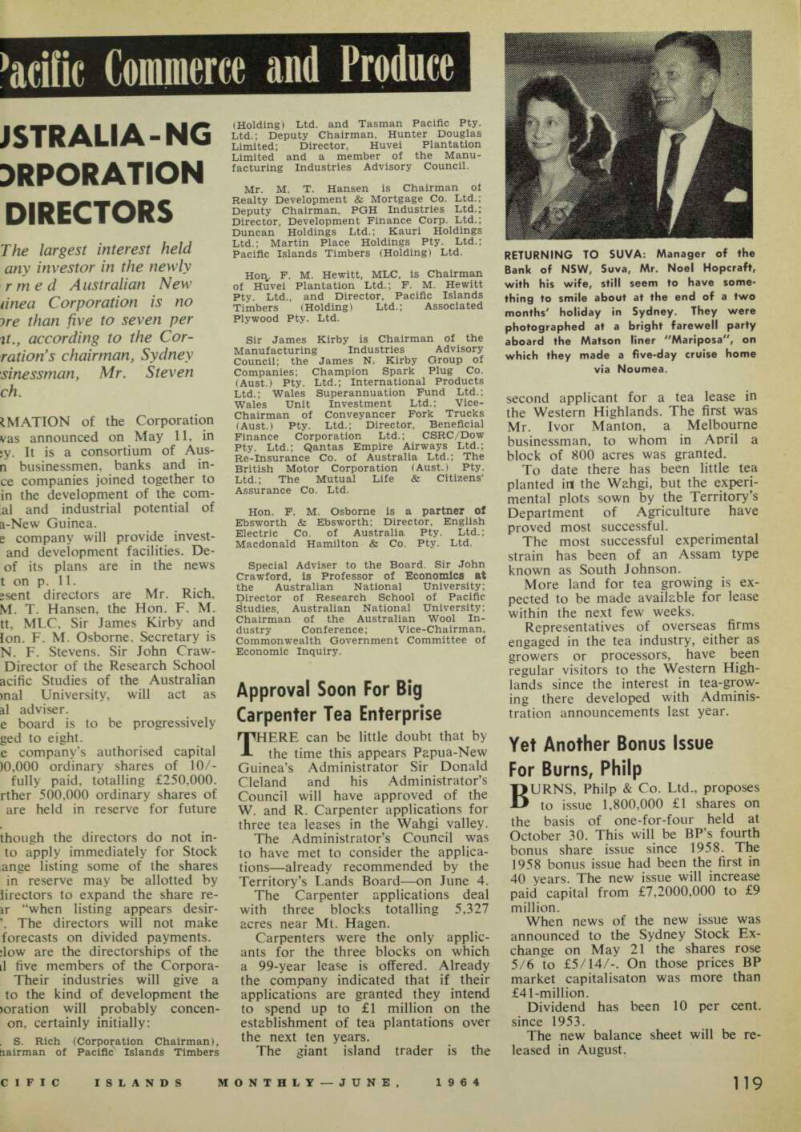
RETURNING TO SUVA: Manager of the Bank of NSW, Suva, Mr. Noel Hopcraft, with his wife, still seem to have some thing to smile about at the end of a two months' holiday in Sydney. They were photographed at a bright farewell party aboard the Matson liner "Mariposa", on which they made a five-day cruise home via Noumea.
rns Philp (SS) Co.
sfit Up
HE net profit of Burns Philp (South Sea) Co. Ltd. rose by 7 10,536 to £F163,029 for the year led January 31. This was an in ase of 6.9 per cent, fhe profit is reported to be the ond highest in the company’s :ory and only £6 below the record 1960. rhe chairman, Mr. H. Maurice >tt, said in his report at the com ly’s 44th annual meeting in Suva May 23 that the increased profit s a result of the improved morny in Fiji caused by a healthier 1 more stable sugar industry, a ger sugar export quota, im >ved returns from other primary >ducts and a substantial incease in irist traffic.
Parts of Tonga, particularly the rth, were still suffering from rricane damage to crops but results tained from operations in Samoa 1 other island branches and from r estment were satisfactory.
The report added; “The volume of the company’s merchandise sales showed a marked increase during the year to offset considerably higher working costs and depreciation.”
The net profit for the year is after providing for depreciation of £88,686 (up £18,335) and unstated tax.
The earning rate is an increase from 15.2 to 16.3 per cent, on paid capital of £lm..
The dividend is 10 per cent, for the 14th successive year.
Company To Pull Out
From Vanikoro
MR. I. ROGERS, secretary of Kauri Holdings Limited, went to Vanikoro in mid-May in the MV Milos to arrange for the Kauri Tim ber Company Limited to withdraw from the conduct of logging opera tions at Vanikoro. (PIM reported on these pages last month that a de velopment of this nature was ex pected).
Timber has been extracted from
Vanikoro since 1922, and the Kauri Timber Company has been closely associated with these activities almost since the beginning.
Mr. Rogers has stated that the company’s decision to terminate ex traction has been made with very great regret, in view of the long asso ciation of the company with the Vanikoro people and with the BSIP Government.
It is believed that another timber company may take over KTC’s opera tions at Vanikoro.
No Television For
Fiji-Yet
THE Fiji Government has decided the time is not ripe for the in troduction of television into the Colony. An official statement in May said the first necessity was to achieve 100 per cent, radio coverage of the Colony and improve reception in out lying areas.
The statement added: “Govern ment appreciates that television must
come to Fiji sooner or later and it proposes to keep the issue under constant review and, as and when circumstances change, will reconsider the issue.”
Electronic Industries Ltd., of Aus tralia, had applied to establish and operate a television service in Fiji and inquiries about the possibility of television being introduced had also been made by Thomson Television (International) Ltd., and Cathay Hotels (Fiji) Ltd.
Big Increase In P-NG
Cocoa Crop Expected
AT current world prices, Papua- New Guinea’s cocoa crop will be worth more than £4 million this year, according to an article in Mac.
Robertsonland News, the official staff journal of the Mac. Robertson group of companies.
The paper says experts predict a jump in cocoa production from 17,000 tons this financial year to about 30,000 tons in 1966-67 because the area of pod-bearing trees will soon be doubled.
The paper adds: “With world cocoa prices rising and falling be tween wide limits, Mac. Robertson interest in our Wanaru plantation (in the Markham Valley, near Lae) has seldom been higher”.
Fiji's Gold This Year
Could Reach £F2,000,000
A LTHOUGH a source of consider f* able speculation by people who have bought Emperor shares, the Melbourne interests which own and operate the gold mines at Tavua, on the northern part of the island of viti Levu, are regarded with affection and esteem by the economists respon- Slb jf f °r the Government of Fiji The Emperor Goldmining Com pany has not paid a dividend for six or seven years; but the company seldom exports, from Fiji, gold worth ess than £1,500,000 per annum, and will hf r ,^ e val r e of its production Wfil be at least £2,000,000.
Ihis enterprise-established some Dttro y f- ars a B°— I maintains the very at i^ ti y e little town of Vatukoula which houses a community of Euro
pean and Fijian workers, with their families.
Except for considerable sums which are sent abroad for the pur chase of plant, supplies and expert service, the whole of the goldmines’ earnings, during the last few years, have been ploughed back for the development of the valuable strata discovered by deep drilling a few years ago, after the rich veins which could be got at by open cut had been exhausted.
A great deal of the developmental expenditure authorised by the directors may be credited to capital, of course; but it is a patent fact that the greater part of the £1 million to £2 million per year taken out of the ground at Vatukoula remains in the Colony for the Colony’s benefit.
To keep that Melbourne group operating in Fiji, the Government in recent years subsidised the company by between £lOO,OOO and £200,000 per annum, and gives Customs concessions. The subsidy has now ceased.
No one questioned the wisdom of the directors in withholding dividends and ploughing back most of their profits into development. Obviously, it would not have been wise to distribute dividends while the Gov ernment of Fiji was providing sub sidies. But now onlookers, especially among the shareholders, hope that with the increasing quantity of gold coming out of the deep levels there may be a dividend or two coming along. Otherwise, why continue operations? The company cannot be expected to carry on this impor tant industry merely to provide salaries and wages. Something must happen soon. So the 1/- shares of the Emperor Company remain at 6/and 7/- in the Australian market.
Close observation, however, does suggest that dividends may be postponed for some little while yet.
Probably the real answer lies in the world price of gold. As long as the United States keeps the price where it is—there is not a great margin of profit in the operations at Vatukoula. But should the price of gold move up—and most economists argue that it should have done so long ago—the output at
Vatukoula could become very prof able indeed.
Even if the price of gold does n move for the present, there seer to be enough profit in the oper tions to justify the directors carryii on the industry on its present sea for some further period.
Since this Melbourne group cor menced operations at Vatukoula tl value of the gold taken out of t] three mines (Emperor, Loloma, ai Dolphin) is £27 million Fijian (£' million, Australian).
On today’s operations the compai is paying out in wages and salari alone no less than £765,000 a ye —a very important item in t] country’s economy.
There are some who think th an increase in the world price of go would not only stimulate the indust: at Vatukoula, but probably wou encourage a search along the V Levu ranges for more gold countr Several places in Fiji were provi to be richly gold-bearing in the pai but when post-war conditioi throughout the world held the pri< of gold down at its present lev* all enterprise in that direction grad ally faded out.
Disappointing Year
For Kerema Rubber ltd.
I/'Erema Rubber Ltd., P-N
rubber producer, had had a di appointing result for the year end( December 31, 1963, the chairma Mr. H. D. Underwood, said at tl 12th annual general meeting of shar holders in Port Moresby on May 2 For this reason, directors had recoil mended that no final dividend for tl year should be paid, and the directo had voluntarily reduced their fees t 50 per cent, for the year.
Mr. Underwood said the profit f( the year was £1,166/6/7, after pr( viding £750 for directors’ fee £2,282/0/8 for depreciation an £2,415 or amortisation of plant: tion property. (The previous year profit was £5,178/10/3).
An associated company, Rubbe: lands Limited, made a net proft fc the year of £12,445/8/2, after pn viding for directors’ fees of £1,50( depreciation, £2,492/1/2; amortis* tion of plantation property, £ and provision for income ta £1,923/4/. (The previous year’s prof was £10,535).
The board recommended paymer of a final dividend of 2i per cent, oi the issued ordinary capital of th company, making 71 per cent, for th year ended December 31, 1963.