Cruising Yachts
pp. 97-118 · Read in the full issue
Pacific Shipping And
Important Developments In Islands Harbour Plans
There were some important developments in May in plans to improve harbour facilities in several Islands territories.
1 the Solomons, the name of the contractor was announced for building of the deep-water berth Point Cruz, Honiara; in Western noa, a couple of experts made in tigations to determine the exact ; of the wharf at Matauta, Apia; i the New Zealand Federation of hour expressed concern at a ;nch proposal to recruit Cook anders for the Papeete harbour )ject.
Fhe contractors for the Point Cruz )ject are Hornibrook Constructions i. of Port Moresby.
The contract price provisionally lounts to £160,850, which includes 2,500 for alterations and extra >rks if ordered.
The chairman of the BSIP Ports ithority, Mr, L. M. Davies, says it at present, no additional works ; envisaged.
The period of construction quoted the company is 19 months. * * *
Investigations to determine exactly where Apia’s wharf should go were made by two engineers, Messrs.
Steven Olko and Joseph Peraino.
Mr. Robert Gittins, vice-president of the Tecon Corporation, who was also in town, told the Apia newspaper Samoana that a test boring that went down 60 ft to the basalt revealed formations that could cause trouble if the wharf was not sited exactly right.
He said that Swedish engineers had discovered that structures on re claimed land, if not sited correctly, could later slip out of place. This was known as the “Swedish fault”.
It had helped cause the destruction of dams in France and the United States over the past two years.
Samoana said that, acting on re sults of the test borings, Messrs. Olko and Peraino had decided that to en sure the stability of the wharf, it would have to be situated 100 ft fur
ther out from shore than originally planned.
The exact situation of the Apia wharf also gave concern to Apia’s Harbour Master, Captain H. J.
Moors, in May. In a letter to Samoana, he said: “As the prevailing wind in Apia harbour is easterly, I hope the ex perts in command of our harbour project will decide to run the Apia wharf in an east-west direction.
“With the wharf parallel to the wind, berthing a ship will be easy and safe. . . .
“If the wharf is to run in any
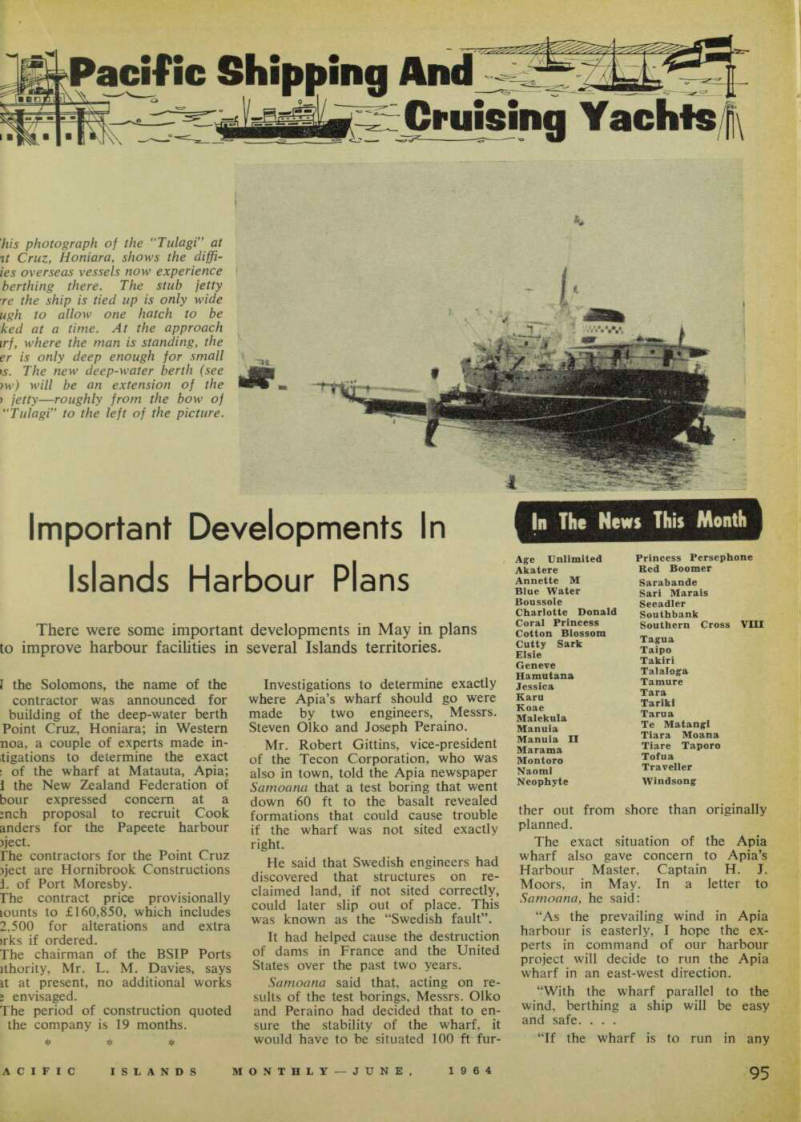
[?]his photograph of the “Tulagi” at [?]t Cruz, Honiara, shows the diffi [?]ies overseas vessels now experience berthing there. The stub jetty [?]re the ship is tied up is only wide [?]ugh to allow one hatch to be [?]ked at a time. At the approach [?]rf, where the man is standing, the [?]er is only deep enough for small [?]s. The new deep-water berth (see [?]w) will be an extension of the [?] jetty—roughly from the bow of “Tulagi” to the left of the picture.
ion that will cause the easterly to act on the ship’s beam or aft earn, ship handling will be ditti md unsafe, unless powerful tugs vailable. erthing a ship would have to till the lull of the wind. A ship eking with the wind abaft its , will be lucky to clear West Also a ship alongside the whart the wind acting on its beam d be pushed off the wharf, xtra precautions would have to iken to prevent the cargo from i g into the drink between the and the dock, and with a fresh i wind blowing it may be neces to periscope the ship’s l strong gust could part a ship s and cause her to fetch up in It would be unusual to find a looking for a berth at the no.”
Papeete Project
be New Zealand Federation of aur has warned Cook Islands e unions by letter that their ibers should not accept employ t on the Papeete harbour pro which will give that port much e wharf space. he federation says it was recently rmed that the French Govern it in Tahiti had invited the Cook nds Legislative Assembly to ply 600 workers for the harbour ject. ’he warning letter, signed by the oration secretary, Mr. K. McL.der, was addressed to the Cook ,nds Industrial Union of Workers. :he letter said; “It would be well your union’s executive and its mbership to have a very careful k at this proposed action to re it the 600 male workers to be em yed at Papeete. ‘lt seems that the project is closely ociated with the French nuclear ts in the Pacific. ‘lt is understood that Tahitians are tnanding higher wages for their iployment. Introduction of cheaper d more amendable Cook Islands >our would possibly lead to serious ishes of workers as the Cook anders would be regarded as ‘scab xmr’.”
An Swims For 12 Hours
) Save Companions
A Solomon Islander swam for ore than 12 hours in mid-April to ing news that three companions are adrift between Nugu and uadalcanal following the wreck of eir boat near Sealark Reef.
The man, Paul, from Walande, crawled ashore near Tasimboko after his long swin and triggered an air-sea search for his companions which resulted in all three being saved.
Two of the survivors were sighted at Nugu by the Megapode Airways plane, and were picked up by the Coral Princess. The third came ashore at a village on Small Gela on Tuesday afternoon, after 56 hours in the water.
The three survivors Kenneth Lo, Caspar, and Talaira, were brought to Honiara by the Coral Princess and admitted to hospital for observa tion. All three were permitted to leave next morning.
Paul was back at work within a day or so as if nothing had happened.
Raftman To Resume Drift
Voyage Soon
William Willis, the 70-y ear-old American raftman, returned to Apia, Western Samoa, in mid-May to prepare for the second leg of his drift across the Pacific on his metal raft Age Unlimited.
Willis reached Western Samoa on November 12 last year after drifting 7,000 miles or so in 130 days from Peru. He later flew home to New York for medical attention to injuries received during his voyage.
Age Unlimited was anchored off the Apia seafront during Willis’ absence in New York, and the broken rudders that gave him much trouble during his trip from Peru
were repaired by the Public Works Department.
When Willis resumes his voyage, he hopes to drift to Sydney, or to Brisbane if the winds are unfavour able. He expects the voyage to take 10 to 12 weeks.
Master's Licence Suspended
Over Grounding
A Marine Board of Inquiry into the grounding of the MV Karu off Cape Lemankoa, Buka, on January 24, has directed that the ship s master, Bernard McMahon Ritchie, be disqualified for six months from acting as an officer or from com manding a ship under Papua-New Guinea’s Coastal Shipping, Ports and Harbours Regulations.
The board, consisting of Captain G. A. Hawley, Superintendent of Marine, Lieutenant-Commander J. S.
Hill and Mr. Keith Chambers, de livered its report to the Adminis trator, Sir Donald Cleland, in May.
Sir Donald later announced that he had accepted the board’s findings and recommendations.
Sir Donald Cleland said that the board’s decision on the disqualifica tion of Captain Ritchie was reached despite his experience and record, be cause it felt it could not condone “disclosures relative to the naviga tional and general direction” of the Karu.
The board found, among other things, that;— • The grounding of the Karu was due to an unexpected current which placed the ship 19 miles
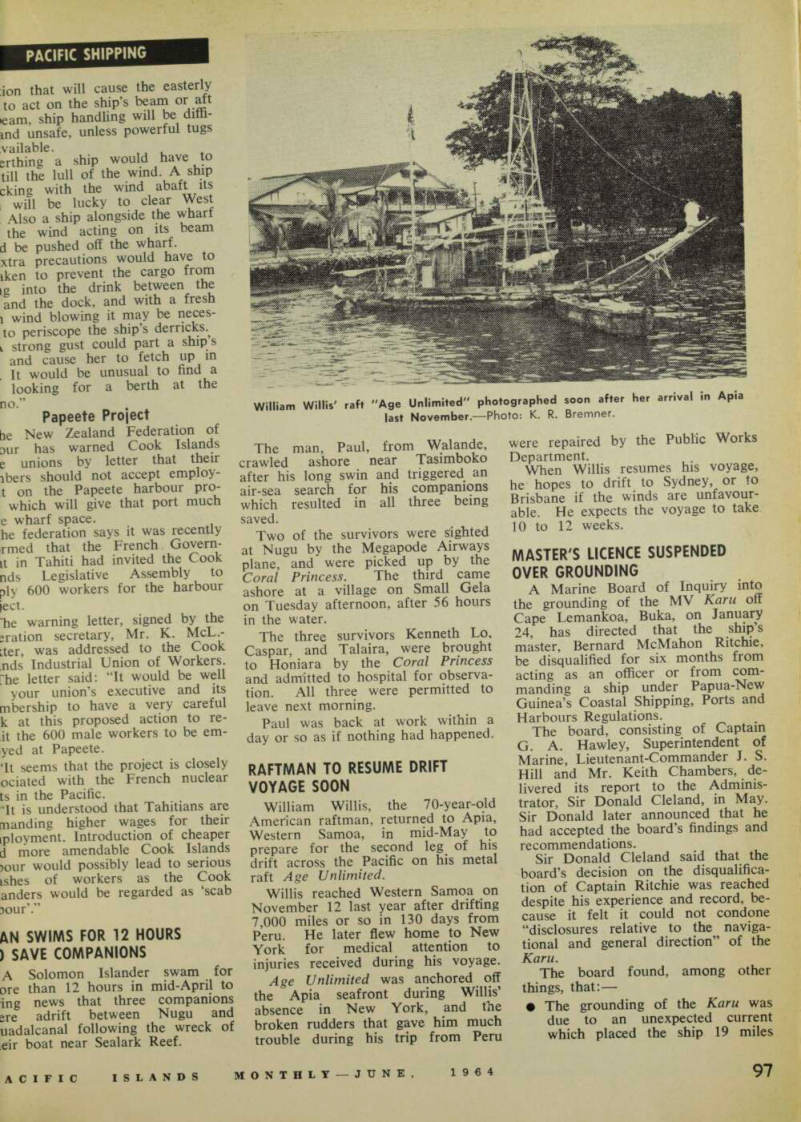
William Willis' raft "Age Unlimited" photographed soon after her arrival in Apia last November.— Photo: K. R. Bremner.
043 degrees true from the dead reckoning position. The master was not to blame for the ground ing, though he may have contri buted towards it by a lack of vigilance after sighting the land and by a decision to turn to star board.
The navigation of the Karu was not negligent but it left much to be desired. The master failed to stream a log, claimed to have used a chart which had, in fact, been superseded, failed to make full use of that chart, failed to take soundings after sighting un recognised land and failed to keep under observation the movement of the ship’s head after sighting land and after orders had been given hard to starboard to 270 degrees.
The conduct of the ship left much to be desired. The master was unaware of the revolutions of the engine and had no knowledge of the qualifications of his officers; and though the fact that he was not aware that the auxiliary power engine was under repair was not necessarily his fault, it was, in common with the other
factors, ail indication of an inefficiently run ship. • The vessel was not manned in accordance with regulations insofar as concerned the officers, as the engineer held no certificate and official approval had not been obtained for the employment of another officer.
The board recommended that the owner of the MV Karu, G & M Shipping Company, should be proceeded against for failure to comply with the regulations concerning officers; and the regulations should be amended so that a harbour master or port authority could only issue a sailing permit if a vessel was properly manned.
Two Canoes Blown 200
mii cc in SOLOMONS
Miles In Suluiyiuini
Two native canoes reached Choiseul Island, BSIP, in mid-May after having been missing for more than a week, during which they had been blown about 200 miles off course.
The canoes, with 11 people on board, and another two canoes carrying 13, left Ontong Java (Lord Howe Island) on May 6 to return home to the Tasman Group, 26 miles to the north.
Strong easterly winds blew the canoes off course and on May 12 two of them arrived at Kieta, Bougamv -jj e They reported the other two were still at sea and the Department of Civil Aviation was asked to look out for them.
The first of the two arrived at Nuatabu on Choiseul a day or two later, and the second turned up at Polo on the north-east coast on May 16.
The Superintendent of Marine,
AT IS IT? When the French Resident [?]missioner in the New Hebrides, Mr.
Delauney, went to Vanikoro earlier year to see the wreck of the "Bous [?]", the flagship of his famous country [?] La Perouse, the copper chain which is holding was brought up from the [?]ed. Nobody is quite sure what it [?] used for, but one suggestion is that it was a sounding chain.
Photo: Reece Discombe.
in M. A. Campbell, said that board were well. ;y were to be repatriated to the in Islands.
Her Burns Philp Ship
\Ll At Kavieng
: Burns Philp motor vessel :ula will call at Kavieng ixly from about July 30, follow le decision of the China Navi i Co. Ltd. to abandon services vieng for the time being (P/M, p. 14). •ns Philp (NG) Ltd. announced in mid-May after some 50 ng residents had complained to linister for Territories, Mr. C. arnes, that Kavieng would be with a “drastic shortage” of es if another ship did not re the China Navigation Com > Soochow. i Burns Philp ship Montoro, i now serves Kavieng, will con to call. This means that, with addition of the Malekula, ng will get two freezer cargo a month.
He's Interested In The
Pacific's Small Ships
If, in the next 12 months or so, you should happen to see a sandy haired Scotsman disembarking from a small ship in the Gilbert and Ellice Islands, Fiji or Tonga, and asking a lot of questions, it’s a pretty safe bet it will be 32-year-old Alastair Couper, a master mariner-turned university man, who is writing a thesis on the small ships trade of the
Central Pacific for his doctorate of philosophy.
Mr. Couper, who has an honours degree in economics, a diploma in education, and a master of arts de gree from Aberdeen University, came to Australia about seven months ago and is now connected with the De partment of Geography at the Aus tralian National University, Canberra, Before he moved into the academic world, he spent 10 years at sea, dur
ALL THAT'S LEFT: This is all that now remains of the Melanesian Mission vessel "Southern Cross VIII", which ran aground at Morovovo, Guadalcanal, in March, 1960, only a year or so after she was launched. Fiji PRO photographer Rob Wright took the picture during a recent visit to the Solomons.
; he spent a lot of time on small on the Norwegian coast. He ater chief officer of a cargo ship ag between Australia, New Zea and Fiji. . Couper, with his wife and children aged one, three and was due to leave Sydney for i Island in the Trlaser on May 7 rom there he will go to the ) where he plans to spend three iur months “going to as many is as possible in colony ships to le methods of loading and work er his look-see in the GEIC, he jpend seven months in Fiji and ibly three months in Tonga.
Dus Old Schooner Back
« Cook Islands
len the 173-ton trading schooner Taporo reached Rarotonga Auckland in April, the people arotonga, who had not expected e her again, greeted her like a dear friend. ie Tiare Taporo, which was built uckland in 1913 to the order of 3. Donald Ltd., of Auckland, d her owners in the Eastern ic for 50 years—many of them ie Cook Islands—until Donalds ired the 150-ton Akatere late year. ie Tiare Taporo (meaning of the lime” in Tahitian) then sailed to Auckland where was put up for sale and bought, darch, by Mr. W. B. Christo
phers, of Rotorua. Mr. Christophers promptly sailed her back to Raro tonga on a trading voyage with a crew of three Australians, two New Zealanders and two Danes.
Her presence at her old familiar berth in Avatiu Harbour prompted the Cook Islands News to publish a sort of biographical profile of the ship which ended with the wish that “the ‘Flower of the Lime’ will have calm seas and pleasant landfalls for the rest of her sailing life and that it will be a long time before we say farewell (again) to this sturdy little schooner”.
As the details of the old schooner given in the Cook Island News are likely to be of interest to many readers, we reproduce them here.
The schooner was built of New Zealand kauri with frames of pohutu-
New Hebrides
Harbour
The southern New Hebrides island of Tanna is not well en dowed with harbours —as can be seen from this photograph which depicts Lenakel Bay, the safest the island has.
Lenakel, on the west coast, is one of two trading settle ments on the island. The other is at White Sands on the east coast.
Near Lenakel is the Condo minium administrative centre (upper right) and a mission hospital. Bob Paul, a well known trader, operates a trad ing store here, as does the French company, CFNH.
Photo: Rob Wright.
i and a keel of heart of kauri, measurements are: Length, 97 ft breadth, 23 ft 5 in., depth, 9 ;ross tonnage, 172.59, registered ;onnage, 137.33. le was one of the last fore and lailing ships built in New Zealand islands trading. . B. Donald Ltd. first used her a trader among the Society ids, based at Papeete, with Cap- Joe Winchester in command, ne of the captain’s daughters is h Hall, widow of author James man Hall, who collaborated with rles Nordhoff in writing Mutiny he Bounty, Men Against The Sea, Pitcairn’s Island. uring World War I, the Tiare oro was in continuous service in Society Islands, and was fortunate keeping out of the track of the man raider Seeadler. However, ship did come into the Seeadler ode when she sailed for Mopelia pick up the marooned Allied )rs whose ships had been sunk by Luckner and who were left on Delia when von Luckner and his v escaped in one of the Seeadler’s ts. he Tiare Taporo’s only souvenir the Seeadler is the oval, brass ned mirror from von Luckner’s in. n 1918, the Tiare Taporo sailed San Francisco and loaded case oil Auckland, where she arrived on uary 8, 1919, after a voyage of days.
Mter an overhaul the vessel was ired for Rarotonga where she
entered the Cook Islands trade of A.
B. Donald Ltd.
Captain Viggo Rasmussen, a Dane who had lived in Tahiti since 1896, commanded the vessel for the next 17 years.
On his retirement two temporary masters were in command until 1939 when Captain Andy Thomson took command after the sale of his former vessel Tagua. He remained with the ship until 1949, when the Tiare Taporo was retransferred for the company’s trade in the Society Islands.
The ship remained in these islands until April, 1960, when she returned to the Cook Islands and Captain Andy Thompson was again put in charge of her, after serving in the
, MV Charlotte Donald. He remained in command until his retirement last year at the age of 74 years.
Captain A. J. Pickering then com manded her until her owners put her up for sale.
Although the old schooner weathered several hurricanes during her 50 years with A. B. Donald, she year at the age of 74. jjer new owner sa y s s he is still in “good fettle”, and very shipworthy under strain and stress, The ship was practically renewed (hull, deck, etc.) in 1961 and further improvements were carried out re cently.
Ship For Cook Islands
CD\/irc cnnw tKVILt iuun e Tagua, a steel vessel of 80 deadweight cargo capacity, will
%rs.wssf,a , s
New Zealand Trade Commisr n f “ noi f silk and Les Livings- ' V in Hone Kong recently
wising I final Stages of con-
tion, Ind Captain Dunsford, who Tno„n\ master ipft Ancklariv Tn May to go to Hong , fn/the delivery voyage [e Tagua has accommodation for assengers. She will be registered , va
(Seas Freighter Damages
5 Wharf—Again!
le western end of Lae’s wharf damaged to the tune of about )0 early in May when the overfreighter Southbank cut much ic fender system from the wharf nulled buffers about eight feet af alignment Rppional Works Officer of the
imonw B eTth Department of
ks, Mr. Tom Passmore, said later
that it would be some time before the damage could be repaired as con tractors erecting a 100 ft extension t the wharf nee ded the damaged t wor i f ; n u s . c. s .
WKfcfeins
time a shi P had run into il since December 22, 1958.
Mr. Holland said that the masters °f these vessels could not be blamed a 8 a combination of varied tides and strong currents from the inflowing Markham created extreme navigational hazards.
However, it was necessary to do something soon “to change this embarrassmg and costly situation .
New Life For Fiji's Old
Capital
Levuka, once a thriving copra port and the capital of Fiji until 1882, was dealt a severe blow when copra mills began operating in Suva. But its economy will be boosted soon when the Pacific Fishing Company s factory goes into operation, and the town, which has an attractive, oldworld air, will come to life again.
A minimum of 30 Japanese fishing craft will operate out of Levuka, and
the total will rise to 100 when the Fishing Company’s factory is fully operational.
Cargo Of Beer For
Niue Gets A Ducking
Niue is a dangerous port for ships to work and all loading and unload ing is carried out by lighters. During the unloading of the Tofua a few weeks back one of the Niue Island Administration lighters went ashore on the reef.
Desperate attempts were made to get her off with her cargo intact, but each succeeding wave carried her fur ther inshore.
Luckily, or unluckily, she was loaded mostly with canned beer, and as she filled with water and it was obvious she wasn’t going to come off easily, she was unloaded.
Although the first cartons taken out were undamaged, the later ones burst and cans of beer floated in the lighter until they were salvaged.
Remarkably, almost no cans were lost, but for the next few weeks cus tomers at the Government bond store were asked to bring their own con tainers to take away their beer.
• JESSICA, a handsome yacht owned and skippered by Ted Jacob sen, was in Apia early in April fol lowing a cruise from Honolulu which began on March 15. Mr. Jacobsen planned to go on to Pago Pago and then possibly to Tonga, Rarotonga or Aitutaki, and Tahiti, returning to Honolulu about the end of July. • TRAVELLER, a yacht, was in Avatm Harbour, Rarotonga, in mid- April. • SARABANDE, an unusual looking craft from Guernsey, Chan nel Islands, arrived in Papeete on April 29 with a crew of four men and three girls, all either Britons or New Zealanders. Sarabande is a 45 ft lobster boat that has been turned into a pleasure craft.
She left Guernsey last November for New Zealand skippered and navi g?ied xT by Charles Cottrill, a 36-year old New Zealand chiropractor who was m the Merchant Navy during the war.
The other crew members are Glyn Hurley, 28, a UK engineer; Bob Abbotf 1 2fi 23 ’ ?i£ iW i salesman ; Tim tiv^ b ]u- 26 \^ U - K advertisi ng execu- Adkn^ IS p,f Va i en ? Gadson and Miss for™ w lford ’ both 23 > and both former Wrens; and Miss July Dyas, :’ an Auckland hairdresser.
Mr. Cottrill left New Zealand six
years ago for the United States to train as a chiropractor. After two years’ training, he went to the United Kingdom to practise, but the climate finally caused him to decide to return to New Zealand.
After buying Sarabande, he ad vertised for a crew and got 125 appli cations.
Those finally chosen were those who seemed most likely to stay happy in a small ship for several months.
They were a good choice.
En route to Tahiti, Sarabande called at Spain, the Leeward Islands, Panama and the Marquesas. In Spain, Mr. Cottrill raised funds by running a chiropractic clinic four hours a day.
Mr. Cottrill expected to reach Auckland about the first week of June. His wife and small child will fly out from England to join him there. • TALALOGA, a tiny yacht of only 19i ft, reached Tahiti on April 17 in the course of a voyage round the world. The yacht is being sailed by a young Canadian couple, Mr. and Mrs. Hein Zenker. • NEOPHYTE, 45 ft ketch skip pered by Lee Quinn, arrived in Raro tonga from Bora Bora on April 14.
Neophyte, which is noted for having all-girl crews, is on a cruise to Aus tralia.
Skipper Quinn was in the news earlier this year when his wife Mary divorced him in San Jose, California, and Quinn married Mrs. Bernice Berkson, a former crew member, in Honolulu {PIM, April, p. 47). • TEMATANGI, Block Island ketch, built, owned and skippered by American Jack Ferguson, reached Lord Howe Island from Whangarei, NZ, on April 21. Also on board was Jack’s wife Daisy. They married in NZ. The pair were on their way to Brisbane where they intend to spend the winter. They will go on to Sydney next summer.
Te Matangi, which is registered in San Diego, California, has been cruising the Pacific since 1955. Her itinerary has been: Hawaiian Islands (1955-58), Tahiti (late 1958), Bora Bora, Rarotonga, Palmerston Island, Tongatapu, Vavau and Auckland (1959), Fiji (1961) and back to New Zealand (1962). • GENEVE, 25 ft Marcon’i ngged sloop with lone-handed Swiss yachtsman Michel Mermod, arrived in Manila (Philippines) in May.
Mermod left Callao, Peru, about two years ago to sail around the world. So far, he has called at
the Galapagos, Marquesas, Tuamoti
Society and Cook Islands, Fiji, N< Caledonia, New Hebrides, Solomo and Carolines. He says he is ma ing his voyage not so much for t love of sa'illing, but because he wai to see as many countries as he ca After three weeks in Manila i pairing his yacht, Mermod plans sail across the Indian Ocean ai around Africa to Europe. • KOAE, 30 ft ketch, wi 61-year-old C. B. (Buck) Taylor, 1 60-year-old wife, and crew memb John Burgess, 24, arrived in Pc Moresby in the first half of May.
Koae has been in and out of tl pages of PIM for the past two yea as she has moved across the Pacil from Seattle.
We last heard of Koae when M Taylor wrote to us from Townsvil two or three months ago after doir a leisurely trip up the Barrier Re from Brisbane.
Mr. Taylor, who spent 30 yea in the US Navy, decided 1 “couldn’t stick around home for tc long” after he retired in 1949.
He says he keeps on travellin because “when you get to the rod ing chair and television stage yo might as well use a gun on yourse! —you’re dead anyway”.
From Port Moresby, Mr. Taylc plans to go on to Indonesia, Indii the Mediterranean and Caribbear and home through the Panam Canal. • ANNETTE M, ketch-rigged, 4 ft motor-sailer, from Launcestor Tasmania, arrived at Norfolk Islam on April 28 and spent a couple o days at Cascade Bay. The vessel i skippered by Jim Pike and has i crew of two. Annette M called a Lord Howe Island on her way t(
Michel Mermod.
-folk. She is bound for the Cook nds and will possibly call at New land on her return trip.
I ELSIE, 29 ft yacht, sailed solo a 60-year-old white-bearded icrican, Frank Casper, reached liti early in May from Miami. . Casper left Miami on December and hopes to go right round the rid after spending a month or two Tahiti making repairs to his sel. Mr, Casper once made a ise from Miami to Gibraltar and ;k in the Elsie. » WINDSONG, 48 ft ketch, was ; to leave Papeete on May 8 for Leeward Group of the Society mds, then the Marquesas, Hono j and San Francisco.
Windsong —it’s Windsong IV, to absolutely correct —left Mel jrne on January 12 for a cruise the Pacific and has since called Sydney, several spots in New aland and Rarotonga. The passage im New Zealand (Auckland) to rotonga, beginning on March 12, >k 17 days. Papeete was reached April 20. • RED BOOMER, 42 ft ketch >m Fremantle, which arrived in irt Moresby in December with ipper Bob McNeil, his wife fonne, daughter Yvette, and two ;w members, is now in Rabaul and ely to stay there for about three Dnths. • SARI MARAIS, 45 ft American ;tch with Royce Hubert aboard, rich has been in Port Moresby and ipuan waters for some time, was ported to be heading for the obriands in May, en route to Dar in, the long way round, apparently, id from there to Indonesia.
A note from Mr. Hubert com ents on our report of him in the pril issue (p, 107). He felt that •me readers could have misunder ood the few words referring to his ove affair with a chiefs daughter Manihi, Tuamotus”.
He writes; “She was a lovely jung lady of 13, intelligent, charm ig and highly moral. She was no tore than a welcome visitor aboard iri and both my own daughter and lyself regarded her with sincere af jction.”
Mr, Hubert adds that he has Iways enjoyed reading PIM and fol ding the news of his yachting riends.
Lavish Noumea Hospitality For
Racing Yachtsmen From N.Z.
The presence on Noumea streets on April 25 of a number of lobster hued gentlemen, some unshod, most looking as though they had passed through a wringer, and one or two developing towards evening a gait that was not acquired aboard a ship indicated that the first yachts of the New Zealand —New Caledonia yacht race were in port.
URST across the line was Tara, a beautiful, 59 ft Auckland ketch ippered by Norman Galbraith, son the owner. Her time was 5 days, hours, 55 minutes.
Tara’s * crew believe this time will md for a long time.
Cimpers, the smallest and last of e entrants, came to anchor m oumea on April 29.
Thirty-six yachts had raced, othered by three escort ships. mong the crews were three women id two children.
Perfect weather and a strong ;ady 15-knot, south-easterly breeze ade the race a “real pleasure uise”, as one skipper put it.
If the race was no ordeal, the reption for the crews in Noumea as something of a trial. The Munipal Council of Noumea turned on cocktail party, the Nickel Company ovided further entertainment, there as a reception at the Governor’s :sidence, and another reception at ie New Caledonian Yacht Club hich also marked the opening of the üb’s new clubhouse.
The yachts’ crews unanimously greed that their first task on return ig home was to organise another few Zealand-New Caledonia yacht ace; while many people in Noumea rged that the next race should coicide with the Second South Pacific lames in Noumea in 1966.
Results of the race, on corrected
times, were that Tarua took the first prize of £2OO and a trophy.
The skipper of Tarua, Mr. M.
O’Donoghue, very generously pre sented his prizemoney to the French division of the Red Cross.
Finishing line results were: Ist, Tara, 131 hr. 59 min.; 2nd, Tamure, 132 hr. 43 min. 46 sec.; 3rd, Cotton Blossom IV, 134 hr. 15 min. 54 sec.; 4th, Tarua, 134 hr. 26 min. 8 sec.; sth Marama, 136 hr. 25 min, 16 sec.; 6th, Taipo, 136 hr. 38 min. 4 sec,; 7th, Takiri, 137 hr. 2 min. 12 sec.; Bth Tiare Moana, 144 hr. 32 min. 20 sec.; 9th, Princess Perse phone, 145 hr. 28 min. 29 sec.
Corrected time results were: Ist, Tarua, 91 hr. 45 min. 57 sec.; 2nd, Taipo, 94 hr. 55 min. 12 sec.; 3rd, Cotton Blossom IV, 95 hr. 39 min 2 sec.; 4th, Takiri, 96 hr. 23 min. 30 sec.; sth, Tamure, 96 hr. 35 min. 50 sec.; 6th, Tiare Moana, 98 hr. 3 min. 18 sec.; 7th, Princess Perse phone, 98 hr. 27 min. 36 sec.; Bth, Maraval, 10 hr. 49 min. 27 sec.; 9th, Blue Water, 102 hr. 18 min. 35 sec.; 10th, Naomi, 103 hr. 7 min. 46 sec.
Fred Dunn.
• Some 50 Boy Scouts, accom panied by 10 volunteers, climbed to Tahiti’s Lake Vaihiria recently and built a galvanised iron shelter for the benefit of anyone hardy enough to want to stay there overnight.
[?]he 89 ft. ketch "Hamutana", an escort vessel for yachts in the Whangarei-Noumea [?]acht race skippered by Captain Gallagher, called at Norfolk Island on April 22 [?]o pick up the skipper's wife and daughter Jenny who had bene holidaying on [?]he island. Jenny Gallagher, second from left, is pictured here with three other [??]i r ls who were travelling in the yacht. They are, from left, Faith Gilberd, Evelyn Page and Jilt Brewer. —Photo: Ray Hoare.
:W CALEDONIANS and French citizens in the New Hebrides will to the polls on June 7 to elect new deputy for the French mber of Deputies to replace Mr. arice Lenormand, who was ousted n his position after being found ty of complicity in a dynamiting ir. (P/M, April, p. 15 and May, rD 'hree candidates are standing for election —Mr. Rock Pidjot, of the ion Caledonienne (Mr. Lenor nd’s party); Mr. Edouard Pente t, a mining and commercial aon; and Mr. Pierre Jeanson, who generally known as a Socialist and o played a big part in seeing that Vietnamese were repatriated.
Each candidate has an understudy, o, under a new law, will replace succesful candidate in case of ith but not —as PlM’s Noumea •respondent puts it—if he falls foul the law and is heaved out like *. Lenormand.
PlM’s correspondent says that Mr. mson is “presumably just going >ng for the ride”, and that the fight tween Mr. Pidjot and Mr. Pettie st will be a close one.
He adds that Mr. Lenormand ar red in Noumea from France to irds the end of May to support Mr. djot, and that if Mr. Pidjot should n it will be “a smashing affront to e Metropolitan Government”.
Whatever the outcome, the new puty will be a man of colour.
• The Roman Catholic Bishop of the Southern Solomons, Most Rev.
Daniel Stuyvenberg, who recently at tended a conference of bishops at Alexishafen, P-NG, to discuss a pro posed substitution of vernacular texts in place of Latin in some parts of the services of the Catholic Church, said on his return to Honiara that the con ference had accepted the use of Eng lish, Pidgin English, and native languages in certain parts of the ser vice.
As texts for the English version, the bishops adopted a simplified trans lation of the Latin text, and it was agreed that texts should be prepared in the other languages. These texts must be sent to Rome for approval before they can be used.
• Fiji Airways has announced that its proposed twice-weekly service to the BSIP will begin on Friday, July 17. • It is being freely rumoured in the French section of the Pacific that the French Prime Minister, Mr.
Georges Pompidou, will visit the Pacific about the end of June to in spect French military installations. • A brochure on Norfolk Island’s historic church, St. Barnabas Chapel, is planned by the Church of England Committee under the chairmanship of the Rev. O. Weaver. It will include a history of the church written by the Rev. John Tyrrel and will be aimed at Norfolk’s growing army of tourists.
The Church, completed in 1880, was built by the Melanesian Mission,
which had its headquarters on i island for nearly 60 years. • Lever’s Pacific Timbers Limi made their first shipment of logs fr Gizo, BSIP, in May by the J Daisei Maru. Just over a mill super feet of logs were loaded. • The lease of a site for a secc hotel at Lae has been granted Lae Hotels Pty. Ltd., a subsidiary Steamships Trading Co.
Lae Hotels tendered £31,367 seven acres and must build a he for not less than £A50,000.
The company plans a fully j conditioned hotel with 40 double b< rooms and swimming pool. • Copra production in the B 5 for the first quarter of this year v about 600 tons below production j the first three months of 1962 a 1963. The Acting Director of Ag culture, Mr. J. T. Hall, says Janrn was a particularly poor month, w unseasonably dry conditions whi tended to prevent coconuts from h ing. • The GEIC Advisory Coun will hold its second meeting for t year in November. • A full-scale scientific expedite from the Royal Society will visit t Solomons next year to make obsen tions on flora and fauna, and assess the BSIP’s ecological relatio ship with the East Indian tror region and South America. About ! scientists are expected to be includi in the party that will vi: Guadalcanal, San Christobal, San Ysabel, Choiseul and Kolombangai • More than half a ton of pin apples arrived in Auckland by a from Fiji recently as a beginning ( what is hoped will develop into regular trade. The idea of supplyii the New Zealand market was th of Mr. G. Ewins, a Fiji surveyor, wh with his son, bought 11 acres ne; to Nadi Airport. • New Zealand exporters have ‘ substantial market” awaiting thei in the Pacific islands, accordin to a report released recently by M K. R. Gillon, who led a party ( Hawke’s Bay (New Zealand) mam facturers to Fiji and Samoa la: October. • Students and experts from Ne' Zealand’s Victoria University bega a survey in Auckland in May aime at improving the housing and soch welfare of about 7,000 Cook, Niu and Tokelau Islanders living in tha city.
t is being made at the request of Island Territories Department, ich hopes it will produce facts that 1 provide a basis for legislation improve the islanders’ conditions • A satellite tracking station has ;n set up at Rarotonga, and a smographic station will soon be ;ned there, according to NZ Press >orts. • New Zealand will send an ex dition to the Cook Islands in May xt year to observe a solar eclipse >m Manuae atoll, 124 miles north st of Rarotonga. (PIM, Feb., p. 85.) The NZ Minister for Science (Mr. dboys) said in May that various terested organisations had set up a mbined working committee, with e Scientific and Industrial Research apartment providing co-ordinating cilities. It was hoped the Royal ew Zealand Navy might provide a transport for the expedition dur g a routine cruise. • TEAL will use Comet jets on ; Auckland-Noumea service from me 5 instead of Electras. It is un jrstood that one of the reasons for le change is that much more freight being booked on the service. • A manpower survey which will alp to determine the future course f Fiji’s educational system is to be lade by Professor A. Rodger, Pro jssor of Occupational Psychology at iirkbeck College, University of ,ondon.
Professor Rodger, brother of Fiji’s
Director of Education, Mr. J. G.
Rodger, will spend about seven weeks in the Colony beginning in early May. • The Papua-New Guinea Depart ments of Civil Aviation and Public Works have finished a survey of islands in the Milne Bay area to find airstrips to link the D’Entrecasteaux Group, the Louisiade Archipelago and the Papuan mainland.
They located a possible “A” strip site which will takes planes up to DC3 standard on Normanby Island and a category “B” strip site which will take planes up to Piaggio size on Misima.
• A United Kingdom Defence Ministry spokesman said in May that the future of Christmas Island, Britain’s H-bomb testing ground in the Pacific, was under review now the nuclear test ban agreement had been signed with Russia. Associated Press of America reported that the base would soon be closed, but the Defence Ministry spokesman said no decision had been reached. • The Chief Forestry Officer in the BSIP, Mr. K. W Trenaman, re cently visited the New Hebrides with Forestry Adviser to the Department of Technical Co-operation, Mr. C.
Swabey, to consider timber possibili ties in the Condominium.
They made an aerial reconnais sance over the kauri forests of Erro manga, and then flew to Aneityum, where they saw forest which was last exploited 15 to 20 years ago.
Mr. Trenaman said later that there was some promising regeneration of kauri on Aneityum, but it was not nearly as far advanced as it would have been if it had been given some silvicultural assistance. At the present stage, a worthwhile new growth of kauri would be possible if such assis tance could be provided fairly soon. • More than 200 delegates will attend the 10th international confer ence of the Pan Pacific and South East Asia Women’s Association, in Nukualofa, Tonga, on August 15.
The woman delegates will be billeted in private homes. • At a public meeting in Suva on May 13, the leaders of three leading Christian churches spoke of a grow ing desire for a united church in the Pacific. They said this was leading towards a Pacific Christian Council and, in Fiji, a Fiji Council of Churches. The three main speakers at the meeting, which was held to promote Christian unity, were the Anglican Bishop in Polynesia, Rt.
Rev. John Vockler; the Roman Catholic Vicar Delegate of Fiji, the Rev. Father Hannan, and the Rev.
L. D. Fullerton, of the Methodist Church of Fiji. • Fiji’s Central Liquor Board, in its annual report, says that the re laxation of liquor laws in Fiji has brought about an improvement in drinking habits and a decrease in drunkenness and liquor offences.
There has also been a decrease in the making of home brew and the drinking of methylated spirits. In 1962, Fiji abolished the permit
system for male Fijians and Indij wanting to buy spirits. The boj reported it was still too early to commend that the permit system ] women should also be abolished. • With several new hotels unc construction or planned, Fiji is the verge of a tourist boom compi able with that on Queensland’s Gc Coast about 12 years ago, accordi to Mr. H. E. Brumby, New Zeala sales manager for Air India, w visited Fiji recently.
Air India will begin a service Fiji on August 4 as an extension its New York, London, Sydney rou • Two Gilbertese, Te Tewai bai and Te Kaeba, who borrowed canoe without the owner’s knowled, at Tarawa on March 20, were carrii by a strong current into the opi ocean and cast up nine days later Nauru, 500 miles away. Except f< being fatigued and hungry, they we in good health on reaching their ui expected destination. • Two natives appeared in cou: in Port Moresby on May 20 charge with the rape, at Jackson Airpoi four days earlier, of a 29-year-ol woman barrister from Queenslam The natives are Bauwai Giava, alia Steven Bauwai, airlines mechanic, an Ambrose Lovevaia, electrician. The were remanded in custody unt June 4.
Three weeks earlier, P-NG’
Administrator, Sir Donald Cleland told a Press conference that thi number of arrests for sex offences h Port Moresby in the first quarter o this year was 28 per cent lower thai in the last quarter of last year. Si; Donald was commenting on i Press report that Port Moresby householders were “living in fear’ following a recent wave of bashing: and attacks by natives on Europear women in the town.
The Rabaul Scene:
Rabaul, NG, is at last to have new Government build -
ings. They will be
air - conditioned and cost about £l80,000.
Here is the first stage under construction.
Photo: C. H. Meen.