Magazine Section
pp. 79-82 · Read in the full issue
Pacific Islands Monthly
Sir Bernard's Visit To
The Cooks Made It
Three Of A Kind
From GORDON RUSSELL, in Wellington When Sir Bernard Fergusson, New Zealand’s Governor-General, landed at Rarotonga from HMNZS Royalist on May 2 in the course of his Pacific islands tour, he became the third member of his family to visit the Cook Islands in a vice-regal capacity.
IIR Bernard’s father, Sir Charles ' Fergusson, visited the island as overnor-General in 1926, and Sir ernard’s grandfather on his mother’s de, the Earl of Glasgow, did the line thing in 1894. (The Earl was le first NZ Governor-General to do >)• The visits of Sir Bernard’s family > the Cook Islands thus span a ;riod of exactly 70 years, which is nly six years short of the total sriod that those islands have been nder the British Crown.
And now that the Cook Islands re on the verge of internal self ivernment, it is pertinent to ask ow the British Crown got involved i that handful of small islands in le first place, and what part Sir ernard’s family has played in the inning of them.
It all dates back to the year 1823 hen missionaries of the London lissionary Society, who had been -orking in the neighbouring Society rroup since 1797, spread to the outhern Cook Group (Rarotonga, lauke, Mitiaro, Mangaia, Manuae, diu and Aitutaki). These islands 'ere then known as the Hervey dands.
In the Hervey Islands, the LMS lissionaries achieved a theocratic utonomy unmatched in any other roup. In- 1837, however, Roman 'atholic priests reached Tahiti and, acked by the French Navy, soon ad a following. By 1842 the ociety Islands became a French irotectorate and the LMS lissionaries were on the way out.
Meanwhile, in the Hervey Islands, he LMS missionaries lost no oppor-
tunity of emphasising the “horrors of Papism” to their converts, and the outcome was a petition from the arikis of Rarotonga to LMS headquarters in London praying for British protection in the event of French aggression.
Nothing came of this petition, nor of one made in 1865 by the arikis of Rarotonga, the resident missionary and 11 European residents through the NZ Governor-General, Sir George Grey.
French Warship Scare Another appeal for British intervention was made by the Rev. W.
W. Gill, of Rarotonga, in 1881 after a French warship visited Rarotonga ostensibly to promote trade with Tahiti. This time, Gill asked LMS headquarters to persuade the British Government to guarantee the island’s independence.
Britain was too engrossed in colonial expansion elsewhere to pay much attention, but the Foreign office was persuded that New Zealand interests in the area needed protection and appointed a local trader, Goodman, as British Consul for the Hervey Islands.
Meanwhile, as early as 1870, New
Zealand had acquired the bulk of the Hervey Islands’ trade from the Tahitian merchants, with Auckland schooners carrying cotton, coffee, vanilla, arrowroot, oranges and pine apples to New Zealand.
By 1888 two steamers were operat ing a six-weekly service to Tonga, Samoa, Rarotonga and Tahiti and, despite the activities of France, Germany and America in these groups, New Zealand statesmen were talking quite aggressively of a British Pacific Ocean and of their right to be agents and advisers to the Crown m matters of Imperial interest in the Pacific. , The two most powerful figures m the group at this time were the Makea, anki of the Rarotongan tribe Je Au Tonga, and her husband Ngamaru, Virtual ruler of the islands °f Atm, Mauke and Mitiaro.
In 1885, the Makea had paid a visit to Auckland and was acclaimed the Queen of Rarotonga, Three years later, a petition from the Makea convinced the British authorities that a French invasion of the Hervey Islands was imminent, and Exham, who had succeeded Goodman as British Consul, was instructed by the Colonial Office to
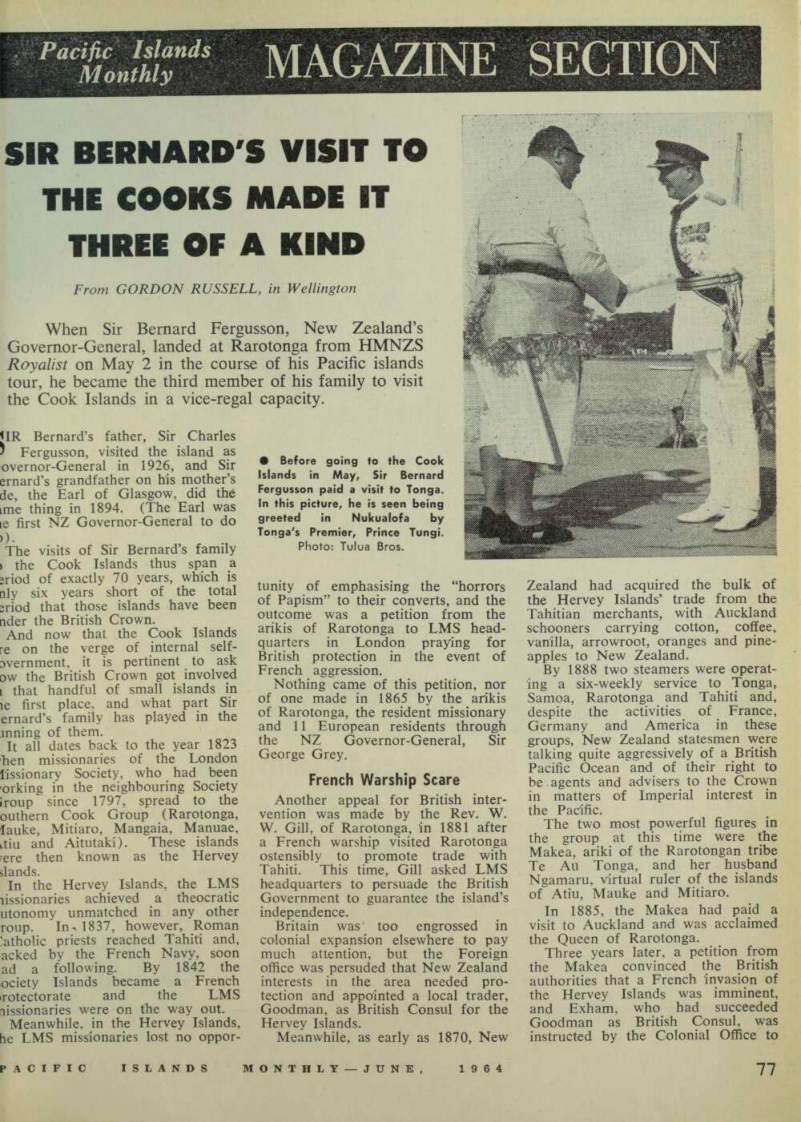
Before going to the Cook Islands in May, Sir Bernard Fergusson paid a visit to Tonga.
In this picture, he is seen being greeted in Nukualofa by Tonga's Premier, Prince Tungi.
Photo: Tulua Bros.
■mally proclaim a British pro torate over the Group.
A month later, in October, 1888, plain Bourke reached Rarotonga >m Hawaii in HMS Hyacinth to □firm the proclamation at each and.
Instead of this, he went through » motions of annexation—being w to such duties, in a hurry, and t properly briefed.
The Colonial Office was not greatly rturbed, however, as it was con ent that the arikis did not under ind the legal technicalities of what d been done.
Frederick W. Moss, a member of e NZ House of Representatives, as appointed the first British Resi nt of the Protectorate and took fice in April, 1891.
Building upon the established iuncils of chiefs. Moss created
district governments, island govern ments and a federal government for the Group.
In 1894, Sir Bernard Fergusson’s grandfather, the seventh Earl of Glasgow, visited the Group (which had become known officially as the Cook Islands) as NZ Governor- General.
With him in the Government steamer Hinemoa went his wife and two daughters, one of whom was destined to become Lady Alice Fergusson.
The Earl saw the local situation as a most interesting experiment and believed that Moss had the con fidence of the peonle.
However, although Moss had truly made a brave start, by 1896 differences had developed between him and the arikis which the local Europeans ensured did not heal.
Moss was succeeded in 1898 by Lt.-Col. Gudgeon, a forceful leader
with long experience of the Maoris of New Zealand. He was ushered into office with much pomp and ceremony and acclaimed as a great White chief.
Secure in this mana, he soon put the Europeans in their place, cleaned up the liquor trade, came to terms with the LMS, introduced land reforms and carefully whittled away at the feudal powers and privileges of the arikis.
Annexation He was confident that annexation was just round the corner and planned to that end. Within his considerable term as British Resi dent and then Resident Com missioner, he set in motion the administrative structure that was to serve, with modifications, to the present day.
The Earl of Glasgow was not happy about annexation by New Zealand, believing that her lack of skilled colonial administrators would mean that the Colony would merely
exploit the islands at the expen: of the Maoris.
However, his successor, Loi Ranfurly, who visited the group 1899 and assessed the calibre of tl local Europeans, recommend* annexation by New Zealand as tl only way of obtaining law and orde The Premier of New Zealand this time was Richard (“King Dick’
Seddon, the most dynamic ai vociferous imperialist that Ne Zealand had produced and it w he who engineered the annexatu of the Cook Islands in 1901.
Seddon's Arguments
Two of his arguments warrant i airing. These islands, he said, cou easily be made self-supporting; ai unless immediate steps were tak* to expand New Zealand’s interesi the newly-formed Australia Commonwealth would overshadc New Zealand in the Pacific.
Sir Charles Fergusson, who w appointed NZ Governor-General 1924, visited the Cook Islands in tl Government steamer Tutanekai 1926. With him was his wife, La* Alice, who had already tasted Rar tongan hospitality with her fath in 1894.
The State machine, by this tim was an accepted institution, chuggii along by trial and error and witho much reference to the people. Ai whereas the Church was a pote factor in their lives, the State ai the people were just neighbours, ( a nodding acquaintance. Both tl arikis and the merchants were favour of this peaceful co-existen without fraternisation.
More Say
Today it is rather different. With the last decade, a genuine effort h: been made to reach the people, ar there is no doubt that the persiste background noise from anti-coloni agitators in the United Nations wi a factor in promoting this lon
delayed approach.
The Cook Islanders have bee given more say and more respoi sibility in the running of their affai and are responding as people do such circumstances. Some like local leaders are emerging and her in contrast to other spots where tl lid has been lifted, they are contei to walk before they run.
International self-government promised for 1965 and a “shadov government is busy facing up to th reality.