Territories TALK-TALK
pp. 53-57 · Read in the full issue
With Tolala
Turning the pages of the Sydney Morning Herald the other day I sighted a heading on the financial page: “Choiseul Profit Rises 27.6 p.c.” and the sub-heading showed the net profit of Choiseul Plantations (Holdings) Ltd., copra and cocoa planter, for the year ended November 30.
’ PAUSED a moment and I did some • back-thinking. The mention of le month of November (the close of le company’s financial year) rang a ttle bell, and I went back just on 0 years to when CPL was only a sry small pup in the Burns Philp tter. No “(Holdings)” in its title len; life was much more simple; no igh-pressure tactics . . .
It was in November, 1912, that I let W. H. Lucas (BP’s Islands in jector at the time) in Kieta (Bouga iville).
He was land-seeking for this newly >rmed company and was accom anied by his able lieutenant, Jim Campbell. They were travelling in the Dod ship Sideia, with Capt. Buckley 5 master and engineer Tally.
Choiseul Island had offered no litable areas in the British Solomons, nd the untouched, extensive isle of ougainville in the neighbouring terman colony, with its affable Com lissioner Doellinger, eager to develop le area, appealed to WHL as holding ossibilities: good soil, unlimited ibour and official encouragement ad co-operation.
After a slight delay, caused by my larriage ceremony, WHL and Doel nger went land-hunting, which re ilted in the acquisition of the areas iter to be known as Soraken, Kunua, aniu, Teopasino and Arigua plan itions.
CPL’s First Estate: Soraken, was :arted in 1913 with Jim Campbell 1 charge of operations. Being located ot distant from Buka Passage it ttracted the Buka Island natives to make paper”. They had the reputa on in the colony of being the cream f labourers.
At long last the “English” had sturned, a Buka kukurai (luluai) Did me when he heard the news. As Don as I had taken over the old hieen Emma trading station on 'ororan Island from Paul Schmidt later “Karkar”) in 1912, the Buka ids had quizzed me as to “What ime English he come now?” To diich I, naturally, being a foreigner
and not having the foggiest idea of the coming 1914-18 conflict, had re plied a terse: “No got!”
But with the advent of CPL at Soraken a year later the chiefs smiled knowingly, for had they not asked when the English were coming?
They had already started, laka?
And they had big schooners and plenty of tobacco; they gave out tea and sugar and biscuits in the morn ing. Jim Campbell had been allowed to “let his head go” and, knowing the native mind, had done just that, with amazing results.
Natives swooped on Soraken from near and far to “make paper”.
This was the “slave labour” of German times, so often referred to in later years when describing the “bad old days” of colonialism.
So ready was the response that the other estates, Baniu, Teopasino and Arigua were soon in operation and I found myself caught up in the vortex to “join the English” and started planting the Arigua property
in late 1913 and was in rather the unique position of being the only married man (with the exception of Jimmy Gibson, the diver, at Man-
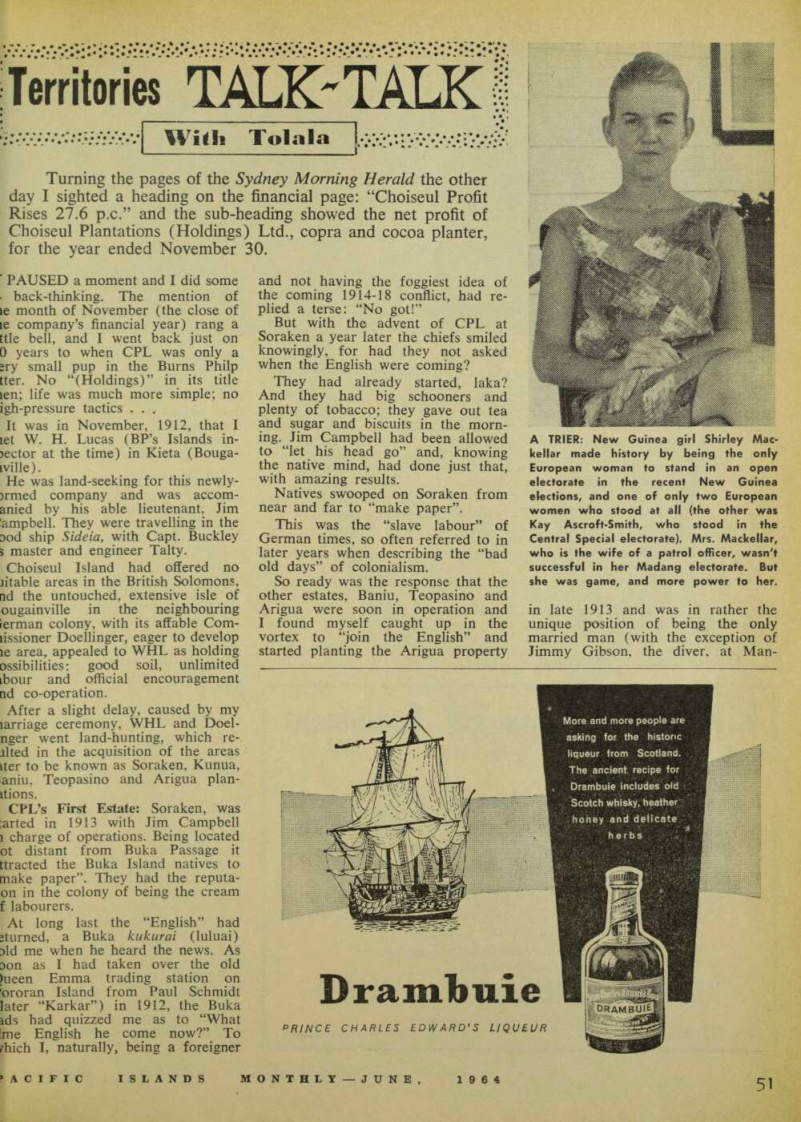
A TRIER: New Guinea girl Shirley Mac kellar made history by being the only European woman to stand in an open electorate in the recent New Guinea elections, and one of only two European women who stood at all (the other was Kay Ascroft-Smith, who stood in the Central Special electorate). Mrs. Mackeliar, who is the wife of a patrol officer, wasn't successful in her Madang electorate. But she was game, and more power to her.
ning Straits) on the plantation staff of the island estates under Lucas’ control “I don’t want married men,” Lucas used to say. “They are only ruddy verandah planters. I’d rather lose a few bolts of calico out of the trade store, given to a ‘mary’, than lose the whole plantation.”
The First Annual Stock-Taking: Early in November, 1914, I received word by runner (all CPL ships had been out of action since September, owing to the war) from Jim Camp bell to proceed from Arigua to Soraken for the purpose of assisting in the annual stock-taking.
So I hied me forth in a whale boat and a week later was busy counting the few bags of rice (no supplies had been received since the latter end of July, and the main diet had been kaukau), tins of bulamakau, salmon,
tobacco and the general what-have you’s on a plantation in those days.
The Aussies Arrive. We had reached the stage of costing and the general faking of plantation returns, which takes place on every well-run establishment; reconciling stocks con sumed with stocks on hand and re ceived, when we heard that ever welcome cry of “Sailoo!”
Was it a German or an Aussie steamer? It was slowly nosing its way through the reefs of the Buka Pas sage.
Excitement reigned as we recognised the Australian flag and we charged our glasses with a modicum of Painkiller (one of the few remaining stimulants).
It was the old German steamer Meklong with 500 Australian troops aboard en route to Kieta, where op position was expected from the Ger
man settlement there, I was able to tell the CO (a chap named Colonel Watson) that Doellinger and his staff were sitting down, with their bags packed and ready to hand over the keys.
Doellinger had even scuttled his dearly-loved steamer Buka in Roro wana Bay.
It was a happy conclusion to Choiseul's first stock-taking in 1914.
The “English” had come, even as the old Buka chiefs had foreseen.
Our months of isolation from the outside world were finished.
Once again we could receive sup plies from Faisi (BSI) and we toasted Meklong with her Aussie troops (members of the AN & MEF) in something more tasty than Painkiller, And from those early days to 5C years later I would say that CPL has never looked back. It was the first big Australian planting enterprise tc start in New Guinea.
Ng Artifacts
Spears, bows and arrows, masks, wooden statues from New Guinea ai one time were known simply as native curios and were looked upon by the more privileged people as crude and, at times, obscene.
Today they come under the category of Art—with a capital A Whether this is due to the modern trend towards abstract or contem porary paintings and sculptures 1 wouldnt know.
Anyway, they are referred to b> critics as avant garde and thus ac cepted, despite the fact that most ol the noses and eyes are in the righl places.
Whether this trend to acclaim these native works as Art is con nected in any way with a subtle in tegration campaign is anybody’s guess. Suffice it to say native curios of almost any type are very much U
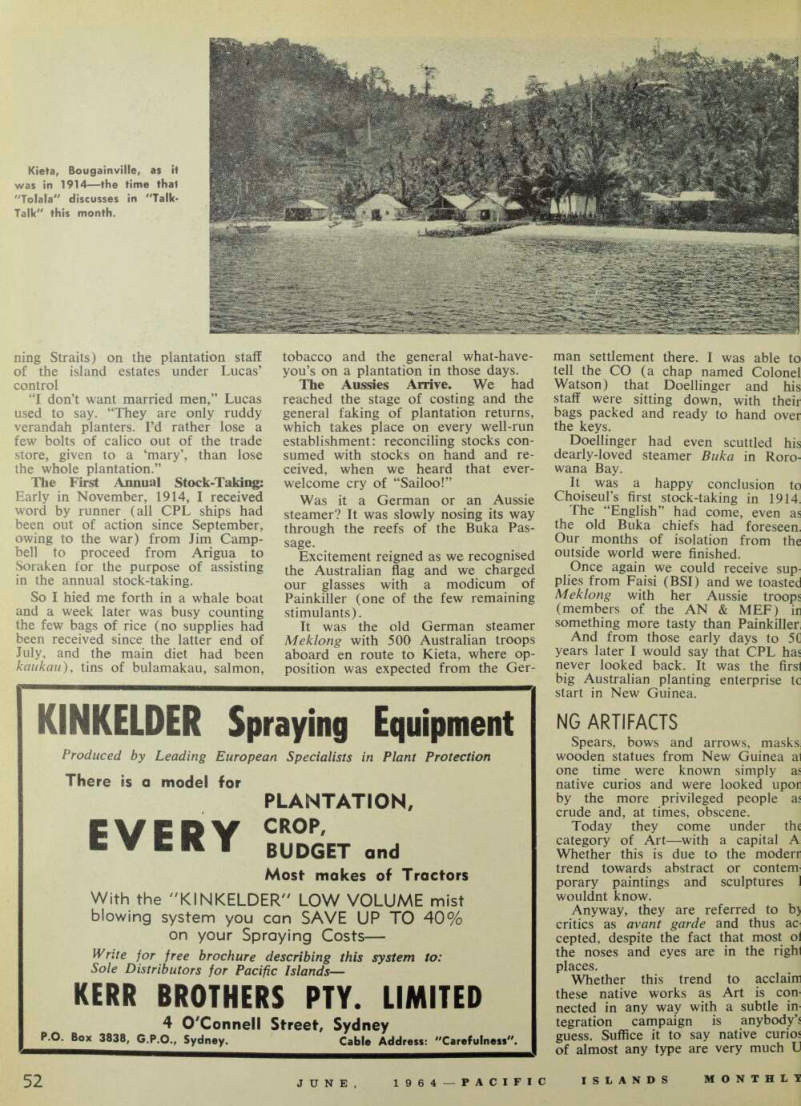
Kieta, Bougainville, as if was in 1914 —the time that "Tolala" discusses in "Talk- Talk" this month.
Australia at the moment, judging recent reports of art critics at the mgry Horse and other Sydney lleries. Artifact-seekers from other ids have long ago recognised their itinctive features, as I mentioned t month.
It reminds me of an experience I d 52 years ago in Sydney when I -ived there in mid-1912 and, as is usual in those days, loaded down th hessian-bound bundles of spears, ws and arrows and the usual para ernalia that comprise the parting ts from native friends who had ed “Yoko” to me as I left the and.
Curios of any description are bulky anyone’s luggage and I had them >wed away in the baggage-room of j Metropole Hotel, where most ;w Guinea folk stayed in those days.
To get rid of them was a problem I visited a curio shop. Today it >uld be in Martin Place; then it was oore Street and known as Tost & )hu. I entered the dim-lit premises, ;erviewed the manager, told him lat I had for sale. He was not terested.
New Guinea? It didn’t appeal to m.
I was about to leave the shop when spied a chap whom I recognised imediately as a Yank tourist. With e precociousness of youth I ap oached him and asked him for iat was he looking. He wanted me “genu-wine” South Seas curios decorate the den of his home in ew York.
I told him I had what he wanted id after a noggin or two at the etropole he inspected my collection 1 farewell gifts and, after having awn on my imagination to some :tent, giving him a case history of ich item, its authenticity and rarity, * realised how fortunate he was.
He wanted them, I sold them and e were both satisfied.
From this early experience I ialised the value of native artifacts, ie proceeds of which enabled me to :e the sights of Sydney Town with /o ship-board companions, Frank id Jim Pryke, who had joined the rinz Sigismund at Samarai after a respecting venture up the Yodda.
Catty Question
With all the modern scientific aids hich we are said to have at our dis osal it would seem that when it jmes to a show-down we must rely n Mother Nature. I refer to the ise of Rats on Bougainville. An rgent SOS was sent out last month >r two thousand cats, to keep the its down. It received appropriate üblicity.
Rats have been pests in certain
arts of TNG for many years. One p the worst infested spots (to my nowledge) was the Carteret Islands, so in the Bougainville district.
I stayed there one night and never ept a wink. The rodents in number id size reminded me of the trenches p the Western Front in World War I.
Tbe Chinese trader on the Car pets was well supplied with cats, ut they were so fat and well-fed ley had lost their usefulness as •adicators.
Fresh supplies of “pussies” were nported to him from Rabaul about very three months and the skipper E the schooner about to leave Rabaul >r the island would send his boats rew ashore “pussy-hunting,” paying small bonus for the felines.
No Rabaul cat was safe at such me, and cat-lovers, knowing then ich a clean-up was due, would romptly lock up their pets.
The Carteret trader always had •esh meat on the island. He told me; Pussy he good fella kai-kai too mch”.
Perhaps the newly-formed New ruinea Biological Foundation will find solution to the problem.
Hot In The Arm
The announcement last month of le formation of the New Guinea lorporation must certainly be an ncouragement to the private Aus •alian investors in primary and in ustrial development of the Territory, t received a good Press coverage nd the names connected with the enture are impressive.
I liked chairman Steven Rich’s emarks when he said; “The col oration would be as dedicated to its New Guinea’s) development as the ioneering Australians already there,” bus giving due credit, indirectly, to hose private individuals and com panies who had really pioneered the [erritory This was in contrast to a state nent by an official of the Depart nent of Territories who is reported o have referred to the new company is “Pioneers in New Guinea Finance” md followed on with the usual )fficial view that nothing had been lone in either Papua or New Guinea >efore the end of War 11.
He said: “Australian pioneers and explorers helped New Guinea with lealth and education. It is now the urn of the businessmen to help the territory towards economic maturity”.
Ye gods and little fishes!
What of the old German pioneers who brought trading to the country in the ’7o’s and ’Bo’s, such as the Neu Guinea Compagnie, Hernsheim & Co. and the D.H. & P.G., then later Queen Emma and H. R. Wahlen
in New Guinea and UNO's Capt.
Fitch (which became Steamships), the Whitten Bros, and the Buntings in D P fd p^Vdo b nth r ?n g^ ar I?
And what of BP, WRC, Guinea Airways, Bulolo Goldfields, and NG Goldfields in the post-War I period?
To say nothing of private individuals like Cecil Levien, the Big six, and the Leahy brothers.
Other recent commercial fillips, of course, have been the W. R. Carpenter ‘E a ! n ! he , Valley and the NG Biological Foundation, which has acquired Aropa plantation and which was, incidentally, Started as a big experimental estate back in the German days when old Louis Somer was the manager.
There are other big ventures pending (SO I hear) that also have Bougainville Island as the locale for the^e OP w r hole nS attitude of officialdom towards private enterprise at long last appears to have softened, which will be to the Territory’s advantage, even if it does bring down the wrath of the Afro-Asian clique at Lake Suecess as encouraging capitalism!