Fiji Land
pp. 47-51 · Read in the full issue
Behind The Ba Leases
Problem
From a Suva Correspondent The vital problem of Fiji land has been thrown into sharper focus in recent weeks. It has be come clear even to people who have never thought much about it before that land can become
an explosive subject between
races.
ALTHOUGH the Fijians own most of the Fiji land it is the Indians, who outnumber the Fijians and who make up more than half the popula tion of the colony, who are the major agriculturists. The Fijians, through the Native Land Trust Board, lease much land for cane-growing by Indians.
The recent public interest has arisen following notification by the board that 5,425 acres leased by the CSR company in the Ba area will not be renewed to the CSR after December 31, 1965, when the 50year leases are due to expire.
This in itself is nothing unusual.
But the fact that the opportunity has been taken to make a public issue out of the Ba release is indicative of the feeling that can be aroused on land matters in Fiji.
Whether the issue has been contrived to any extent is not the point.
The CSR at present has more than 300 cane-growing tenants on the Ba land, and the company has asked the board to consider leasing direct to the tenants any land not required by the Fijian owners.
On the expiry of native leases like these, the Fijian owners are entitled to exercise their rights as landlords and decide whether they want some or all the area retained for their own use, or released.
In the Ba area some of the owners have asked for possession, and the board in May was investigating individual cases.
The board chairman urged the Fijians to think carefully before deciding, because Fijian individuals would have to farm the land properly so that the cane contracts were not lost.
The possibility of the land going to new owners has not unnaturally caused some agitation among the present Indian tenants, but more fuel seems to have been added to the smouldering embers.
"UN Intervention"
This showed itself in rather spectacular fashion in April when the Fiji Kisan Sangh, a major group of Indian cane-growers, met at Lautoka and came up with a curious resolution which was sent to the United Nations Secretary-General, with a copy to Mr. Duncan Sandys, Secretary of State for the Colonies. (Over)
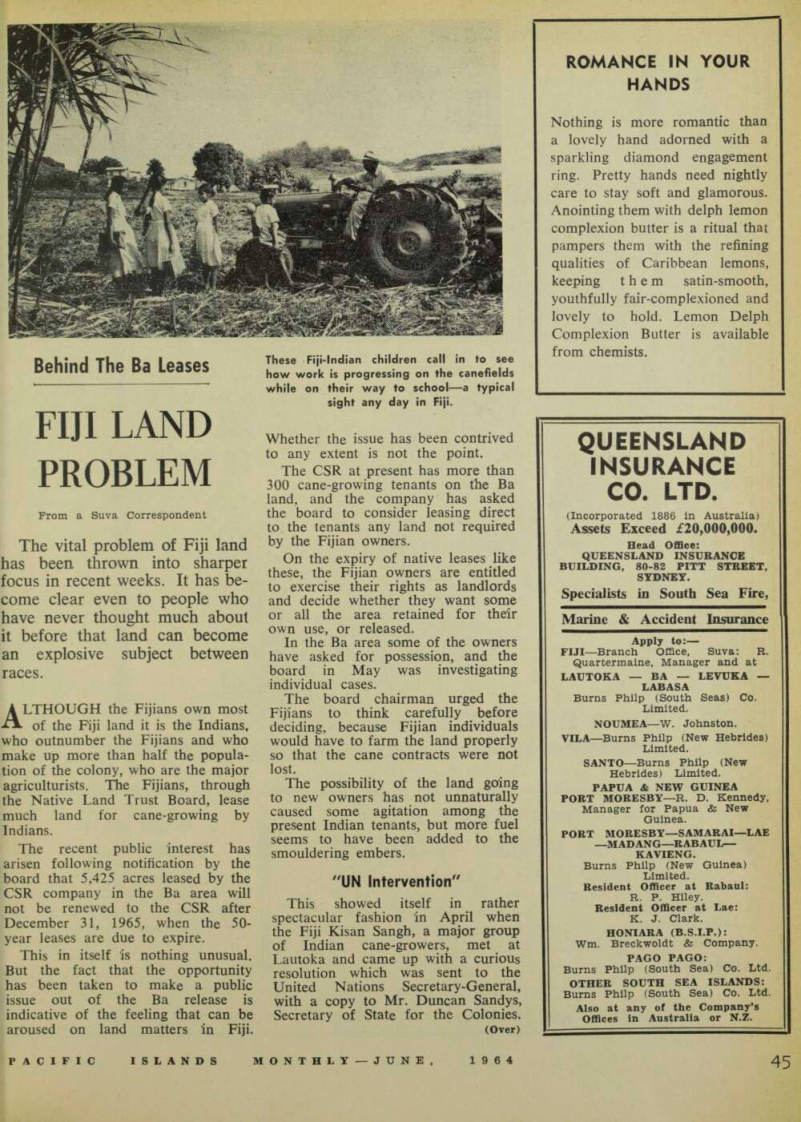
These Fiji-lndian children call in to see how work is progressing on the canefields while on their way to school —a typical sight any day in Fiji.
The resolution said that Indian rimers were being deprived of their nds by the Fiji Government, and at UN intervention was required.
Furthermore, the Fiji Kisan Sangh ould make arrangements to resettle e unhappy Indians in some other mntry. About 80,000 Indians ould be involved in the resettle ent.
The action of the Fiji Kisan Sangh •ought a sharp response from the iji Government, which said it was irprising that direct representations ad been made to UN by a small ction of cane-farmers without first jproaching the Fiji Government.
The Government statement men aned that other organised cane irmers had put their grievances to le Indian MFC’s, who would put icm to the Government.
No Indian farmer would be sprived of land, crops or money to hich he was lawfully entitled.
If the leases of any of the present issees (at Ba) were not renewed, le lessees would be given priority i the allocation of land under Gov rnment settlement schemes. It was □true to say that the Government as not assisting farmers.
The Government described the nplications in the UN telegram as mischievous and misleading”.
Indian View Later, the Government released etails of an interview with the rovernor which had been sought and ranted by the six Indian members f the Legislative Council.
The members had expressed con ern at the possible plight of the odian families who might have to acate the Ba land.
They said great hardships would e incurred by the farmers and their amilies. They would lose not only heir tenancies but their cane con racts as well; no compensation /ould be paid for improvements; heir contributions to the Sugar Price itabilisation Fund would be lost; md the access roads they had built ind the school building contributions hey had made would be enjoyed by rther people.
"Landless"
The problem was not one affecting he Ba district tenants alone. If and leased to Indians were taken wer by native owners when the eases expired, the end result would be to leave the Indian community landless, the Indian MLC‘s added.
The Governor, Sir Derek Jake way, said he was acutely conscious of the issues involved both in the Ba district and in their wider application.
It should not be taken for granted
that none of the present leases would be renewed to existing tenants.
Not all the land under lease was in fact being claimed. Even when claims were made and substantiated it did not follow automatically that the leases would not be renewed.
Larger Issue
The larger issue of greater security of tenure for farmers in general was one which the Government was exhaustively considering.
The evolution of a fair and equitable relationship between land occupier and land owner was a matter of such vital importance that he felt he should make a personal study of the problem.
This he was doing, in preparation for the day when Members with portfolios would be associated with his official advisers in the formation of Government policy on such matters.
The Governor said he understood and sympathised with the anxieties of tenant farmers who felt their livelihood threatened.
No good, however, would come from playing on these fears for temporary political advantage or of reckless talk of a mass exodus to some unnamed Promised Land.
This would merely lead to a hardening of attitudes and make eventual solution infinitely more difficult.
The right and only way ahead was for the political leaders of the three main communities to get together with him to work out agreed and mutually acceptable policies.
The Indian members could help the community they represented and the country as a whole by co operating in this.
It seemed that this interview had hardly been concluded when another
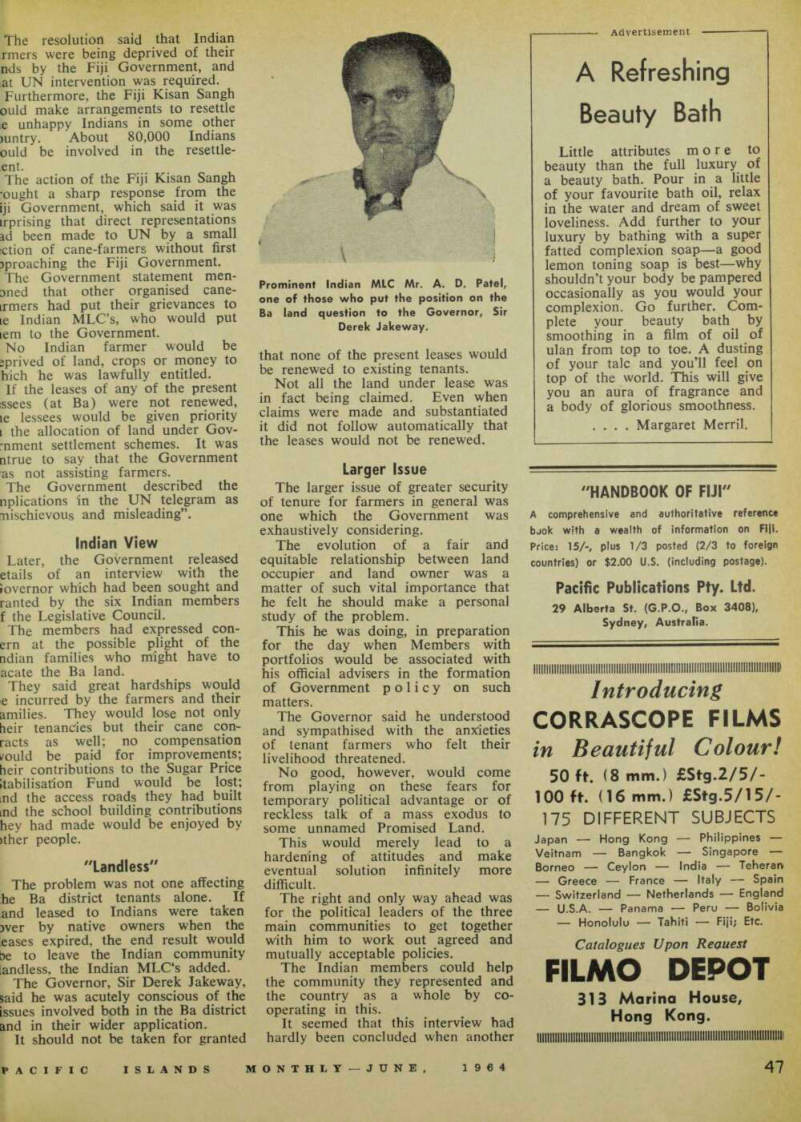
Prominent Indian MLC Mr. A. D. Patel, one of those who put the position on the Ba land question to the Governor, Sir Derek Jakeway.
last was fired off —this time from le Fijian camp.
Speaking to the adjournment in ic Legislative Council, Fijian ;mesa Sikivou issued a blunt “hands I Fijian land” warning.
“The subject of Fijian land is an [plosive one,” he said, in a tense mosphere in the House. “We lost uch land in the past and we don’t tend to lose any more land.”
Sikivou said some political leaders id been making capital of the Ba nd question, but the Fijians would unand fullest consultations before ly change was made in Fiji land ws.
He said the political leaders had ily succeeded in “worsening spicion and mistrust”.
He said one could appreciate the irdships some Indian farmers might i faced with, and he hoped every nsideration would be given them, it the Ba land matter was a simple atter of an expiry of leases—a rfectly normal thing. The Fijian md Board should be left alone thout agitation to complete its liberations.
Sikivou’s comments were not going be the last on a vital subject, everybody in Fiji knew. The oblem of Fiji lands is in fact wider an a mere 5,000 acres at Ba.