Malarial Pills
p. 39 · Read in the full issue
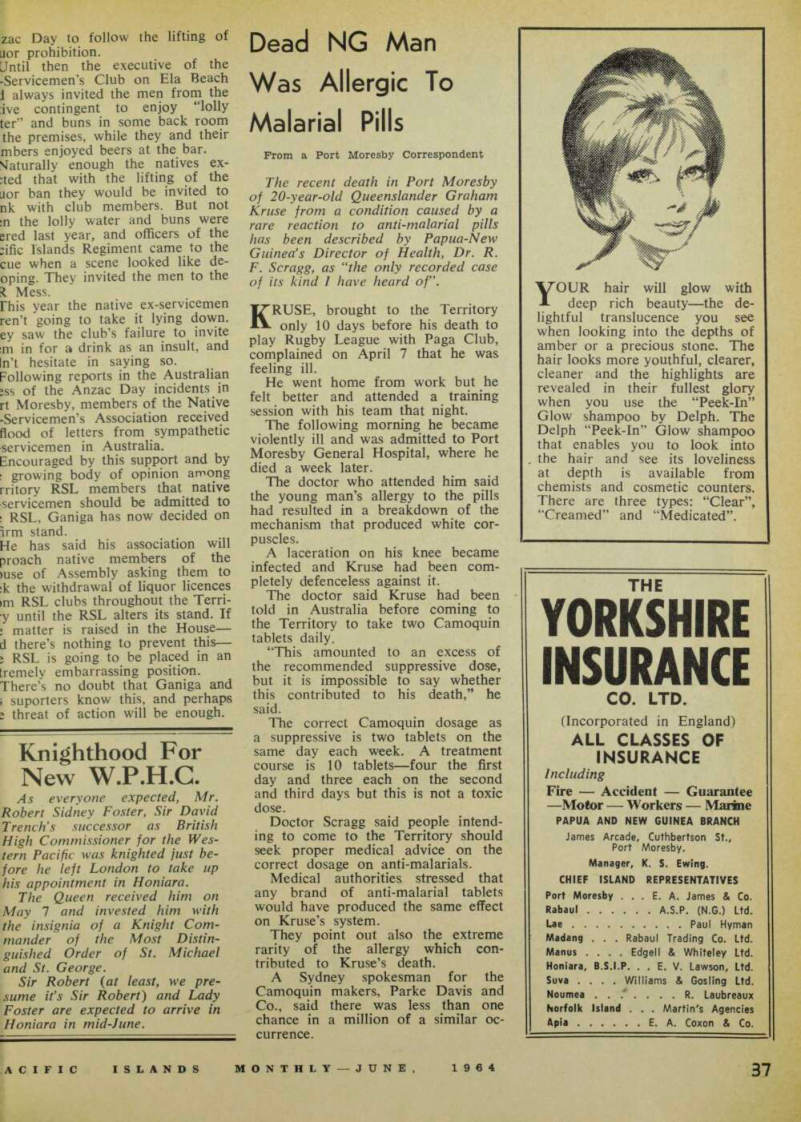
Dead NG Man Was Allergic To Malarial Pills
Prom a Port Moresby Correspondent The recent death in Port Moresby of 20-year-old Queenslander Graham Kruse from a condition caused by a rare reaction to anti-malarial pills has been described by Papua-New Guinea’s Director of Health, Dr. R.
F. Scragg, as “the only recorded case of its kind I have heard of”.
KRUSE, brought to the Territory only 10 days before his death to play Rugby League with Paga Club, complained on April 7 that he was feeling ill.
He went home from work but he felt better and attended a training session with his team that night.
The following morning he became violently ill and was admitted to Port Moresby General Hospital, where he died a week later.
The doctor who attended him said the young man’s allergy to the pills had resulted in a breakdown of the mechanism that produced white cor puscles.
A laceration on his knee became infected and Kruse had been com pletely defenceless against it.
The doctor said Kruse had been told in Australia before coming to the Territory to take two Camoquin tablets daily.
“This amounted to an excess of the recommended suppressive dose, but it is impossible to say whether this contributed to his death,” he said.
The correct Camoquin dosage as a suppressive is two tablets on the same day each week. A treatment course is 10 tablets—four the first day and three each on the second and third days but this is not a toxic dose.
Doctor Scragg said people intend ing to come to the Territory should seek proper medical advice on the correct dosage on anti-malarials.
Medical authorities stressed that any brand of anti-malarial tablets would have produced the same effect on Kruse’s system.
They point out also the extreme rarity of the allergy which con tributed to Kruse’s death.
A Sydney spokesman for the Camoquin makers, Parke Davis and Co., said there was less than one chance in a million of a similar oc currence.