The Belle Of
pp. 33-37 · Read in the full issue
[?]he Problems Of [?]uying Your Bride
Kalo Village
From Don Hogg, in Port Moresby She was the belle of Kalo illage and her father knew it.
A ND the man with his eye on her \ was the Hula trade store owner, x-Londoner John Meikle, 50, an un uccessful candidate in Papua-New juinea’s recent House of Assembly lections.
It all began about 18 months ago, yhen Dorothy was little more than 6.
Mr. Meikle would give her presents rom his well-stocked shelves each ime she passed on her way to the .MS school, and the slender Dorothy Cila would smile her thanks.
The presents from the trade store helves continued to go to the girl done for some months, then the rader extended his generosity to her 'amily.
Dorothy’s father. Pastor Kila Pat —for seven years an LMS pastor— vould often call on the generous Mr.
Meikle and go away well rewarded.
Then one day about a year ago Mr. Meikle asked for Dorothy’s hand.
The pastor was delighted. “But, of course, it will all depend on Dorothy,” tie said. It is legal for a Papuan to
marry at 16 if she has her parents’ consent.
That night the family held a conference at which the ins and outs of such a marriage were explained to Dorothy, who was then asked what she thought.
According to Dorothy, she remained mute, but according to her father and other members of the family who would share in the bride price, she agreed to Mr. Meikle’s proposal.
Pastor Kila Pat told Mr. Meikle of Dorothy’s willingness to marry him and the gifts continued.
Mr. Meikle, an ex-Royal Navy officer who lost his English wife and
two children in a wartime air raid on London, wanted the ceremony held as soon as possible, But there was unexpected opposi tion.
The Rev. Maurice Nixon, Austra- Han missionary at Hula, refused to marry them. He doubted that the girl wanted to marry Meikle.
But her father still insisted she did.
There were two alternatives for the match-making pastor. Either the couple could be married by the Dis trict Officer or by native custom, “But,” Kila Pat told John Meikle, “you must wait a little longer.”
The trader was fast becoming tired of waiting and in a letter written to
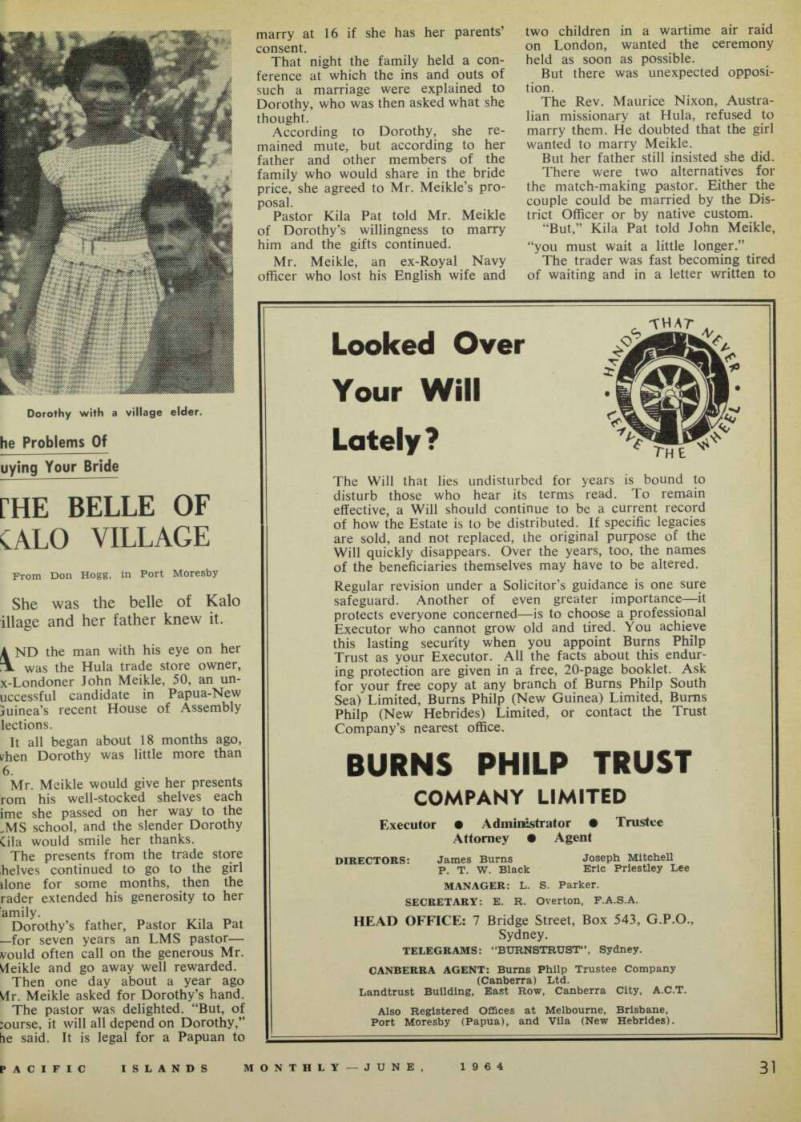
Dorothy with a village elder.
rothy’s father three months ago ed him to “quit stalling”.. he pointed out that by now pastor’s family had accepted ds and cash to the value of 104/8/5 from him.
I have kept my side of the bargain 1 now you must keep yours,” he >te. “And so I shall,” replied the man pastor. dr. Nixon left the village for ic months’ leave in Australia and a Pat assured his daughter’s or that “it won’t be long now”, lut events took another unexpected i. tumours that a girl was being :ed by her father to marry a man inst her will reached District ce in Port Moresby. ‘She doesn’t love John, she loves her aoldays’ sweetheart, an apprentice ;r now in Port Moresby,” went rumours. icting District Commissioner Mr. dd Marsh sent Assistant District cer Neil Lucas from his office at rby Rigo to interview the Kila family and Mr. Meikle.
"She Must Marry Him" le was there when I arrived in the age. The officer had turned out whole family for a meeting. He [ the pastor that to force the girl » marriage was against the law.
Tie pastor argued back that Mr. :as did not understand the ways of people.
The family decided she would :ry John and we have accepted bride price. She must marry him, t is the way of the people,” he I. Mr. Lucas turned to Dorothy > had stood silently staring at the d black earth.
Do you want to marry John?” asked. But the girl would not wer.
She is very shy,” explained her ler.
Mr. Lucas asked the same question of Dorothy’s mother. But she, too— after casting a fearful glance at her husband—remained mute.
Mr. Lucas left the village after warning the pastor to do nothing to influence the girl in her choice of a husband.
But as I, too, left the village Maki, Kila Pat’s father, and Dorothy clambered aboard the Land Royer.
Maki spoke to me as we jolted toward Hula, “Don’t let them make her marry John. He is a good man but she is too young and he is too °ld-”
“Do you want to marry John?” I asked Dorothy, “No,” she whispered, , At his trade store I found John Meikle weighing out brown rice, “Dorothy doesn’t want to marry you,” I told him.
“I was beginning to suspect that,” he answered, “but her father has always insisted she wanted to.”
“Will you press your claim?”
“I’d be a fool to marry a girl who didn’t) want me,” he said, “And what about the bride price?”
“I won’t press for its return. I’ve been here for 12 years and thought I
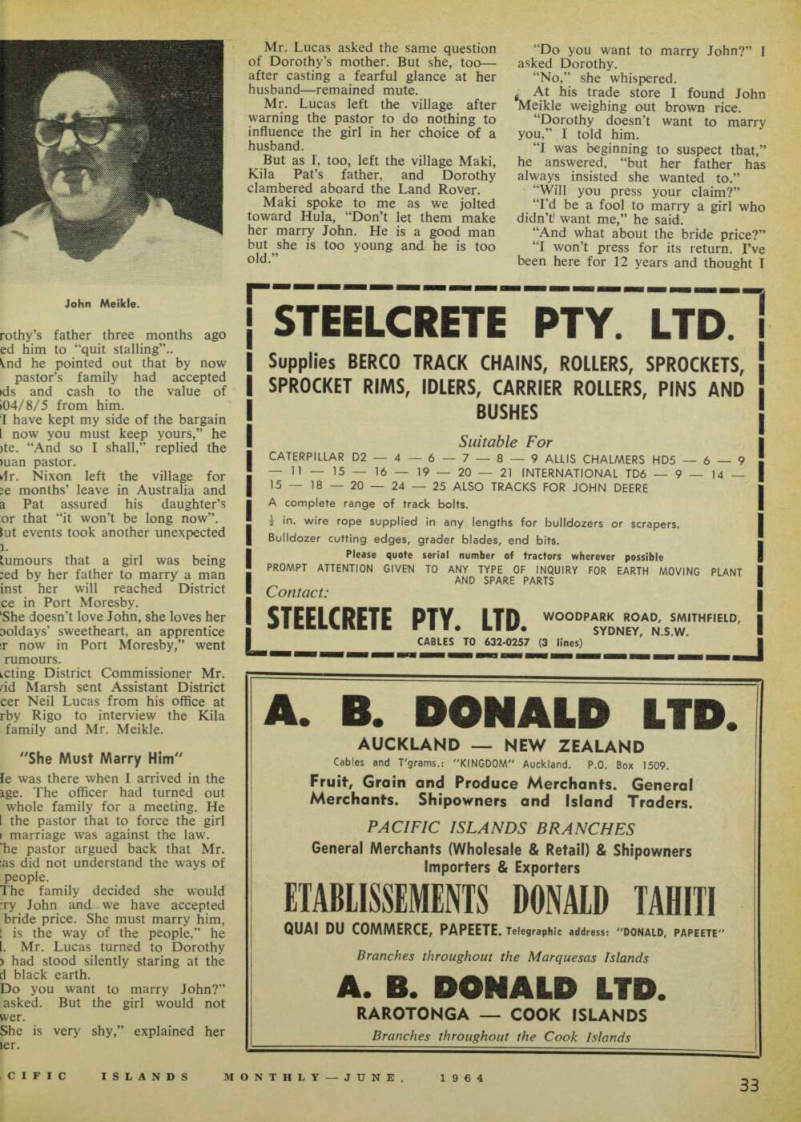
John Meikle.
lew the people, but now I agree— •u can never really know what’s gog on,” [An expert in the bride price stem, Oala Oala-Rarua, says that if orothy now marries someone other an Mr. Meikle, her husband will ,ve to pay a bride price for her, ila Pat would then, by native
custom, be obliged to pay £604/8/5 of that bride price to Mr. Meikle.] Latest development in the story came in the form of a letter from Mr.
Meikle to the editor of the South Pacific Post, Port Moresby, “You can put in your paper that Dorothy still has one suitor—me,” wrote Mr. Meikle!