In Tonga , The Liquor
pp. 27-28 · Read in the full issue
Laws Work Happily
From Dorothy Lavin, in Nukualofa The casual tourist to Tonga, who might like to rest his \eet and cool off with a long cold beer, would find it virtually 'mpossible to quench his thirst on anything more potent than coconut milk. But this sad state of affairs is shortly to be r emedied with a tourist hotel planned for the waterfront.
OR the resident of Tonga, or in particular of its main town, kualofa, the picture is very dif ;nt. Being an independent king n, Tonga has not felt constrained follow any laid down pattern of r s governing liquor, but has de sd for itself what is best suited people and circumstances. The r s apply to both Tongans and ropeans.
Anyone who wants to drink must t have a liquor licence. The grant of the licence, and the amount of lor allowed by the licence, is a tier for the Minister of Police, 0 takes into account the reputa -1 of the person concerned. The intity of liquor allowed on that mce depends on the applicant’s mcial position, but in any case it a very liberal allowance.
The licence allows a monthly ration —so many dozen Deer, so many bottles of spirits and wines— and what is not consumed in one month may not be carried over to the next.
The licence comes up for renewal every year, when the drinker may have his ration reduced or increased, depending on what he requires and what he has proved he can handle ... (or hold?).
Controlled, Not Restricted Special permits are always avail able for anyone giving perhaps a big cocktail party, to cover that par ticular night’s entertainment, without affecting their monthly allocation. In short, although liquor is controlled in Tonga, it is not restricted for those who want to enjoy it in moderation.
Two licences for a married couple are issued, and they can be left at either of the two main European stores where liquor is sold, or per haps one at a store and the other at any of the clubs licensed to sell liquor.
The three main clubs in Nukualofa are the Tonga Club, the Nukualofa Club and the Yacht Club.
Each has its own bar, where mem bers can drink, and if their licence is deposited there they can take home their choice of a bottle. Hours are virtually unrestricted, seven a week, yet such a thing as a police raid is unheard of—or unnecessary.
No Drunkenness The Nukualofa Club is primarily a European club, but the Tonga and Yacht Clubs are open to all. There is no colour bar—only a behaviour bar!
Drunkenness in Tonga is almost non-existent.
Possibly the lack of ready money has a lot to do with it. Although food is there for the growing and fish are there for the catching, the
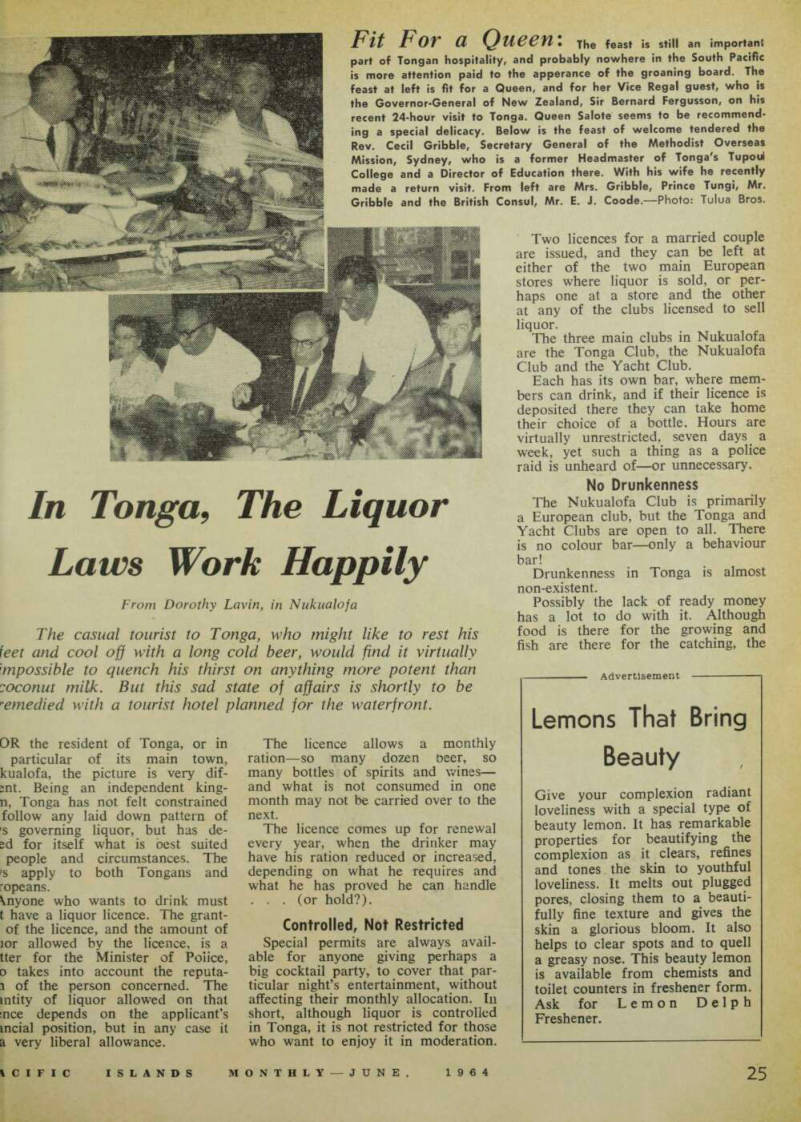
Fit For a Queen : The feast is still an important part of Tongan hospitality, and probably nowhere in the South Pacific is more attention paid to the apperance of the groaning board. The feast at left is fit for a Queen, and for her Vice Regal guest, who is the Governor-General of New Zealand, Sir Bernard Fergusson, on his recent 24-hour visit to Tonga. Queen Salote seems to be recommend ing a special delicacy. Below is the feast of welcome tendered the Rev. Cecil Gribble, Secretary General of the Methodist Overseas Mission, Sydney, who is a former Headmaster of Tonga's Tupou College and a Director of Education there. With his wife he recently made a return visit. From left are Mrs. Gribble, Prince Tungi, Mr.
Gribble and the British Consul, Mr. E. J. Coode.— Photo: Tulua Bros.
average Tongan has little in the way of actual cash.
The old idea of Europeans be coming sodden with gin in the tropics, is a complete fallacy in Tonga. You could walk into any of Nukualofa’s clubs on a Saturday around 5 p.m., and frequently find them deserted, for most everyone is boating, playing golf or out on a tennis court. There is no lack of social life. Cocktail parties are popular, generally from 6.30 p.m. to 8.30 p.m.—not from 6.30 to drunk, as in more “civilised” centres—after which groups will
migrate to the clubs for a game of billiards, table tennis, or just a quiet drink and a talk.
The home-brewer is rarely found in Tonga, at least in the town.
Out in the bush, where transport is sparse, there may be found a few keen souls brewing up a jungle juice of fermented pineapple juice and pumpkins, plus coconut milk. But they are exceptional.
Sly-grogging is practically non existent, too. It is confined perhaps to the odd bottle passed over to a mate, who for some reason has been
denied a liquor licence, but little m( than that.
What is the reason for this succe ful handling of the liquor probl< in Tonga? Perhaps it can be mail attributed to the fact that the Tong is more interested in his kava.
These non-alcoholic parties i much beloved by Tongan men a frequently turn into all-night parti There is, as elsewhere in the Pacil a great deal of ceremony involv( not just in the drinking of kava, t in the making of it. As the gue sit cross-legged on mats and £ served in strict order of precedes it is a time for talk, and any subjc may be discussed at length, and wi great oratory.
Although the Tongans are a high religious race it is doubtful if th< religious fervour has any bearing ( their abstemious behaviour, except f members of certain religious sects.
It seems that lack of ready ca and lack of inclination are the ma factors in Tonga’s success, for the is no doubt that the liquor syste works.