New Crop Pest
pp. 15-146 · Read in the full issue


Scares In The
South Seas
Outbreaks of crop diseases
nd pests were causing problems
i several South Pacific terri
fies in May.
rHE New Hebrides was warned about a new coconut pest, at resent occurring only around Vila, hich can have a serious effect on ipra production.
It is a small, flat, scale insect named spidiotus destructor, and looks like miniature, brown, waxy shield ttached to the leaves of plants. It produces itself so quickly that it m completely cover the undersides I leaves, and the flower buds and >ung coconuts, and by sucking the ip it can kill the palm.
Dr. F. J. Simmonds, Director of ic Commonwealth Institute of iological Research, saw this pest hen he passed through Vila on his ay from Honiara to Apia for the >uth Pacific Commission’s plant jarantine conference, and he warned iat it was a very grave danger.
If it spreads through a plantation can completely finish copra produc -3n for two or three years. It also tacks fruit and vegetables, including manas, papaw, sugar cane and •eadfruit. The leaves of infested ees turn yellow, and later the con tion spreads until the tree is com etely covered with scale.
The pest has been found in vari is plantations near Vila, from evil’s Point, Tagabe and Bellevue to £ Pango Pensinula.
In other countries where this scale sect exists, it is kept in check by edators, including ladybirds.
Mr, de Boissoudy, the Con >minium Senior Agricultural Officer, scussed the problem at the Apia inference with Dr. Simmonds, Dr. arrau of the South Pacific Com ission, and the entomologists, Mr. ochereau, of the French Institute of ceania, and Mr. B. O’Connor, of e Fiji Agricultural Department. As result of the discussion, one species ladybird is being introduced into e New Hebrides.
But control by introduced predators kes time, while the predators build » to a strength where they can keep e numbers of a pest down. Mean bile precautions are being taken the New Hebrides at once to pre-
vent Aspidiotus destructor from spreading.
Leaves and nuts carrying the pest are being cut off roadside trees and burned, and planters have been ad vised to burn leaves and nuts wherever they find infected trees in their plantations.
Warning has been given of the danger of carrying coconut leaves from place to place, or leaving them on the side of the road, and the De
partment of Agriculture in the New Hebrides has appealed to people to report the presence of this pest when ever they find it, so that the Depart ment can help to deal with it. Ex periments are being made in spraying with oil, washing soda, and various chemicals.
Mr. M. J. Macquillen, Govern ment Entomologist in the Solomons, says that outbreaks of this scale in sect affecting coconuts and bananas have occurred before in Fiji and Mauritius.
Ladybirds were introduced, and a report states that in Mauritius palms which had been so severely damaged that there was no suggestion of their possible recovery returned to health and full bearing when the predators became fully established.
P-NG Cocoa Problem Papua-New Guinea’s second most important industry, cocoa growing, is being attacked by a fungus disease.
Thousands of cocoa trees, mostly in the Gazelle Peninsula of New Britain and the Markham Valley on the New Guinea mainland, have been struck by the fungus.
According to a survey by the Rabaul branch of the New Guinea Planters’ Association, 28 of the 37 European-owned plantations in the Gazelle Peninsula have been hit by the fungus disease.
In addition, it is present in varying degrees in at least 20 native-owned plantations.
The survey showed that in some
(Continued on page 144)
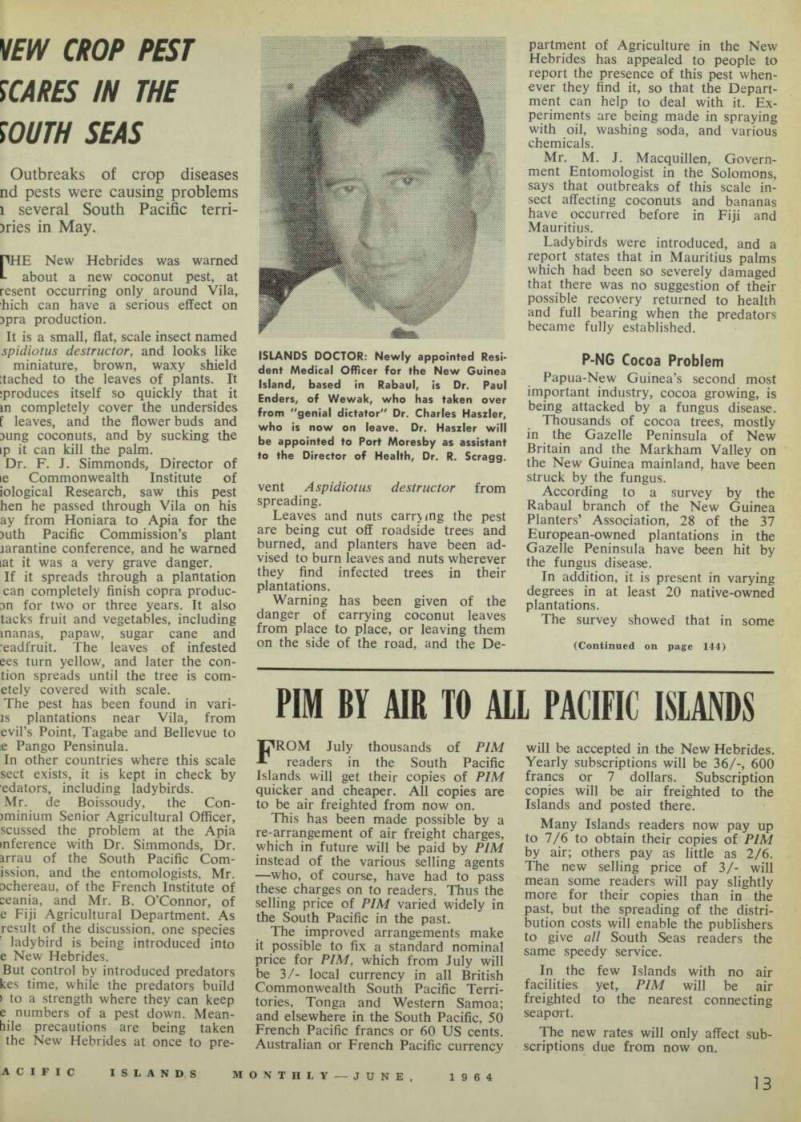
ISLANDS DOCTOR: Newly appointed Resi dent Medical Officer for the New Guinea Island, based in Rabaul, is Dr. Paul Enders, of Wewak, who has taken over from "genial dictator" Dr. Charles Haszler, who is now on leave. Dr. Haszler will be appointed to Port Moresby as assistant to the Director of Health, Dr. R. Scragg.
cases the disease had struck only a few isolated trees, but in others, nearly every tree in a plantation, from the oldest tree down to the youngest seedling, had been attacked and was dying.
The fungus is Botryodiplodia, one of the most common tropical fungi according to the Territory Depart ment of Agriculture’s Chief Plant
Pathologist, Dr. Dorothy Shaw.
It obtained an entry to the tree through a wound in the bark then grew m the water ways in the wood, Dr. Shaw said.
This virtually “strangled” the branch or trunk, killing it. • spoke at a meeting held m Babaul recently between agricul tural officers and European, Chinese and native planters. said that f °r the last six years, the department had been carry into all aspects of mZ? e had been known for many years, but little work had been ntvU-u ° n • 11 because it was not a fng area/" m ° St o,her cocoa S™w
“We now probably know more about fungi and other organisms which attack cocoa than anyone else in the world,” Dr. Shaw said. “We even found a new species of fungi.”
A survey of cocoa growing areas had shown that Botryodiplodia hit where the rainfall was highest, Dr.
Shaw said.
Where the rainfall was below about 85 in. a year, Botryodiplodia either did not attack cocoa trees or only slightly affected them, although the spores were present in the air.
In Port Moresby the Acting Direc tor of Agriculture, Mr. W. L. Con roy, warned planters against believing “exaggerated and distorted accounts” of the effects of the disease.
He said published statements that there was no control or that the Ter ritory’s cocoa could be progressively killed out by the disease were “false” and had caused some concern in New Guinea’s major cocoa market areas.
The disease would not effect the mar ket reception of Territory cocoa.
He said early identification of the disease and the pruning out of affected wood, together with insect control, was a satisfactory control method and the only one available at present. But the Department was continuing its inquiries into finding other methods.
Rhinoceros Beetle
The rhinoceros beetle, the dee pest that attacks and kills coco palms, was found recently on Vc Island, 12 miles from Lautoka 15 miles from the nearest island the beetle-free Yasawas. The covery meant that the beetle ] made the jump from an infested i of Fiji.
However, according to Mr. C.
Stokes, executive officer for the Cc nut Pests and Diseases Board, beetle’s existence on Vomo was vealed before it could become fin entrenched.
Mr. Stokes told The Fiji Tit that, as there were only 1,000 pa] on the island, it would be possi “to clean the island right out”.
“We will treat every palm on island and also search every bure £ anywhere where the beetle mi lurk,” he said.
A couple of weeks before Vomo infestation was announced, discovery of two rhinoceros beel in the unaffected Cook Islands g; agricultural officers there a b scare.
Both had come from Samoa, whi has been troubled by the pest sir 1909. Both were dead.