P-Ng's Electoral
p. 14 · Read in the full issue
Laws To Be
Altered-Already
Papua-New Guinea’s Adminis tration finally admitted to a blunder in the Electoral Or dinance under which the House of Assembly elections were held, when Administrator Sir Donald Cleland publicly announced in
Port Moresby in May that legis
lation would be introduced at the House’s first session to amend Section 161.
THIS is the section on which an unsuccessful candidate, Mr. Mick Casey, has said he would base his appeal against the declaration of Mr.
Graham Gilmore as winner of the poll in the South Markham electorate.
But so far Mr. Casey has not lodged his appeal, and there now seems some doubt as to whether he will.
Time is running out for him. The law requires any appeal to be lodged within two months of the declaration of a poll, which gives Mr. Casey until 8,30 a.m. on June 5 to enter his objection.
Many believe Mr. Casey will wait until the last moment before lodging his appeal so that the result of it won’t be known in time for other un successful candidates to be en couraged by his example. It has
been feared that a run of complaints would turn P-NG’s first common roll elections into a laughing stock.
Others say Mr. Casey has been talked out of going on with it.
Letters have appeared in the Terri tory’s Press urging the planter to drop his case, and an editorial in the South Pacific Post said, “If this were an action motivated by a desire to correct an injustice, nothing but good could come of it.
“But it is clearly a challenge of the people’s will on technical grounds, in which goodness has been given little consideration.”
Following the appearance of the South Pacific Post editorial, Mr. H.
G. Cooke, the newspaper’s general manager, made a trip to Kainantu to see Mr. Casey.
“He’s a friend of mine,” explained Mr. Cooke. He would not divulge the outcome of his visit.
Mr. Casey explains his reasons for
appealing this way, “There is an obvious flaw in the ordinance and I feel I have a duty to bring the section under discussion to the notice of the Court of Disputed Returns.”
Other than that he has remained silent.
There have been strong inferences that Mr. Casey intended to appeal only because he was anxious to de feat Mr. Graham Gilmore. And it has been suggested that if the South Markham election were re-held Mr.
Casey would hot stand, thereby mak ing things easier for Mr. Lloyd Hurrell whom Gilmore beat by a mere 348 votes.
But this doesn’t sound reasonable.
In fact Mr. Casey had given the Chief Electoral Officer, Mr. R. R.
Bryant, an indication he might appeal as early as March 19, only one day after the poll closed.
And at that stage Mr. Casey, or no-one else for that matter, could possibly have known who would poll heaviest; there were still thousands of primary votes to be counted and preferences to be distributed.
Footnote: Mr. Casey claims Mr.
Gilmore does not have an “absolute majority” as defined by the ordinance.
The ordinance defines an absolute majority as more than one-half of the total votes polled.
Mr. Gilmore polled 9,311 of 23,932 votes recorded. His op ponents, Mr. Hurrell and Mr. Casey polled 8,963 and 5,658 respectively.
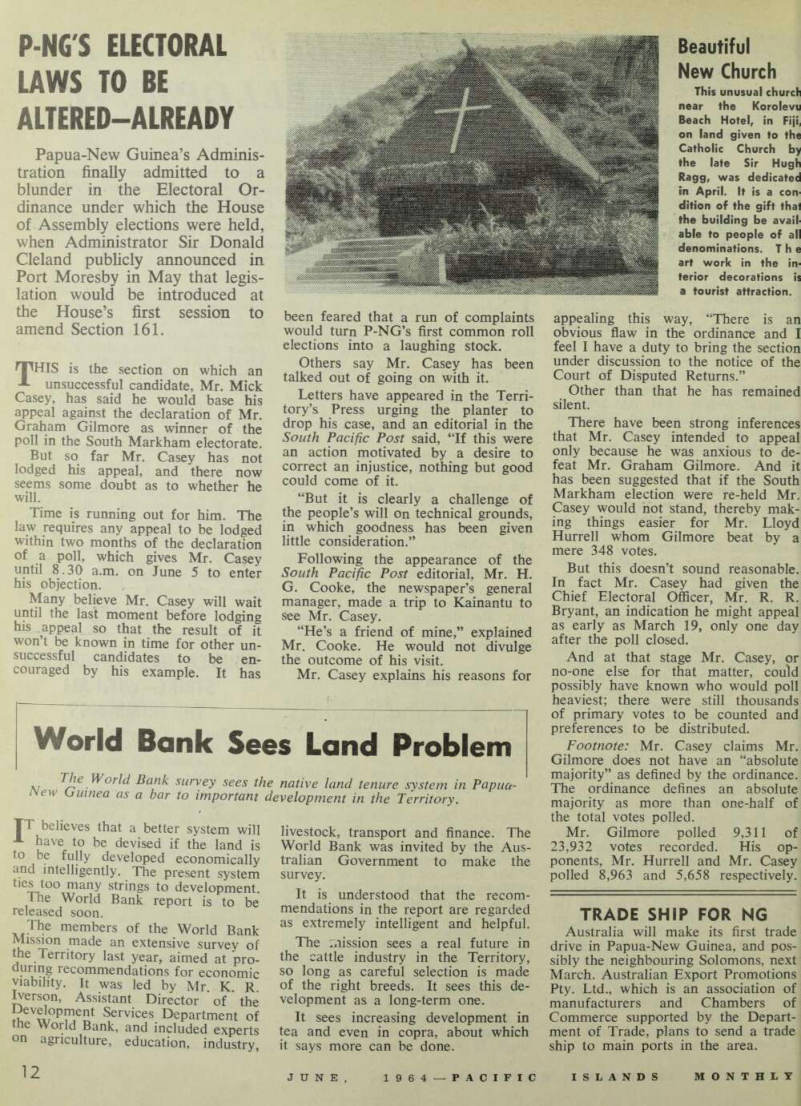
Beautiful
New Church
This unusual church near the Korolevu Beach Hotel, in Fiji, on land given to the Catholic Church by the late Sir Hugh Ragg, was dedicated in April. It is a con dition of the gift that the building be avail able to people of all denominations. The art work in the in terior decorations is a tourist attraction.