Talk
pp. 133-135 · Read in the full issue

Try Madang, New Guinea, For Tropical Lushness
Travel
"Pacific Islands Monthly" is a member of the Australian National Travel Association and the Pacific Area Travel Association.
Recent additions and improvements to the Madang Hotel, Madang, New Guinea, have made it one of the most up-to-date hotels in the Terri tory. And, if the tourist is seeking tropical lush ness, there is no other in the Territory to equal it in location.
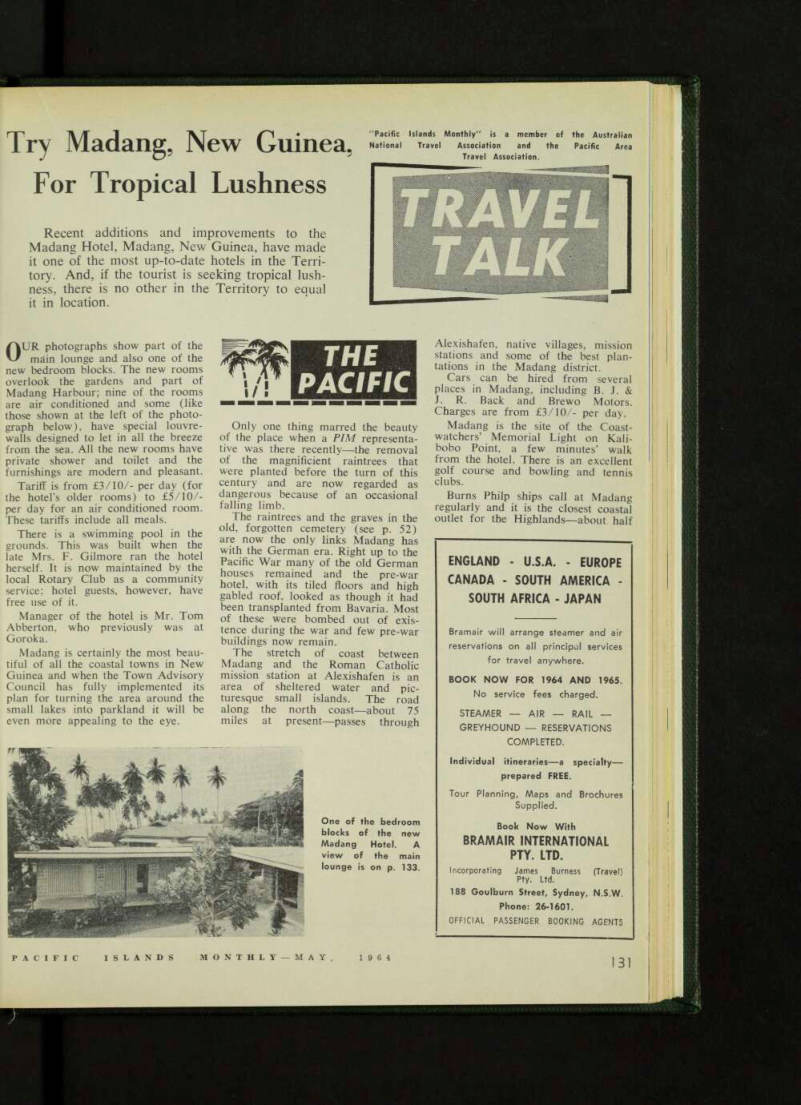
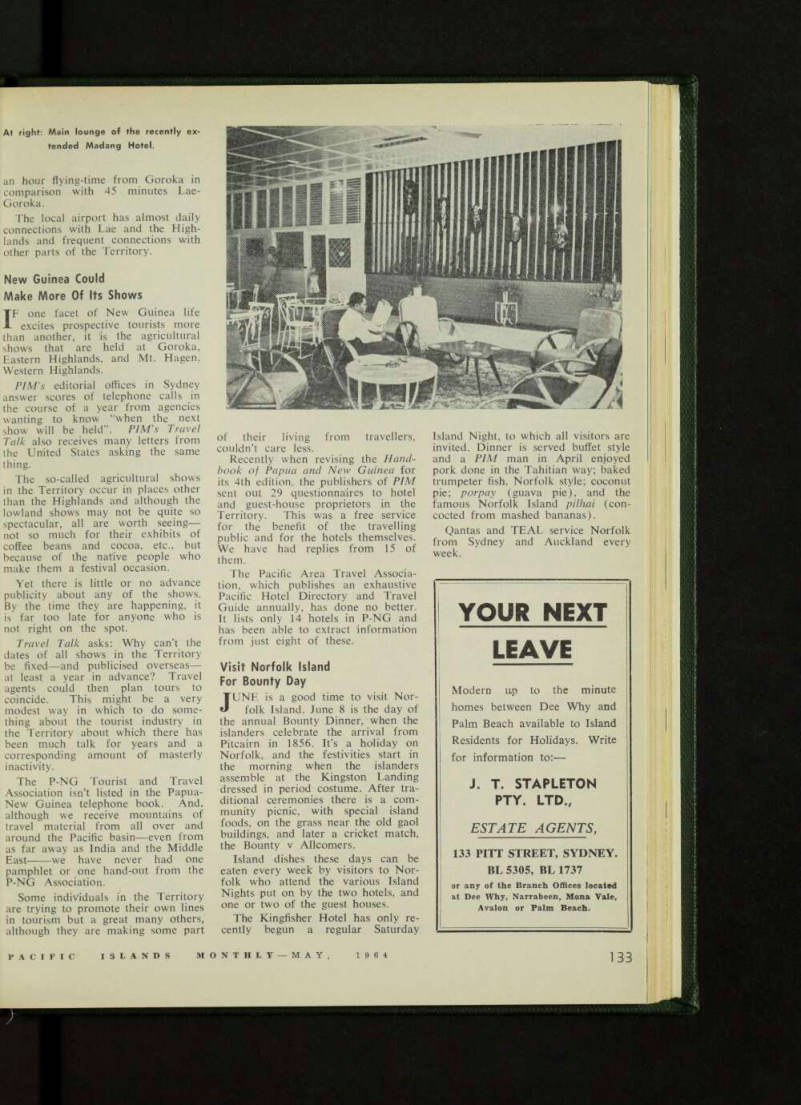
OUR photographs show part of the main lounge and also one of the new bedroom blocks. The new rooms overlook the gardens and part of Madang Harbour; nine of the rooms are air conditioned and some (like those shown at the left of the photo graph below), have special louvre walls designed to let in all the breeze from the sea. All the new rooms have private shower and toilet and the furnishings are modern and pleasant.
Tariff is from £3/10/- per day (for the hotel’s older rooms) to £5/10/per day for an air conditioned room.
These tariffs include all meals.
There is a swimming pool in the grounds. This was built when the late Mrs. F. Gilmore ran the hotel herself. It is now maintained by the local Rotary Club as a community service; hotel guests, however, have free use of it.
Manager of the hotel is Mr. Tom Abberton, who previously was at Goroka.
Madang is certainly the most beau tiful of all the coastal towns in New Guinea and when the Town Advisory Council has fully implemented its plan for turning the area around the small lakes into parkland it will be even more appealing to the eye.
Only one thing marred the beauty of the place when a PIM representa tive was there recently—the removal of the magnificient raintrees that were planted before the turn of this century and are now regarded as dangerous because of an occasional
falling limb.
The raintrees and the graves in the old, forgotten cemetery (see p. 52) are now the only links Madang has with the German era. Right up to the Pacific War many of the old German houses remained and the pre-war hotel, with its tiled floors and high gabled roof, looked as though it had been transplanted from Bavaria. Most of these were bombed out of exis tence during the war and few pre-war buildings now remain.
The stretch of coast between Madang and the Roman Catholic mission station at Alexishafen is an area of sheltered water and pic turesque small islands. The road along the north coast—about 75 miles at present—passes through
Alexishafen, native villages, mission stations and some of the best plan tations in the Madang district.
Cars can be hired from several places in Madang, including B. J. & J. R. Back and Brewo Motors.
Charges are from £3/10/- per day.
Madang is the site of the Coast watchers’ Memorial Light on Kali bobo Point, a few minutes’ walk from the hotel. There is an excellent golf course and bowling and tennis clubs.
Burns Philp ships call at Madang regularly and it is the closest coastal outlet for the Highlands—about half
One of the bedroom blocks of the new Madang Hotel. A view of the main lounge is on p. 133.
an hour flying-time from Goroka in comparison with 45 minutes Lae- Goroka.
The local airport has almost daily connections with Lae and the High lands and frequent connections with other parts of the Territory.
New Guinea Could Make More Of Its Shows IF one facet of New Guinea life excites prospective tourists more than another, it is the agricultural shows that are held at Goroka, Eastern Highlands, and Mt. Hagen, Western Highlands.
PlM’s editorial offices in Sydney answer scores of telephone calls in the course of a year from agencies wanting to know “when the next show will be held”. PlM’s Travel Talk also receives many letters from the United States asking the same thing.
The so-called agricultural shows in the Territory occur in places other than the Highlands and although the lowland shows may not be quite so spectacular, all are worth seeing— not so much for their exhibits of coffee beans and cocoa, etc., but because of the native people who make them a festival occasion.
Yet there is little or no advance publicity about any of the shows.
By the time they are happening, it is far too late for anyone who is not right on the spot.
Travel Talk asks: Why can’t the dates of all shows in the Territory be fixed —and publicised overseas— at least a year in advance? Travel agents could then plan tours to coincide. This might be a very modest way in which to do some thing about the tourist industry in the Territory about which there has been much talk for years and a corresponding amount of masterly inactivity.
The P-NG Tourist and Travel Association isn’t listed in the Papua- New Guinea telephone book. And, although we receive mountains of travel material from all over and around the Pacific basin —even from as far away as India and the Middle East we have never had one pamphlet or one hand-out from the P-NG Association.
Some individuals in the Territory are trying to promote their own lines in tourism but a great many others, although they are making some part
of their living from travellers, couldn’t care less.
Recently when revising the Hand book of Papua and New Guinea for its 4th edition, the publishers of PIM sent out 29 questionnaires to hotel and guest-house proprietors in the Territory. This was a free service for the benefit of the travelling public and for the hotels themselves.
We have had replies from 15 of them.
The Pacific Area Travel Associa tion, which publishes an exhaustive Pacific Hotel Directory and Travel Guide annually, has done no better.
It lists only 14 hotels in P-NG and has been able to extract information from just eight of these.
Visit Norfolk Island
For Bounty Day
JUNE is a good time to visit Nor folk Island. June 8 is the day of the annual Bounty Dinner, when the islanders celebrate the arrival from Pitcairn in 1856. It’s a holiday on Norfolk, and the festivities start in the morning when the islanders assemble at the Kingston Landing dressed in period costume. After tra ditional ceremonies there is a com munity picnic, with special island foods, on the grass near the old gaol buildings, and later a cricket match, the Bounty v Allcomers.
Island dishes these days can be eaten every week by visitors to Nor folk who attend the various Island Nights put on by the two hotels, and one or two of the guest houses.
The Kingfisher Hotel has only re cently begun a regular Saturday
Island Night, to which all visitors are invited. Dinner is served buffet style and a PIM man in April enjoyed pork done in the Tahitian way; baked trumpeter fish, Norfolk style; coconut pie; porpay (guava pie), and the famous Norfolk Island pilhai (con cocted from mashed bananas).
Qantas and TEAL service Norfolk from Sydney and Auckland every week.
At right: Main lounge of the recently ex tended Madang Hotel.