Pacific Commerce and Produce
pp. 123-124 · Read in the full issue
W. Samoa's First
National Loan
Oversubscribed
Western Samoa’s first national loan of £250,000, which closed on March 20, was oversubscribed by more than £92,000. An
nouncing this a few days later,
the country’s Minister of Finance, Mr. G. F. D. Betham, said this was a magnificent effort by the nation.
MR. BETHAM said schoolchildren, village and district committees, women’s committees, churches, public service and returned servicemen’s or ganisations, and many other institu tions had assisted in filling the loan.
He went on: “Our first national loan has been an unqualified success in every way, demonstrating above anything else that with unity and resolve, our progress as a nation is assured.”
Vote Of Confidence The UN regional director, Mr.
Harry Spence, said in a cable of congratulation that the “overwhelm ing success” of the loan verified the people’s determination to build as strong and progressive a country as possible.
It also represented a vote of con fidence in the Government’s leader ship, he said.
The loan was open for subscription for four weeks. At the end of the third week, less than half of the target total had been subscribed, and with only two days left, the total was only £129,510.
Even on the morning of the last day, nearly £35,000 was still needed to reach the target figure.
It was therefore not surprising that some pundits were confounded in predicting, before the loan closed, that it would be a failure. (See p. 45.) Subscribers to the loan will earn 5i per cent, interest on money lent for five years, and 5} per cent, on 10-year investments.
Securities are Western Samoa Government stock.
New Timber Project
For Fiji
Westralian Plywoods, A
large producer of plywood in Australia, plan to extend their opera tions to Fiji and build a sawmill on Vanua Levu capable of producing two and a half million super feet a year.
The Fijian landowners, whose tim ber will be used, will be given an equity shareholding in a company which has yet to be formed.
A pilot mill will open at Malau, the port of Labasa, and initially timber will be drawn from an area within a radius of about 20 miles.
Later timber will be taken from the main spine which runs down the middle of the island.
The company has made an exhaus tive ground and air reconnaissance of forests and has conducted in Aus tralia production and market accept ability tests of most of the commerci ally available timber species of Fiji.
It considers that much of Fiji’s tim ber is better than that which comes from South-East Asia.
The company, eventually, will em ploy about 450 Fiji people. As they become skilled in the operation of mechanised logging and sawmilling plant, expatriates will be phased out.
The venture pleased no one more than the Fiji Conservator of Forests, Mr. J. R. B. Angus, who has, for many years, been saying that timber could be built into one of the major industries in the Colony.
Bigger Nickel Output
In New Caledonia Expected
REPORTS from Paris in April said that Le Societe Nickel, which operates New Caledonia’s nickel mines and smelters, was considering tripling its output.
The reports said that extra plant would be installed at the smelters and that 15,000-ton ships would be used to carry ore from coastal ports to the smelters at Noumea. At present, 4,000-ton ships are used.
Electrical output at the Yate h> Jro-electric station was also to be increased, according to the reports, but it was not stated how this would be done.
PlM’s Noumea correspondent says that the recent drought has shown that, in a crisis, Yate cannot cope with present needs.
BSIP Timbers Found
Suitable For Paper Pulp
THE BSIP’s Chief Forestry Officer, Mr. K. W. Trenaman, said in March that many timber samples sent to Japan last year by the British Solomons Forestry Company had been found suitable for paper pulp production, Mr. Trenaman said that the suit able species included some local timbers, but full details of the tests had not been received.
Meanwhile, the BSIP Forestry De partment is establishing a forest nur sery at Gizo as part of the depart ment’s experimental work in the Eas tern District.
Seeds and plants are being intro duced from overseas, and collected locally. Trial plots of various species are to be planted at Gizo, Baga, Kolombangara, and later at other centres.
Each plot will be about one-tenth of an acre in size, but selected species which have shown particular promise will be planted in plots of an acre or more.
Carolines Tuna Project
Under Way Soon
THE MS Jaglaxmi, a 17,000-ton freighter chartered by the Van Camp Sea Foods Company, was ex pected at Palau, Caroline Islands, on April 11 with 610 tons of machinery and supplies for the company’s tuna project in the US Trust Territory.
Herbert Schuch, Van Camp con struction engineer, arrived in Palau recently to build a 1,500-ton fish storage freezer, ice-making machines,
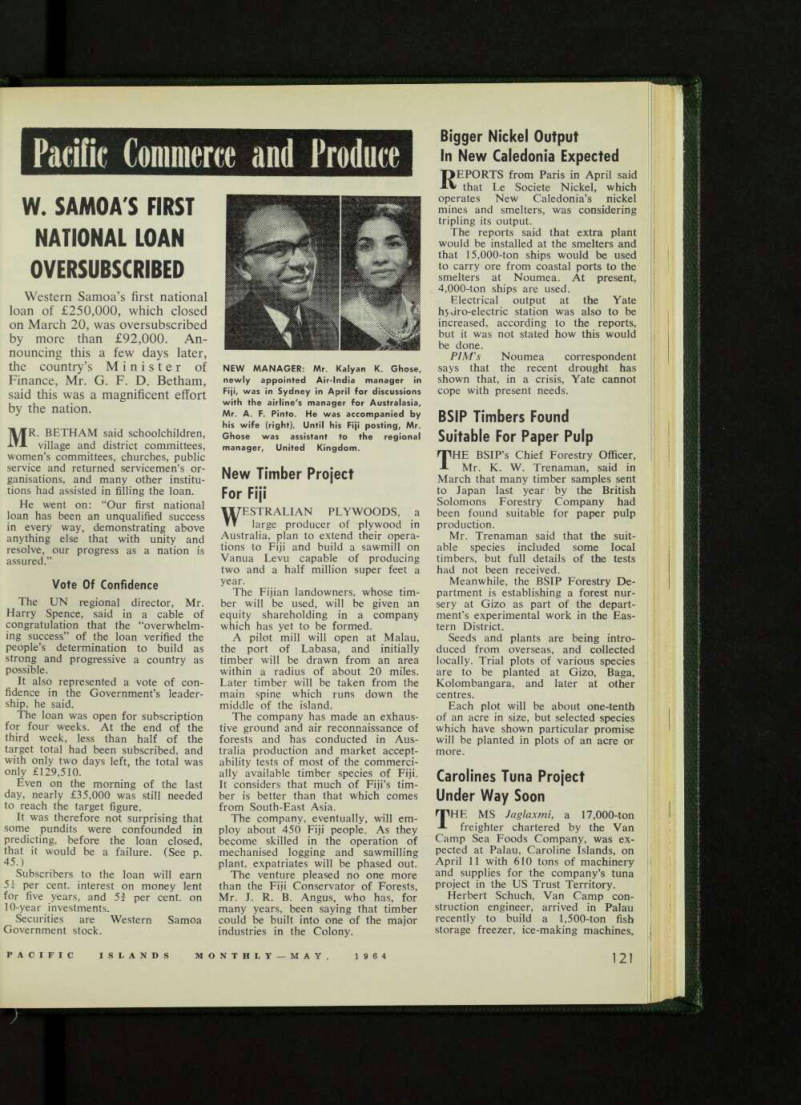
NEW MANAGER:Mr. Kalyan K. Ghose, newly appointed Air-lndia manager in Fiji, was in Sydney in April for discussions with the airline's manager for Australasia, Mr. A. F. Pinto. He was accompanied by his wife (right). Until his Fiji posting, Mr.
Ghose was assistant to the regional manager, United Kingdom.
water storage tanks, and offices for the project. The plant is expected to be fully operational by July 1.
Six 25-ton tuna boats will begin operating from Koror’s main port with 72 Okinawans and 48 Palauans as crew and fishermen.
Under the provisions of the con tract signed by the Trust Territory and Van Camp officials, Palauans or other Micronesians will be trained as tuna fisherman, with the ultimate goal that all boats will be manned by Micronesians.
The Van Camp company has been established in American Samoa since 1954.
Announcement Soon
On Vanikoro Operations
A REPORT from Honiara in April indicated that an announcement was expected soon about the opera tions on Vanikoro of the Kauri Timber Co. of Melbourne. It is ex pected that the Vanikoro operations will shortly cease.
The operations began there in 1924 and they have become probably the best known timber stands in the South Pacific. Vanikoro was operat ing when few others were. In recent years there has been renewed interest in the timber industry in other parts of the South Pacific, particularly New Guinea and the Solomons, due to Japanese investment.
Lord Howe Palm Crop
THE Lord Howe Island palm seed crop has been sufficient to fill orders placed for 1964 so far. In April, 600 bushells has been selected and packed ready for shipment to Australia on the Colorado del Mar.
Nail And Wire Factory
Opened In Fiji
Fiji’s first nail and barbed wire factory was officially opened re cently by the Development Commis sioner, Colonel W. B. Rogers.
It produces about 800 tons of barbed wire and nails a year, which is sufficient for Fiji’s needs.
The owners of the factory, Sydney Cooke (Fiji) Ltd., hope to establish an export market.
More Trade With NZ
TAHITI, Tonga, American Samoa, the New Hebrides and New Caledonia imported more goods from New Zealand in the 12 months ended June 30, 1963, than they did the previous year, according to “Export News”, a trade promotion publica tion of NZ’s Department of Indus tries and Commerce.
The publication says Fiji and Wes tern Samoa were the two largest cus tomers in the Pacific. Exports from New Zealand to Fiji for the year ended June, 1963, were worth £833,000 and exports to Western Samoa, £827,000.
Fruit, vegetables, frozen and canned meat and butter were princi pal items sent to Fiji. Milk powder, canned and frozen meat, cigarettes and soap made up the bulk of ex ports to Western Samoa.
P NG Loan For 1963-64
Fully Subscribed
Papua-New Guinea’S Trea
surer and Director of Finance, Mr. A. P. J. Newman, announced in April that the loan target of £1,700,000 for the current year had been achieved, and that this was “another demonstration of faith in the future of the Territory”.
Included in the loan moneys raised was £221,000 from subscriptions to premium securities, £28,000 from sales of savings certificates, and £1,451,000 from private negotiated loans.
The loan target for 1963-64 was £BOO,OOO higher than that set for the previous year, and because of this in creased total the field of private nego tiated loans had to be extended be yond the usual statutory bodies.
Especially gratifying was the response by banks and life assurance com panies operating in the Territory.
Some of the main subscribers in this new field were the Bank of New South Wales, the Commonwealth Savings Bank, and the Australasian
Temperance and General Mutual Life Assurance Society, each having sub scribed £200,000.
Mr, Newman added that premium securities and savings certificates would remain on sale, and proceeds of such sales would be held against next year’s loan programme.
New Companies Law
PAPUA-NEW GUINEA’S Secretary for Law, Mr. W. W. Watkins, announced recently that work was well in hand on the preparation of the necessary regulations and other subordinate legislation required to bring into effect the Companies Ordinance and associated ordinances passed by the Legislative Council last year.
The legislation is based on com parable uniform companies legisla tion in the Australian States and other Territories. Its purpose is to facilitate the operations of legitimate business and at the same time safe guard the investing public by strengthening the provisions to pre vent fraudulent and undesirable practices.
Mr. Watkins said it was hoped to have the legislation in force on July 1.