Cruising Yachts
pp. 97-111 · Read in the full issue
Pacific Shipping And Cruising Yachts
Nearly 100 Die In Fiji's
Worst Sea Disaster
Fiji suffered its worst maritime disaster on March 29 when the 2 3-ton auxiliary trading schooner Kadavulevu over turned in the Koro Sea. Only three people, of more than 90 on board, survived. The ship was licensed to carry only 29 people.
HE Kadavulevu disaster, coming immediately after the floods ich devastated Viti Levu, made it grim fortnight for the Colony.
Fhe Kadavulevu had sailed from va to the island of Nairai, in the maiviti Group, for a solevu ithering). Her passengers were im many parts of southern Viti vu - On her return voyage—of about miles—the ship left Nairai on the ming of March 29, expecting to ich Suva early next day.
Grossly overloaded and with little *go to act as ballast, the Kadavu- •u ran into trouble in heavy seas.
Some of the passengers, fearing for dr lives, pleaded with the master put into Gau Island till the seas re calmer.
But the master, no doubt confident it his craft could weather the irm, insisted on going on.
Just before midnight, the Kadavu- J u turned turtle. The passengers
in the holds were apparently drowned soon afterwards, Those thrown into the sea held on to the hull and floating debris, and hurriedly tried to build small rafts, Eventually, a fire broke out in the hull, forcing those holding on to it to seek other supports, No hint of the disaster reached Suva until April 1 when a message was broadcast at midday saying the schooner was overdue,
Barely Conscious
At 4.30 p . m . the same day, some Fijians cutting copra on Nasoata Island, at the mouth of the Rewa River, found a woman, barely con scious, lying on the shore, The woman, Seini Wakese, 43, was a ble to mumble to her rescuers something of what had happened, but her ordeal had been too great for her to tell a coherent story.
Next day, after hospital treatment, she had recovered sufficiently to say
that she and several others, including a grandchild, had drifted towards Viti Levu for two and a half days on a makeshift raft.
Her companions had been lost.
She, herself, had swum ashore at Nasoata Island after her raft had struck the reef near Naislai.
Only two other survivors were found when the search-rescue or ganisation made sweeps by sea and air from west of Beqa Island to east of Nasilai on April 2 and 3. They were clinging to a raft near Nasoata Island.
A body was also sighted from the air between Gau Island and Nasilai.
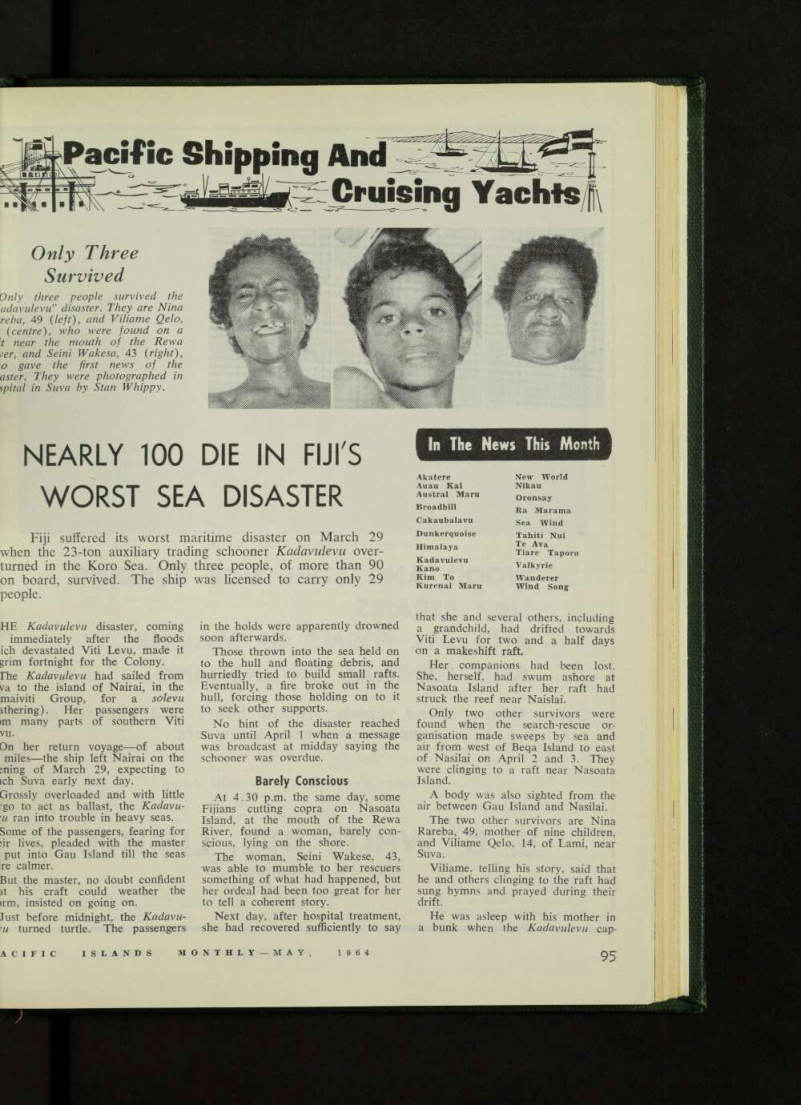
The two other survivors are Nina Rareba, 49, mother of nine children, and Viliame Qelo, 14, of Lami, near Suva.
Viliame. telling his story, said that he and others clinging to the raft had sung hymns and prayed during their drift.
He was asleep with his mother in a bunk when the Kadavulevu cap
Only Three
Survived
Only three people survived the [?]adavulevu” disaster. They are Nina reba, 49 (left), and Viliame Qelo, (centre), who were found on a [?]t near the mouth of the Rewa [?]er, and Seini Wakesa, 43 (right), [?]o gave the first news of the aster. They were photographed in [?]spital in Suva by Stan Whippy.
sed and his father was on the floor, le wind was very strong and there ;re a lot of high waves.
Viliame said he was very ightened when he surfaced. He iuld not find his parents and there as a lot of crying and screaming as ople called out for relatives and lends. In the turmoil he saw a raft ith people clinging to it so he swam it.
During the raft drift, he became ry thirsty and was always hungry, imetimes they came across a coco it which men on the raft husked ith their teeth. They ate the meat id drank the milk.
But as the drift went on, those i board weakened and let go one by
le. On Wednesday morning (April
i only he and Nina remained inging to the raft.
The two of them then climbed on the raft, but big waves frequently 'erturned it, throwing them off.
Several times that night they saw e lights of Suva, but they were o weak to direct the raft in that rection.
"Welcome Surprise"
“On Thursday (April 2) we were ing face down on the raft when iddenly something told me to look 3,” Viliame said. “When I did I ceived a very welcome surprise be mse there in front of me was the lot launch about three yards away.
“Nina and I became very dear to ich other in the three and a half ays we were together and I was tiling her ‘auntie’. When I saw the unch I called out: ‘Auntie, auntie, ;t up. A boat has come to rescue > .
Nina was too weak to get up and ad to be helped into the launch.
Nina said that two of her aughters, Lora, 14, and Vika, were ith her when the Kadavulevu cap zed.
“The wind was very strong and the ;as rough with a bright moon,” she tid. “An elderly couple travelling ith their grandson pleaded with the aptain to go to Qarani, Gau, and aelter till the weather abated.
“I was listening when the captain aid. ‘Everything is all right. We will et to Suva.’
“Soon after this the ship heeled ver, taking everyone by surprise.
Taere were a lot of children on oard and I could hear their cries a the night.
“I was separated from my daughters. At one stage Lora answered my call. I asked her about Vika and she said that she was safe on another raft.”
Nina did not see her daughters again.
Viliame and Nina, like Seini, were sent to hospital to recover.
Flying boats and small craft con tinued searching for survivors on April 2 and 3. All they found was wreckage and a piece of a raft bear ing the words, “Kadavulevu 11 pers”.
On April 3 the sea search was called off. but a land search along the coast of Viti Levu from the Rewa delta to Korolevu was continued.
Three life rafts, pieces of deck housing, a bundle of mats, damaged cushions and a pair of bleached khaki shorts bearing bloodstains were discovered.
The tragedy shocked Fiji. It brought into bold relief the age-old practice—which the authorities have vainly tried to control—of small ships sailing grossly overcrowded.
These ships often carry three or four times as many passengers as they are licensed to carry. Some skippers do it deliberately, some be cause they are frightened of re prisals if they turn someone down.
Sometimes the law is flouted right under the eyes of the Suva authori ties, who find it difficult to remove people from ships once they are on board.
More often, the ships sail at night with no more passengers than they are licensed to carry. Then, out in
the harbour, they pick up, by arrange ment, all who wish to join them, from rowing boats and the like.
On inward journeys, arrival times at Suva are generally fixed for the small hours when there is unlikely to be anybody about.
Another way of dodging authority on the inward journey is to unload passengers in Laucala Bay and then sail on to Prince’s Landing as though a legal number of passengers had been carried all the way.
Now, at last, a new attempt to control these practices seems likely.
Soon after the Kadavulevu disaster, the Government announced that Mr.
Justice Knox-Mawer, of the Supreme Court, would head a commission of three to inquire into the Colony’s legislation relating to the safety of ships.
The other commissioners are Mr.
C. D. Aidney, managing director of Williams and Gosling Ltd., import agents, etc., and Captain S. B. Brown, master and owner of the Maroro.
Both Mr. Aidney and Captan Brown have a close personal knowledge of
inter-island shipping.
The terms of reference are to consider: • The adequacy of the legislation of the Colony relating to the safety of vessels (other than foreign-going ships) normally voyaging within the waters of the Colony, and the crew, passengers and cargo of such vessels; and • The enforcement of the pro visions of such legislation.
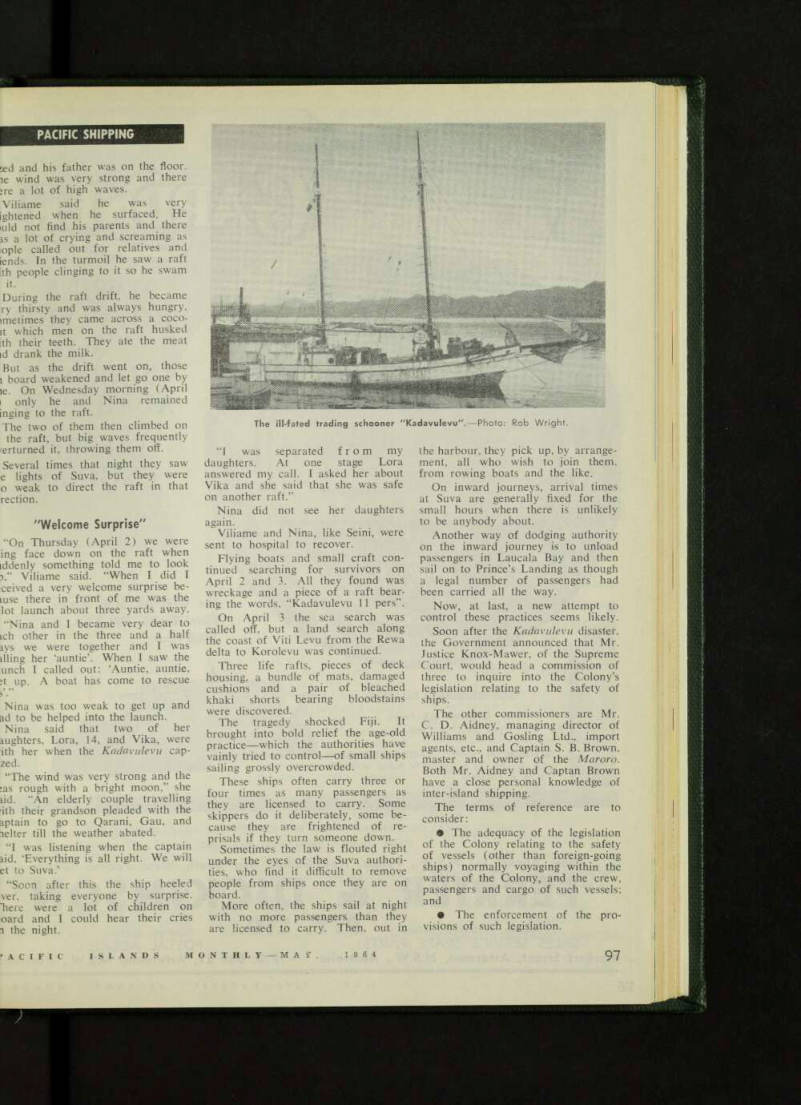
The ill-fated trading schooner "Kadavulevu".-Photo: Rob Wright.
\P Tuna Boat Lost
I New Caledonia
The Kurenai Maru, a 100-ton panese tuna fishing vessel, became total loss when she ran aground on mth-West Reef, at the extremity of oumea’s lagoon, on Good Friday, [arch 27. The vessel had been in rvice only a few months and was dued at £50,000.
She was the second tuna vessel to i lost in New Caledonian waters — ie first being lost last year on the jrthern reefs.
First news that the Kurenai Maru as in trouble came on the morning I Easter Saturday when the mari me authorities in Noumea received call for assistance. The French aval unit Dunkerquoise was imme iately sent to the scene with towing luipment and life boats.
Approaching from the sea side of ie reef, the naval captain saw at nee that any attempt to get the ves :l off the reef was hopeless, as she as hard and fast and following tides
were pushing her further up. Fifteen to 20 ft breakers did not help mat ters.
The Dunkerquoise’s captain there fore decided to take the crew off, but to do this, the rescue vessel had to re-enter the lagoon by a pass and then thread her way through a maze of coral heads to get within working distance of the wrecked ship. It took some three hours to accomplish this dangerous task.
Boats were launched and the cap tain of the Dunkerquoise, himself, went aboard, only to find that the Japanese captain refused to leave the vessel with his crew.
When Noumea was informed, offi cials of the fishing company operat ing the Japanese vessel advised the Japanese captain to comply with the naval man’s wishes. It then took nearly five hours to get the captain and his crew of 21 off the stricken vessel—the rescuers being hampered by heavy seas and a gale force wind.
Writing on April 1, PlM’s Noumea correspondent said an attempt was to be made to salvage the instru ments and other equipment.
Some 40 tons of fish, all the fish ing gear and a lot of other equipment had been thrown overboard in an attempt to lighten the Kurenai Maru as soon as she went aground.
Trading Schooner Held Up
The well-known Islands trading schooner Tiare Taporo, which was bought in Auckland in March by Mr.
W. B. Christophers, of Rotorua, was still in Auckland at the end of March because the New Zealand Marine De partment issued a writ preventing the vessel from sailing for Rarotonga until she had a qualified first mate.
Mr. Christophers protested against the writ, saying that the red tape was costing him £lOO in wharfage and wages a week. He added that most of the crew were able navigators and that the Department had not been so particular about a mate on other trips.
The Tiare Taporo previously be longed to A. B. Donald Ltd., who had the vessel built in 1913.
Jap Freighter For
P-Ng Timber Trade
A new Japanese freighter, which was specially-built for the timber trade between New Guinea and Japan, arrived in Rabaul on her maiden voyage on March 29.
She is the Austral Maru, 5,500
is, run by a Japanese firm, ny, a subsidiary of the Nitto Ship ig Line.
Mr. J. Shindo, NG manager of New linea Lumber Development Com ny Limited, and Rabaul representa e of Southern Trade and Industry, rs the Austral Mam marks a new ase in timber trade with Japan.
She is the first of four ships that athern Trade and Industry is hav ; built to handle increasing exports timber from New Guinea.
Fhe Austral Maru has heavy duty Ties instead of normal derricks for ing, and two long hatches and one ig hold. Mr. Shindo says these pro ions are necessary because of lack port facilities in the area where ging is going on, and because logs taken to Japan unsawn.
Hr. Shindo says Japanese timber rs are experimenting with all types New Guinea timbers to see if y are suitable for plywood furni- B-making and construction work, fhe Territory is exporting about > million super feet of timber a nth to Japan, worth about )0.000 a year. It plans to expand > to six million super feet a month the end of this year, eventually Japan will take at least million super feet a month, worth >ut £200,000 a month at present ;es. dr. Shindo says Japan is turning New Guinea for timber to ensure "eady supply as timber becomes der to get from the Philippines I Borneo.
H the end of March, 12 executives Japanese companies with interests Southern Trade and Industry were Rabaul surveying the progress of timber industry and checking on ire development. ( PIM, Mar. p.
Ie Survive Grim
Oeal In Papua
"he family of a man who was lost :r a canoe accident off the Papuan st over Easter left Port Moresby air early in April to live in Perth, he man, Donald Hamilton, was of 10 people who were in a ive canoe which capsized on a ing trip about 30 miles west of t Moresby, Light of the 10—five men and :e boys—were rescued by a US copter after drifting for 66 hours their overturned canoe. One of the s is Hamilton’s five-year-old son. laid, Jr. He was wrested from his ler’s arms when Hamilton jumped n the canoe in an attempt to swim ore.
The ninth survivor, Raymond Lewis, 32, of Bowen, Queensland, was found by natives on a reef after drifting 90 miles in 79 hours, first on an inflated rubber mattress, then on a petrol tin and finally on a log.
Hamilton left a widow and four children, the eldest of whom was Donald, Jr.
Besides this five-year-old boy, those rescued by helicopter are Frank Mol linger and his son John Pierre, 12, Carl Praunpsinger, 25, a German, single, Douglas Stewart, 33, married, and his brother Colin Stewart. 39, also married, both from Perth, Jack Quinn and his son Graham. 12.
Colin Stewart said in Port Moresby
General Hospital after being rescued that he and his party left Port Moresby about 3 p.m. on Good Friday to fish from Idia Island, about 30 miles west of Port Moresby.
Their canoe, which had twin 30 ft hulls, was driven by an outboard motor. It took in water all the way to the fishing grounds, but those on board were able to handle it by bailing.
Then it turned into a 5 ft swell and about 7.30 p.m. capsized in less than a minute when one hull filled.
Except for a plastic container con-
ining six pints of water and a cket of biscuits, all the food and iter was lost, and the motor was it out of action.
Next day, the canoe drifted within o miles of Fisherman’s Island, four iles from Port Moresby.
Ray Lewis decided to leave the noe on an inflatable mattress to ddle to Fisherman’s Island to get Ip, but was swept out to sea by a ong swell.
On the third day, the canoe started break up in the heavy ocean swell d the water ran dangerously low.
That night Donald Hamilton, Sr., iped overboard in an attempt to im ashore after those on board had estled with him to stop him taking boy.
Canoe Sighted
Fhe canoe was first sighted at ,10 a.m. on March 30 by Mr. vid Robertson, a pilot engaged by Department of Civil Aviation to ;e part in an aerial search for the loe in his Cessna. \ Department of Civil Aviation craft later dropped rafts, water and )d, then a US helicopter, from the )detic survey team at Port iresby, arrived, two and a half iirs after the first sighting. \fter winching down Sergeant Wil u Pearson to a liferaft on which party had assembled, the eight vivors were taken aboard and wn to Port Moresby.
Fhey were treated in the General spital for exposure, shock and sun •n.
Lewis, the ninth survivor, was lost dead when native fishermen m Kaparka village, about 60 miles
from Port Moresby, found him about 5 p.m. on March 31.
The Administration-chartered ves sel Kano brought him to Port Moresby next day, badly scarred and burnt by the sun.
Lewis said in Port Moresby that he had been delirious before his rescue.
He said that during his drift he had had to keep blowing up his rub ber mattress to keep it afloat. He abandoned it when it was finally holed and unable to support him.
For the next 10 hours he clung to a petrol tin, which he had taken with him for buoyancy and for use as a paddle. Then a log floated by and he dragged himself toward it.
Straddling the log he was able to have his first sleep for three days.
Lewis said sharks followed him all the time, but none troubled him.
On the night of March 29 he drifted close to a beacon marking the entrance to Port Moresby Harbour.
He paddled within 300 yards of it before he was exhausted and had to give up.
Lewis said he could remember little of the final hours of his ordeal, but that natives who found him had treated him “like a king”.
When Old Friends Meet
Captain J, H. (Frog) Evans, who retired last year from the post of Harbour Master at Madang, got to gether with an old and distinguished friend when he called at Kuala Lum pur recently on his way to Europe.
Frog Evans was an official in Malaya before he joined the P-NG service.
He arrived in Kuala Lumpur on February 8, the day that Tunku Abdul Rahman, Malaysia’s Prime Minister, was celebrating his birth day. Frog sent the Tunku warm greetings, because, 30 years ago, when the Tunku was District Officer at Kulim in the State of Kedal, the two men were friends.
Thereupon, the Tunku ordered Captain Evans to stay for a while; and, when all the diplomatic repre sentatives in the capital had as-
When you return from your holiday your home will be absolutely cockroach-free if you powder the floors before you go away. Pea Beu non-poisonous, odourless cockroach powder should be used because cock roaches will roam around in it unsuspectingly and be wiped out.
ptain Frog Evans and Tunku Abdul Rab in at the breaking of the Moslem fast.
See "When Old Friends Meet" below.
nbled at his birthday reception, he reduced Captain Evans as “my old end of 30 years standing, Frog ans, from the days when we were ung and gila”.
Gila is a Malay word meaning )lish; “but” says Captain Evans in lote to PIM, “he was never really dish, although when I first met n. he was a bit of a rebel”.
Fhe Tunku devoted an afternoon showing Frog new developments the State of Selangor and at Port ettenham —“amazing evidence of igress and expansion”, Fhen he insisted that his visitor >uld join him at the official break of the Moslem fast ( Bulan Pu- ) —see photograph, page 103.
The Tunku is a charming man 0 detests formality,” says Captain ans. “But, of course, he now is irded like a monarch. He com ined they will not allow him to ve a car—he is only 61”,
Jb For Skin Divers
Ixrted In Tahiti
Phe Polynesian Diving Centre mtre de Plongee de Polynesie), ose object is to popularise skin ing and under-water explora -1 among sportsmen and tourists in inch Polynesia, held its inaugural ing in Papeete Harbour on April fhe centre, or club, is under the action of Mr. Jean Pelissier, a Sessional diver and author of a tmical book on diving. Mr. Pelis ■ was one of the companions of ill id Eric de Bisschop on his raft age in Tahiti-Nui from Chile to cahanga (Cook Islands) several rs ago. dr. Pelissier is assisted by a chief nitor (chef moniteur), Gerard olini, and two Tahitians, who are ilified skin-divers. The club has a nch, Te Ava, for the use of divers, ing and photographic equipment ivailable on loan.
'he annual subscription to the club 150 francs. Insurance costs 1,000 ics and 600 francs are charged for h diving outing. Visitors are rged 750 francs for each outing 1 100 francs for insurance. (The hange rate is approximately 200 ics to the £ Australian.)
Hing Boat Wrecked
hoadbill, an Hawaii-based fishing sel under the command of Captain rry English, broke its moorings at ia in rough weather on March 28, I a week later was still lying lost wholly submerged on the reef
100 yards in front of Vaisigano. The ship had been battered by heavy seas and appeared to be a total wreck.
Captain English had a licence to supply fish to Apia businessman Hans Keil, but with subsequent poor catches the agreement was termin ated. The vessel had been moored in the harbour for several months.
Lautoka's Importance Grows
Lautoka, Fiji, is developing as a port of some importance. Apart from shipping out all Fiji’s gold and
the major part of the sugar crop, it is now starting to cater for the liners.
Already two big liners have called there, without difficulty, and now it may go on to the regular Pacific schedule for P and O-Orient liners.
Now Union Steam Ship Co., Fiji agents for P and O-Orient, have an nounced that the Oronsay will call there in January, 1966, on a north bound voyage from Sydney. (Over)
Aster Made Error Of
Idgment
Jovilisi Vuki, master of the Ra arama, made an error of judgment len he was navigating a passage Ono-i-Lau, Fiji, on November 15, 63, and struck the reef. This was ; finding of a formal court which luired into the stranding.
The court, presided over by a igistrate, Mr. Mod Tikaram, who is assisted by Captains A. S. Lewis d S. B. Brown, as assessors, jtioned Jovilisi, but did not cancel suspend his certificate of com tency. Mr, Tikaram told Jovilisi it the ship, when he was in charge, s always his responsibility. He i to make the decisions, as master.
Die court formally found that re was only superficial damage to Ra Marama; Jovilisi was not in npetent generally in his navigation 1 handling of the ship; Jovilisi was Ity of a wrongful act as he did : use all the power available to a; and a contributing factor was strong current at the time.
Nk By A
Conut Tree
fhe Fiji inter-island trading ship, kaubalavu, 27i tons gross, sank in Wainibokasi River on April 11
after striking a submerged coconut tree.
The ship was travelling at half speed when she hit the log head on.
The pumps were put into action im mediately, but within 10 minutes the rising water covered them and they were useless.
The three passengers and crew of six rowed to the river bank about 20 ft. away. Some of the cargo was saved, but much of it was below decks and had to be left there.
The owner, Mr. Shiu Narayan, of Tailevu, was on board at the time.
The master was Taniela Keva, from the small island of Ono-i-Lau.
The Cakaubalavu was in the news in April, just after the Kadavulevu disaster. She was then said to be six hours overdue on a voyage be tween Suva and Wainunu. However, after the search-rescue organisation had been alerted, she was found at Nabouwalu at the western end of Vanua Levu. She put in there be cause of engine trouble.
"Conflict Of Interests"
In Geic Shipping
An apparent conflict of interests must be resolved before deciding which shipping service to the Gilberts should be encouraged, according to
Captain G. Douglas, Marine Super intendent in the GEIC.
Captain Douglas, in a review of the Colony’s shipping communica tions, says that for many years Tarawa has been out on a limb as far as sea and air links are con cerned.
Captain Douglas says now that a scheduled commercial air service is in sight, the pattern of sea communi cations is also changing.
In the past there were two main lines of external shipping communi cations: • Through Suva by GEIC ships on their way to and from refits, and by Bank Line ships calling to load copra for the United Kingdom. • By British Phosphate Commis sion ships between Ocean Island and Melbourne.
Captain Douglas says that the Suva line of communication enabled Fiji produce, mainly sugar, to be shipped to the GEIC, plus UK cargo transshipped at Suva.
Although that is a comparatively economical method of obtaining the cargo, the infrequency of the service precludes the dispatch of all cargo from the UK that way, while the
lack of a back load means that it is uneconomic to send ships to Suva for cargo alone.
The more generally used line of communication —by British Phos phate Commission ships—lands cargo from Australia and the UK (trans shipped at Melbourne) at Ocean Is land where it is collected by GEIC ships.
But again there is no backload, and the constant ferrying of cargo from Ocean Island to Tarawa occu pies a great deal of shipping time which the small Colony fleet can ill afford. In addition, the breakages in volved in the double handling of goods are serious.
Captain Douglas says that a few times, when the quantity of cargo available for a single shipment from Australia reached about 1,000 tons, the British Phosphate Commissioners agreed to divert one of their ships to discharge this at Tarawa, and it was clear that, as far as the GEIC was concerned, this was an attractive and economic proposition.
So inquiries were set in train to find a shipping firm which would be
prepared to load in Australia for discharge at Tarawa.
It was thought that the British Phosphate Commisioners would be in a position to offer favourable terms, as they would be assured of a backloading of phosphate from Ocean Island or Nauru.
However, the Colony Wholesale Society, through its Australian agents, entered into negotiations with the Karlander Line, which led to the inception of a service with sailings about every six weeks. Melbourne and Tarawa are the terminal ports on this service and calls are made at ports in Papua and the BSIP.
“At the start of the negotiations it appeared fairly certain that this ser vice could be assured of about 600 tons of Colony cargo every six weeks,” Captain Douglas says.
“However, the situation became complicated by the fact that, at the same time, an offer was received from certain Dutch shipping interests to nrovide a sailing every two months or so from the United Kingdom and the Continent, for discharge at Tarawa.
“But to provide this service with an economical pay load meant that virtually all cargo of United King dom origin should be shipped by it, and to do this meant reducing the quantity of United Kingdom trans shipment cargo available in Mel bourne for the Karlander service, “It thus appears that it may not be possible to offer sufficient induce ment for both services, but it is not easy to decide which service is the
more beneficial to the Colony as a whole.
“The pattern, somewhat simplified, is that the bulk of cargo for the Government comes from the United Kingdom, while that for the Colony Wholesale Society comes from Aus tralia.
“There is thus an apparent conflict of interests which must be resolved in deciding which service to en courage, and the solution must take account, not merely for the im mediate effect on costs of supplies, but also on the more far-reaching effects on the overall economy of the Colony.”
Talks On Air-Sea
Rescue Held In Suva
The Governor of American Samoa, Mr. H. Rex Lee, and the Com mander of the United States 14th Coastguard District, Rear-Admiral Christopher Knapp, had talks in Suva in April on air-sea rescue arrange ments with representatives of the Fiji Government and the Royal New Zealand Air Force.
The United States was also repre sented by the American Consul in Suva, Mr. George Gray, and Captain Crosby of the Coastguard Service.
In the past, search and rescue in the South-West Pacific has fallen mainly on the RNZAF Sunderland flying boats based at Laucala Bay, but these aircraft are soon to be replaced by land-based Orions.
The US Coastguard Service pro poses to base a fast 90-ft. rescue cutter at Pago Pago.
TIME FOR REFLECTIONS or something like that seems the right sort of title for this picture, taken in Rabaul recently, of the liner "Himalaya" with a native out rigger in the foreground. The "Himalaya" was in Rabaul for 10 hours in the course of a cruise to Japan, Hong Kong and Manila.—Photo: C. H. Meen.