Indonesia’S Intoxicated Visions
pp. 91-92 · Read in the full issue
The Month's New Reading
Menace The South Pacific
With Jud> Tudor
Most people probably regard Soekarno, President of Indonesia, as a combination of toy dictator, playboy and poseur, with a potential nuisance value in the East Indies that is immeasurable. He is a good deal more than that. He is a very clever politician, and he is influenced by powerful anti-West forces which play on his inordinate vanity, and he is motivated by Napoleonic dreams.
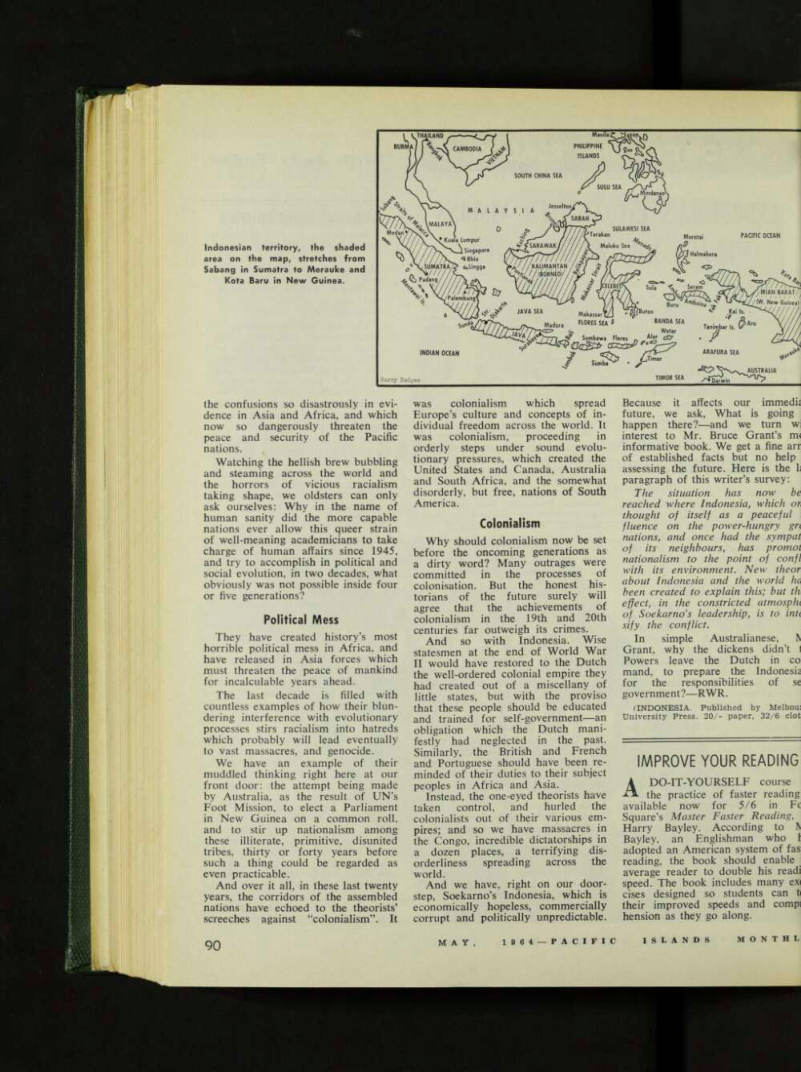
AKE a look at the map of the East Indies-Southeast Asia area, is inhabited predominantly b> aple of the Malay race, and here ; their numbers; A pproximately millions Indonesia 100 Malaysia (excluding Singa pore), including Sarawak, Sabah 12 3 hilippines 30 Singapore (Chinese) and West w Guinea (Melanesians) are not luded because they are not of Malay race; but they bulk largely the dreams of Soekarno, and they ether represent some three million >ple.
Indonesian Empire
Beyond any doubt, Soekarno en ages an Indonesian Empire, ex ding over all those territories, at would provide him with a mtry of about 150 million people ich. in point of population, would the world’s fifth biggest nation, ;t to China, India, Russia and the ited States. fhat is an intoxicating vision. Is it f wonder that Soekarno reacted h such fury to the British plan for creation of Malaysia? Malaysia, nprising Malaya, Singapore, Sara k and Sabah, not only cuts off In lesia from her related race in the ilippines, but also imposes a clear . non-Indonesian political barrier ween Indonesia and her ideolo al friends in Southeast Asia.
Britain, supported by United States, in that barrier deliberately to tect the European nations of the ith Pacific, especially Australia I New Zealand, against the south ■ds thrust of Asian Communism, the same time, it destroyed Soe no’s Napoleonic dream of an onesian empire. Hence, the “con-
frontation” mischief along the Borneo frontier with Sarawak and Sabah, and a threat of continuing trouble there.
Inevitably, while Soekarno leads Indonesia, there is danger of conflict between Indonesia and the British nations who are pledged to protect Malaysia. Inevitably, conflict with Britain means war, or something very close to it, along the frontier between Irian Barat (Soekarno’s new name for West New Guinea) and Austra lian New Guinea.
Thus, Soekarno and all his works, present and future, are of direct in terest to all the peoples of the South Pacific.
What is the history and back ground of this very new and quite unpredictable Indonesian Republic, and what makes Soekarno tick?
Could this tinsel dictator and would be Napoleon be a threat to our peace and security? He could.
New, Valuable Book A new and valuable book, Indonesia, written by Australian his torian Bruce Grant, and just pub lished by Melbourne University Press, provides something that hitherto has been strangely lacking.
Here we have the history of the hotch-potch of States that now is called the Republic of Indonesia, and some indication of what it really is now and what is likely to happen to it. It is the work of a careful and skilled researcher, and it supplies a need that, in view of what now is happening on our northwest frontiers, is becoming clamant.
The author has given the history
of Indonesia in its three clearly defined phases—namely, the pre- European period, when Borneo and the surrounding archipelagoes were merely a group of non-homogeneous little States; the European period, which covers the 350 years of Dutch rule, when this vast region was brought under one administration and generally known as the Dutch East Indies; and the period since 1941, when the Japanese occupation sup pressed Dutch rule and allowed a small group of anti-Dutch rebels to get control of the main island (Java).
The author’s alignment of his torical facts is excellent, especially in its coverage of the very complex his tory of the third phase, and this should be of great help to present and future students.
But his presentation of the facts is coloured by his personal pre judices. He claims that his views are neutral and unbiased; but his writing —and he is an able writer—gives the impression that he is anti-colonial, anti-Dutch and, in some degree, anti-British. His book suggests that be belongs to the school of thinkers that, since 1945, has sent the well ordered Western world hurtling into
the confusions so disastrously in evi dence in Asia and Africa, and which now so dangerously threaten the peace and security of the Pacific nations.
Watching the hellish brew bubbling and steaming across the world and the horrors of vicious racialism taking shape, we oldsters can only ask ourselves: Why in the name of human sanity did the more capable nations ever allow this queer strain of well-meaning academicians to take charge of human affairs since 1945, and try to accomplish in political and social evolution, in two decades, what obviously was not possible inside four or five generations?
Political Mess They have created history’s most horrible political mess in Africa, and have released in Asia forces which must threaten the peace of mankind for incalculable years ahead.
The last decade is filled with countless examples of how their blun dering interference with evolutionary processes stirs racialism into hatreds which probably will lead eventually to vast massacres, and genocide.
We have an example of their muddled thinking right here at our front door: the attempt being made by Australia, as the result of UN’s Foot Mission, to elect a Parliament in New Guinea on a common roll, and to stir up nationalism among these illiterate, primitive, disunited tribes, thirty or forty years before such a thing could be regarded as even practicable.
And over it all, in these last twenty years, the corridors of the assembled nations have echoed to the theorists’ screeches against “colonialism”. It
was colonialism which spread Europe’s culture and concepts of in dividual freedom across the world. It was colonialism, proceeding in orderly steps under sound evolu tionary pressures, which created the United States and Canada, Australia and South Africa, and the somewhat disorderly, but free, nations of South America.
Colonialism Why should colonialism now be set before the oncoming generations as a dirty word? Many outrages were committed in the processes of colonisation. But the honest his torians of the future surely will agree that the achievements of colonialism in the 19th and 20th centuries far outweigh its crimes.
And so with Indonesia. Wise statesmen at the end of World War II would have restored to the Dutch the well-ordered colonial empire they had created out of a miscellany of little states, but with the proviso that these people should be educated and trained for self-government—an obligation which the Dutch mani festly had neglected in the past.
Similarly, the British and French and Portuguese should have been re minded of their duties to their subject peoples in Africa and Asia.
Instead, the one-eyed theorists have taken control, and hurled the colonialists out of their various em pires; and so we have massacres in the Congo, incredible dictatorships in a dozen places, a terrifying dis orderliness spreading across the world.
And we have, right on our door step, Soekarno’s Indonesia, which is economically hopeless, commercially corrupt and politically unpredictable.
Because it affects our immedh future, we ask, What is going happen there? —and we turn wi interest to ftlr. Bruce Grant’s m< informative book. We get a fine arr of established facts but no help assessing the future. Here is the li paragraph of this writer’s survey: The situation has now be reached where Indonesia, which on thought of itself as a peaceful fluence on the power-hungry gn nations, and once had the sympat of its neighbours, has promot nationalism to the point of confl with its environment. New theor about Indonesia and the world ha been created to explain this; but th effect, in the constricted atmosphi of Soekarno’s leadership, is to inti sify the conflict.
In simple Australianese, ft Grant, why the dickens didn’t 1 Powers leave the Dutch in co mand, to prepare the Indonesia for the responsibilities of se government?—RWß. (INDONESIA. Published by Melbouj University Press. 20/- paper, 32/6 clot
Indonesian territory, the shaded area on the map, stretches from Sabang in Sumatra to Merauke and Kota Baru in New Guinea.