Magazine Section
pp. 79-82 · Read in the full issue

Pacific Islands Monthly
III-Fated "Melanesian"
Brought A New Spirit To The Solomons
By D. M. THORSEN, Formerly Port Officer at Honiara
When the RCS Melanesian anchored in the roads of Honiara, Guadalcanal, on December 1, 1956, after her maiden voyage from her Kowloon builders’ yard, she was already a legend within the Solomon Group.
DOR a long time the scattered v population of these Islands had icard about this ship by radio, Dis rict news-sheet and “bush telegraph”, myone who travelled in the Gov rnment vessels, or was concerned nth the transport of passengers, mail r cargo by water, looked forward to er coming.
By the nature and extent of this erritory—lo large islands or clusters f islands and hundreds of smallei nes lying in a broken double chain 00 miles long and enclosing an cean area of about 205,000 square files —inter-island water transport 'as a major problem—and especially d in 1956.
Of course, there were several hundred privately-owned auxiliary vessels working in the Group, but when the headquarters of the Western Pacific High Commission moved from Suva to Honiara in 1953 it was necessary for the Government to operate its own fleet to maintain in ternal communications.
Until now they had attempted this task with a dozen small craft of all shapes and sizes built on local slip ways and in the boatyards of Aus tralia and New Zealand. Only three of these could carry 70 tons of copra and none could sleep more than three European passengers. Boat ser
vices were quite inadequate.
And even the best of them was quite unsuitable for the High Com missioner’s touring programme, which called for regular visits to the four local districts, 14-day trips to the New Hebrides and 2,000-mile voyages to Tarawa, in the Gilbert Islands, By contrast to the wooden vessels of the Marine Department’s fleet, the new Melanesian was a steel ship— and a shapely one.
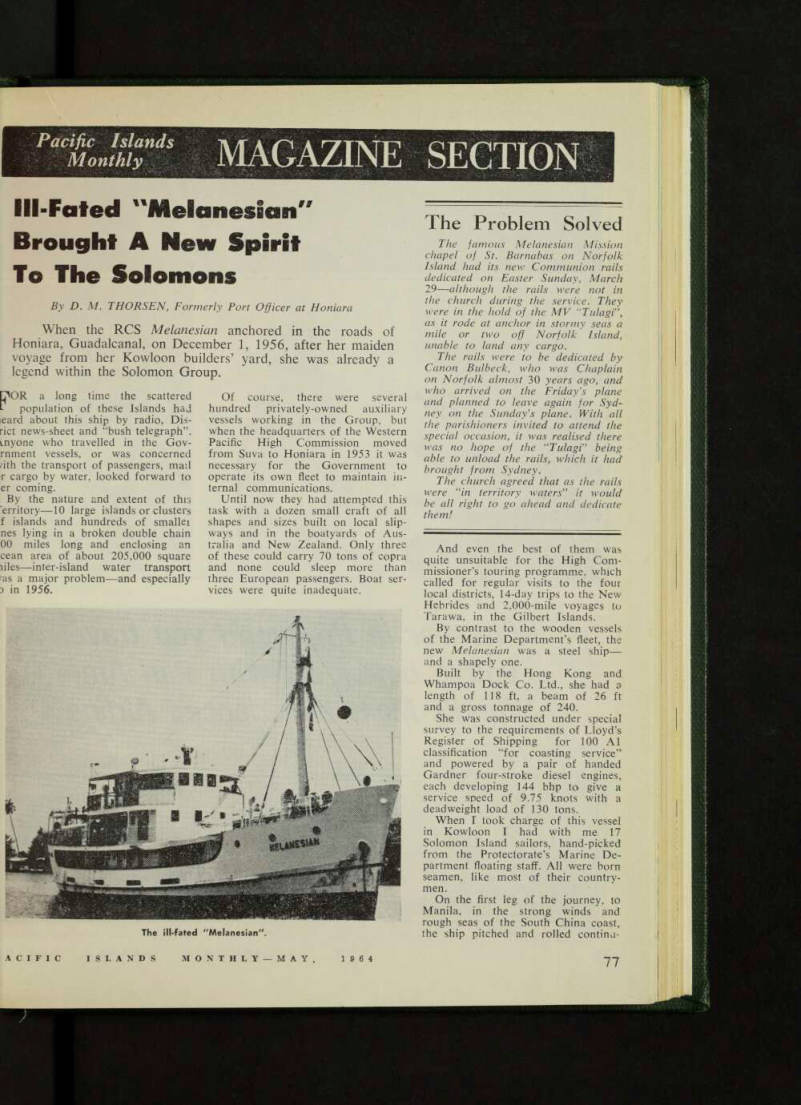
Built by the Hong Kong and Whampoa Dock Co. Ltd., she had o length of 118 ft, a beam of 26 ft and a gross tonnage of 240.
She was constructed under special survey to the requirements of Lloyd’s Register of Shipping for 100 A 1 classification “for coasting service” and powered by a pair of handed Gardner four-stroke diesel engines, each developing 144 bhp to give a service speed of 9.75 knots with a deadweight load of 130 tons.
When I took charge of this vessel in Kowloon I had with me 17 Solomon Island sailors, hand-picked from the Protectorate’s Marine De partment floating staff. All were born seamen, like most of their country men.
On the first leg of the journey, to Manila, in the strong winds and rough seas of the South China coast, the ship pitched and rolled continu-
The ill-fated "Melanesian".
isly. But the cargo of 60 tons of gged cement in the hold made ex llent ballast.
The steering was unsatisfactory and len we arrived in Manila, Lloyd’s rvey was consulted and it was de led to make a “skeg” (a flat plate tween the propellers to reduce rbulence) in Kowloon and ship it the Philippines for fitting on a pway there.
When the skeg had been fitted and ; barnacles scraped we were all id to resume the voyage and lamed across the eastern part of the Jebes and Molucca Seas in perfect sather, making over 10.5 knots for 0 successive days.
The steering was very much im aved but on this stretch it was jnd that one of the quarter isters could not read and had vays steered by the large and small irks on the compass-card! He was ight his numbers by the officers.
We called at Sorong, in the former ritory of Dutch New Guinea, at ik Is., in the same green primitive Lintry, and at Hollandia to ship ?plies for the final passage.
We were welcomed to home waters the District Commissioner at zo, and covering the last 220 miles Honiara in an easy day’s run, :hored off Point Cruz just two mths after our departure from mg Kong.
A Familiar Sight There was a warm welcome for ; fine new ship that would solve all r marine problems.
The job of master of the Mel ’sian had been widely advertised, 1 Captain J. Davies, who had pre usly been in command of coasting :sels around New Guinea, took ;r from me. \fter an engine overhaul, his ship s soon trading throughout the inds on the first scheduled run de by any Government vessel re.
The little white ship became a ailiar sight in a hundred lagoons 1 anchorages from the Shortlands Vanikoro. >he made occasional trips to haul and took the High Com ssioner and his entourage in com t to Vila, New Hebrides, and to rawa. she rested between voyages at lagi’s wooden wharf and watered the crystal spring in Mboli ssage.
Everyone who used the vessel, for mselves or the carriage of goods vehicles, was happy about her per-
formance. Captain Davies soon be came conversant with the dangers of inter-island navigation in this group and the vagaries of local tides and currents.
Landing on the beaches of tiny settlements without a wharf was no problem for passengers who were content to be carried ashore through the surf from a motor-boat. Travel ling priests said their masses happily from an altar which did not roll over.
It soon seemed that the coming of Melanesian had prospered the main business of the Colony, and in the scattered plantations the tall palms sang softly and bore their rich harvest in season.
Those who had previously travelled precariously and alone in the tiny cabins of the launches and ketches now found themselves sharing the comfort of deckchairs on a boat-deck, under awnings. Served with well-
cooked meals by a steward at the table of the neat saloon, men and women about their business talked of the things that lay nearest their hearts and came to a closer under standing of each other’s problems.
Bishop Alfred Hill, urbane in tropical grey, with a neat gold crucifix on his purple vest, told of the self supporting Mission schools he’d founded on Ugi Is., and at Pawa, San Christobal, 10 years previously.
Police Chief T. A. Handford, im maculate in khaki drill, with silver peaked cap and ebony swagger-stick, pondered the problems of criminal lunatics in distant regions staffed only by a single native sergeant.
Sister Mary Joseph, MBE, white habited head of the Government leprosarium (the Angel of Tetere, they called her), spoke vividly of her current expedition to a trackless bush village to seek out the marked and forgotten ones, whom no one else seemed to want.
John Grover, the Colony’s Chief Geologist, expounded the secrets of the rocks and the volcanic belt in this part of the Great Ocean.
Dr. De Beaux recounted tales of amputations following crocodile bites along the rivers, without benefit of anaesthetics.
Mr. Brown, of Agricultural re search, with his ladder folded away in the hold below, hoped to find some new entomological specimen for the British Museum on this trip to a blight-infected plantation.
Tragedy Strikes
These folk lived for their work and served the needs of the people in the way they knew best. Like others who had come and gone before them, they, too, had heard the sound of music in the trade winds.
Then tragedy struck. On the morn ing of July 9, 1958 Melanesian sailed from Suulafu, on the south-west coast of Malaita, for Sikaiana, in the Stewart Islands, 90 miles away.
She had 64 people on board, in cluding seven passengers, as well as a quantity of cargo and mail.
The weather was overcast with a moderate north-easterly breeze and a short, sharp sea. Captain Davies had
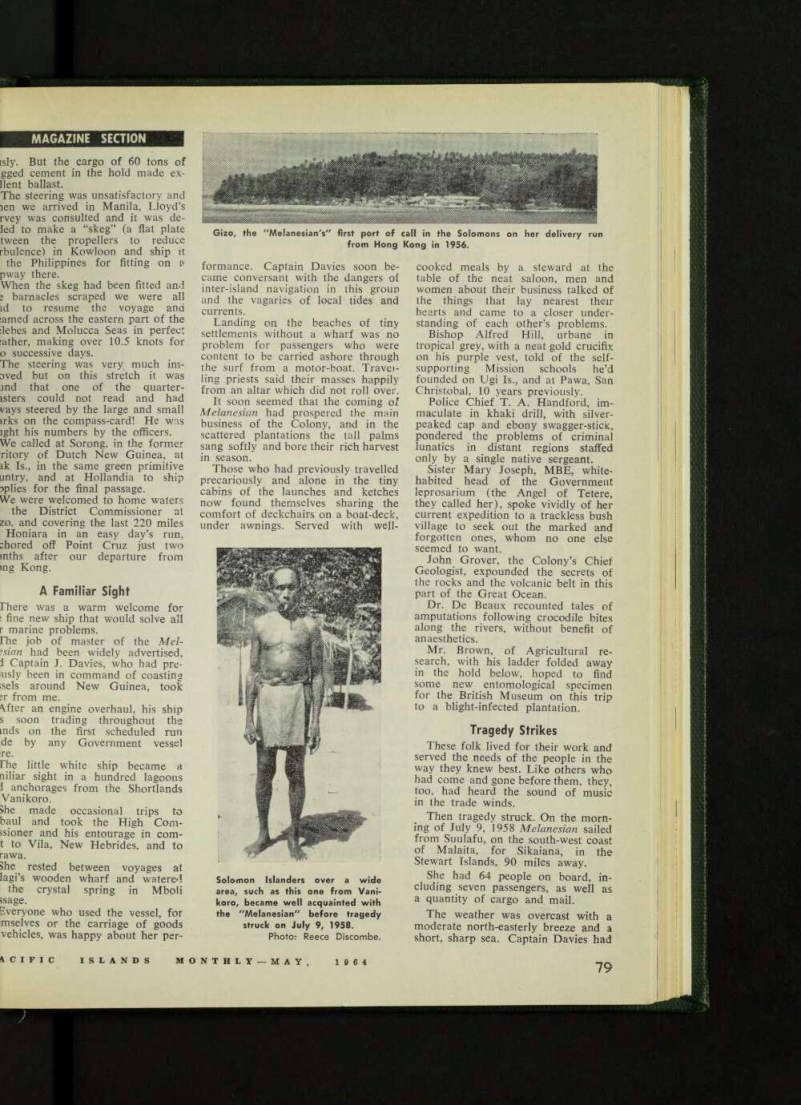
Gizo, the "Melanesian's" first port of call in the Solomons on her delivery run from Hong Kong in 1956.
Solomon Islanders over a wide area, such as this one from Vani koro, became well acquainted with the "Melanesian" before tragedy struck on July 9, 1958.
Photo: Reece Discombe.
made this trip before and expected tc make his landfall about 5 p.m.
In the afternoon radio schedule ht told the Marine Office that he was 25 miles west of his destination a three o’clock. Soon afterwards he be gan to scan the horizon with hi; glasses for the first sign of tree-tops It was his custom to approach witl caution and after identifying the isle of Sikaiana, to make his anchoragi before dark and wait for first ligh next morning to transfer passenger and mail.
He had an alternative radio fre quency for use with Radio Honiar; after post office hours, but no on l was at all worried when he didn’ come on the air again that night.
But next morning, when Melanesiai didn’t answer her name when it wa called in the alphabetical list of smai ships on the 9 o’clock schedule, th Marine Superintendent phoned th Chief Secretary suggesting that al vessels in the vicinity be asked t search the area.
Search Begins
A couple of Mission boats on th coast of Malaita, some Chinese trad ing schooners bound from Sa Christobal, and several Governmer vessels which could be diverted fror their current assignments slowly a: sembled near the spot where the guessed Melanesian’s last message ha come from.
A Qantas aircraft, which linke the Solomons with New Guinea an Australia each week, took off with volunteer party of 10 observers froi the townsfolk of Honiara, and mad a six-hour search at palm-tree heigl over the beaches of lower Malail and Ulawa Islands, and over the se within a hundred miles of th Stewart Islands.
Some days later the bosun’s bod was found with pieces of flotsan But there was nothing else. After week the search was abandoned. Tf combined churches of Honiara he! a memorial service for the 64 peop who were lost.
When the Commission of Inquii was convened and took all the evi< ence, it was unable to point oi any probable cause of the ship’s di appearance.
Here was another riddle without a answer.
Today there is a new beacon-lig] for the dangerous reefs at Rua Sur on the small ships’ eastern passag and by that the people will rememb. their comrades and the ship th brought a new atmosphere to tl Solomons.