Dwindling Fast
pp. 59-61 · Read in the full issue
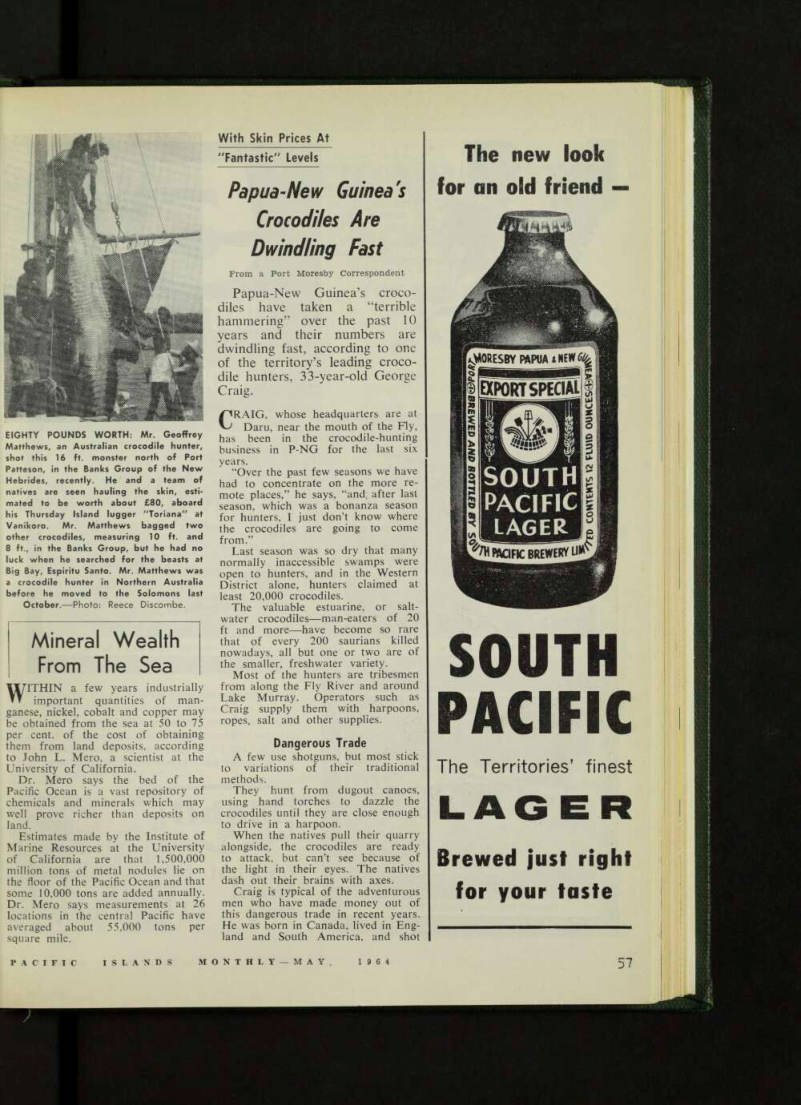


With Skin Prices At "Fantastic" Levels Papua-New Guinea's Crocodiles Are Dwindling Fast
From a Port Moresby Correspondent Papua-New Guinea’s croco diles have taken a “terrible hammering” over the past 10 years and their numbers are
dwindling fast, according to one
of the territory’s leading croco
dile hunters, 33-year-old George
Craig.
CRAIG, whose headquarters are at Daru, near the mouth of the Fly, has been in the crocodile-hunting business in P-NG for the last six years.
“Over the past few seasons we have had to concentrate on the more re mote places,” he says, “and; after last season, which was a bonanza season for hunters, 1 just don’t know where the crocodiles are going to come from.”
Last season was so dry that many normally inaccessible swamps were open to hunters, and in the Western District alone, hunters claimed at least 20,000 crocodiles.
The valuable estuarine, or salt water crocodiles—man-eaters of 20 ft and more—have become so rare that of every 200 saurians killed nowadays, all but one or two are of the smaller, freshwater variety.
Most of the hunters are tribesmen from along the Fly River and around Lake Murray. Operators such as Craig supply them with harpoons, ropes, salt and other supplies.
Dangerous Trade
A few use shotguns, but most stick to variations of their traditional methods.
They hunt from dugout canoes, using hand torches to dazzle the crocodiles until they are close enough to drive in a harpoon.
When the natives pull their quarry alongside, the crocodiles are ready to attack, but can’t see because of the light in their eyes. The natives dash out their brains with axes.
Craig is typical of the adventurous men who have made money out of this dangerous trade in recent years.
He was born in Canada, lived in Eng land and South America, and shot
crocodiles for five years in the Northern Territory before coming to
P-Ng.
His best single night in Papua pro duced 42 hides, but those prolific days are behind him now.
He has £lO,OOO worth of gear in cluding a trawler and five dinghies.
But he now leaves most of the hunt ing to others.
Travelling by boat for 500 miles up the fast-flowing Fly River to Lake Murray and beyond, he trades with natives for the hides.
Craig says prices for crocodile skins are now at a “fantastic” level —25/- a belly inch for saltwater hides and 16/- for freshwater—but crocodiles are so hard to find that a financial depression seems about to set in among the Fly River natives, some of whom have been earning as much as £l5 or £2O a night.
Craig says declining incomes could also bring unrest, as Daru, with a population of about 400, depends on crocodile hunting for most of its in come; and in places like Balimo, at least 6,000 of the 10,000 natives make their living from hides.
Meanwhile, as the numbers decline, some Australian hunters are looking enviously across the border into West New Guinea, where crocodiles still swarm in thousands in every river and swamp.