Sydneysider
pp. 54-55 · Read in the full issue
Early New Gui Lies Forg
Goes Walkabout In New Guinea
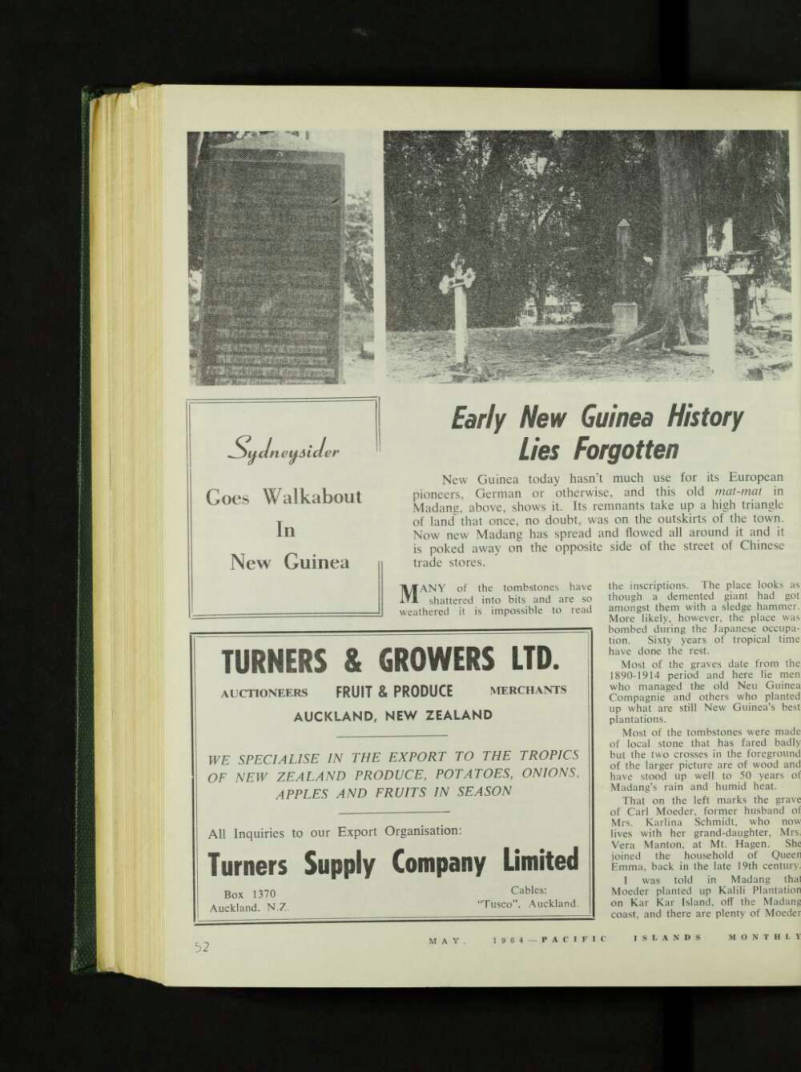
New Guinea today hasn’t much use for its European pioneers, German or otherwise, and this old mat-mat in Madang, above, shows it. Its remnants take up a high triangle of land" that once, no doubt, was on the outskirts of the town.
Now new Madang has spread and flowed all around it and it is poked away on the opposite side of the street of Chinese trade stores.
MANY of the tombstones have shattered into bits and are so weathered it is impossible to read
the inscriptions. The place looks as though a demented giant had got amongst them with a sledge hammer.
More likely, however, the place was bombed during the Japanese occupa tion. Sixty years of tropical time have done the rest.
Most of the graves date from the 1890-1914 period and here lie men who managed the old Neu Guinea Compagnie and others who planted up what are still New Guinea’s best
plantations.
Most of the tombstones were made of local stone that has fared badly but the two crosses in the foreground of the larger picture are of wood and have stood up well to 50 years of Madang’s rain and humid heat.
That on the left marks the grave of Carl Moeder, former husband of Mrs. Karlina Schmidt, who now lives with her grand-daughter, Mrs, Vera Manton, at Mt. Hagen. She joined the household of Queer Emma, back in the late 19th century.
I was told in Madang that Moeder planted up Kalili Plantation on Kar Kar Island, off the Madang coast, and there are plenty of Moeder
descendants still in New Guinea today.
The name on the other cross can be only partly deciphered as Whm.
Wahleemulh. He died in March, 1914, at 39.
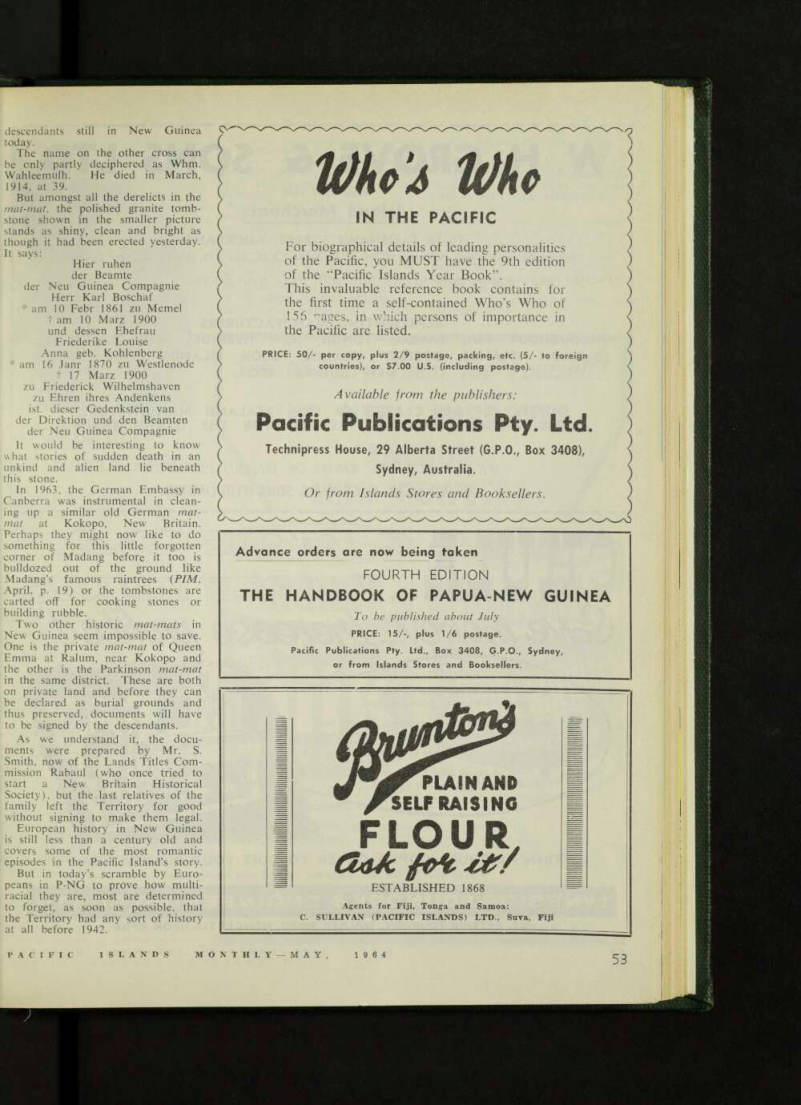
But amongst all the derelicts in the mat-mat , the polished granite tomb stone shown in the smaller picture stands as shiny, clean and bright as though it had been erected yesterday.
It says: Hier ruhen der Beamte der Neu Guinea Compagnie Herr Karl Boschaf * am 10 Febr 1861 zu Memel tarn 10 Marz 1900 und dessen Ehefrau Friederike Louise Anna geb. Kohlenberg * am 16 Janr 1870 zu Westlenode t 17 Marz 1900 zu Friederick Wilhelmshaven zu Ehren ihres Andenkens ist. dieser Gedenkstein van der Direktion und den Beamten der Neu Guinea Compagnie It would be interesting to know what stories of sudden death in an unkind and alien land lie beneath this stone.
In 1963, the German Embassy in Canberra was instrumental in clean ing up a similar old German mat mat at Kokopo, New Britain.
Perhaps they might now like to do something for this little forgotten corner of Madang before it too is bulldozed out of the ground like Madang’s famous raintrees ( PIM, April, p. 19) or the tombstones are carted off for cooking stones or
building rubble.
Two other historic mat-mats in New Guinea seem impossible to save.
One is the private mat-mat of Queen Emma at Ralum, near Kokopo and the other is the Parkinson mat-mat in the same district. These are both on private land and before they can be declared as burial grounds and thus preserved, documents will have to be signed by the descendants.
As we understand it, the docu ments were prepared by Mr. S.
Smith, now of the Lands Titles Com mission Rabaul (who once tried to start a New Britain Historical Society), but the last relatives of the family left the Territory for good without signing to make them legal.
European history in New Guinea is still less than a century old and covers some of the most romantic episodes in the Pacific Island’s story.
But in today’s scramble by Euro peans in P-NG to prove how multi racial they are, most are determined to forget, as soon as possible, that the Territory had any sort of history at all before 1942.