Preservation
pp. 31-33 · Read in the full issue
Work Almost
Finished
ven a Suva or a Noumea— Ithough, like freedom, the best pro motion is constant vigilance.
Norfolk’s new look in tourism appens to be coinciding with a new )ok in local politics. Norfolk’s Kperiment with local government is bout to be replaced with a new astern of Administrator-in-Council see page 32).
Already agitation has begun—is it progressive step or a move back ards? You hear both points of ew expressed with equal confidence id even heat, for most of those on orfolk who take their politics riously take them very seriously ideed, and often with bitterness.
Unfortunately not enough people iy serious attention. Few islanders irn up to listen to the monthly luncil meetings, and the attitude ems to be summed up by the man ho commented, “I haven’t got much • do, but I’ve got more to do than ) to a council meeting!”
While that kind of apathy exists orfolk Islanders are not entitled i howl behind scenes when mncillors make majority decisions icy don’t agree with.
Work on the preservation of the convict ruins on Norfolk Island is expected to be finished
in August.
rE work began in March, 1962, following a special financial allocation made by the Common wealth Government. The Minister for Territories at that time, Mr. Paul Hasluck, was specially interested in preserving the ruins which he regards as valuable Australian history.
A detailed report on what was worth preserving was made by Mr.
D. E. Limburg, of the Common wealth Department of Works, and it is his report that has generally been followed in the preservation work.
Mr. Limburg pointed out in the report that without attention final decay of the ruins was inevitable with in 30 years.
The preservation work has been in charge of Mr. V. Mellish, who has a genuine love of historical build ings. He served his time in the build ing trade in the Windsor district of New South Wales, where several of Australia’s historic buildings are to be found, and he has carried out restoration work on some of them.
Mr. Mellish is conscious of the fact that the work being done at Norfolk is preservation work and not restoration. The preservation when it is finished will cost about £32,000, but proper restoration might cost anything upwards of £lOO,OOO, as
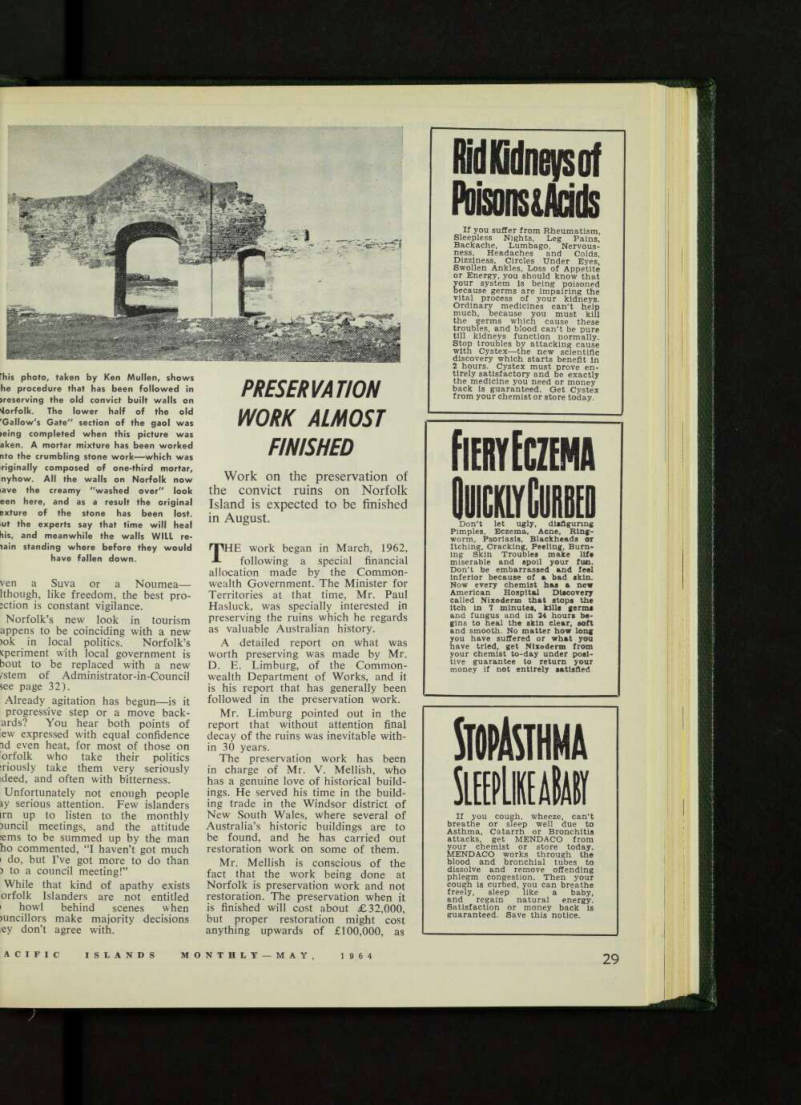
This photo, taken by Ken Mullen, shows [?] he procedure that has been followed in [?]reserving the old convict built walls on Norfolk. The lower half of the old [?]Gallow's Gate" section of the gaol was [?]eing completed when this picture was [?]aken. A mortar mixture has been worked [?]nto the crumbling stone work—which was [?]riginally composed of one-third mortar, [?]nyhow. All the walls on Norfolk now [?]lave the creamy "washed over" look [?]een here, and as a result the original [?]exture of the stone has been lost. [?]ut the experts say that time will heal [?]his, and meanwhile the walls WILL re [?]ain standing where before they would have fallen down.
much stone would have to be brought Prom Australia.
A stone mason has carried out some of the more detailed preserva tion work, but it would have been too expensive to use his services on many oi the projects.
Mr. Limburg in his report wanted :he famous Bloody Bridge to be re built as it was originally, but this las not been done, again because of sxpense, but the preservation has seen done in such a way that full •estoration can be carried out if money becomes available.
The preservation work generally las meant that walls have been re iealed with cement plaster and only n a few cases has an attempt been made to rebuild them. The original vails were mostly of small limestones md chiselled sand stone, and about >ne-third of all the original wall material is composed of lime and land mortar.
Work Still To Be Done One of the jobs not attempted in he preservation is on what have been :alled the pentagon, cells in the main ;aol building. These over the years lave fallen down or been pulled lown and have been covered with :arth.
A year or two ago a number of ocal historical enthusiasts on the sland, including Mr. Brian Marsh, vho was then the Agricultural Officer, md Mrs. Merval Hoare, began ex ;avating these cells and uncovered mtlines of several of them.
But Mr. Marsh later went to Fiji md the others in the small party bund it difficult to keep the task ;oing, especially as they got little ir no support from the islanders.
There is no more money available or the Government to do the job hey 'started but it would be reward ng work if it could be done. The •Id cells would be of great interest o visitors, and the excavating is likely o uncover numbers of metal relics
vorth preserving.
First Settlement The settlement at Kingston, where post of the ruins are, was Britain’s irst island settlement in the South •acific.
The island’s first settlers were eight fficers and men and 15 convicts who lad arrived at Botany Bay only six /eeks earlier in Governor Phillip’s 7 irst Fleet. This Norfolk settlement ontinued until 1806, when it was losed.
In 1826, a second settlement was stablished and it was from this date hat most of the stond buildings were reeled. The second penal settlement asted until 1853.