Away From All —On Wild Norfolk Island
pp. 27-30 · Read in the full issue
Wild Norfolk Island
By Stuart Inder, hurricane bound on Norfolk Island.
April 8.
With wind and rain howling in at 60 knots, trees and lines down everywhere, the roads muddy red bogs, the air-service suspended, communications in a jumble and the guest houses and hotels jammed with tourists playing parlour games, I beg to state that Norfolk Island isn’t the Paradise of the Pacific the Qantas travel folders claim.
rHIS is not just an island,” says the travel blurb. “This is the and you have dreamed about; the ace where jangling telephones, roar g traffic and ever - demanding hedules are far, far away. Tension id rush have no place on Norfolk land.
“From the gently undulating park ;e countryside, cliffs plunge 400 ft the glistening expanse of the icific. Here and there are dazzling aches which offer fine, safe, swim ing and surfing ...”
Ah, to be on an island like that this moment, instead of here on arfolk, with Hurricane Henrietta reatening us today as she has for - last four days, when she first ared in from the north like a mad )man.
We arrived here last Friday—my fe and I—for the long weekend. £ wanted to get away from those £r-demanding schedules, the ten ►n, the rush, and the kiddies, and inder hand-in-hand across the un iting park-like countryside in the zzling sunshine. We were to be
back in Sydney on Sunday, but it is now Wednesday and we haven’t seen an aircraft, or the sun, or even a break in the howling storm since Saturday.
Who could blame the tourists here for thinking evil thoughts about what the island convicts once knew as The Hell of the Pacific?
But fortunately I’ve been on Nor folk in balmier times. I know that the Norfolk people are embarrassed on behalf of the visitors for Hen rietta’s unexpected appearance. Hen rietta, they consider, is a woman of ill-fame, and they have been anxious to assure tourists that the likes of her are not often seen this far south, for hurricanes usually turn tail to wards Fiji or dissipate themselves at sea.
They needn’t worry. Tourism on Norfok Island is about to hit the big time, and an off-beat hurricane won’t affect the bright future ahead.
And though Henrietta may have inconvenienced a lot of visitors, she also introduced them to a slice of genuine Islands life as they watched,
and assisted, Norfolk people to batten down their roofs and water tanks, clear their roads and commiserate on the power failures, the communication delays and the fact that it’s been impossible to get the kids to school.
The visitors have found themselves part of the family, their ears tuned to the Department of Civil Aviation transmitter which DCA boss Roy Pierce kept on the air continuously, after the Administration station went out of action, interspersing the latest news of Henrietta’s approach with recorded music borrowed from his friends.
That has shown them better than anything else the truth of that other piece of blurb you find on the Qantas folder—the bit that says, “Please don’t come to Norfolk Island expecting super-sophistication ... if you do you could be disappointed.
Come instead ready to accept the
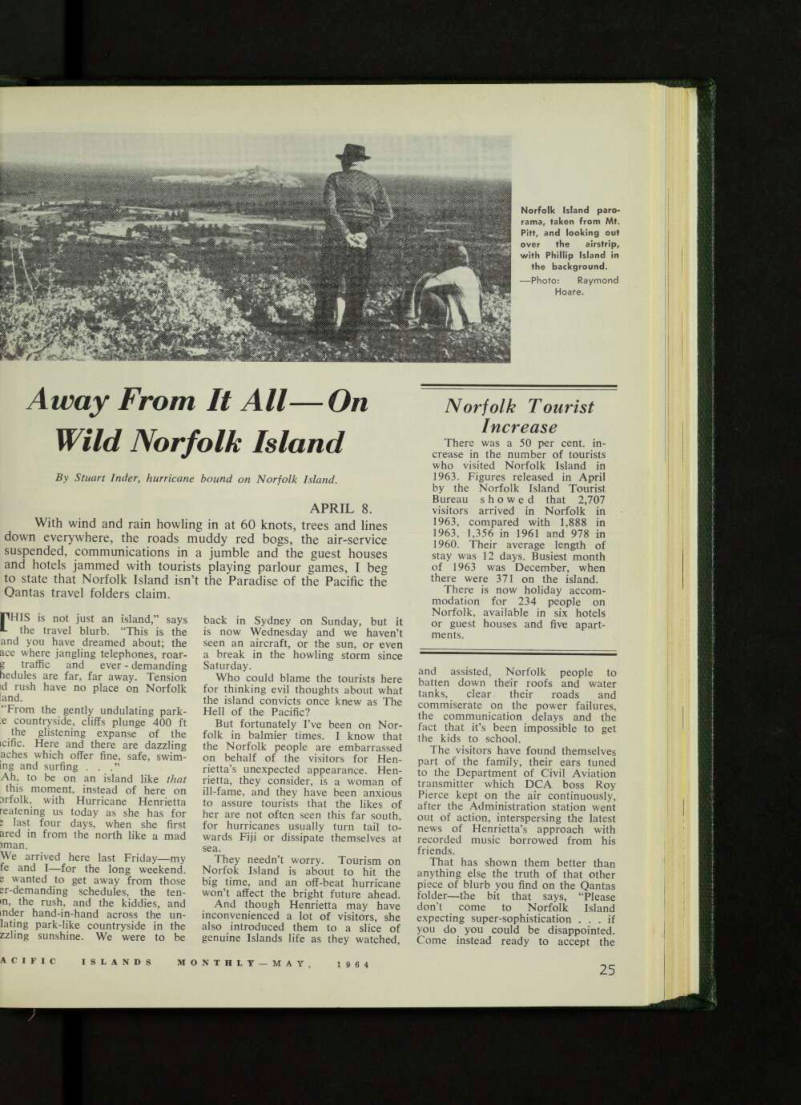
Norfolk Island pano rama, taken from Mt.
Pitt, and looking out over the airstrip, with Phillip Island in the background. —Photo: Raymond Hoare.
'arm hospitality of the Islanders lemselves —a holiday so different :om the more outward ‘glamour’ of ther resorts”.
Although the tourist boom is about ) break full-force, it is the warm ospitality of Norfolk—the get-away :om-it-all charm of the people them jlves, the friendly nods and waves, le unsophisticated dress and hous ig—that will remain Norfolk’s main [traction to visitors for a long time ) come. And while that remains le fear of “Miamisation” will not e serious.
Even with present plans for more )phisticated tourist accommodation cannot see —and neither can any ne else I have spoken to —that there ill be any big change in the guest ouse and apartments pattern that as been firmly established on the land for many years. There are ine guest houses or apartments on forfolk and only two hotels, with total of 234 beds. Although the otels have more beds available than le guest houses have combined, the itter at present have a higher occu ancy rate.
Like Mr. and Mrs. R. W. ‘Robbie”) Ombler’s Redleaf Guest [ouse, where we are comfortably uartered while Henrietta roars Gui de, most of the apartments and nest houses would win no prizes )r architectural excellence or radical layout, for there are no uilding regulations on Norfolk and nybody can build anything on any Id hunk of land.
But generally these places are lexpensive, homely and hospitable— ere at the Ombler’s we are part of le family—and New Zealanders
especially are happy to book into them. New Zealanders account for the majority of tourists—they com prised 1,724 of the 2,707 visitors in 1963—and that pattern is likely to continue, even with increased air services which are planned for late this year.
The sophisticated accommodation has been provided by the new hotel made from the old cable station property—the Kingfisher. More is to be added next year when a new hotel at Kingston opens for business, right alongside the only other hotel on the island, the Paradise.
The new Kingston hotel will begin building at the end of this year; the Kingfisher was opened for business only a few months ago.
The local people have watched the development of the Kingfisher with the kind of critical eye locals naturally reserve for something new.
Because the hotel’s credit rating with local businessmen has not been good there has been talk that the hotel is in difficulties. But this isn’t true.
Prince Takes Over The Kingfisher was built as a pro motion development by the Aus tralian firm of Empress Australia Ltd,, and I gather from the Empress man here, licensee David (“Scotty”) Neagle, that further development was handicapped by the lack of cash. But in the last few days Empress has found a buyer—a private European banking group presided over by Prince Francois Radziwill, of France, and there is already a new air about the hotel.
Already the name of Prince Radziwill, with its glamorous over
tones of the international set (he is the cousin of Prince Stanislaus, who is brother-in-law of Mrs. Jackie Kennedy, if you please) has had one or two people here wondering whether Norfolk is about to become socially fashionable.
And perhaps it may be—though it is more likely to be through the patronage of the Australian and New Zealand middle classes than Euro pean millionaires.
Already there is something of a boom in land.
Prices have been increasing and good land with a view and served with electricity is becoming harder to find, although there is still plenty of freehold about. Land prices will get higher as air services improve.
The greatest interest on land lately has been in the business area of Burnt Pine, which only a couple of years ago was barely recognisable as a business centre.
The plans for the new Kingston hotel are proof enough for anyone in doubt that tourism is here to stay. One of the principals is Mr.
N. H. Mclntyre, a partner in a big
To rid your home of cock roaches, set this simple trap in all rooms where they are observed. If jam is not readily available for the saucer, use food bait. The powder must not have an insecticide poison smell otherwise the insects will be come suspicious and it must have a permanent action so it can be relaid each night. There fore Pea Beu powder is recom mended. Cockroaches walking over the powder, will retire to their hideouts and die. Also sprinkle the Pea Beu in drawers and back of range, frig, and radio.
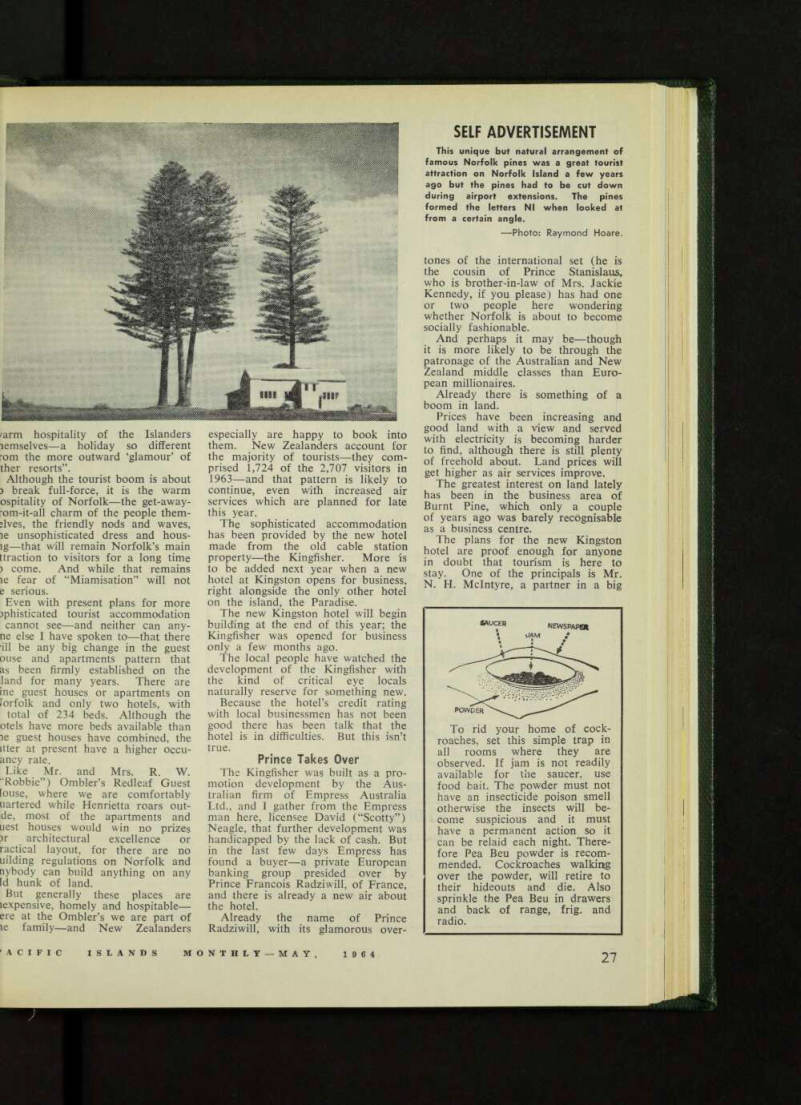
Self Advertisement
This unique but natural arrangement of famous Norfolk pines was a great tourist attraction on Norfolk Island a few years ago but the pines had to be cut down during airport extensions. The pines formed the letters NI when looked at from a certain angle. —Photo: Raymond Hoare.
YOUR hair will glow with deep rich beauty—the de lightful translucence you see when looking into the depths of amber or a precious stone. The hair looks more youthful, clearer, cleaner and the highlights are revealed in their fullest glory when you use the “Peek-In”
Glow shampoo by Delph. The Delph “Peek-In” Glow shampoo that enables you to look into the hair and see its loveliness at depth is available from chemists and cosmetic counters.
There are three types: “Clear”, “Creamed” and “Medicated”.
Sydney law firm well known to New Guinea people, and a man of high repute. His initial surveys have been carefully and soundly carried out and there is nothing wild cat about the scheme.
The new hotel will make clever use of some of the convict-built ruins, which will be incorporated into the building, and other ruins nearby will be a star draw-card according to Mr. Mclntyre, who is also sharing the joys of Hurricane Henrietta at the moment.
“This must be the best set of historical buildings in Australia,” said Mr. Mclntyre. “Norfolk will be a wonderful holiday spot for tired city businessmen with jaded nerves.”
Norfolk Islanders have not realised the significant part in Norfolk’s tourist future those ruins at Kingston are going to play.
Most islanders would be pleased to see the ruins bulldozed flat, and they have given little or no support for the work of the Commonwealth in preserving the buildings (see page 29). They consider the Common wealth could have spent the money better elsewhere on Norfolk.
It’s easy to condemn this attitude as hopelessly narrow, but it would be unfair to do so without knowing that it has existed virtually since 1856, when the Pitcairners arrived on Norfolk and looked with horror upon
the stark gaol buildings that ha< witnessed so much cruelty am degradation under a convict systen that had only recently ended.
Better that the record should b obliterated; so much of the ston was pullled down and used fo houses in the hills that had m convict associations. Something o this old attitude still lives—and : is strong enough to be shared b many other immigrants who hav made their homes on Norfolk i comparatively recent years.
Perhaps it is this spirit of ii dependence which has resulted i some people being concerned at th development of tourism on th island.
People have said to me in passin] “What do you think about it? Dor you think we might lose control we get flooded with more tourists'] That an attitude exists w£ acknowledged by Mr. F. J. Needhan chairman of the Tourist Burea (and president of the Norfolk Islar Council) when he made his annu; report only a few days ago.
Support Needed
“The future of the industry bright . . he said. “The islai is completely dependent on tl tourist industry, which now seems i be fairly well established. It is i to all residents to realise the impo tance of the industry and to give their support in order that it w; continue to bring the islar prosperity.”
Yet I haven’t found any re opposition to tourism on Norfo Island—it is rather more £ apprehension of what will come wi sophisticated tourism.
It is probably shared mainly 1 those old people who live quiet on a small or fixed income, especial those who have been attracted Norfolk only in recent years ai who fear change and increasi prices. The cost of living has risi here in the last year or so.
Changes Will Come Undoubtedly there will be chang when Norfolk Island is finally d covered by the rest of the world, it is about to be.
One can foresee changes in t liquor provisions, especially in t] practice of the Administration supplying all liquor, at the one pri to everybody. And there will applications for bar licences, distinct from residential hoi licences, and these things can me: social changes.
But “Miamisation” doesn’t have follow, and I can’t myself s Norfolk being another Honolulu,