Trcpicalities
pp. 19-21 · Read in the full issue
Back in September, 1962, we published a report saying that the French Government was considering using Mangareva in the Gambier Archipelago of French Polynesia as a nuclear testing site in the South Pacific.
report seemed pretty far - fetched at the time; yet some ght months later, the French Gov nment let it be known that it was >ing to use Mururoa Atoll, which is most next door to Mangareva, as a iclear testing centre.
Since then, other startling plans of e French Government—recognition Red China, for example—have aked out well before they were offi ally announced.
So it seems any French Govern ed plan, no matter how fantastic, is to be plainly impossible these iys before you can dismiss it as so uch hot air.
One such fantastic-but-not ipossible plan that we read about cently appeared in the famous ■ench satirical newspaper Le Canard ichaine (The Chained Duck), aich is noted for its success in fer ting out Government secrets.
The paper said the French Gov ament was planning to build shel •s for atomic submarines, armed th rockets, in the Wallis Island ea.
Wallis Island, together with Futuna 0 miles away, is a small little own French territory roughly dway between Western Samoa to ; east, Fiji to the south-west, and ; Ellice Islands to the north-west.
French missionaries began working jre in 1837; a French protectorate is established 50 years later; and ; territory became part of the ench Union after President de mile’s referendum of 1959.
Wallis and Futuna have a total pulation of 11,400, most of whom : Polynesians. They are among the orest people in the Pacific because ; rhinoceros beetle has wrecked :ir copra industry, which was their ly source of wealth.
Nearly 3,000 Wallisians have grated to New Caledonia and the :w Hebrides in recent years.
Since Wallis and Futuna became rt of the French Union, the French wernment has been making a de mined effort to lift the standard
of living there with a rehousing scheme, the construction of in firmaries, and a positive approach to wards agricultural matters. Several public schools are also planned.
Until now, education has been in the hands of the Roman Catholic Mission, and the islands, in the words of Bishop Joseph Poncet, SM, former Bishop of Wallis, have re mained “a little bit of medieval Christianity lost in the middle of the 20th century”.
The islanders are therefore likely to wonder what has struck them if the French should suddenly descend on them with such ultra-modern gee gaws as shelters for rocket-armed atomic submarines.
Le Canard Enchaine, by the way, said that the Wallis Islands area had been chosen for the shelters because “the strategists of the Elysee (Presi dent de Gaulle’s address) see in this part of the Pacific the centre of world strategy”.
“From this area,” the paper added, “the three great Powers (Russia, the
US and China) can be menaced by submarines and rockets.”
In a cartoon, Le Canard Enchaine made it clear that it did not think much of de Gaulle’s Pacific strategy.
The cartoon depicted de Gaulle standing on his head on a Tahitian beach, clutching a bomb labelled: “Ma Bombe. Made in France.”
Looking at him, right way up, were the French War Minister Messmer, US President Johnson, Russia’s Premier Khrushchev and the British Prime Minister, Sir Alec Douglas- Home.
The cartoon’s caption read: “He (de Gaulle) is at the antipodes of reality!”
Another First For
Willie Watson
/DENIAL W. H, (Willie) Watson, of Rarotonga, Cook Islands, has added another first to his collection— and collecting firsts is a kind of
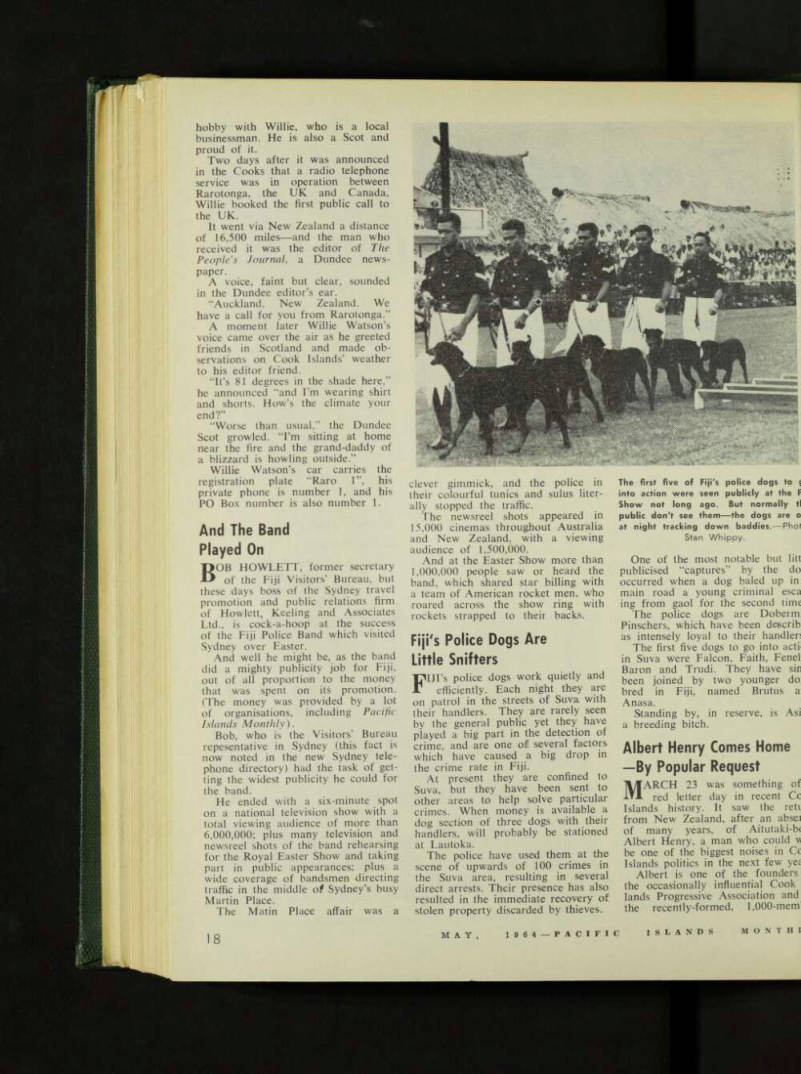
The Fiji Police Band made a big hit when it visited Sydney in April (see p. 18).
Here they are on the set of a national television show, Bobby Limb's "Sound of Music".
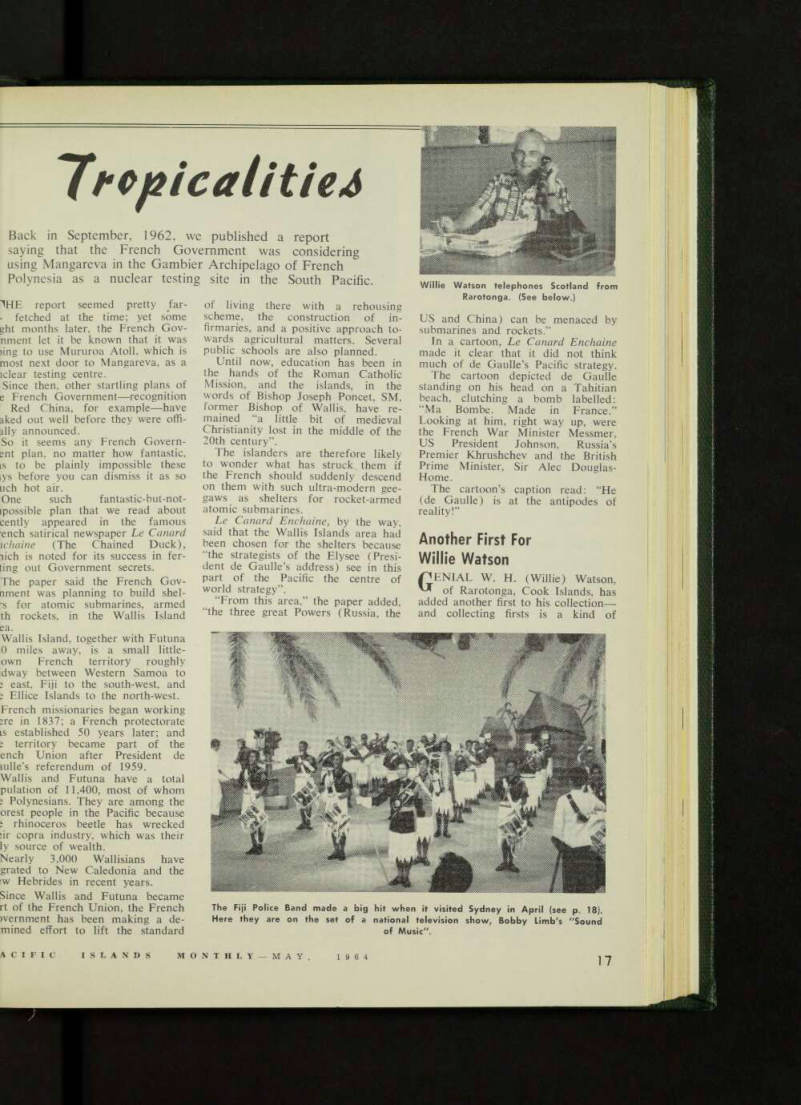
Willie Watson telephones Scotland from Rarotonga. (See below.)
hobby with Willie, who is a local businessman. He is also a Scot and proud of it.
Two days after it was announced in the Cooks that a radio telephone service was in operation between Rarotonga, the UK and Canada, Willie booked the first public call to the UK.
It went via New Zealand a distance of 16,500 miles—and the man who received it was the editor of The People’s Journal, a Dundee news paper.
A voice, faint but clear, sounded in the Dundee editor’s ear.
“Auckland, New Zealand. We have a call for you from Rarotonga.”
A moment later Willie Watson’s voice came over the air as he greeted friends in Scotland and made ob servations on Cook Islands’ weather to his editor friend.
“It’s 81 degrees in the shade here,” he announced “and I’m wearing shirt and shorts. How’s the climate your end?”
“Worse than usual,” the Dundee Scot growled. “I’m sitting at home near the fire and the grand-daddy of a blizzard is howling outside.”
Willie Watson’s car carries the registration plate “Raro 1”, his private phone is number 1, and his PO Box number is also number 1.
And The Band
Played On
808 HOWLETT, former secretary of the Fiji Visitors’ Bureau, but these days boss of the Sydney travel promotion and public relations firm of Hewlett, Keeling and Associates Ltd., is cock-a-hoop at the success of the Fiji Police Band which visited Sydney over Easter.
And well he might be, as the band did a mighty publicity job for Fiji, out of all proportion to the money that was spent on its promotion. (The money was provided by a lot of organisations, including Pacific Islands Monthly).
Bob, who is the Visitors’ Bureau repesentative in Sydney (this fact is now noted in the new Sydney tele phone directory) had the task of get ting the widest publicity he could for the band.
He ended with a six-minute spot on a national television show with a total viewing audience of more than 6,000,000; plus many television and newsreel shots of the band rehearsing for the Royal Easter Show and taking part in public appearances; plus a wide coverage of bandsmen directing traffic in the middle of Sydney’s busy Martin Place.
The Matin Place affair was a
clever gimmick, and the police in their colourful tunics and sulus liter ally stopped the traffic.
The newsreel shots appeared in 15,000 cinemas throughout Australia and New Zealand, with a viewing audience of 1,500,000.
And at the Easier Show more than 1,000.000 people saw or heard the band, which shared star billing with a team of American rocket men, who roared across the show ring with rockets strapped to their backs.
Fiji / s Police Dogs Are
Little Snifters
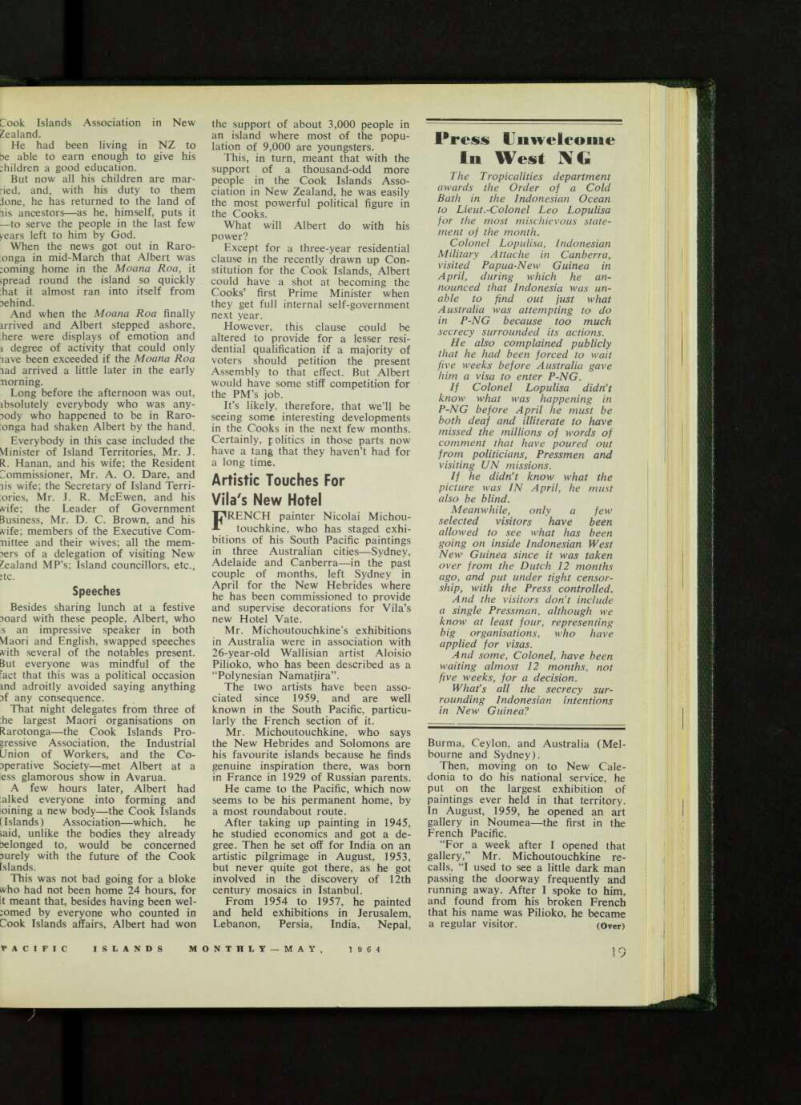
Fill’s police dogs work quietly and efficiently. Each night they are on patrol in the streets of Suva with their handlers. They are rarely seen by the general public yet they have played a big part in the detection of crime, and are one ofi several factors which have caused a big drop in the crime rate in Fiji.
At present they are confined to Suva, but they have been sent to other areas to help solve particular crimes. When money is available a dog section of three dogs with their handlers, will probably be stationed at Lautoka.
The police have used them at the scene of upwards of 100 crimes in the Suva area, resulting in several direct arrests. Their presence has also resulted in the immediate recovery of stolen property discarded by thieves.
One of the most notable but litt publicised “captures” by the do occurred when a dog baled up in main road a young criminal esca ing from gaol for the second time The police dogs are Doberm; Pinschers, which have been describ as intensely loyal to their handlers The first five dogs to go into acti« in Suva were Falcon, Faith, Fenel Baron and Trudi. They have sin been joined by two younger do bred in Fiji, named Brutus a Anasa.
Standing by, in reserve, is Asi a breeding bitch.
Albert Henry Comes Home
—By Popular Request
MARCH 23 was something of red letter day in recent Cc Islands history. It saw the reti from New Zealand, after an absei of many years, of Aitutaki-b( Albert Henry, a man who could \* be one of the biggest noises in Cc Islands politics in the next few yea Albert is one of the founders the occasionally influential Cook lands Progressive Association and the recently-formed, 1,000-meml
The first five of Fiji's police dogs to [?] into action were seen publicly at the F[?] Show not long ago. But normally t[?] public don't see them—the dogs are o[?] at night tracking down baddies.- Phot[?]
Stan Whippy.
Cook Islands Association in New Zealand.
He had been living in NZ to be able to earn enough to give his ;hildren a good education.
But now all his children are mar ried, and, with his duty to them lone, he has returned to the land of lis ancestors —as he, himself, puts it —to serve the people in the last few years left to him by God.
When the news got out in Raro onga in mid-March that Albert was :oming home in the Moana Roa, it spread round the island so quickly hat it almost ran into itself from lehind.
And when the Moana Roa finally arrived and Albert stepped ashore, here were displays of emotion and i degree of activity that could only lave been exceeded if the Moana Roa lad arrived a little later in the early Horning.
Long before the afternoon was out, absolutely everybody who was any lody who happened to be in Raro :onga had shaken Albert by the hand.
Everybody in this case included the Vlinister of Island Territories, Mr. J.
R. Hanan, and his wife; the Resident Commissioner, Mr. A. O. Dare, and lis wife; the Secretary of Island Terri ories, Mr. J. R. McEwen, and his wife; the Leader of Government Business, Mr. D. C. Brown, and his wife; members of the Executive Com nittee and their wives; all the mem bers of a delegation of visiting New Zealand MP’s; Island councillors, etc., dc.
Speeches
Besides sharing lunch at a festive loard with these people, Albert, who s an impressive speaker in both Vlaori and English, swapped speeches with several of the notables present.
But everyone was mindful of the fact that this was a political occasion md adroitly avoided saying anything if any consequence.
That night delegates from three of he largest Maori organisations on Rarotonga—the Cook Islands Pro gressive Association, the Industrial Union of Workers, and the Co iperative Society—met Albert at a less glamorous show in Avarua.
A few hours later, Albert had alked everyone into forming and oining a new body—the Cook Islands [lslands) Association—which, he laid, unlike the bodies they already lelonged to, would be concerned lurely with the future of the Cook Islands.
This was not bad going for a bloke who had not been home 24 hours, for it meant that, besides having been wel comed by everyone who counted in Cook Islands affairs, Albert had won
the support of about 3,000 people in an island where most of the popu lation of 9,000 are youngsters.
This, in turn, meant that with the support of a thousand-odd more people in the Cook Islands Asso ciation in New Zealand, he was easily the most powerful political figure in the Cooks.
What will Albert do with his power?
Except for a three-year residential clause in the recently drawn up Con stitution for the Cook Islands, Albert could have a shot at becoming the Cooks’ first Prime Minister when they get full internal self-government next year.
However, this clause could be altered to provide for a lesser resi dential qualification if a majority of voters should petition the present Assembly to that effect. But Albert would have some stiff competition for the PM’s job.
It’s likely, therefore, that we’ll be seeing some interesting developments in the Cooks in the next few months.
Certainly, politics in those parts now have a tang that they haven’t had for a long time.
Artistic Touches For
Vila's New Hotel
FRENCH painter Nicolai Michou touchkine, who has staged exhi bitions of his South Pacific paintings in three Australian cities—Sydney, Adelaide and Canberra—in the past couple of months, left Sydney in April for the New Hebrides where he has been commissioned to provide and supervise decorations for Vila’s new Hotel Vate.
Mr. Michoutouchkine’s exhibitions in Australia were in association with 26-year-old Wallisian artist Aloisio Pilioko, who has been described as a “Polynesian Namatjira”.
The two artists have been asso ciated since 1959, and are well known in the South Pacific, particu larly the French section of it.
Mr. Michoutouchkine, who says the New Hebrides and Solomons are his favourite islands because he finds genuine inspiration there, was bom in France in 1929 of Russian parents.
He came to the Pacific, which now seems to be his permanent home, by a most roundabout route.
After taking up painting in 1945, he studied economics and got a de gree. Then he set off for India on an artistic pilgrimage in August, 1953, but never quite got there, as he got involved in the discovery of 12th century mosaics in Istanbul.
From 1954 to 1957, he painted and held exhibitions in Jerusalem, Lebanon, Persia, India, Nepal,
Burma, Ceylon, and Australia (Mel bourne and Sydney).
Then, moving on to New Cale donia to do his national service, he put on the largest exhibition of paintings ever held in that territory.
In August, 1959, he opened an art gallery in Noumea—the first in the French Pacific.
“For a week after I opened that gallery,” Mr. Michoutouchkine re calls, “I used to see a little dark man passing the doorway frequently and running away. After I spoke to him, and found from his broken French that his name was Pilioko, he became a regular visitor. (Over)