Grossly Overloaded
p. 17 · Read in the full issue
Findings on "Polurrian", "Kadovulevu" Disasters
Ill-Fated Islands Ships
Marine Board inquiries into the foundering, with heavy and' ‘4S °I ° i 3ndS \ hi P s the 399-ton MV t a . nd , ‘ h ® 45 ft - auxiliary schooner have found that both were grossly overloaded.
THE Polurrian sank on the night of “*■ March 28, 1963, while on a voyage from Sohano to Rabaul with the loss of 53 of the 82 people on board.
The Kadavulevu sank on the night of March 29, 1964— 0ne year and one day later—on a voyage from Nairai, in Fiji’s Lomaiviti Group, to Suva. Eighty-nine of the 92 people on board were lost. (See page 95.) A Papua-New Guinea Marine Board of Inquiry into the loss of the °olurrian delivered its report to the 3 apua-New Guinea Administrator, hr Donald Cleland, on April 23.
The board found, among other hings, that: • The Polurrian was not manned trictly in accordance with regulations a that no certificated person in addi ion to the master was carried on the oyage on which she was lost. • The number of passengers on oard was grossly in excess of the umber permitted. • The deck cargo was not stowed i accordance with regulations. • No sailing permit was obtained y the master before leaving Sohano, s required by regulations. • No definite conclusion on the mse of the casualty could be :ached. But the master was to blame >r stowing cargo in an improper anner; carrying 35 passengers more lan the Administration permitted; id failing to obtain a sailing permit Tore leaving Sohano.
The board added that the owners the Polurrian, the Bougainville Co. d„ were also to blame for not em oymg a certificated person in addi m to the master; and they were sponsible for, though not neces nly a party to, the breaches of )wage regulations.
The board recommended that: • The law should require the pro aon on every coastal vessel of ap
oved inflatable life-rafts, sufficiently
accommodate all persons on ard, in lieu of, or in addition to,
lifeboats and buoyant apparatus of other types. • The Administration should see that more supervision was exercised at out-ports over vessels engaged in the coasting trade, “preferably through the expansion of the staff qualified to exercise such supervision equipped with means and facilities tor rapid and free movement for the purpose of instituting surprise checks and inspections”.
"Kadavulevu" Disaster
_,.I n Ij l6 case °f the Kadavulevu, the Fiji Marine Board, which conducted a preliminary inquiry, found that the schooner was unseaworthy for its last voyage because of gross overloading of passengers and the fact that there were many people on the cabin top, the main cabin, and on the main deck.
The Kadavulevu was licensed to carry a crew of seven and 22 passen gers.
The board recommended that a formal inquiry was both “requisite and expedient”.
The evidence of Mr. R. Wood ward, a surveyor of marine engines, and a member of the Institute of Marine Engineers, was, in general, an indictment of small ships which operate in Fiji waters.
Asked if he had noticed whether the Kadavulevu appeared to have been kept in a seaworthy condition, Woodward answered: “No, for some time past I have been very dissatisfied with the general standard of ships I have surveyed since I arrived at Suva” (in August, 1963).
Some witnesses gave evidence that they had sailed from Suva to Nairai in the Kadavulevu, but refused to sail in her on the return voyage because of a broadcast storm warning and because of gross overloading.
The board found that the adverse weather and sea conditions at the time of the accident were contributing factors to the loss of the ship.
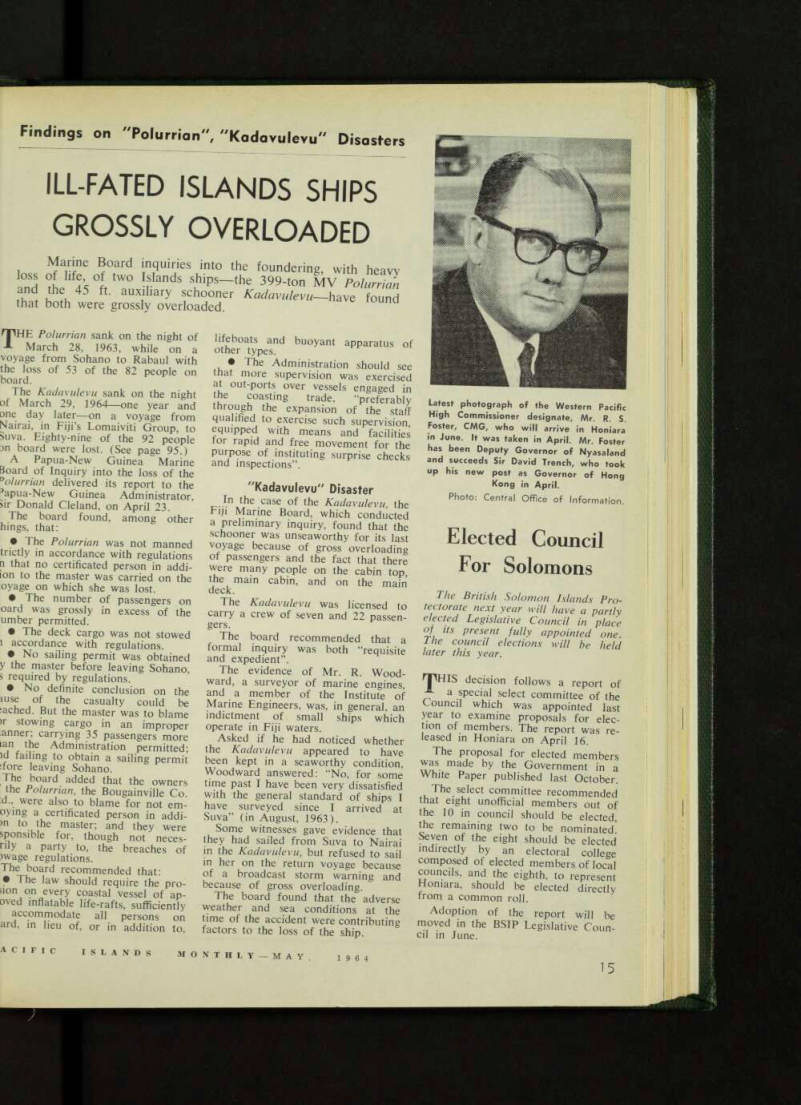
Latest photograph of the Western Pacific High Commissioner designate, Mr. R. S.
Foster, CMC, who will arrive in Honiara in June. It was taken in April. Mr. Foster has been Deputy Governor of Nyasaland and succeeds Sir David Trench, who took up his new post as Governor of Hong Kong in April.
Photo: Central Office of Information.