French Naval Expert Formally
pp. 13-14 · Read in the full issue
Identifies "Boussole" Wreck
A French naval expert, Commandant de Brossard, has formally identified a wreck found at Vanikoro as that of the Boussole, the flagship of the French navigator La Perouse, who disappeared after leaving Botany Bay in March, 1788.
New Zealander Reece Dis
combe, of Vila, New Hebrides, found the wreck in June, 1962, after taking part in two earlier expeditions to Vanikoro in search of La Perouse relics. PIM revealed his discovery in January, 1963.
Discombe, an experienced skin diver, found the wreck in deep water on the outer edge of the reef. In the following December, he recovered a number of relics from the wreck; and in February this year, he showed the “grave” of the Boussole to the French Resident Commissioner in the New Hebrides, Mr. M. Delauney, who visited Vanikoro while Discombe was there on a business mission {PIM, April, p. 19).
Mr. Delauney’s inspection led to Commandant de Brossard being sent to Vanikoro by the French Minister for the Army, Mr. Messmer, to make further investigations.
Commandant de Brossard is head of the historical section of the French Navy. He was in Noumea as naval commander for about three years from 1958.
Commandant de Brossard, who flew to the Pacific from Paris via
Noumea, joined the French naval vessel Dunkerquoise at Santo and reached Vanikoro on March 20.
The Dunkerquoise carried a team of Navy and civilian divers, plus Reece Discombe, who had been invited to act as guide.
Bad Weather Bad weather limited diving at the scene of the wreck to one day, but this was long enough for the divers to retrieve the ship’s bell and part of a pump from about 100 ft. of water. A plan of the wreckage seen on the ocean bed was also made.
At a Press conference in Noumea in April, Commandant de Brossard said that the bell was of French manufacture and that it was of the same model as that of the Astrolabe (La Perouse’s other ship), which Captain Peter Dillon obtained ashore at Vanikoro in 1827. (The Astro labe’s bell is now in the Naval Museum in Paris.) Commandant de Brossard said that the remains of the pump were characteristic of the type used in the French Navy in La Perouse’s time, and that the bell and pump, together
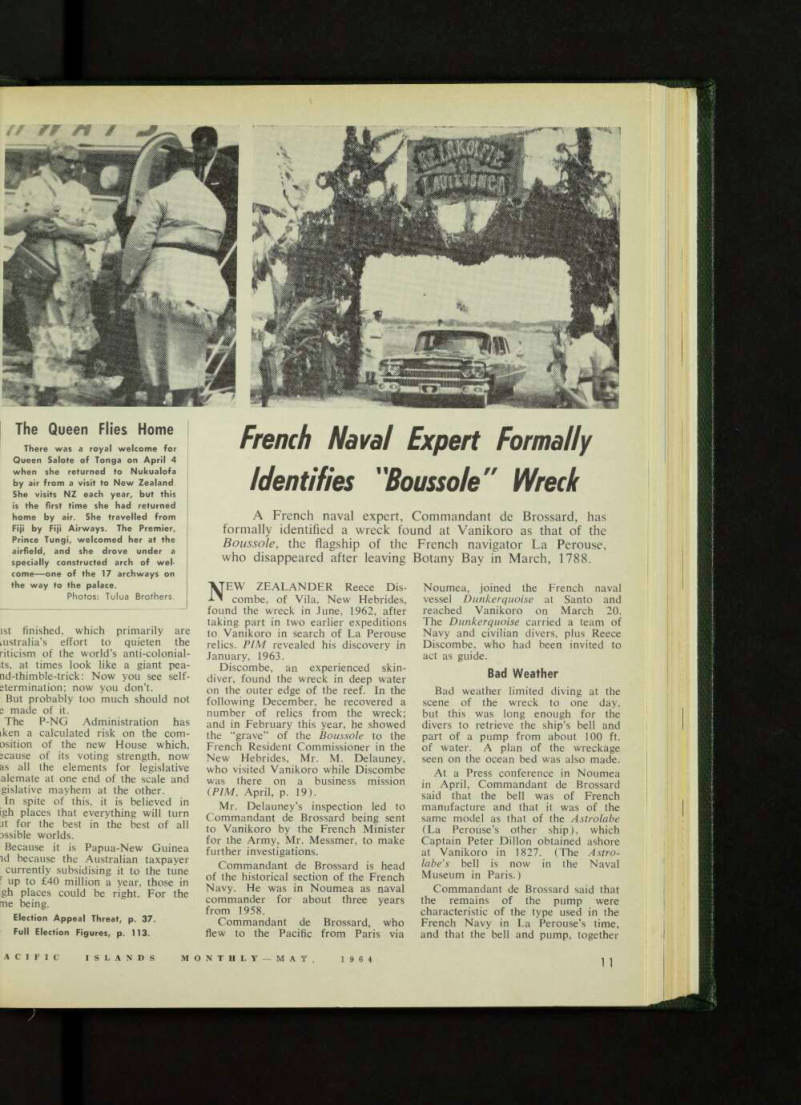
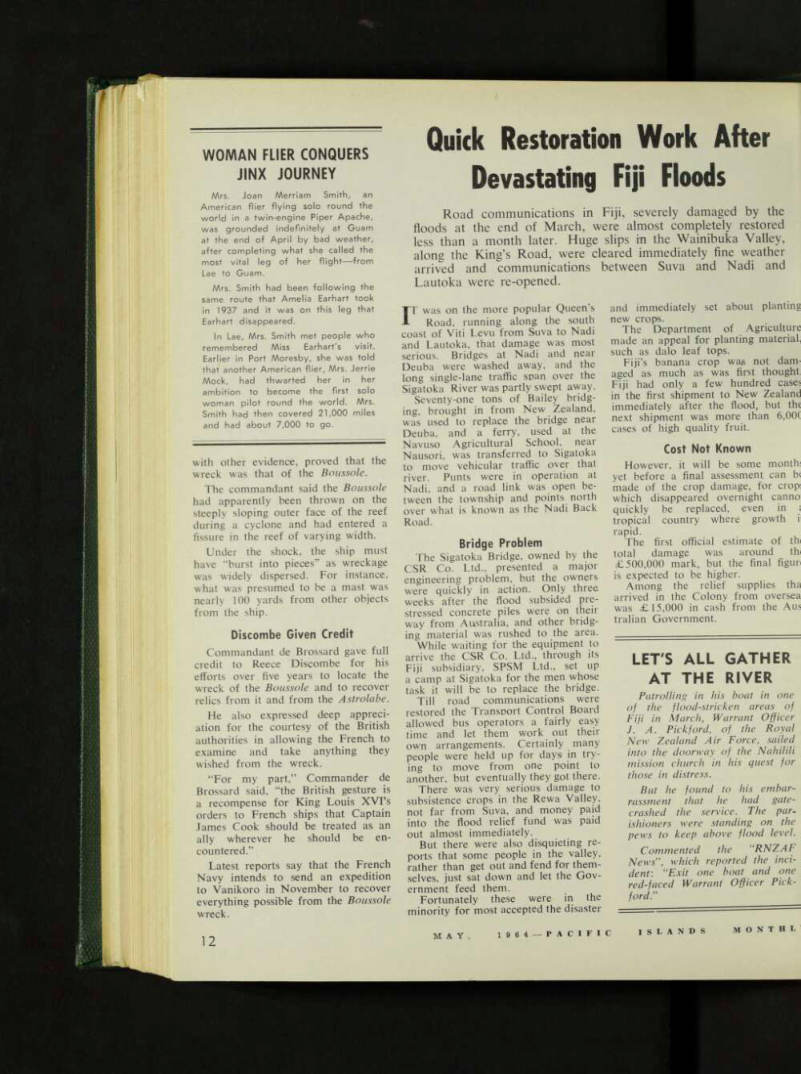
The Queen Flies Home
There was a royal welcome for Queen Salote of Tonga on April 4 when she returned to Nukualofa by air from a visit to New Zealand.
She visits NZ each year, but this is the first time she had returned home by air. She travelled from Fiji by Fiji Airways. The Premier, Prince Tungi, welcomed her at the airfield, and she drove under a specially constructed arch of wel come —one of the 17 archways on the way to the palace.
Photos: Tulua Brothers.
with other evidence, proved that the wreck was that of the Boussole.
The commandant said the Boussole had apparently been thrown on the steeply sloping outer face of the reef during a cyclone and had entered a fissure in the reef of varying width.
Under the shock, the ship must have “burst into pieces” as wreckage was widely dispersed. For instance, what was presumed to be a mast was nearly 100 yards from other objects from the ship.
Discombe Given Credit Commandant de Brossard gave full credit to Reece Discombe for his efforts over five years to locate the wreck of the Boussole and to recover relics from it and from the Astrolabe.
He also expressed deep appreci ation for the courtesy of the British authorities in allowing the French to examine and take anything they wished from the wreck.
“For my part,” Commander de Brossard said, “the British gesture is a recompense for King Louis XVTs orders to French ships that Captain James Cook should be treated as an ally wherever he should be en countered.”
Latest reports say that the French Navy intends to send an expedition to Vanikoro in November to recover everything possible from the Boussole wreck.