Surprises To The Last
pp. 11-13 · Read in the full issue
In P-Ng Election
By Judy Tudor
The Papua-New Guinea election results continued to be full of surprises right up to the last declaration of the polls in the second week in April, although the numerical composition of the new legislature was apparent at a much earlier stage.
fTJHE House of Assembly will have 38 native members and 26 non native members of whom 10 will be official members; 10 will be those elected from special, non-native elec torates; and six will be non-natives who won seats from native opponents in the 44 open electorates.
Distribution of preference votes— where there were preferences to dis tribute—began after April 1, and :oyered as erratic a course as the primary vote. But only in a minority }f cases did preferences alter the final esult.
Bill Bloomfield, a driller and tester rom Wau, in the primary count, was ilmost 1,000 votes behind David Iti, i local native interpreter, but beat lim by about 2,500 votes when pre erences were allocated.
Tom Leahy, on the other hand, yho was expected to win the open
Markham electorate, was beaten by 300 votes on preferences that went to Gaudi Mirau, a native clerk from Kaiapit.
Lloyd Hurrell, who had been hav ing a see-saw fight in the South Markham special electorate through out the voting, finally lost out to Graham Gilmore by about 400 votes.
Preferences saved the day for Simogun Pita of Wewak-Aitape open.
He was a nominated member of the Legislative Council from 1951 to 1961 but when the council was re constituted in 1961, with six of the native members elected, Simogun was defeated at the polls.
His re-entry into P-NG politics is just one of the many things that have confounded the quid nuncs in this election. They felt that he had had his day and that the brave new world of the House of Assembly would have no place for members of the old guard.
Preferences No Help Preferences did nothing, however, to extricate Port Moresby’s Oala Oala Rarua from the hopeless position in which the bloc Goilala vote had placed him in the Moresby electorate.
Victory went to Eriko Rarupu, a storeman of Woitape, with 8,867 votes after distribution of preferences from the rest of the field.
Of the 38 native members who will sit in the new House, only two mem bers sat in the last Legislative Coun cil—John Guise of Milne Bay and Nicholas Brokam of New Ireland.
Taking Simogun into consideration, this means that there will be 35 new native faces in the House when it meets on June 8; and behind those 35 faces there will be 35 unknown quantities.
Of the 16 elected European mem bers four have appeared in Legisla tive Councils of the past: lan F.
Downs, of the Highlands; John Stuntz, of East Papua; H. L. Niall,
who was an official member of every Legislative Council from its incep tion in 1951, and who resigned in January to enter local politics as a private member; and Don Barrett, a former MLC who had two terms as a MLC but who was defeated in 1961.
While the native unknown quanti
ties are finding their feet, most of the real business of the House will be carried on—as it was in every Legis lative Council that went before it— through the opposing interests of the official members, on the one hand, and the non-official European mem bers on the other.
It is the ultimate alliance of the solid bloc of native members in the new House that presents the most interesting speculation at pre sent.
Some European members, both official and non-official, believe the native bloc can be led by them and it would be following old New Guinea custom if this turns out to be so.
But if the 38-member native team, backed by the six European members elected on the native vote in open electorates, emerges as a third force in the House, P-NG politics, which up to now have amounted to little more than expensive window dressing, are going to take on a new dimension.
Nothing so dramatic is likely to happen, however. The chances are that native members will act as their predecessors did in the Legislative Council and have a little of every thing. More often than not they allowed Administration-introduced legislation to succeed by default; occasionally they voted according to the dictates of the last person who had had their ear; and occasionally they performed a volte face at the very moment of voting and con founded everyone.
Old Guard Officials Back The names of the 10 official mem bers of the House were announced on April 6 and proved more disap pointing than surprising.
They are: Dr. J. T. Gunther, OBE, Assistant Administrator (Services), who will be Leader of the House and have the additional departmental responsi bility of Health.
Mr. H. H. Reeve, Assistant Ad ministrator (Economic Affairs) who will be Deputy Leader of the House and be responsible for the Depart ment of the Administrator.
Mr. W. W. Watkins, Secretary for Law. who will attend to Police mat ters also in the House.
Mr. A. P. J. Newman, Treasurer, who will represent the Public Service as well as his own department.
Mr. W. F. Carter, Director of Posts and Telegraphs, who will have the additional responsibility of Public Works.
Mr. F. C. Henderson, Director of
Agriculture, Stock and Fisheries, who will be responsible for Forests and Lands also.
Mr. J. K. McCarthy. Director of Native Affairs —or when the name of the department is changed shortly.
Director of the Department of Dis trict Administration —who addition ally will represent the Department of Information and Extension Services.
Mr. G. D. Cannon, Director of Trade and Industry, Mr. L. W. Johnson, Director of Education.
Mr. N. J. Mason, Secretary for Labour.
All the above, except the last three, were members of previous Legislative Councils.
Remarkable by their absence from the official list are any field staff.
There is not even a place for senior District Commissioners, who were represented on all Legislative Coun cils. , .
Of the 10 official members only one could be regarded as a Pidgin- English linguist, although at least 29 of the 38 native members speak Pidgin and nothing else. This means that to know what these members are talking about most official mem bers will have to depend on transla tions heard through headphones.
Pidgin-English, because of its long
circumlocutions to explain quite simple English words and phrases, is difficult to treat in simultaneous translation. It often happens that while the translator is waiting to get the gist of an involved passage, the whole trend of the speech is lost.
Only one man on the official team —J. K. McCarthy—has had real field service in the Territory, progressing from cadet patrol officer in 1927 to his present position as Director of his department. Mr. Henderson, in his earlier years as an agricultural officer, also had experience in the field.
It had been hoped—in some Ad ministration circles as well as out of them—that officials closer to the grass-roots of the country, who had worked and lived among the natives, who understand their prob lems and the way they think, might have been included in the official list.
However, the offical side of the House has other weapons in its armoury; The Under-Secretaryships.
According to the legislation, the Administration may appoint up to 15 elected members of the House as Under-Secretaries but 10 seems tc be the favoured number.
Their job will be to understudy heads of departments and probably represent, in the House, departments which are not represented by official members.
Salaries Under-Secretaries will receive s salary of £1,300 per year plus allow ances, etc. (Ordinary members wil have a salary of £950 plus allow ances).
It was assumed that the Under Secretaries would be natives althougl it was stated at the time the legisla tion was introduced in 1963 that thi was not necessarily so. However, it i hard to see any of the Europeai elected members, all of whom hav other occupations, wishing to devot time understudying a head of a Gov ernment department at a salary c £1,300.
In the concept of the new Papu£ New Guinea being educated for sell government, Under-Secretaryship anyhow make no sense unless the do go to native members. At th same time, the bestowal of this rani with its increased salary and perk will attach the holder so firmly t the Administration it is unlikely ihi he will vote against it.
The Under-Secretary in effect b( comes a servant of the department I represents, which is precisely contrar to the implied wishes of the ele ( torate which put him there to be i independent representative.
This and other aspects of tt House of Assembly and the electioi
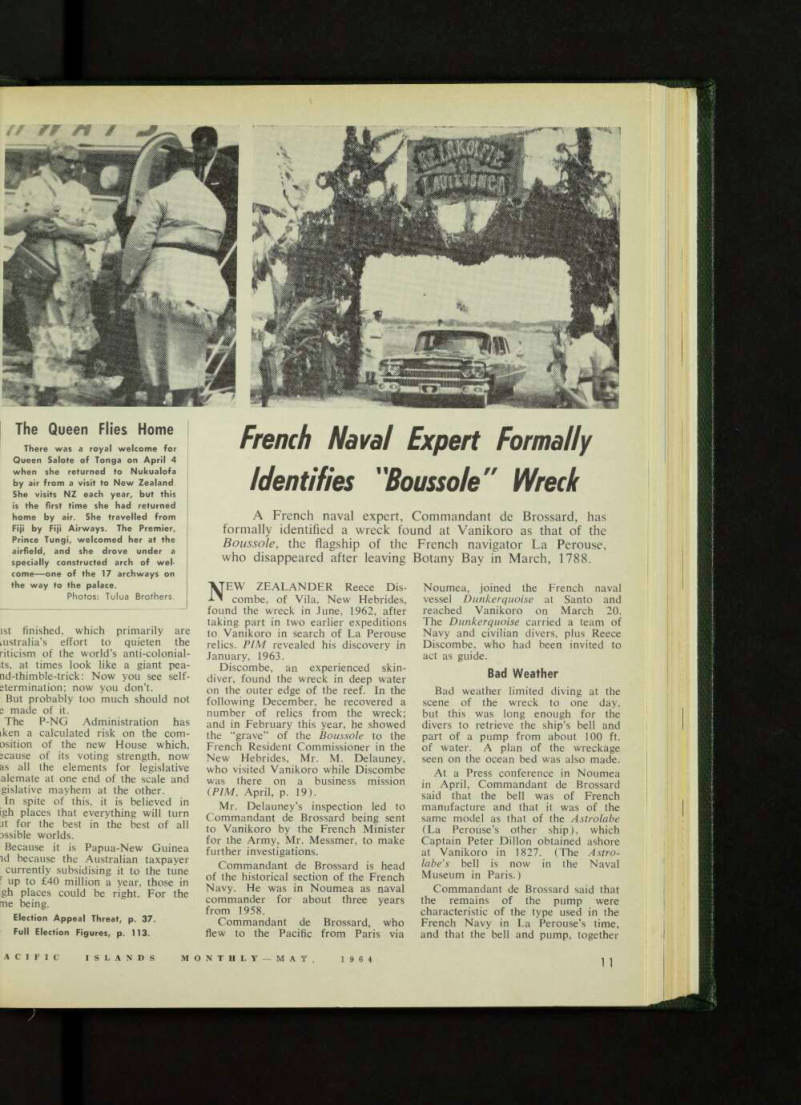
College Opened
The first stage of the Papuan Medical College, Port Moresby, was opened by the Minister for Territories, Mr. C. E.
Barnes, on April 18. The college trains doctors, medical assistants, nurses and hospital technicians. In March there was a graduation, and here is one of the graduate nurses. Miss Shirley Warren, of Samarai. She has reason to smile—she came second in the examination results.
P-NG Official Photo.
ist finished, which primarily are mstralia’s effort to quieten the riticism of the world’s anti-colonial ts, at times look like a giant pea nd-thimble-trick: Now you see self etermination; now you don’t.
But probably too much should not 2 made of it.
The P-NG Administration has iken a calculated risk on the com osition of the new House which, jcause of its voting strength, now as all the elements for legislative alemate at one end of the scale and gislative mayhem at the other.
In spite of this, it is believed in igh places that everything will turn at for the best in the best of all assible worlds.
Because it is Papua-New Guinea id because the Australian taxpayer currently subsidising it to the tune P up to £4O million a year, those in gh places could be right. For the me being.
Election Appeal Threat, p. 37.
Full Election Figures, p. 113.