A Peter Pinney With Sand
pp. 90-91 · Read in the full issue
Sand In His Shoes
Peter Pinney, son of a former Administrator of Norfolk Island and a relative of some sort of Sir Hubert Murray of Papua, has spent a good deal of his adulthood leading a law less, adventurous life.
FOR the last 16 years or there abouts, he has drifted round the word—usually without money and the appropriate visas in his pass port, often at war with authority,
and always in company with peop doing things the hard way, the wroi way, the cheap way or the unconve tional way.
From time to time, Peter Pinn< produces a book about his travels astonishingly vivid, well-written boo which prove the author to be a mo sensitive soul than he sometimes lik to make out.
His first book, Dust on My Shot probably inspired more young Austr lians to go wandering round tl world than any other book by i Australian author.
The latest Pinney opus, The Lm less and The Lotus, is a record i the author’s wanderings in ai around the West Indies, and fro there to Tahiti, the New Hebride New Caledonia and home to An tralia.
As with the earlier Pinney trav books, it is impossible to believe th all the adventures the author ascrib to himself are true. But with th reservation, The Lawless and Tl Lotus can be heartily recommend* to anyone in the mood for some noi conformist armchair travelling.
Naturally, the section of the boc that appealed most to PlM’s review< was that dealing with Tahiti, the Ne Hebrides and New Caledonia.
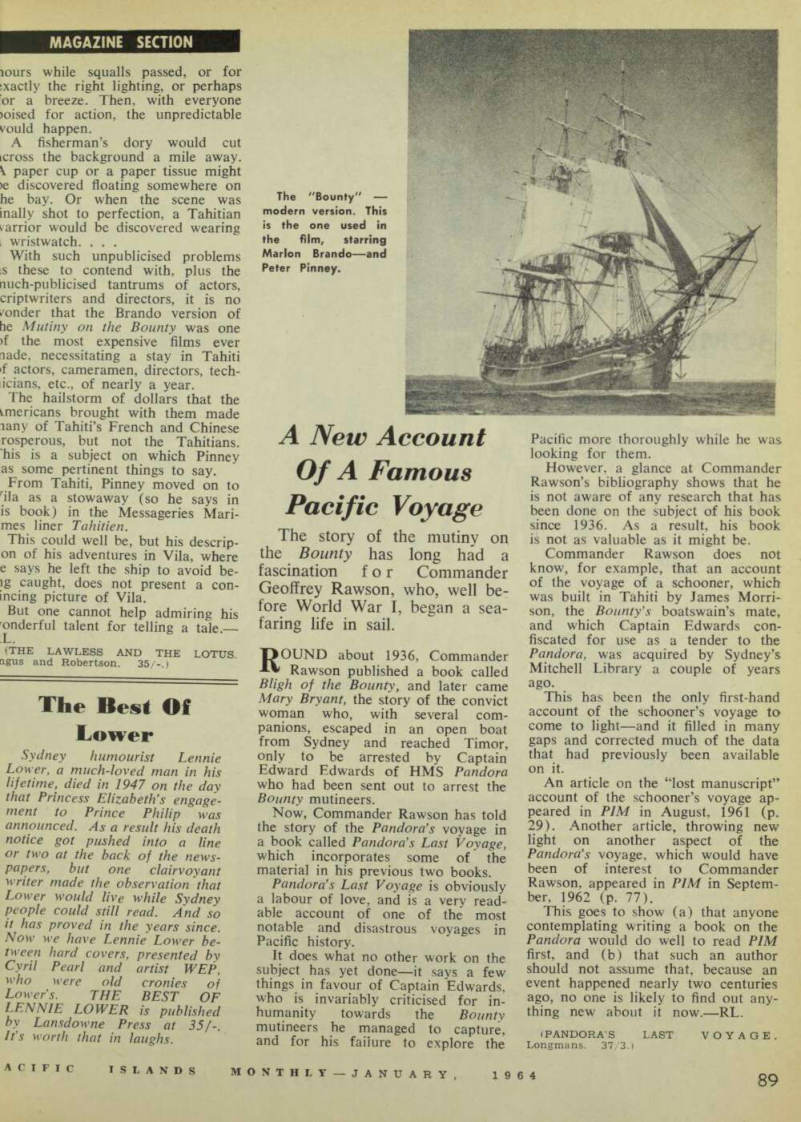
It was in Tahiti, anyway, that or of the highlights of the book toe place—the author got a job as £ extra and finally as a stand-in f« Marlon Brando (who had returne to Los Angeles) in the film Mutir on the Bounty.
Disguised as Brando, and playir the part of Fletcher Christian, Pinne took part in scenes in which thre deserters from the Bounty wei chased in Tahitian war canoes.
The shooting of these scenes w; not all plain sailing. Instructions hs to be relayed over radios and lorn speakers in English, French an Tahitian; and, at critical moment the Tahitian actors were often foun asleep or reading comics, huntiri clams or nursing bottles of soc drink.
Occasionally, everyone waited f«
tours while squalls passed, or for :xactly the right lighting, or perhaps or a breeze. Then, with everyone >oised for action, the unpredictable vould happen.
A fisherman’s dory would cut icross the background a mile away, k paper cup or a paper tissue might >e discovered floating somewhere on he bay. Or when the scene was inally shot to perfection, a Tahitian warrior would be discovered wearing 1 wristwatch. . . .
With such unpublicised problems is these to contend with, plus the nuch-publicised tantrums of actors, criptwriters and directors, it is no /onder that the Brando version of he Mutiny on the Bounty was one >f the most expensive films ever nade, necessitating a stay in Tahiti •f actors, cameramen, directors, tech icians, etc., of nearly a year.
The hailstorm of dollars that the Americans brought with them made lany of Tahiti’s French and Chinese rosperous, but not the Tahitians, his is a subject on which Pinney as some pertinent things to say.
From Tahiti, Pinney moved on to r ila as a stowaway (so he says in is book) in the Messageries Mari mes liner Tahitien.
This could well be, but his descrip on of his adventures in Vila, where e says he left the ship to avoid be ig caught, does not present a con incing picture of Vila.
But one cannot help admiring his onderful talent for telling a tale.—
(The Lawless And The Lotus,
ngus and Robertson. 35/-.)