Since The "Old Firm" Split Up,
pp. 82-83 · Read in the full issue
Life In The Cooks Just Hasn't Been The Same
From W. H. Percival In Rarotonga
Life in the Cook Islands has never been quite the same since Captain Hugh C. Williams retired to live in Sydney in late 1961.
CAPTAIN Williams, an Australian from Townsville, and his mate of-long-standing, Les Livingstone, also an Australian, first visited Rarotonga in 1951. They arrived in the Inspire, a Brixham trawler, that Captain Williams had bought in England and was sailing to Sydney for conversion for Islands trading.
The following year Captain Wil liams returned to Rarotonga and be gan trading between the Cook Group’s 15 small and widely scat tered islands and New Zealand.
His engineer, dour, hard-working Les Livingstone, had known and worked with him for several years and remained as his engineer for nine more on a succession of small ships.
The 85 ft Inspire had been refitted at a cost of over £3,000 to carry 43 tons of cargo and 11 cabin pas sengers, One of her two powerful diesels was brand new, she had a new suit of sails, new cordage, three an chors, and cabins fitted with mirrors and hand basins. Electric light was generated from her own power plant.
Curios Skipper Williams’ cabin was em bellished with curios collected from various parts of the world—carvings from Bali, the Three Wise Monkeys from Japan, a wooden dancer’s mask covered with carved cobras from Ceylon.
A launch was secured on deck, and also an old Baby Austin in which the two Australians used to get around in Rarotonga.
Dodging coral reefs and surviving hurricane seasons and tidal waves the Inspire proved to be both a money-maker and a fine sea boat. skipper and engineer, bound by the rare quality of “mateship” were strikingly different in appear ance and character.
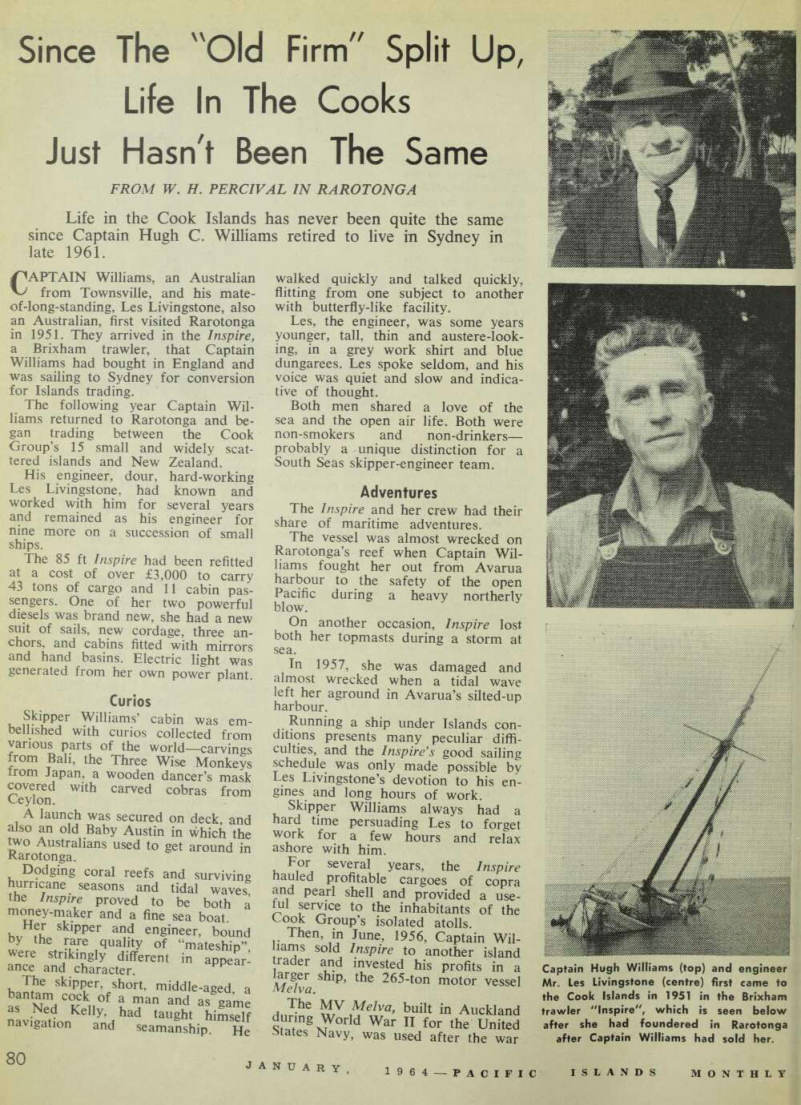
The skipper, short, middle-aged a bantam . “ ck , of a and as game as Ned Kelly, had taught himself navigation and seamanship H e
walked quickly and talked quickly, flitting from one subject to another with butterfly-like facility.
Les, the engineer, was some years younger, tall, thin and austere-look ing, in a grey work shirt and blue dungarees. Les spoke seldom, and his voice was quiet and slow and indica tive of thought.
Both men shared a love of the sea and the open air life. Both were non-smokers and non-drinkers— probably a unique distinction for a South Seas skipper-engineer team.
Adventures The Inspire and her crew had their share of maritime adventures.
The vessel was almost wrecked on Rarotonga’s reef when Captain Wil liams fought her out from Avarua harbour to the safety of the open Pacific during a heavy northerly blow.
On another occasion, Inspire lost both her topmasts during a storm at sea.
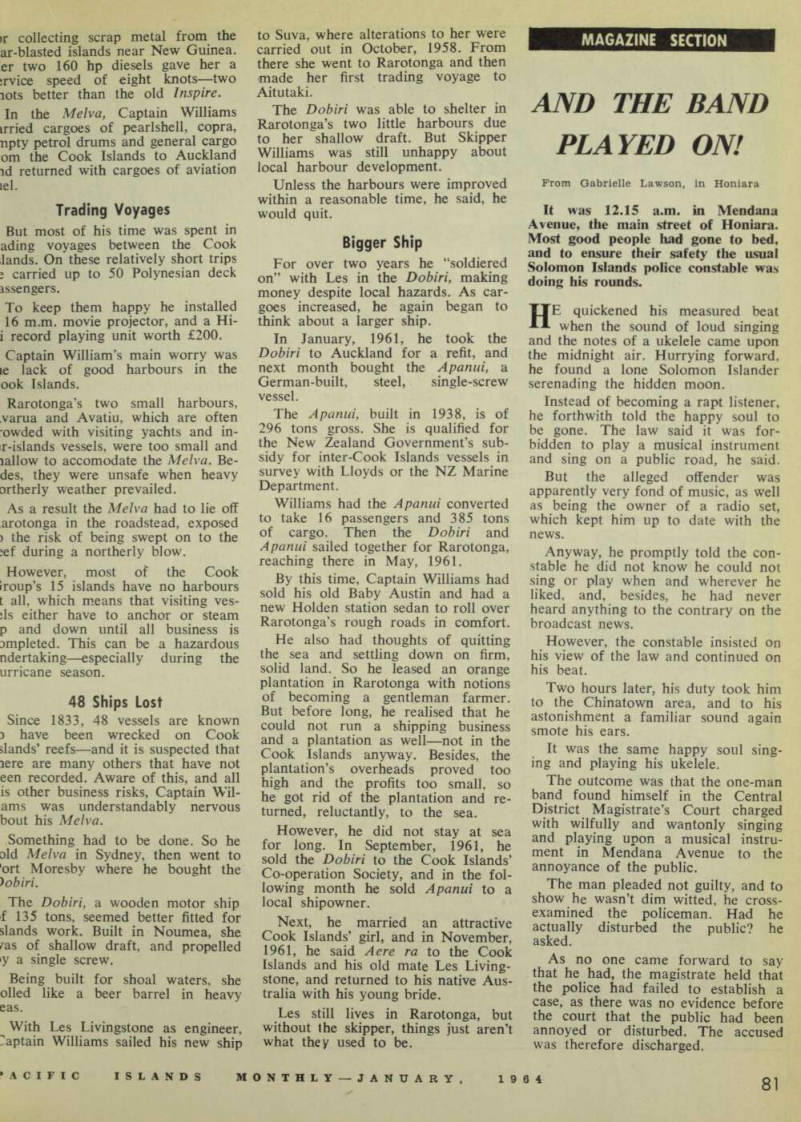
In 1957, she was damaged and almost wrecked when a tidal wave left her aground in Avarua’s silted-up harbour.
Running a ship under Islands con ditions presents many peculiar diffi culties, and the Inspire’s good sailing schedule was only made possible by Les Livingstone’s devotion to his en gines and long hours of work.
Skipper Williams always had a hard time persuading Les to forget work for a few hours and relax ashore with him.
For several years, the Inspire hauled profitable cargoes of copra and pearl shell and provided a use ful service to the inhabitants of the c °o* Group’s isolated atolls.
Then, in June, 1956, Captain Wil liams sold Inspire to another island trader and invested his profits in a arger ship, the 265-ton motor vessel Melva.
The MV Melva, built in Auckland I 1 ™ 8 World War II for the United Mates Navy, was used after the war
Captain Hugh Williams (top) and engineer Mr. Les Livingstone (centre) first came to the Cook Islands in 1951 in the Brixham trawler "Inspire", which is seen below after she had foundered in Rarotonga after Captain Williams had sold her.
»r collecting scrap metal from the ar-blasted islands near New Guinea, er two 160 hp diesels gave her a jrvice speed of eight knots —two lots better than the old Inspire.
In the Melva, Captain Williams irried cargoes of pearlshell, copra, npty petrol drums and general cargo om the Cook Islands to Aucldand id returned with cargoes of aviation id.
Trading Voyages
But most of his time was spent in ading voyages between the Cook lands. On these relatively short trips j carried up to 50 Polynesian deck assengers.
To keep them happy he installed 16 m.m. movie projector, and a Hi i record playing unit worth £2OO.
Captain William’s main worry was le lack of good harbours in the ook Islands.
Rarotonga’s two small harbours, varua and Avatiu, which are often owded with visiting yachts and in r-islands vessels, were too small and lallow to accomodate the Melva. Be des, they were unsafe when heavy ortherly weather prevailed.
As a result the Melva had to lie off arotonga in the roadstead, exposed ) the risk of being swept on to the jef during a northerly blow.
However, most of the Cook rroup’s 15 islands have no harbours t all, which means that visiting ves ds either have to anchor or steam p and down until all business is This can be a hazardous ndertaking—especially during the urricane season. 48 Ships Lost Since 1833, 48 vessels are known d have been wrecked on Cook dands’ reefs—and it is suspected that iere are many others that have not een recorded. Aware of this, and all is other business risks. Captain Wil ams was understandably nervous bout his Melva.
Something had to be done. So he □ld Melva in Sydney, then went to ’ort Moresby where he bought the dobiri.
The Dobiri, a wooden motor ship f 135 tons, seemed better fitted for slands work. Built in Noumea, she fas of shallow draft, and propelled •y a single screw.
Being built for shoal waters, she oiled like a beer barrel in heavy eas.
With Les Livingstone as engineer, Captain Williams sailed his new ship
to Suva, where alterations to her were carried out in October, 1958. From there she went to Rarotonga and then made her first trading voyage to Aitutaki.
The Dobiri was able to shelter in Rarotonga’s two little harbours due to her shallow draft. But Skipper Williams was still unhappy about local harbour development.
Unless the harbours were improved within a reasonable time, he said, he would quit.
Bigger Ship
For over two years he “soldiered on” with Les in the Dobiri, making money despite local hazards. As car goes increased, he again began to think about a larger ship.
In January, 1961, he took the Dobiri to Auckland for a refit, and next month bought the Apanui, a German-built, steel, single-screw vessel.
The Apanui, built in 1938, is of 296 tons gross. She is qualified for the New Zealand Government’s sub sidy for inter-Cook Islands vessels in survey with Lloyds or the NZ Marine Department.
Williams had the Apanui converted to take 16 passengers and 385 tons of cargo. Then the Dobiri and Apanui sailed together for Rarotonga, reaching there in May, 1961.
By this time, Captain Williams had sold his old Baby Austin and had a new Holden station sedan to roll over Rarotonga’s rough roads in comfort.
He also had thoughts of quitting the sea and settling down on firm, solid land. So he leased an orange plantation in Rarotonga with notions of becoming a gentleman farmer.
But before long, he realised that he could not run a shipping business and a plantation as well—not in the Cook Islands anyway. Besides, the plantation’s overheads proved too high and the profits too small, so he got rid of the plantation and re turned, reluctantly, to the sea.
However, he did not stay at sea for long. In September, 1961, he sold the Dobiri to the Cook Islands’
Co-operation Society, and in the fol lowing month he sold Apanui to a local shipowner.
Next, he married an attractive Cook Islands’ girl, and in November, 1961, he said Aere ra to the Cook Islands and his old mate Les Living stone, and returned to his native Aus tralia with his young bride.
Les still lives in Rarotonga, but without the skipper, things just aren’t what they used to be.