Magazine Section
pp. 79-81 · Read in the full issue
Pacific Islands Monthly
Famous Mission Schooner Played Heroic Role In Pacific War
By R. W. Robson, from material supplied by E. V. Tibbo
The ship which services the London Missionary Society’s stations in the South Pacific Islands always is called John Williams, after the famous pioneer missionary who was murdered in the New Hebrides about 125 years ago.
A NEW ship, named John Williams VII, was commissioned about a year ago for ervice in the South Seas—which, of course, leans that she was preceded by six other hips called John Williams.
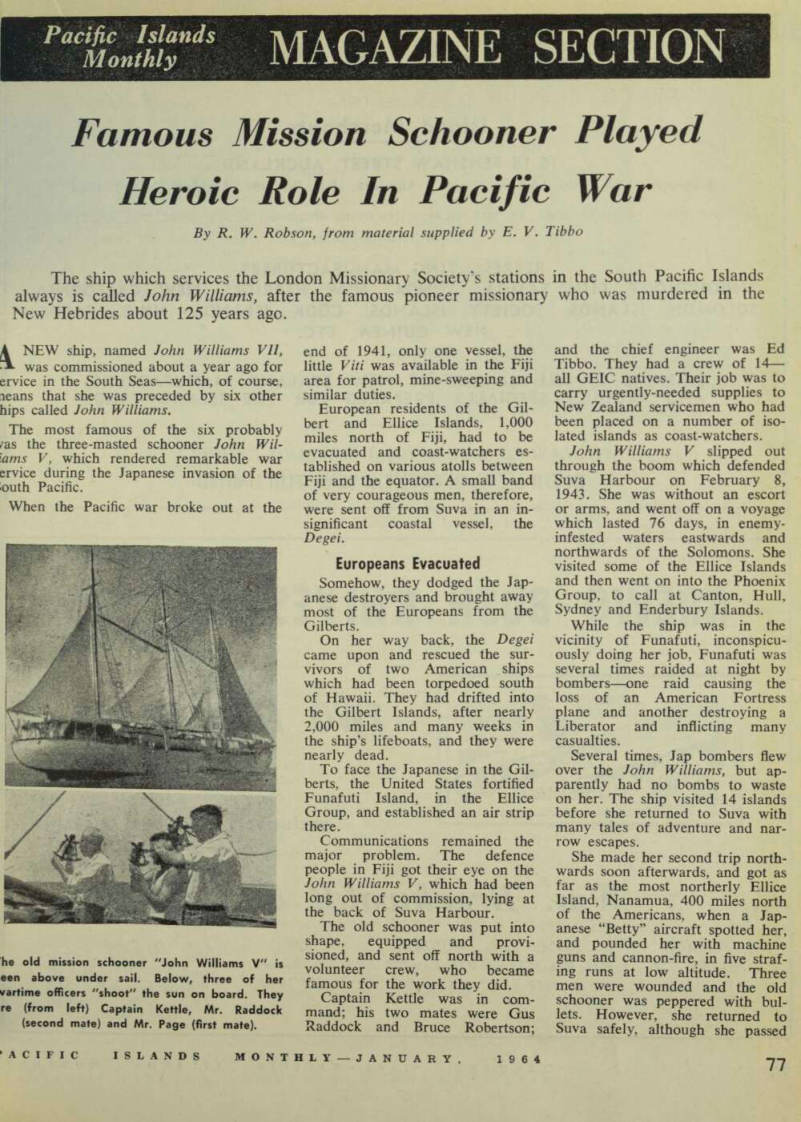
The most famous of the six probably /as the three-masted schooner John Wil iams V, which rendered remarkable war ervice during the Japanese invasion of the louth Pacific.
When the Pacific war broke out at the
end of 1941, only one vessel, the little Viti was available in the Fiji area for patrol, mine-sweeping and similar duties.
European residents of the Gil bert and Ellice Islands, 1,000 miles north of Fiji, had to be evacuated and coast-watchers es tablished on various atolls between Fiji and the equator. A small band of very courageous men, therefore, were sent off from Suva in an in significant coastal vessel, the Degei.
Europeans Evacuated
Somehow, they dodged the Jap anese destroyers and brought away most of the Europeans from the Gilberts.
On her way back, the Degei came upon and rescued the sur vivors of two American ships which had been torpedoed south of Hawaii. They had drifted into the Gilbert Islands, after nearly 2,000 miles and many weeks in the ship’s lifeboats, and they were nearly dead.
To face the Japanese in the Gil berts, the United States fortified Funafuti Island, in the Ellice Group, and established an air strip there.
Communications remained the major problem. The defence people in Fiji got their eye on the John Williams V, which had been long out of commission, lying at the back of Suva Harbour.
The old schooner was put into shape, equipped and provi sioned, and sent off north with a volunteer crew, who became famous for the work they did.
Captain Kettle was in com mand; his two mates were Gus Raddock and Bruce Robertson;
and the chief engineer was Ed Tibbo. They had a crew of 14— all GEIC natives. Their job was to carry urgently-needed supplies to New Zealand servicemen who had been placed on a number of iso lated islands as coast-watchers.
John Williams V slipped out through the boom which defended Suva Harbour on February 8, 1943. She was without an escort or arms, and went off on a voyage which lasted 76 days, in enemy infested waters eastwards and northwards of the Solomons. She visited some of the Ellice Islands and then went on into the Phoenix Group, to call at Canton, Hull, Sydney and Enderbury Islands.
While the ship was in the vicinity of Funafuti, inconspicu ously doing her job, Funafuti was several times raided at night by bombers—one raid causing the loss of an American Fortress plane and another destroying a Liberator and inflicting many casualties.
Several times, Jap bombers flew over the John Williams, but ap parently had no bombs to waste on her. The ship visited 14 islands before she returned to Suva with many tales of adventure and nar row escapes.
She made her second trip north wards soon afterwards, and got as far as the most northerly Ellice Island, Nanamua, 400 miles north of the Americans, when a Jap anese “Betty” aircraft spotted her, and pounded her with machine guns and cannon-fire, in five straf ing runs at low altitude. Three men were wounded and the old schooner was peppered with bul lets. However, she returned to Suva safely, although she passed
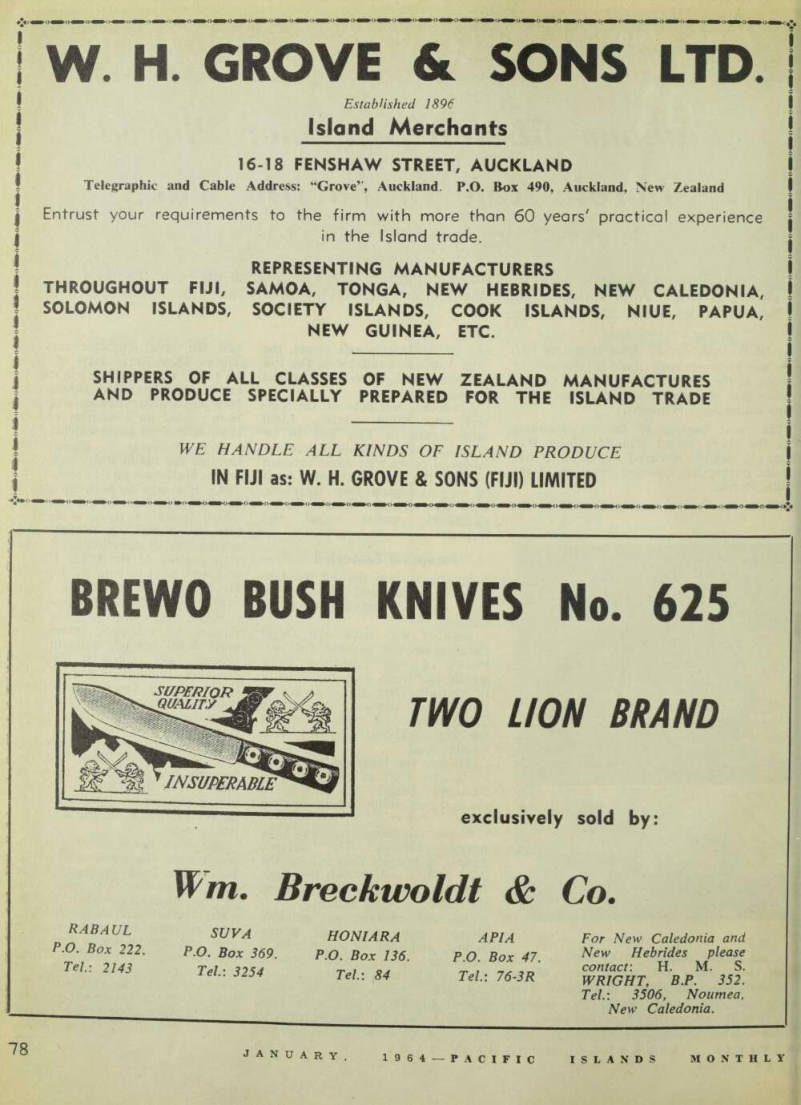
he old mission schooner "John Williams V" is [?]een above under sail. Below, three of her [?]vartime officers "shoot" the sun on board. They [?]re (from left) Captain Kettle, Mr. Raddock (second mate) and Mr. Page (first mate).
through an area where no less than five transports had been attacked a few hours earlier, only one of which limped into Suva.
To The Line Islands Another trip to nine of the Ellice Islands soon followed and then the 1W carried stores and much-needed equipment out to the Line Islands— Washington, Christmas and Fanning.
The JW had done three or four of these trips, when American forces captured Tarawa and drove the Japs DUt of the Gilberts. The old JW was then equipped to carry a medical sur vey team to all the 16 islands vacated by the Japanese. This job she carried 3ut while US planes flew over almost daily on bombing raids into the Mar shalls.
Tarawa was a dreadful sight after :he cruel battle there, and the JW men saw how hundreds of bodies of Koreans and Japanese—and one sup poses a few Americans—had been 3ulldozed into the coral sand. They learned how the Japanese, in retalia tion for the American bombing of Tarawa, had lined up 22 helpless prisoners—five old residents of Tarawa and 17 New Zealand Coast watchers whom they had captured— and beheaded them. It was one of the foulest crimes of World War 11, A gallant Australian, Reg Morgan,
was butchered there before he could receive the George Medal awarded him for great gallantry in operating his mobile radio station.
The John Williams V returned to Suva a fpw davs before the Pacifie Suva a tew days before the Pacific
War ended. She had served the armed forces for 2\ years, traversing thousands of square miles without escort or armaments, except an American .45 revolver and 2,000 cartridges, which were scrounged by Mr. Tibbo, the engineer, from the American store at Funafuti.
Ran Aground
After the war, the old schooner went back into Mission service, but soon afterwards she ran aground on Savaii,Western Samoa, and was lost.
Mr. Tibbo says he has no idea where Captain Kettle now is. “I also have lost sight of Captain Bill Page,” he says. “Captain Page left us on transfer to an American destroyer, so that he could navigate the first US destroyer into Tarawa, for which he got the Bronze Star.
“On that trip, we had Captain Harry Gosling, who became ill before we got to Funafuti, and had to be flown back to Suva.
“Gus Raddock is still the Union Co. head-stevedore at Suva; and I am a resident of Mount Albert, Auck land.”
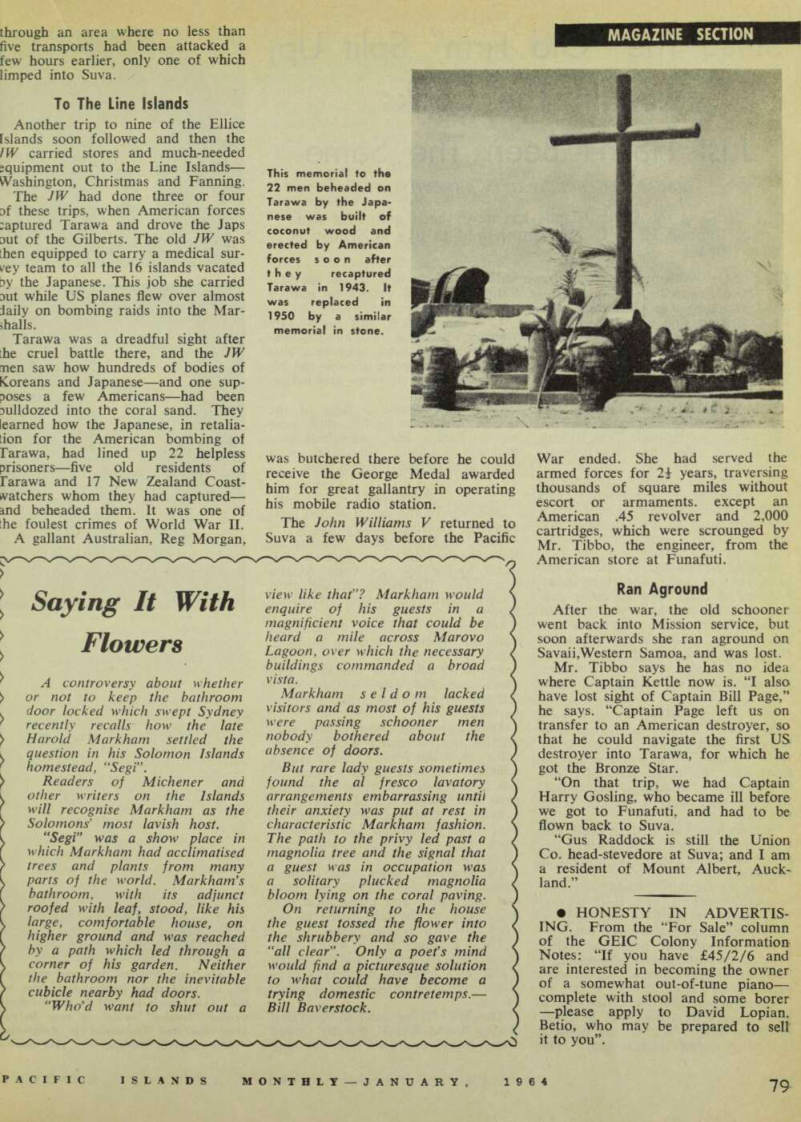
This memorial to the 22 men beheaded on Tarawa by the Japa nese was built of coconut wood and erected by American forces soon after
they recaptured
Tarawa in 1943. It was replaced in 1950 by a similar memorial in stone.