Vital That South Sea
pp. 65-71 · Read in the full issue
Skills Be Preserved
By a Staff Writer
Unless the products of the skilled native craftsmen of the South Pacific can be developed so they will be of worthwhile economic value to the craftsmen, the traditional skills will be lost. The loss will be gradual, but it will be certain.
AT the moment, fortunately, there is almost an infinite wealth of handcraft skills still being practised in the South Pacific, and a large proportion of them with only minor adaptations are suitable for sale abroad.
However, the Melanesian cultures, which have an extraordinary variety of artifacts and art forms, appear to lose their skills more rapidly than Polynesian cultures, and generally little has been done by administra tions anywhere to develop the skills economically.
Economic Help
There are, of course, some excep tions to this, but a greater awareness is needed by Pacific territories of the skills within their midst. Apart from the vital consideration of keeping them alive, they can be a useful aspect of any territory’s economy.
The Social Development section of the South Pacific Commission has been taking a close interest in the whole subject in the last 12 months, with the result that Mr. Angus Mcßean, Social Development Assis tant. who has had a great deal of ex perience with the marketing problems
of native artifacts, spent the greater part of 1963 making the first com prehensive survey of the position.
What he has to say about it all is of interest and importance.
20,000 Miles
From January last year until Oc tober Mr. Mcßean travelled about 20,000 miles around the South Seas by public transport (including 15 air craft and seven small vessels), and in addition covered hundreds of miles on foot and by canoe. Twice his canoes were swamped in heavy seas and on one occasion he was swept off into the surf by a rising tide.
He visited in all 56 islands and more than 200 villages, holding meet ings in most of the villages.
He was back in Noumea in Octo ber long enough to see his report ac cepted by the 25th session of the South Pacific Commission, and then he was off again to wind up his full survey by the end of 1963.
In addition to his general report to the SPC, summing up his overall im pressions, Mr. Mcßean has already provided Island administrations with detailed reports of the situation in their own territories. These individual
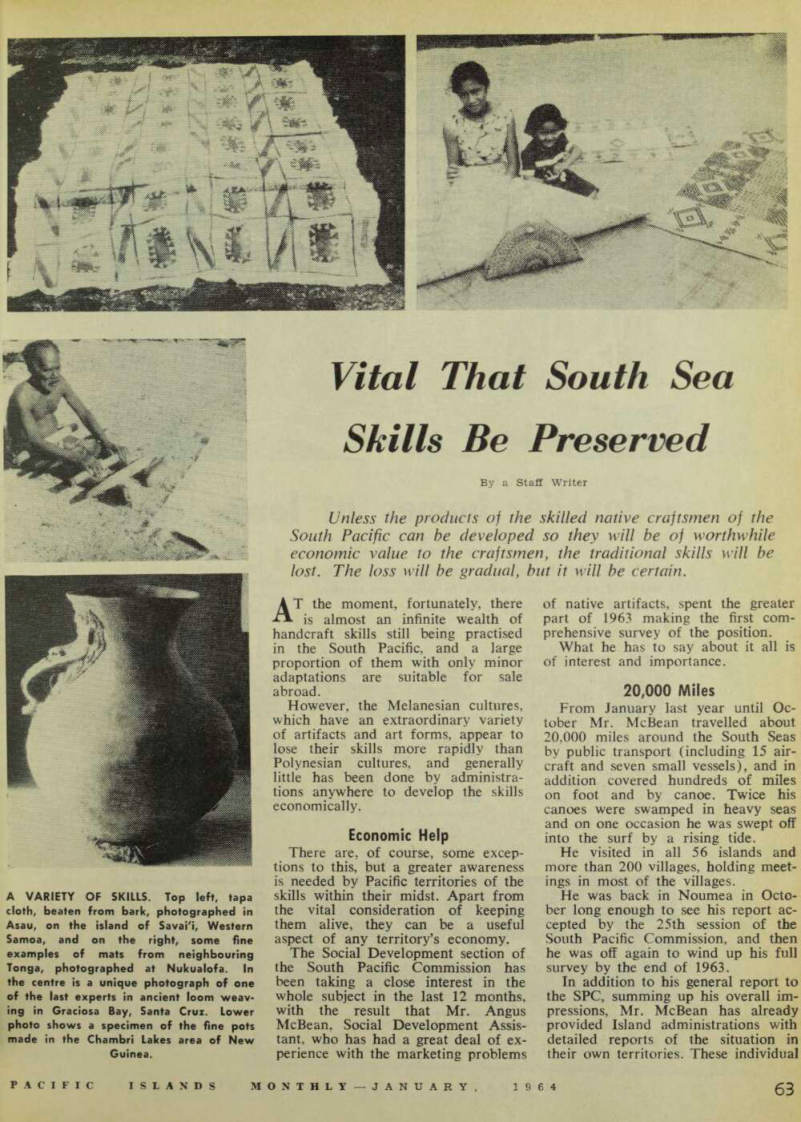
A VARIETY OF SKILLS. Top left, tapa cloth, beaten from bark, photographed in Asau, on the island of Savai'i, Western Samoa, and on the right, some fine examples of mats from neighbouring Tonga, photographed at Nukualofa. In the centre is a unique photograph of one of the last experts in ancient loom weav ing in Graciosa Bay, Santa Cruz. Lower photo shows a specimen of the fine pots made in the Chambri Lakes area of New Guinea.
sports give valuable information on larketing possibilities, any modifica ons needed to artifacts and detailed iformation on the development of rafts within the territories.
To show the commercial world just hat is available from South Seas •aftsmen, the Commission has greed to sponsor, at Mr. Mcßean’s iggestion, a high-class sales cata )gue to be distributed widely to hambers of Commerce, large de artment stores, agents and other in rested firms and organisations in ic main metropolitan countries of ic SPC area.
This free brochure will include )lour photographs (Mr. Mcßean has ken hundreds) and will describe, rritory by territory, the main arti icts and their approximate price, id commercial details such as eighting problems and costs.
However the SPC wants the Island [ministrations to help with the costs production, and since the cost ould probably work out at no more an £lOO for each territory it’s not pected that any of them will decide )t to be in it. Such a booklet would ing in orders worth thousands to en the smallest territory.
The important thing now is to get e catalogue out, and production ap irently is well organised and merely /aits the final financial approval, lich depends on how quicldy the rious territories move.
Mr. Mcßean found the weaving of getable fibres was one of the most dely spread skills of the Pacific, th examples seen from the swamp lages of New Guinea’s Sepik to the iy coral islets of the Tokelaus.
Some of it, notably the fine mats the Samoas, is of “almost incred e” delicacy, and other examples, ch as the string bags of New linea and the Solomons, are of ex lordinary strength.
The pandanus is the most widely used fibre, but people also use the coconut leaf, vine tendrils, coconut fibres, the bark of trees and banana palms and even the skin of the sago palm leaf.
For dyes, the bark, leaves and roots of many different plants are used, in processes that are often jealously guarded secrets. But Mr.
Mcßean thinks it is regrettable that many of these natural fast dyes are being replaced by gaudy trade store dyes. Even a good deal of mercuro chrome and “Gentian Violet” from local hospitals, and purple carbon paper from administrative offices, now finds its way into the dye pots of the village weavers.
Such a diversity of articles are made that not all of them would have commercial value (for instance, the anti-mosquito sleeping bags of New Guinea, made of bark fibres and big enough for a whole family to sleep in at night!). But many can be modified.
Mr. Mcßean saw some lobster traps of such a design and of such materials that they could be produced as attractive lamp-shades.
Tapa making is not known in some territories and in others where it once flourished the skills have almost been lost. In some others it is still an in tegral part of life.
There is an infinite variety of wood carving skills in the Pacific, especially
[?]ji women making pottery in the Sigatoka area of the main island of Viti Levu.
in Melanesia, where some of the car eers are artists rather than artisans, iome of the best available is in the Solomons and parts of the Sepik dis rict of New Guinea.
Pottery making is confined to a •datively small number of islands, Hit even with extremely primitive echniques, some areas, such as the -hambri Lakes, in New Guinea, pro luce articles of “consummate interest md artistic sense”.
All these are the main forms of landicraft, but in addition there is a mge array of articles in Polynesia md Fiji, of polished shell, of items nlaid with silver, intricately ashioned spears with barbs of splin ted bone, “bride money” of many ypes, shell necklaces and armlets.
European Modifications
here are modifications of European kills seen in the bead work of Wallis nd Futuna and other groups, in the •atchwork quilts (ti fai fai) of Tahiti, he hand-painted or silk screened ress fabrics of Western Samoa and 'ahiti and the engraved shell of the rtisans in Tahiti and Fiji.
Some of these items have curiosity iterest only, or are too bulky or too ragile to pack commercially. Mr. tfcßean’s catalogue would list ob ;cts with intrinsic interest created by heir beauty or usefulness or a com ination of both. The sale of curios nd souvenirs, he believes, is best left i the “able hands” of local vendors ealing directly with tourists.
He made no new discoveries of uitable objects for the market in reas where catering for the tourist
The yam masks of Maprik, NG, above, of woven fibres plastered with clays in earth colours, would look fine in miniature. At right, the women of Buin, Bougainville, make "Buka" basketware. Below, a women's committee at Faka'ofo in the Tokealau Islands, weaves fine mats, and at the bottom are some of the fine mats, fans, skirts and basketware, with their makers, at Funafuti in the Ellice Islands. All photographs in this report were made available by Mr. Angus McBean, of the SRC.
ias long been firmly established. This particularly applies to the Polynesian slands.
But in some parts of Melanesia md Micronesia, little or nothing has peen done to promote the sale of arti facts and he found great possibilities 'or new development.
He found frequently that an arti :act, such as a food bowl or a Sepik nask, needed only to be reduced in ize to be ideal for sale.
Sometimes, however “miniaturisa ion” had been tried out but exag gerated, so that model canoes or veapons were little more than toys md lacked atmosphere. They were >ut of proportion in their fittings.
Even in the least sophisticated areas Tr. Mcßean found himself warning igainst the mixing of styles. Gaudy European dies were used on woven vear; model canoes were painted vith house paint and fringes of prightly coloured wool were added to l mat which otherwise was austerely :orrect and beautiful.
Sometimes he found that an arti act on which a lot of labour had )een expended lost its value because t wasn’t finished off properly, baskets of intricate woven design vere fitted with flimsy and insecure landles or a delicate wood carving vould be roughly daubed with cheap r arnish or would show chisel marks; i bead necklace with hundreds of hells, each of which had been care ully sorted and drilled, would be trung on a thread of cotton so light hat it would break the first time the lecklace was worn.
New "Discoveries"
On the other hand, fine mats and gaskets of river grasses in New juinea, artifacts of incised and en- Taved bamboos and products of /oven or plaited sago palm leaf terns, were among the handicrafts he ound had never been put before even local market to any great degree.
Mr, Mcßean found that in Mela esian areas where populations were >nly a generation or so removed rom the first impact of the outside /orld, there was a fascinating wealth f highly developed skills.
Yet in other areas of Melanesia /here the population had become fiore sophisticated, the handicraft icture presented almost an arid esert. This wasn’t so in the Poly esian territories, where most of the ncient skills were still proudly and onsciously retained as a part of the fe of the people, even though they /ere also valuable as sources of in ome.
Mr. Mcßean asks: “The reasons or this might be hard to define. Is
it because Melanesian society lacks the cohesive, communal quality which is partly responsible for maintaining such handicrafts as mat-weaving or the carving of kava bowls within Polynesian society?
“Is it that many of the Melanesian handicrafts, notably wood-carving, were intimately connected with a re ligion that has been abandoned and of which the present generation is perhaps ashamed?
“Have outside organisations such as missions or administrations failed to encourage and support these skills in the way that they were encouraged and supported by analagous bodies in the Polynesian world?
“Or is it a lack of self-confidence
among the Melanesians themselves which has caused them to abandon their handicrafts just as they have abandoned their own singing and dancing in those areas that have been most exposed to European influence?
“It is not within the competence or the functions of my survey to make any attempt to answer these questions; but the point is raised so that the danger of extinction of han dicrafts within Melanesia can be fully realised and steps taken, if adminis tering governments so desire, to en courage the development of these handicrafts before it is too late.
“There are one or two Melanesian territories where already almost noth ing is left of the traditional culture.”