Prosperous Norfolk Is.
pp. 43-47 · Read in the full issue

Tourist Boom Brings Opportunities
Fortunes Go Begging On Prosperous Norfolk Is.
By Staff Writer Robert Langdon.
Norfolk Island, Australia’s pleasant Pacific outpost of green, undulating hills, grim and romantic history, duty-free goods, sheer cliffs and towering pines, has been struck by a tourist gold rush.
7TTH increased publicity abroad, ' additional accommodation, and ra air services, tourists are flock to the island at the rate of about a month, compared with 55 a nth in 1959-60, and their numbers still increasing.
Directly or indirectly, the tourists writing out the pay cheques for riost every person on the island, be ise, with the collapse of the whal ; industry and the closure of the ?le station a year or so ago, Nor k now has virtually no source of ome other than the tourist in stry.
The tourist industry is doing so 11 that the Norfolk Islanders are >re prosperous now than they have ;r been.
Tet fortunes (small ones) are go ! begging simply because many of : people lack either the enterprise, jrgy or inclination to cash in while : going is good.
The most obvious fortunes that no e is making are to be made in the )d line —providing the necessary
meat, fish, eggs, vegetables and fruits for all the hungry tourists.
Another potential “gold mine” is a laundry and dry cleaning business, something that Norfolk lacks.
Anything Grows
Sufficient meat, fish, eggs, fruit and vegetables for present needs could probably easily be produced on the island, as Norfolk is a land where almost anything will grow and the waters around it abound in fish.
At present, however, only a frac tion of the food needed on the island for the tourist trade is being produced there. For example, the Kingfisher Airtel, Norfolk’s newly-opened 70bed hotel, expects to import about 65 per cent, of the food that will be cooked in its kitchen.
Mr. Max Freyer, the Kingfisher’s extremely food-conscious manager, becomes quite miserable whenever he thinks about the difficulty of obtain ing food in such a land of milk and honey.
“There is a shortage of meat,” he
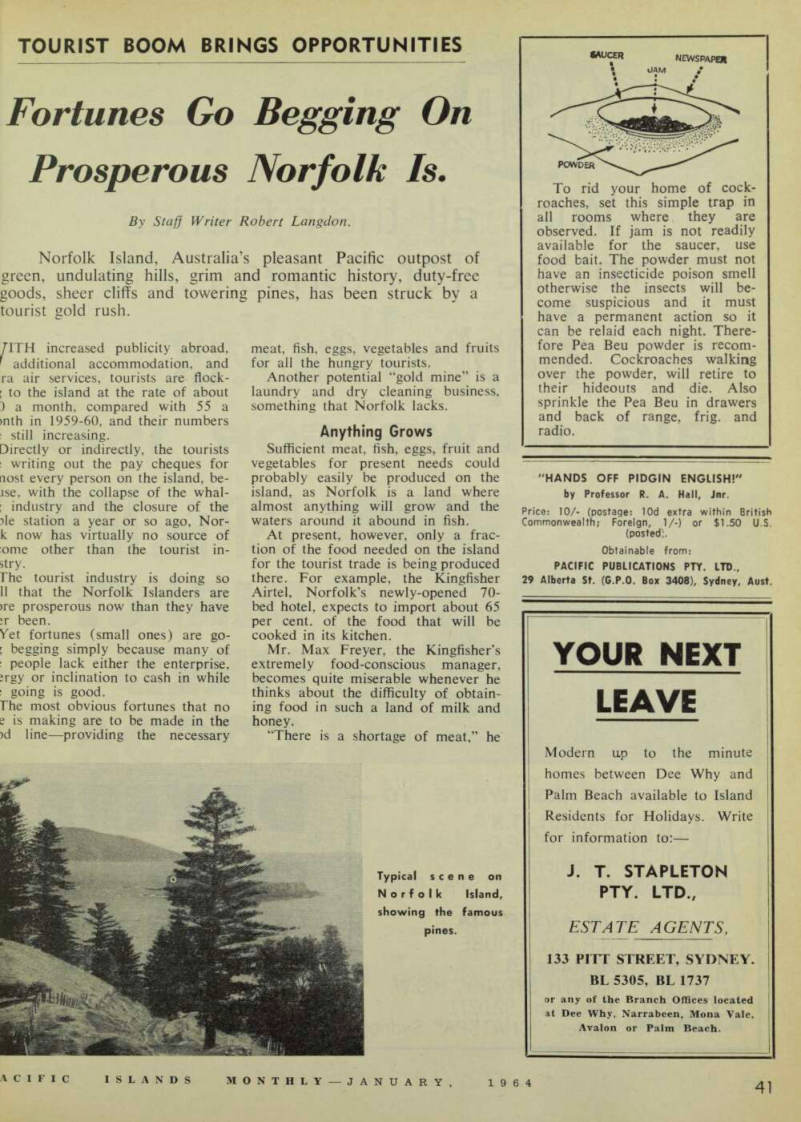
Typical scene on Norfolk Island, showing the famous pines.
ys. “No ham, no veal and no mut n. Everything we need in that line, ; have to import from New Zea id.
“When the sea is rough, we cannot t enough fish—although this situa m will not apply when the new mpany, Norfolk Island Fisheries d., begins freezing fish in a bigger iy “Eggs are at a premium, so I have d to arrange with Qantas to air fight our needs from New Zealand, reckon on taking about 300 dozen week.
“There are very few oranges, and pies are almost non-existent.
“At present, I find it hard to get :h things as rhubarb, lettuce and ives, although I have made rangements with a number of local Tners and gardeners to supply our eds in the future.”
Mr. Freyer might also have men ned a shortage of chickens, pota is, and beans, and possibly several ier vegetables and fruits.
Shortages
But his list of shortages is an im sssive one, when one bears in mind at the Kingfisher is only one among /eral hotels and guest houses on arfolk with the problem of feeding arists, and that more accommoda n to cater for more tourists will □bably be built in the next 12 anths or so.
This new accommodation includes: • A hotel at Kingston, which, ini lly, would accommodate 60 guests d a staff of 20, and could be ex ided to accommodate a further 40 ests. • A group of 40 holiday flats at rnt Pine, to be built in stages in >cks of four. • A 50-bed motel-style guest use to be built at Redleaf, near : entrance to the airport.
All this new accommodation, plus aposed extensions at the Kingfisher rtel, will provide almost twice as my beds for tourists on Norfolk exist at present.
Phis will mean that whereas about 3 tourists can now be accommo ted at one time, there will be beds ; something like 400 when the new ildings are put up.
Fherefore, unless something is ae quickly about producing more ad locally, there will be an even :ater shortage of the basic foods : ore the year is out.
Local food prices would thus prob y become higher; and more, ex isive overseas foodstuffs would /e to be imported. These factors uld increase the cost of a holiday Norfolk, and so the island would
lose one of its attractions—its cheapness—which entices tourists there now.
Chances for Islanders Generally speaking,he people who £ J n oor.ha^ S U P S° n ne t e°ds Pr forTs tourist trade are the 300-odd descendants of the Bounty mutineers. the island as the islanders —everyone else being a “mainlander” from Australia, New Zealand, etc.—make up just under half of Norfolk’s population. They own most of the land that is not Crown land, and they have a long tradition of being farmers, gardeners and fishermen.
However, the islanders have never been commercially-minded people, and, probably because of their Tahitian ancestry, they have never had much inclination for regular work.
Thus, even if they have seen the opportunities for making money out
of the tourist boom, they have not done anything about it.
Some of them, moreover, are op posed to the development of the tourist industry on the ground that and unhurried way of xhis ■ an understandab i e view point, but rational fee . cause, unless Norfolk’s tourist in . ’ • , , , , • . nA • «. 7 7 li' f ‘ S ? d ‘
il, fashion V ‘
thmg but prlmltlve fashlon '
Government Subsidy
In fact, without a Commonwealth Government subsidy (£32,500 last year) and without revenue from post age stamps sales (£23,500), Nor folk Islanders would probably have had to pack up long ago and move to either Australia or New Zealand.
As Norfolk’s Administrator, Major- General R. H. Wordsworth, con-
stantly tries to impress on peoplil every industry that the island has pn viously tried has failed, mainly bw cause its products cannot be place anywhere competitively because of ii remoteness from the rest of tb world.
For instance, the distance betwee Australia and Norfolk (930 miles immediately adds £l7/10/- a ton i freight to any product, and lighteraq adds another 37/- a ton. MoreovvO Norfolk Island does not produce am thing that is not produced in Aui tralia.
“It is therefore quite plain,” Majoc General Wordsworth says, “that it no use trying to take Norfolk’s gooo to market. So the only answer, Norfolk is to survive, is to bring th market to the goods. I am thus firmi convinced that the future of thr island depends on tourists.”
However, Major-General Word! worth has no wish to see Norfof Island turned into another Gox Coast.
This was a point he strongs stressed, and which brought man hear-hears, when he officially openei the Kingfisher Airtel on December before a crowd of 200 guests.
Atmosphere
“We have a beautiful island hen with an atmosphere which I thin must be preserved,” he said. “It h:i a good climate and a very friend! people. It is quiet and has a sloo tempo of life.
“It is eminently suitable for a hole day for a tired business man or s elderly couple, as we do not have tHi attractions for young people wH want to dance every night.”
Major-General Wordsworth saa that in due course, the Kingfishtri Airtel would have squash courts, , golf course, tennis courts and a chas
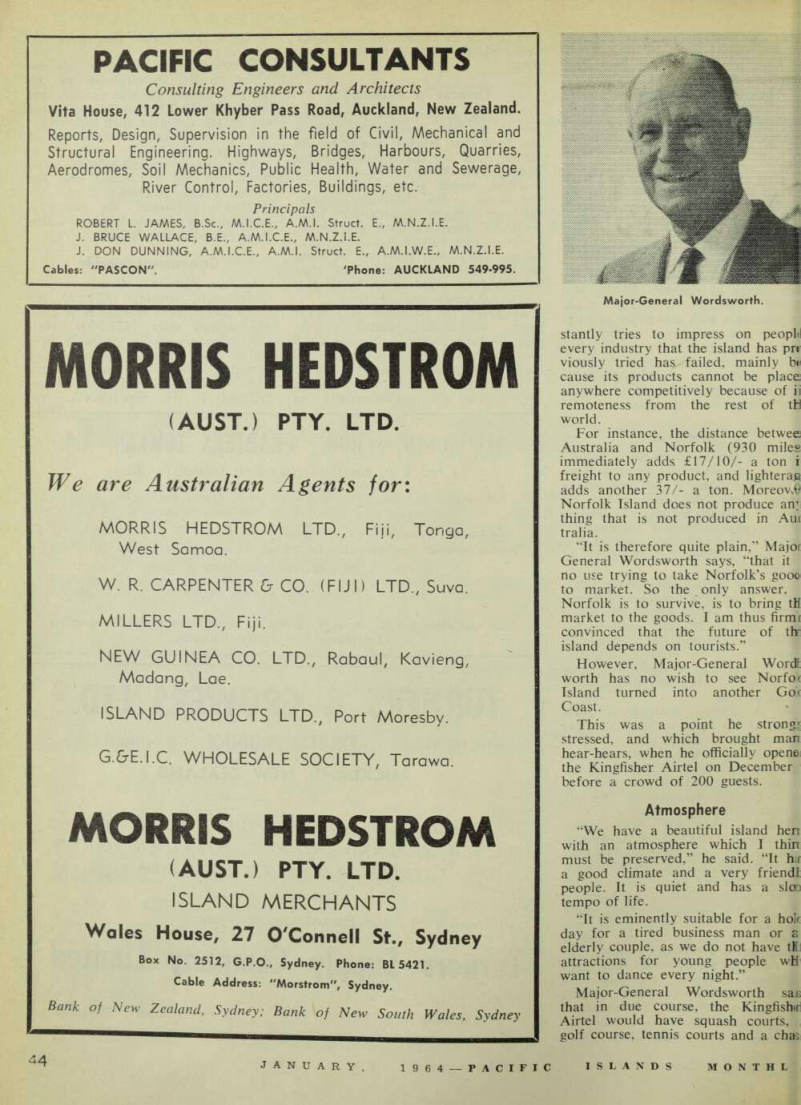
Major-General Wordsworth.
ft down the 300 ft cliff to Anson ay beach.
“But,” he added, turning to King >her’s directors, “do not overdo it id have too many glittering lights id too much Gold Coast.
“The combination of what we have sre now is something I beseech you Dt to disturb.”
However, despite what Major general Wordsworth said, Norfolk iland is changing—though not neces irily for the worse. For example: • Five of the 50-odd miles of lotorable roads on the island have sen sealed in the past few years, ad about another mile is to be ;aled in the next six months.
• The number of motor vehicles is constantly increasing, and most of them are modern. (At June 30, 1963, there were 356 vehicles compared with 325 the year before.) • More and more houses are being supplied with electricity, and are thus able to be equipped with washing machines, refrigerators, and other mod. cons.
• An expert from the Postmaster- General’s Department is to visit the island soon to investigate the possi bility of installing an automatic telephone exchange, capable of serv »ng 10 ? subscribers. This would re- Pl a ? e I* 16 existm g manual exchange, which is only open in business hours, anc * which serves no more than half a dozen pnvate houses.