Larger Advisory
pp. 32-33 · Read in the full issue
Progress Seen In All Fields
Council For The
New Hebrides
The New Hebrides Advisory Council is to be enlarged from 18 to 24 members, and members will serve for two years instead of one as previously.
THE British and French Resident Commissioners announced this when they opened the seventh session of the Advisory Council in a joint speech in Vila on December 3.
The Commissioners are Mr. A. M.
Wilkie (British) and Mr. M. De launey (French), who also an nounced that some of the private members of the Council would be elected by important organisations in the New Hebrides instead of being nominated by themselves (the Com missioners). [Until now, the Advisory Council has consisted of 16 nominated private members and two official members— the Condominium Treasurer and the Superintendent of Works. Of the 16 private members, four have been British, four French, and eight New Hebridean.] Referring to the Condominium Budget for 1964, the Resident Com missioners said that, despite “severe economies”, estimated expenditure had been fixed at £Stg.7BB,ooo com pared with £697,000 in 1963. Esti mated revenue was £Stg.7oB,ooo, making it necessary to find £BO,OOO to balance the Budget.
To obtain the outstanding sum, the Resident Commissioners proposed tJ introduce a proportional tradim licence fee, which would vary accord ing to the total value of imports am exports handled by traders, am would replace the present fixed rati licence.
It was also proposed to calculati copra export duty on a true FOj value, instead of the present artificis one, which was less than the tnu FOB value.
Adjustments would also be made ii the Customs tariff, involving increase in some non-essential items, but re ductions on captial investment good) and agricultural equipment. Finally to complete the sum of £BO,OOO, small sum would be withdrawn fron reserves.
Protection of Copra The Resident Commissioners sail that, with the continued reduction o French import duty as a result o Common Market arrangements, thd protection of New Hebrides copra oc the Marseilles market was rapidll coming to an end.
The quality of New Hebrides copn must therefore be improved if itri future was to be assured, and a tern of grading was essential fct achieve this improvement.
The Resident Commissioners sail that despite uncertainties of price anai attacks on trees by parasites, the ex? port of copra from the New Hebrides for the year 1963 was expected tJ reach the record figure of 36,00*0
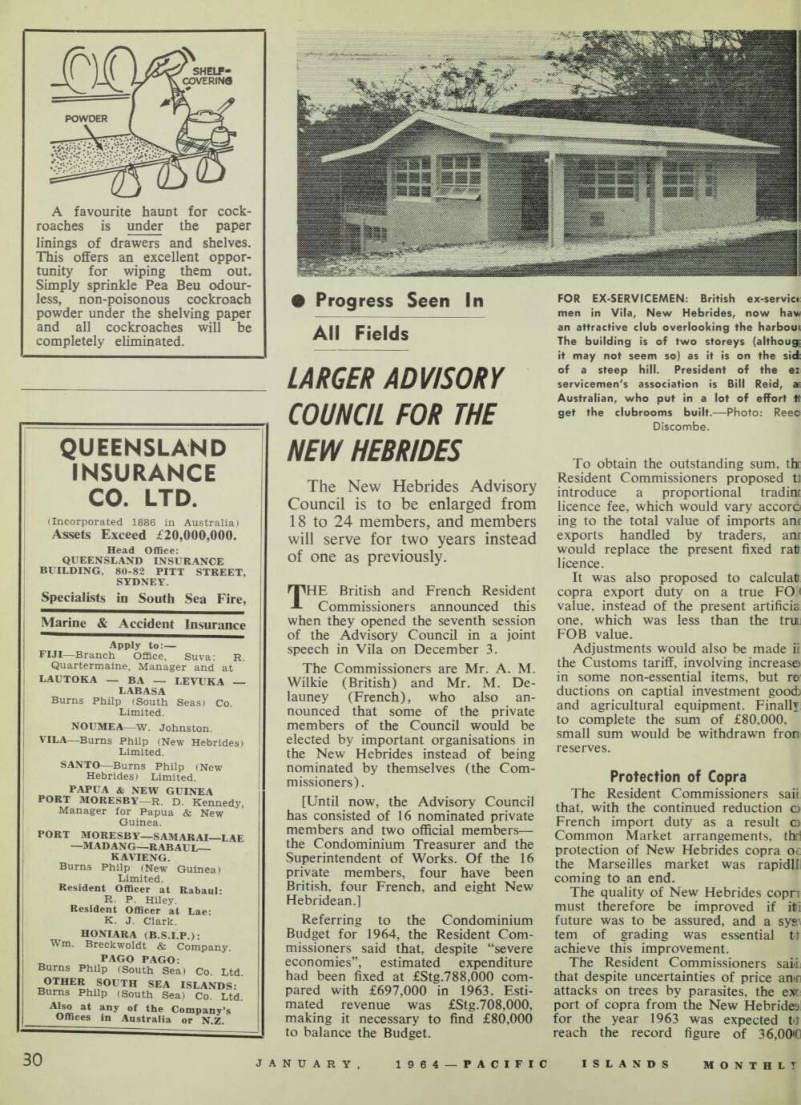
FOR EX-SERVICEMEN: British ex-servic[?] men in Vila, New Hebrides, now haw an attractive club overlooking the harbou[?] The building is of two storeys (although it may not seem so) as it is on the sid of a steep hill. President of the e[?] servicemen's association is Bill Reid, a[?] Australian, who put in a lot of effort t[?] get the clubrooms built. Photo: Reeo Discombe.
is. (This is 1,000 tons more than ; previous record in 1959.) Speaking of the premature fall of conuts, which has affected copra oduction on many plantations, the isident Commissioners said that a jlti-purpose team of experts, includ l entomologists, soil specialists, mt pathologists and plant geneti its, would be sent to the New Heb les by the French Institute of :eania (Institut Francais d’Oceanie) rly in 1964 to investigate the causes the nutfall, which might not be e only to the insect Axiagastus mpbelli, hitherto suspected of being j cause.
They said that despite marketing ficulties at the beginning of the ar, exports of manganese for the ar to December 31, 1963, were ex cted to reach 30,000 tons, corn red with 15,000 tons in 1962. [ln their speech to the Advisory >uncil in December, 1962, the Resi nt Commissioners estimated that mganese exports for 1963 would al 60,000 tons.] The Commissioners said that the la fishery, the third important arce of wealth in the archipelago, d run into “certain difficulties”, but 5 export tonnage for 1963 was ex cted to be about the same in 1963 in 1962 (4,700 metric tons).
Report on Tuna An expert from the South Pacific >mmission had examined the prob ns of tuna fishing in the area in dober and his report, expected in nuary, was expected to indicate lat steps could be taken to improve j present situation.
Other points made by the Resident mimissioners were that:— • Of 15,000 children of school e in the Group, 12,000 (80 per nt.) were now going to school, mpared with 75 per cent, in 1962 d 55 per cent, five years ago. • The exploitation of timber on
Erromanga and the export of frozen beef from Vila and Santo were new industries of promise in the New Hebrides. • Several important companies had shown interest in establishing cocoa and pineapple plantations in the New Hebrides, and the first posi tive steps towards getting the indus tries started were likely soon.
The Resident Commissioners added: “We have the best of reasons for being reasonably optimistic about the future of our archipelago. Despite setbacks, we find resolute progress in all fields of activity—political, social and economic.”