Tropicalities
pp. 17-22 · Read in the full issue
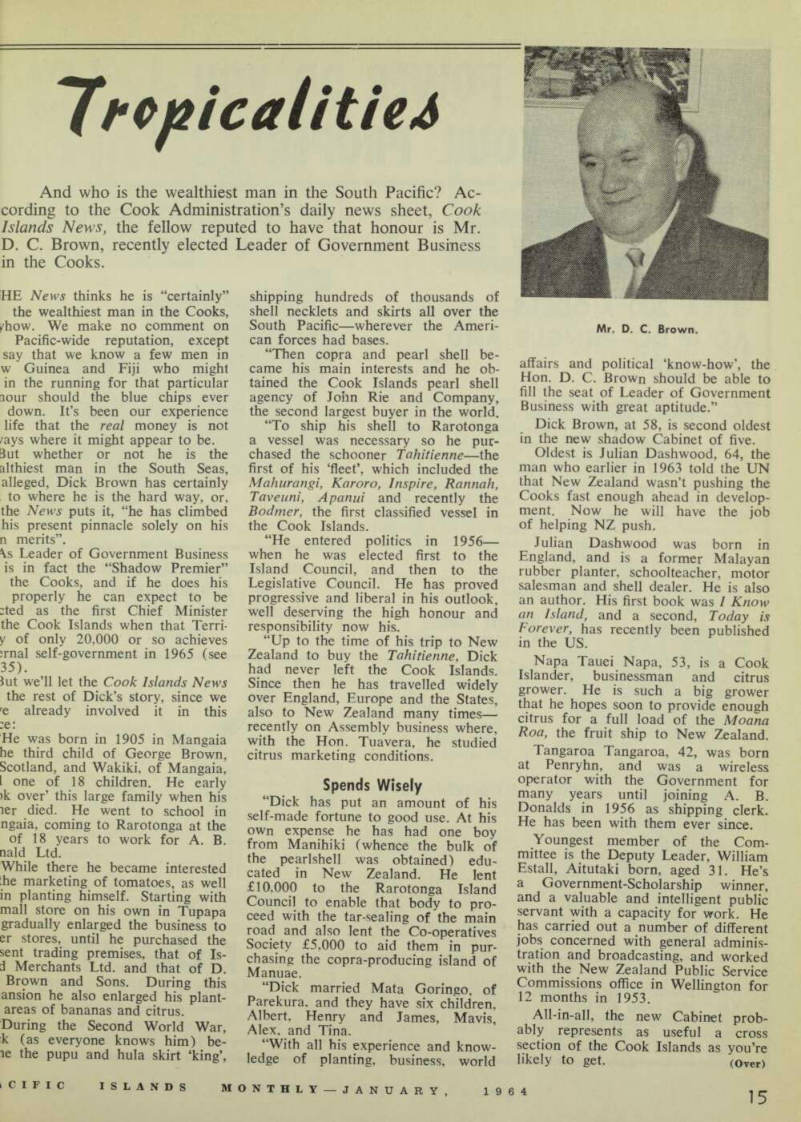

And who is the wealthiest man in the South Pacific? Ac cording to the Cook Administration’s daily news sheet, Cook Islands News, the fellow reputed to have that honour is Mr.
D. C. Brown, recently elected Leader of Government Business in the Cooks.
HE News thinks he is “certainly” the wealthiest man in the Cooks, We make no comment on Pacific-wide reputation, except say that we know a few men in w Guinea and Fiji who might in the running for that particular lour should the blue chips ever down. It’s been our experience life that the real money is not /ays where it might appear to be.
But whether or not he is the althiest man in the South Seas, alleged, Dick Brown has certainly to where he is the hard way, or, the News puts it, “he has climbed his present pinnacle solely on his n merits”. \s leader of Government Business is in fact the “Shadow Premier” the Cooks, and if he does his properly he can expect to be :ted as the first Chief Minister the Cook Islands when that Terri y of only 20,000 or so achieves ;rnal self-government in 1965 (see 35). lut we’ll let the Cook Islands News the rest of Dick’s story, since we r e already involved it in this :e: He was born in 1905 in Mangaia he third child of George Brown, Scotland, and Wakiki, of Mangaia, I one of 18 children. He early )k over’ this large family when his ier died. He went to school in ngaia, coming to Rarotonga at the of 18 years to work for A. B. nald Ltd.
While there he became interested fie marketing of tomatoes, as well in planting himself. Starting with mall store on his own in Tupapa gradually enlarged the business to er stores, until he purchased the sent trading premises, that of Is i Merchants Ltd. and that of D.
Brown and Sons. During this ansion he also enlarged his plant areas of bananas and citrus.
During the Second World War, k (as everyone knows him) be le the pupu and hula skirt ‘king’,
shipping hundreds of thousands of shell necklets and skirts all over the South Pacific—wherever the Ameri can forces had bases.
“Then copra and pearl shell be came his main interests and he ob tained the Cook Islands pearl shell agency of John Rie and Company, the second largest buyer in the world.
“To ship his shell to Rarotonga a vessel was necessary so he pur chased the schooner Tahitienne —the first of his ‘fleet’, which included the Mahurangi, Karoro, Inspire, Rannah, Taveuni, Apanui and recently the Bodmer, the first classified vessel in the Cook Islands.
“He entered politics in 1956 when he was elected first to the Island Council, and then to the Legislative Council. He has proved progressive and liberal in his outlook, well deserving the high honour and responsibility now his.
“Up to the time of his trip to New Zealand to buy the Tahitienne, Dick had never left the Cook Islands.
Since then he has travelled widely over England, Europe and the States, also to New Zealand many times— recently on Assembly business where, with the Hon. Tuavera, he studied citrus marketing conditions.
Spends Wisely
“Dick has put an amount of his self-made fortune to good use. At his own expense he has had one boy from Manihiki (whence the bulk of the pearlshell was obtained) edu cated in New Zealand. He lent £lO,OOO to the Rarotonga Island Council to enable that body to pro ceed with the tar-sealing of the main road and also lent the Co-operatives Society £5,000 to aid them in pur chasing the copra-producing island of Manuae, “Dick married Mata Goringo, of Parekura, and they have six children, Albert, Henry and James, Mavis, Alex, and Tina.
“With all his experience and know ledge of planting, business, world
affairs and political ‘know-how’, the Hon. D. C. Brown should be able to fill the seat of Leader of Government Business with great aptitude.”
Dick Brown, at 58, is second oldest in the new shadow Cabinet of five.
Oldest is Julian Dashwood, 64, the man who earlier in 1963 told the UN that New Zealand wasn’t pushing the Cooks fast enough ahead in develop ment. Now he will have the job of helping NZ push.
Julian Dashwood was born in England, and is a former Malayan rubber planter, schoolteacher, motor salesman and shell dealer. He is also an author. His first book was I Know an Island, and a second, Today is Forever, has recently been published in the US.
Napa Tauei Napa, 53, is a Cook Islander, businessman and citrus grower. He is such a big grower that he hopes soon to provide enough citrus for a full load of the Moana Roa, the fruit ship to New Zealand.
Tangaroa Tangaroa, 42, was born at Penryhn, and was a wireless operator with the Government for many years until joining A. B.
Donalds in 1956 as shipping clerk.
He has been with them ever since.
Youngest member of the Com mittee is the Deputy Leader, William Estall, Aitutaki born, aged 31. He’s a Government-Scholarship winner, and a valuable and intelligent public servant with a capacity for work. He has carried out a number of different jobs concerned with general adminis tration and broadcasting, and worked with the New Zealand Public Service Commissions office in Wellington for 12 months in 1953.
All-in-all, the new Cabinet prob ably represents as useful a cross section of the Cook Islands as you’re likely to get. (ov er)
Mr. D. C. Brown.
;ath of a President
HE assassination of President Kennedy in November brought icial reactions from one end of the uth Pacific to the other, with not Islands territory failing to :ognise the tragedy in some way. t the small kingdom of Tonga, der Queen Salote, reacted more rsonally than any.
The Tongan Government on >vember 26, the day of President mnedy’s funeral, published a izette Extraordinary with a heavy ick border, proclaiming the day a day of national mourning.
Announced the Gazette : “AND E DO by this Our Royal oclamation, COMMAND that on ; said day, flags shall be flown half-mast, cinemas shall be closed d there shall be no public enter nment within the Kingdom”.
From San Francisco, which j happened to be visiting, joint itor of PIM, Judy Tudor, wrote: fothing—not even Pearl Harbour— s so universally effected the whole tion or its friends as the Kennedy lassination, “It may be, as a TV commentator d today during the funeral telecast, it America by and large is not ared to solemn occasions of this rt, but if the stranger within the tes emerges with any impression of iterial things it is of the precision, ;nity and swiftness with which the blic events of the last tragic days ve been carried out. Emotionally, course, to have been here at this ae is an experience one could never -get.”
The death of President Kennedy 11 have no effect on US policy the Pacific. President Johnson is intimately involved in the ■eign and domestic decisions of esident Kennedy’s administration.
The American interest in the South
Seas was stepped up in President Kennedy’s time and this resulted in more attention by the American public. There has been a growing recognition in the US, especially in the Government, of the Pacific as the most important single military area left in the world in which Western alliance nations have complete freedom of movement.
The US has significantly increased its budget for American Samoa and the Trust Territory of the Pacific Islands, and at the time of Kennedy’s death it was in the process of taking a much bigger share of the South Pacific Commission budget—2o per cent, as against the former 12k per cent.
The Problems of
New Guinea Education
LAST month we had a good shot at interpreting the forthcoming report by the Commission on Higher Education in Papua-New Guinea, but we have since begun to suspect that we were just a little too enthusiastic in considering some aspects of it.
University standards, for example.
Should they or should they not be lower in New Guinea than on the mainland? We said last month that the commission would suggest that they should be lower.
Many New Guinea people of all races have been pretty insistent at the public hearings in the Territory that a New Guinea university degree should have the same standing as one from anywhere else, and they don’t want standards lowered.
But there are others who point out that universities are like the United Nations when they meet in New York: all are equal, but some are more equal than others!
Standards differ at universities
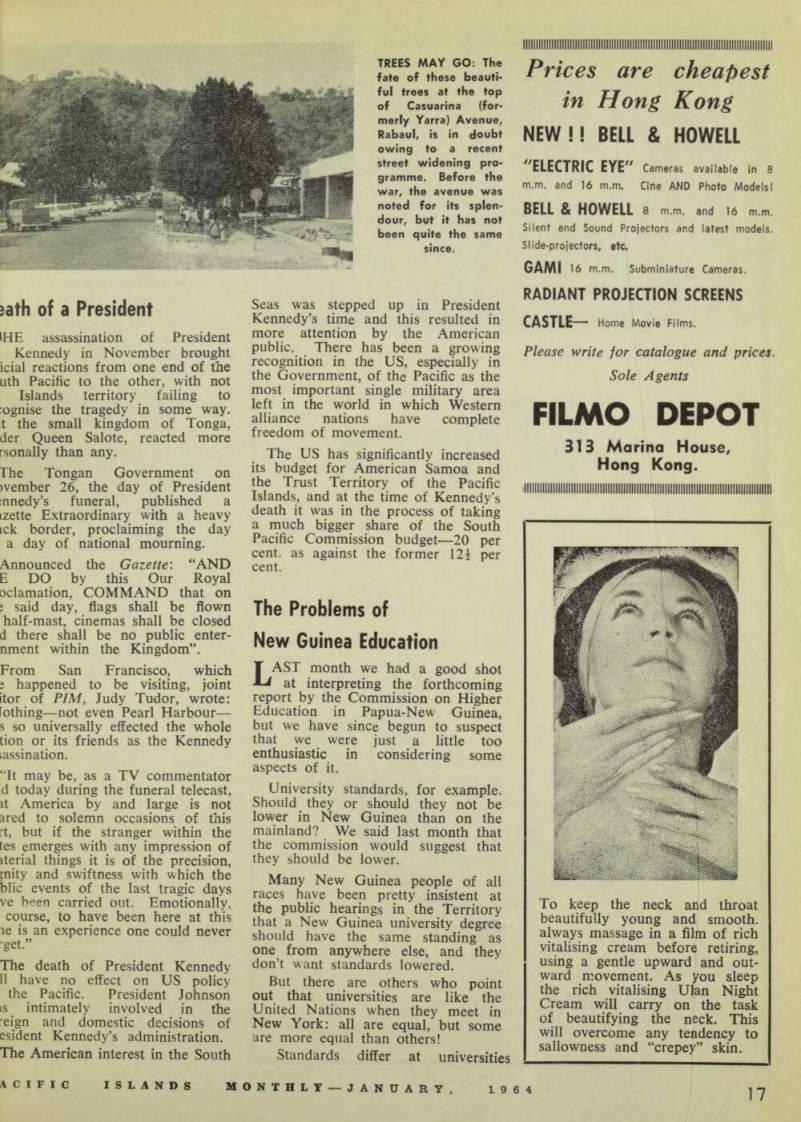
Trees May Go: The
fate of these beauti ful trees at the top of Casuarina (for merly Yarra) Avenue, Rabaul, is in doubt owing to a recent street widening pro gramme. Before the war, the avenue was noted for its splen dour, but it has not been quite the same since.
within the same country—in India and the US for example—and standards differ even within a university. Some may be first-class in the philosophy and maths departments, abysmal in economics or biology. And, say the critics, what about the departments that vary in standards from time to time according to the skill, or otherwise, of the professor of the moment?
A New Guinea man we know, who has taken a reasonably close interest in the work of the commission and thinks he knows what it has been getting at, insists that “a reasonable comparability is all than can reasonably be aimed at. And for New
Guinea, given the very recent development of secondary education, the answer might well be to have entrance standards lower than in the South, and offset this by lengthening the degree course”, Ua T 1 J 2! t ad £ : ° f “ ur s’ 1° if JJ , e f the Sown%nnth b dlfferent from some down South.
“There seems to be no good reason why a New Guinea student need know all about the rise of the absolutist monarchy in Renaissance Europe, but he ought to know a lot about the history of the Pacific people. A Sydney history graduate,
living in the Pacific, could quite like get by with the former and withoi the latter.
“And again, the degree of emphas on deserts and volcanoes could be n versed for geology or geograpl students in Australia and Ne Guinea. What matters is not i absolute identity of standard which doesn’t exist anyway, be the best means of turning out usefl citizens and informed leaders fo Papua-New Guinea.”
We’ll concede our friend hi points—although it would be interes ing to see how it works in practic “given the very recent developing of secondary education”.
And also, because a wink is good as a nod to us, we shall aid concede now that it is most unlikes that the commission will suggest the standards should be lower. Juj entrance standards.
Postscript: Since this matter of university for New Guinea has hsj such a lot of publicity these Is few months we are all likely overlook the fact that the thrn commissioners (Sir George Cunt Dr. John Gunther and Professor ♦ H. K. Spate) have had othc problems to solve besides.
They have also been looking inr the needs of vocational and technics training of all sorts and at all levele and these matters are as importar to P-NG as the academic side.
Their report should be in the hamr of the Minister some time in Janua£ (whether or not the Hon, Ministf decides to release it to the pubic is another matter) and, whatever finally says, the three commissionea should have learnt a lot!
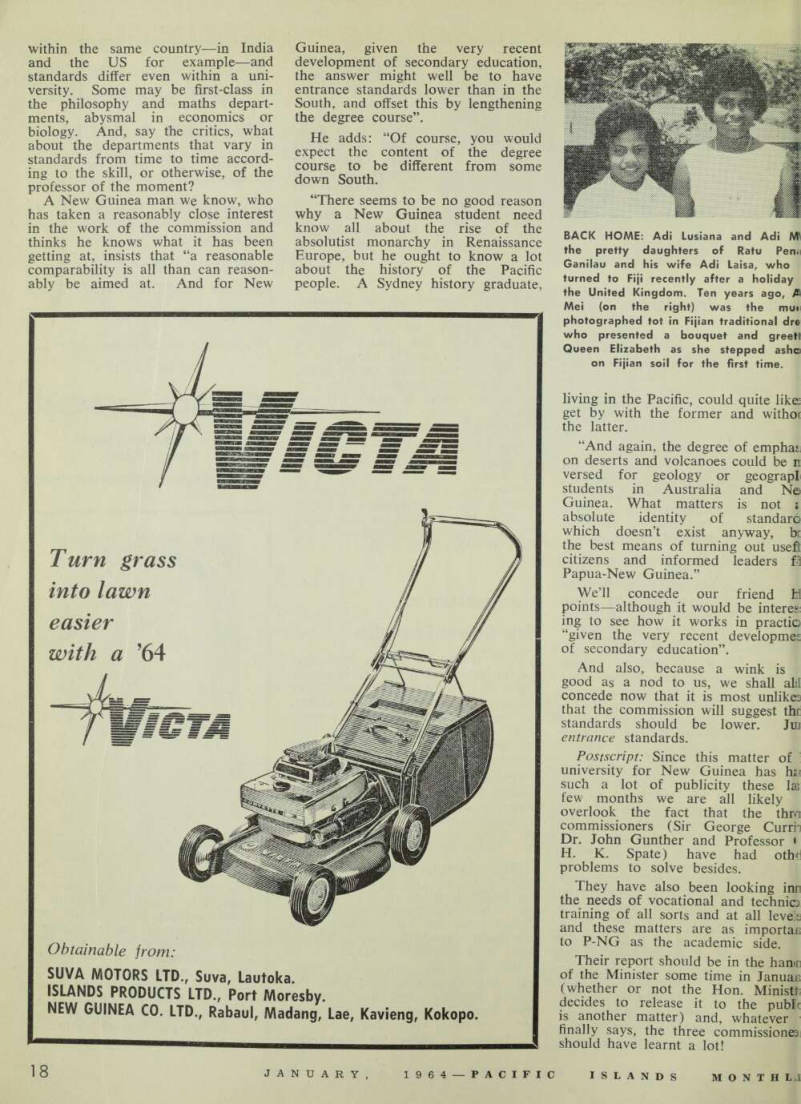
BACK HOME: Adi Lusiana and Adi M[?] the pretty daughters of Ratu Pen[?] Ganilau and his wife Adi Laisa, who turned to Fiji recently after a holiday the United Kingdom. Ten years ago, A Mei (on the right) was the mu[?] photographed tot in Fijian traditional dre[?] who presented a bouquet and gree[?] Queen Elizabeth as she stepped asho on Fijian soil for the first time.
he Banabans In
he Jet Age
THE Banabans of Ocean Island • who shifted their home to a new and, Rabi, in the Fiji group, in >45, continue to prosper. Some de ils of just how well they are going ter their initial unhappiness and set icks were given in an article in PIM November. Since that article was iblished, they have made another ogressive step—the division of land.
In 1957, the Banabans decided to y for a survey by professional sur yors of the island’s land resources, lis cost them more than £12,000, rich they set aside from their Trust ind money, and the survey has now en completed.
The Rabi Island Council has de led to go ahead with lands distri tion, which will give every member the community one acre each, lese lots have been grouped into tnily estates, which vary according the numbers in the family, but the mily estates generally total five to i acres.
They are to be held individually, rich, oddly enough, is in accord ce with Banaban custom, which s always allowed for individual jure, (Many other islands, fighting sir way through the difficulties of stomary land tenures which allow r clan holdings and not individual ies, will wish they had half the luck the Banabans).
A Fiji Government development am has spent an intensive four days i the island, and the Banabans are >ping much from this visit.
A Forest officer in the team is ex cted to advise on what hill land is be left as protective forest (it’s obably likely to be more than half s 17,280 acres in the island).
Meanwhile the Rabi co-operative cieties have amalgamated as the inaban Co-operative Association mited so as to improve efficiency, jcoa planting is continuing apace, r the Banabans hope cocoa, to ther with increased coconut plant gs and cattle raising, will finally vq them a jet age economy.
andalwooders Are At
fork Again in Papua
|NE of the Territory’s first natural * products to be commercialised is joying a brief trade revival. It is e sandalwood trade which flourished Papua during the late 1890’s and ought many traders to the area.
The trade collapsed as mature mds were cut and it is only re ntly that natural regeneration has
yielded sandalwood of commercial significance.
Small quantities are now being cut along the coast from Port Moresby and sold to buyers at 1/- a lb for desapped, sorted and baled logs in hundredweight bundles. Most of it is being exported to Asia—places like Hong Kong and Singapore.
The minimum size for sandalwood logs is 5 ft. long and 5 in. wide.
As far as is known sandalwood in the Territory grows only in the dry savannah areas of Papua. When cut to stump level the tree takes up to 30 years to grow to its normal 30 or 40 feet.
About 40 years ago the sandalwood trade was brisk along the Papuan west coast. Sailing ships brought Australian buyers who found ready markets for the wood in Europe and Asia. Some of these buyers, attracted by the general trading potential, remained in Papua and established the first merchant houses in Port Moresby.
Sandalwood is used for making such items as incense and ornamental boxes.
Dr. John Cumpston, of Canberra, in December sent PIM a reproduction (above) of a small oil painting entitled “Bay in the Pacific Islands, Fiji”, which is from the famous Nan Kivell collection at the Australian National Library, and asked whether any PIM reader could identify the locale.
His own opinion after examining the painting is that it could show sandalwooders at work about 1810. He thinks topography should be much the same today as it was then but can’t see whether the houses on the beach are native or European.
One of the background peaks is faintly reminiscent of New Caledonia, he thinks, Are these in fact sandalwooders at work, and if so where? ri ■ m j j /. •
Likga 10 Livg
Dannemuslv'
T Illian Schoedler Was A Re
markable New York woman who liked to travel.
Christmas, 1963, was the first in a great many years that she had not spent in some odd corner of the world. Many friends in many places noted the absence of her cheerful, in formative letters, loaded with colour and facts. Miss Schoedler roneoed her letters, for she had so many friends to send them to, and her letters on her New Guinea experi ences of the last few years deserved to be preserved as collectors’ pieces, Lillian Schoedler died in late 1963 in a car accident while on her way to visit friends in Oregon. Her death was instantaneous. She had with her a return ticket to Sydney which she hoped to make use of before the beginning of 1964—using Sydney as a jumping off place for New Guinea, for New Guinea was her favourite “odd” country.
In her wanderings she had spent one Christmas on a house-boat on the Nile, and others variously on board a ship between Manila and Singapore, in Java, in Shanghai, in East Africa, on board a Japanese ship between Capetown and Buenos Aires, in Peru in Mexico, in Paris, in Austria, Japan’
England, Australia, New Zealand and Czechoslovakia, We first met her in Madang, New
Where is this sandalwood bay? See the story below.
Guinea, at the end of 1960. She had gone to New Guinea in August, 1959, for “a couple of weeks”, and here she was, still there almost 18 months later—trying to make up her mind whether to go back to Australia or on to Borneo.
She told us in her friendly fashion that she had been having alternative jags of work and travel for almost 40 years. She was then almost 70.
When we met her she had already been all over Papua-New Guinea, and for some months had been living m the wildest parts of West New Guinea, too. She had visited remotest spots, gone out on patrols, stayed with Administration officers and missionaries on out-stations, and her enthusiasm was still firing on all eight cylinders - *. , , i M * • ro .’i eoed f ‘l tters ‘ f dat year told, ironically, of how after endless walking in really hazardous conditions in the Casuanna coast and
sh’ThLt J 7 ° Umea ;
when she had crossed crude piers of loose bamboo strips and walked long r ° u ® h tr “ ‘ runkS -l d flats, of how within ha f-an-hour of getting back to civilisation at Merauke she had threfribs Wanopen dram and broken X e * my sister, Mrs. Kimball,”
Lillian wrote to her friends, “whom you all know through her wonderful help with my mail, and who had
kept worrying about my wandering alone in those headhunting surround ings, was herself attacked at that time by an armed teen-age hoodlum in broad daylight in the public lobby of her New York apartment and had her head bashed in and her purse stolen! It all goes to show how much safer it sometimes can be to ‘live dangerously’.”
She was 71 when that routine car accident claimed her, a long way from the shores of wild New Guinea, .., , , > HG JuntOT CloldDuS mHE two sons of thp PNf. ah ,“c „ „„ / ' , mmistrator. Sir Donald Cleland, f/ 1 • Lady Cleland got one of their rare Pubkc mentions m December when Sir Donald in Sydney addressed the annual speech day at Knox College. Both sons, Robert and Evan, received part of their education at Knox, although their father was educated at Guild ford Grammar School. Western Aus tralia Boih Cleland boys work in New Guinea. Robert Cleland is an Assis tant District Officer, Local Govern ment, and younger brother Evan manages three plantations in the Hisiu area.
Both boys have progressed in the Territory on their own merits, and their father has always taken great pains to avoid giving any impression
that they had extra privileges becau of his own position. When Robe first started in the Territory as cadet, and later became a PO, got his name mentioned a lot le frequently than many others mere because he was the Old Man’s so The Press knew that the Old M; didn’t want any publicity for him Sir Donald and Lady Cleland ov property in the Territory and proc ably will retire there since the family is there. They have no oth children. Sir Donald will be 65 June, 1966.
The Personal Touch
THE old-established Islands tradk A firm of Nelson and Robertso (they started out in business in 1895 now have a new travel departme;; which will book tours and travel ft anywhere in the world. Some peopc won’t see anything extraordinai. about this but many of the thousano of Islanders since sailing ship daj who have been serviced by N & R> unofficial travel department will giy a smile now that it has all becom official—and wish the new depart ment prosperity. N & R’s unofficii travel section began almost when th firm did—bom out of that feeling o togetherness which is still a featun of Islands life. Islands customers wfcl wanted a house or flat in Sydney fo' their leave were in the habit of ash mg the old firm to rustle up som possibilities. The old firm did. If til customers wanted to move from her to there, with the kids, would the oh firm arrange the details, since it wir closer to civilisation? The old firr obligingly did. As a free servio N & R have for years arranged a* bookings for about 150 P-NG schoo< children flying between the Territory and Australia on holidays.
N & R, of course, are typical o Island merchants everywhere whd have retained a lot of that friendKl customer relationship while the re:j of the business world has quickly be( come impersonalised.