New Men At The Helm
pp. 9-10 · Read in the full issue
Of Australian, Nz
South Sea Territories
By Stuart Inder
The policies of Australian and New Zealand South Pacific rritories will be steered by new hands at the helm in 1964. As result of general elections in both countries on November 30, the L Minister, Sir Leon Gotz, lost his seat and the Australian Minister, r. Paul Hasluck, was given a new portfolio.
lEW Australian Minister for Terri ' tories is Mr. C. E. Barnes, a leensland blood stock breeder. The w NZ Minister is Mr. J. R. Han n.
Sir Leon Gotz had been NZ inister for three years. He was de ited for the Manurewa seat, which a district about 16 miles from ickland. He lost by a narrow 1,524 tes. Manurewa is a new seat created
when electoral boundaries were altered recently, and was regarded as marginal. Sir Leon never has had a secure seat and held at least one marginal one before.
Said Sir Leon; “This will probably mean my departure from the political scene but these things happen. I re gret losing, but it was a difficult one.
My main regret is that I will not be able to finish the work I started. I would have liked to have seen self government for the Cook Islands.”
The NZ Department of Island Territories is responsible for policy in Niue and the Cooks (including the Tokelaus). Its former main interest, Western Samoa, has been independent for two years, and the Cooks will be given internal self-government in 1965, so there is not a very big job left for the new Minister, Colourful Sir Leon With the disappearance of Sir Leon (he was knighted last year by the Queen for his work in organising the Royal tour of NZ) there goes from the Islands scene a colourful and controversial character.
A tough ex-planter (Malaya and Western Samoa) with an eye and an arm missing, Sir Leon’s refreshingly apt choice of words with which to describe Islands problems and Is lands personalities has time and again had his staff of career public servants crying into their beer in sheer terror of his being reported.
“What the hell will we do with him!” said one officer to me at a reception a year or two ago, when Sir Leon was expounding forth rightly to a small group about a neighbouring territory.
Like most people with long Islands experience and a genuine love of the Islands, he has strong views on most aspects of Islands life, and he has never much cared who knows it.
His successor will probably seem tame by comparison.
Mr. Hannan, who is 64, has been a member of Parliament since 1946.
He held the portfolios of Health, Public Trust, Friendly Societies and Immigration from 1954 to 1957.
In the last Parliament, he was Attorney-General, Minister for Justice, Minister of Maori Affairs, and Minister-in-Charge of the Elec toral Department—portfolios he re tains in the new Parliament.
Mr. Paul Hasluck, who is now Australian Minister for Defence, is an opposite type to Sir Leon. His statements have always been careful, considered, correct. He rarely makes off-the-record comments to the Press, and has never allowed his staff to give information without his authority.
His official handouts are on routine matters and any worthwhile informa tion is first announced in Parliament or to the UN. Pressmen who may have had wind of it for weeks have meanwhile found it impossible to con firm it, and often impossible to get any additional facts after it has been confirmed.
High Tribute
This policy of handing out infor mation only on his own restricted terms has won Mr. Hasluck many critics.
The same critics would agree that Mr. Hasluck’s term as Minister has won him an honoured place in New Guinea’s history. No Minister has worked harder, with more skill, for better results than he. When New Guinea becomes independent, Mr.
Hasluck will have been the chief architect.
Mr. Charles Edward Barnes, 62, is still an unknown quantity, but the
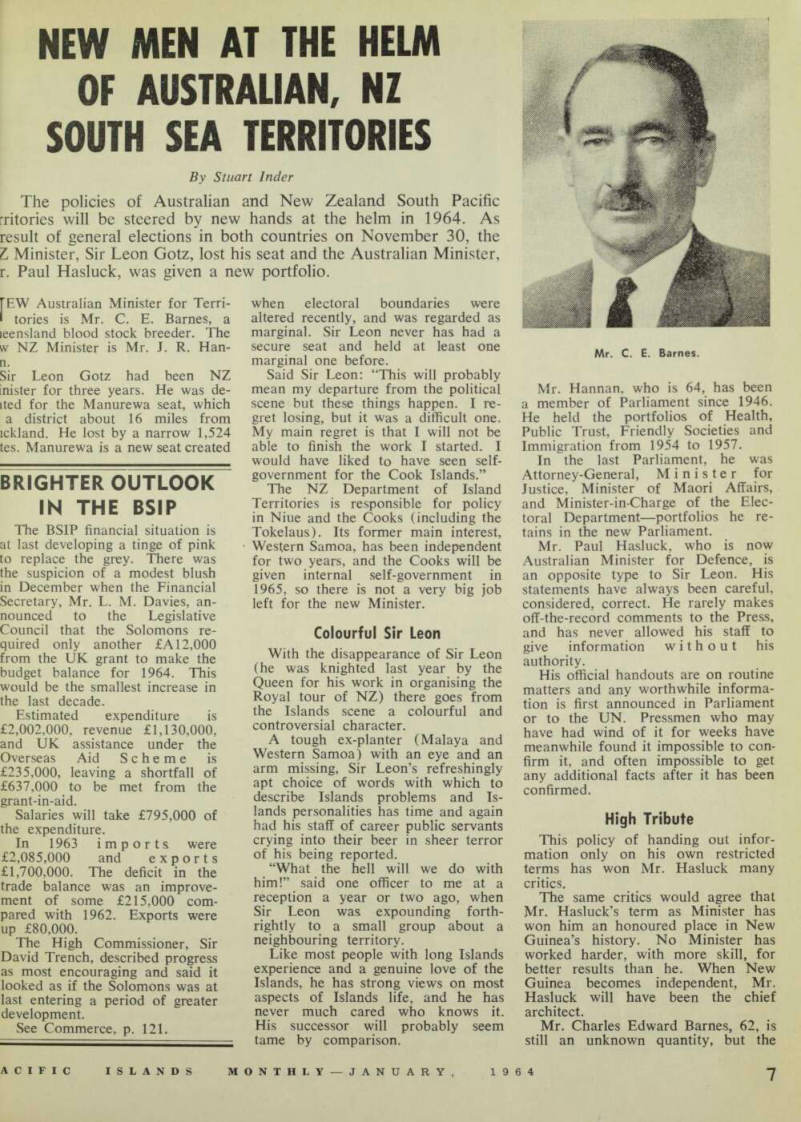
Mr. C. E. Barnes.
general view of his departmental officers soon after he took over in Canberra was, “He looks like being a good bloke”.
Mr. Barnes doesn’t consider that the job in New Guinea has been done and that he is merely winding up a few ends for Mr. Hasluck.
“There is certainly tremendous credit due to Mr. Hasluck and to the officers of his administration,” Mr.
Barnes told me two days after he was sworn-in. “But that doesn’t mean we can be satisfied. Although a lot has been achieved it is nothing to the problems that face us in the future.
But with experience and the honest co-operation of all concerned, a lot more can be achieved.”
To Visit Soon The new Minister hopes to take his first official look at P-NG, the Northern Territory, Nauru and Nor folk Island “as soon as possible”.
First to be visited will probably be P-NG. He was last there with a Parliamentary delegation in April, 1962. His party visited Port Moresby, Goroka and Lae.
“Why did the Prime Minister select you as the Minister instead of a Brown, a Smith or a Jones?” I asked him. He smiled.
“I suppose he had his reasons. All I can do is give you my background and you make what you like of it!”
The Barnes family have had Queensland holdings for more than a century. C. E. Barnes’ grandfather took up Lyndhurst Station, 250 miles SW of Cairns, in 1862. His maternal grandfather took up Oak Park in 1865. .His father bought Lyndhurst in 1914, sold it to the Queensland Government in 1918, having, the previous year, bought Canning Downs m the southern Darling Downs. Can ning Downs is now owned by the Minister, who breeds blood horses.
In the ’thirties, C. E. Barnes formed a syndicate and went mining in the north for such things as wolfram and tin. He got a pilot’s licence and flew his Gypsy Moth for 10 years in and out of remote spots.
When war came his flying ex perience took him into the Air Force as a Flying Officer with a fighter section, and this in turn took him to Milne Bay and the outlying Papuan islands, such as Goodenough, for 12 months around 1943. He ended up with RAAF Intelligence.
When Mr. Barnes’ appointment was announced it was stated some where that he had “extensive business interests in New Guinea”, but he says this isn’t true. He has no com mercial interests in New Guinea.
Mr. Barnes is no professional politician and his rise to Ministerial rank has been remarkably quick. He entered politics only in 1958 in Sir Arthur Fadden’s old seat of Mc- Pherson (“I still hadn’t made up my mind two days before nominations closed”) representing the Country Party. He had become interested in politics as a result of the bank nationalisation fight, and first lent a hand only because of that.
The new Minister has three daughters and a son.
My guess is that he got the appoint ment because of his close interest in the welfare of Australia’s North, which is an important and growing part of the Territories’ portfolio. He has to keep his eye on Norfolk Island and Nauru together with P-NG.
With his private enterprise back ground I personally predict he’ll do the whole job very well.
The departure of Mr. Paul Hasluck from Territories means that two of the key figures in the develop
ment of Papua-New Guinea for til last 13 years served out their tim together.
Mr. Hasluck was given the poi( folio in May, 1951, at the same tim as Territories was made a separas ministry, and took in the Norther Territory.
On the job at the same time cam Mr. C. R. Lambert, as SecretaiL Mr. Lambert retired in Novembd ( PIM, Dec., p. 17), since when thes has been no announcement about H successor. No doubt the nea Minister, Mr. Barnes, will have tlj job of selecting him.
Sir Donald Cleland also has nc much longer to go in New Guinea He has been Administrator sintr February, 1953 (he had held tHj position in an acting capacity fro;c the previous April) and is due ftl retirement in the normal course < events in 1966.
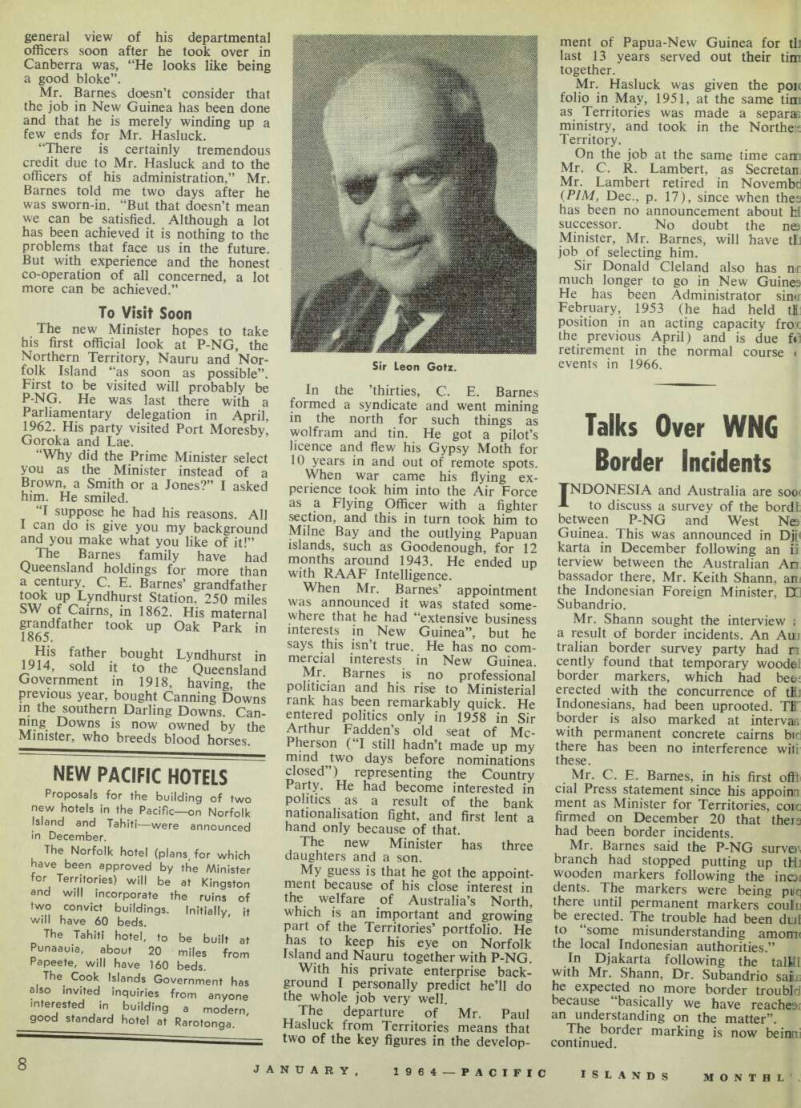
Sir Leon Gotz,