Pacific Commerce and Produce
pp. 129-132 · Read in the full issue

Burns Philp's 80Th Annual Meeting
Profits And Progress Bring Problems For Islands Trader
When James Burns registered his modest Islands trading organisation—a few little stores and ships—Bo years ago, as Bums Philp & Co. Ltd., and directed them successfully on a course of progress and profit, he little dreamed of the troubles that profit and progress would bring upon his successors in 1962-63.
PROBABLY, in his long and busy life, he rarely counted in mil lions, and never heard that horrid word inflation applied to either his or the nation’s enterprises.
But the figures laid before the 80th annual general meeting of the company on August 22, by veteran general manager Joseph Mitchell, act ing as chairman, were almost all in millions of pounds; and many of his explanations of upward changes in various totals could be attributed to war’s heritage—namely the ceaseless, grinding process of inflation.
The Burns Philp interests are now widely diversified, and spread over 30 subsidiary concerns in Australia, and another 20 in the South Pacific Islands. The chief assets of all of them are in stores and merchandise, plantations and ships, stocks and shares—all of which naturally move up in value as the basic value, con trolled by the inflationary spiral, runs out of the £.
Millions—and Millions And so Mr. Mitchell presented ac counts showing assets of no less than £38,162,946 in the consolidated bal ance sheet; and a profit for the year, for the parent company, of £1,019,121 (the aggregated net profit of the group was £1,452,844).
This probably was the first time that the parent company’s annual profit entered the million class; and it was fitting that the ageless general manager should announce it. He said
that all sections—except one—had
traded satisfactorily.
As can be imagined, an old, sound, conservative board like that af Burns Philp hates the process known as ‘watering”—the issue of
bonus shares to take care of increases in the value of assets—and it naturally resisted the tendency so long that “the wolf-packs of take over” were reported to be gathering.
Finally, of course, to protect the company, the board had to accept revaluation and issue bonus shares accordingly; and the company’s issued capital has now been built up to £7,200,000.
Even so, the process of revaluing assets and issuing bonus shares seems to be limping behind inflationary pro cesses. There are no less than £22 million in the reserves and P/L Ap propriation accounts.
The listed assets show £8 million in land, buildings and equipment; £5 million in sundry debtors; £9 million in merchandise; and no less than £l4i million in investments.
No wonder the chairman’s voice sounded a little weary as he talked in millions, to present this picture of huge wealth and widely spread acti vities. An increasing proportion of it is Australian-based now; but BP’s still are the most important single trading factor in the South Pacific Islands Their plantations cover 40,000 acres staffed by 3,000 natives and 60 mana gers and overseers.
Shipping's Uncertain Future But there was plenty of bite in his voice when Mr. Mitchell turned to discuss the shipping section, once the pride and joy of the BP board-room.
Year by year, the directors have reported their increasing troubles in maintaining an efficient, profitable service. The costs of running BP ships, registered in Australia and therefore subject to every whim and fancy of the seamen’s union, have climbed out of all reason; but the
company cannot raise freight and pas senger rates to meet this condition be cause other shipping lines, registered in cheaper labour countries, compete actively with the BP ships on the Islands runs.
So, year by year, the BP ships sec tion, as a separate entity, has shown its annual figures in red and, year after year, the company’s chairman, in his annual review, has made com ment upon them that runs from acidulous to near blasphemy.
The position is that, in sea transport, BP’s are in a cleft stick.
Their ships, as general carriers, can not make profits; but they cannot do without their ships because their mul titude of Islands stores and planta tions must be serviced. So, as Mr.
Mitchell expressed it, “voyage losses have become a burden on other earn ings”.
The spectacle of the ships being held up by local strikes, wet weather, holiday leave and so forth, while aboard all hands wait in idleness with full pay and victualling, is not one likely to soothe the shipping mana gers in Bridge Street.
Freighters Only
The time is not far away when the once proud fleet of BP ships will con sist only of freighters. Other ship owners, who are not tied helplessly to Australian labour conditions, will gather in the scheduled passenger services. The company now has a 4,000-ton freighter under construction in Australia, and there is no sign of new BP passenger ships coming along.
Profit-earning prospects never were better, and investors in gilt-edged keep pushing the BP shares along to higher levels. But if the men who sat in that BP board-room 80 years ago could return today to 7 Bridge Street they would find methods of computation, and trading conditions, utterly beyond their comprehension.
In fact, they probably would be sure that the world of 1963 is quite mad. And the interesting thing is that the acting-chairman of the 1963 Board, Mr. Joseph Mitchell, 89 years of age, and a BP staff man for 72 years, has seen it all happen.
Report on Fiji's Copra
Industry Completed
The report made on the Fiji copra industry by Lord Silsoe (formerly Sir Malcolm Trustram Eve), con taining his recommendations to the Fiji Government for the future development and control of the in
dustry, was completed in July; but it had not been published at the end of August.
This was because the copra and milling interests concerned were given the opportunity of comment ing on the report before it was printed.
The report will be printed in Fijian and English. It is expected to recom mend the establishment of a Copra Marketing Board, and to include proposals for increasing copra output and establishing prices.
It is reported that the authority to control the industry will be acceptable to all interests concerned and that a person very well known in Fiji primary industry will be at its head.
Cook Islands Fruit
Production Increases
Citrus fruit production in the Cook Islands during 1962-63 amounted to 147,167 70-lb cases or 18,615 cases more than the previous year, according to the annual report on the Cook Islands to the New Zealand Parliament.
About 83 per cent, of this total was grown on trees planted under the Government’s citrus replanting scheme.
Nearly 68,000 cases of fruit were exported and the equivalent of 79,445 cases was processed into juice by the canning factory on Rarotonga.
Exports of tomatoes, amounting to 68,068 boxes, were slightly lower than in the previous year.
Total exports from the Cooks in 1962 were worth £710,653, or £112,469 more than in 1961. The value of imports dropped from £1,021,549 to £937,273.
The values of the main exports were: Fruit juice, £187,070; manu factured goods, £171,928; fruit, £118,864; copra, £51,350; tomatoes, £50,106; and mother-of-pearl shell, £39,033.
New Japanese Interest
In Fiji Bananas
The International Fruit Company of Japan has been negotiating re cently to buy Fiji bananas from October next year and to arrange shipping—provided the Colony can guarantee a minimum of 20,000 stems each fortnight.
This would mean a minimum of more than 500,000 stems a year worth about £300,000 to the in dustry.
At present Fiji’s sole market for bananas is New Zealand which takes about 200,000 cases a year.
Fiji’s Land Development Authority
has the sole licence for export of bananas to Japan.
It would take about 800 acres to grow sufficient bananas to meet the demand of the Japanese market. The Authority already has 400 acres under development at Lomaivuna which is within easy reach of Suva.
It is proposed to develop a further 200 acres there and to obtain the remainder from 200 acres occupied by independent farmers outside Lomaivuna.
To enable this expansion to take place, the Colony’s Standing Finance Committee has agreed to additional expenditure by the Authority this year of nearly £BO,OOO.
Fiji made two trial shipments of bananas to Japan last year, but hopes had dwindled of finding a lucrative market there until the International Fruit Company began its negotia tions.
"Badly Needed" Legislation
For P-NG Companies
A new Companies Bill, based on uniform companies legislation in Australia, was introduced in the Papua-New Guinea Legislative Council in August.
The Secretary of Law, Mr. W. W.
Watkins, said in a second reading speech that the bill was a “very badly needed” revision of the Terri tory’s present legislation, which was based on an English Act of 1862.
He said the bill, known as the Companies Bill, 1963, would be as sociated with a number of other bills.
These were Unclaimed Moneys Bill, Business Names Bill, Native Eco nomic Development Bill, Co-opera tives Societies’ Bill, and Savings and Loan Societies Bill.
Mr. Watkins said the Companies Bill had been “firmly based” on Aus tralian uniform codes. In drafting it, the Companies Ordinances of the Northern Territory and Australian Capital Territory were used as models.
Explaining the need for the Bill, Mr. Watkins said the Territory was moving rapidly in the direction of economic development and of more reliance on production for cash and less on purely subsistence produc tion.
Thus, legal and economic require ments became more complicated.
The Bill covers all companies and includes considerable material “in
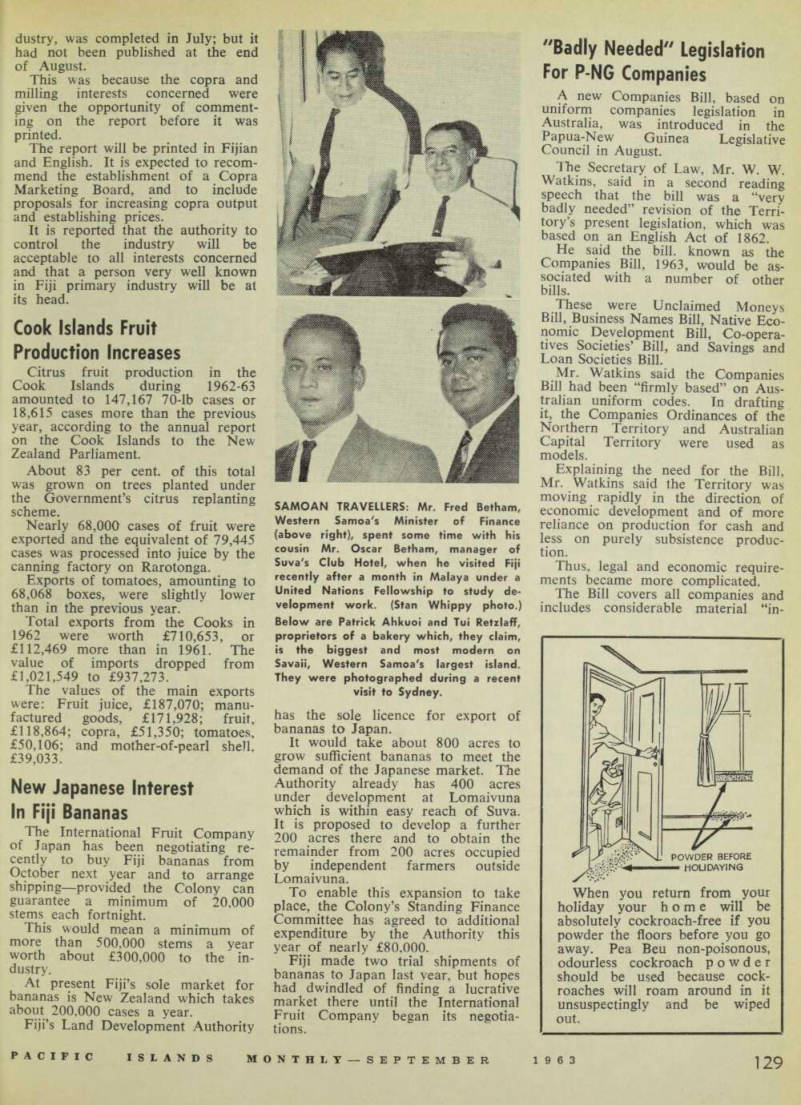
SAMOAN TRAVELLERS: Mr. Fred Betham, Western Samoa's Minister of Finance (above right), spent some time with his cousin Mr. Oscar Betham, manager of Suva's Club Hotel, when he visited Fiji recently after a month in Malaya under a United Nations Fellowship to study de
velopment work. (Stan Whippy photo.)
Below are Patrick Ahkuoi and Tui Retzlaff, proprietors of a bakery which, they claim, is the biggest and most modern on Savaii, Western Samoa's largest island.
They were photographed during a recent visit to Sydney.
tended to instruct company directors and managements as to what they should not do in the interests of their companies and their sharehold ers,” and also details procedures and powers of the Supreme Court in en forcing legislation.
£l5 Million Development
Plan for Fiji
Fiji is planning to spend £3 mil lion a year on capital development projects during the next five years.
An official statement in August said that work was going ahead on preparing a new capital programme to cover 1964-68.
It is the fourth development pro gramme to be prepared since the war and is to total £l5 million.
The emphasis will be on economic development. Between 1945 and 1963, a total of £23i million was spent on development, but only 10 per cent, went on economic projects.
Under the new plan, it is proposed to spend 45 per cent, on economic projects.
The statement said Executive Council had advised that more em
phasis should be put on the develop ment of production—particularly on land development, to which it was proposed to allocate £1 million a year.
The statement added: “The suc cessful mounting of the plan will depend on Government’s ability to raise the money. It is estimated that, apart from contributions from annual revenues and further sub stantial aid from Britain, local loans of at least £1 million will have to be raised each year.”