Territories TALK-TALK
pp. 115-117 · Read in the full issue
It is a natural corollary for Papuans and New Guineans who have attained a higher degree of education in our own arts and culture to contribute “Letters to The Editor” of local and/or Australian newspapers.
CYNIC that I am, there are times when I suspect some letters are the hand of a New Guinean, yet the voice of a European counsellor, be he mission, commerce or even Ad minstration.
Be that as it may: Some good viewpoints have been advanced in some of these letters, and the best that has caught my eye was from one, Patrick Tomausi, who claimed he was a student at the Post and Telegraph School, Port Moresby.
The letter appeared in the Sydney Daily Telegraph (9/8/’63) and joined issue with a J. J. Thompson, of Wagga, who contended that if P-NG became Australia’s Seventh State “the natives would become eligible to move by the hundreds of thousands into Australian big cities to create vast swarming black slums.”
Wrote Tomausi: “My people do not even like to move to the noisy cities, where there are lots of crimes and evil deeds performed every day.
We prefer to remain on the peace ful islands of the Pacific ... We have no fear to remain as Papuans and New Guineans. We are very proud to stay in our peaceful islands”.
In those few simple words Tomausi has presented a viewpoint which dis cards the opinion, held by the majority of Do-Gooders and De- Segregationists, that the ultimate goal of the primitive is to partake of the modern amenities provided in the cities of the “educated”, sophis ticated Europeans, who do not realise that any other sophisticated and highly-educated individual could de sire anything else.
How wrong is that opinion!
“We prefer to remain on the peaceful islands of the Pacific.”
Is there anything decadent or non progressive with such a desire?
Did not the refugees from Tristan da Cunha, deported to the civilised areas of Britain not long ago, sig nify the same desire and were they not eventually returned to their iso lated homeland?
Have the New Guineans ever been consulted as to whether they desire independence and self-government?
They have been presented with a
With Tolala
fait accompli. It has been a ques tion as to when they desire inde pendence, not if they should have it.
The present global trend toward anti-colonialism has forced the Aus tralian Government into an attitude of conformity with this trend, quite irrespective of the natives’ own wishes.
Artifacts Are
Popular
IT would seem that New Guinea native handicrafts are coming into their own—locally—at last. A Sydney newspaper reviewer recently refers to an exhibition of “Melan esian Art” as making an “impressive display.”
Not so long ago a Sydney doctor was charged with exhibiting in an art shop he owns an “obscene statue” which proved to be a carving from the Sepik area. (He was acquitted.) Apparently to Sydney viewers primi tive carvings have just that avant garde quality which tickles their appetites, while the blue-nose cen sors find it difficult to distinguish natural primitiveness from modern obscenity.
They ignore the fact there are two distinct yard-sticks by which to judge these displays: Realism of the moral primitive or the erotic-minded modern.
The latest boost to native work manship comes from Mr. Angus Mcßean, of the South Pacific Com mission, who has made the dis covery that for the Buka basket (which has long been a popular receptacle in the Territory for carry ing anything, from the day’s shop ping to a gurgling babe) “a good market exists in Australia and the Pacific area . . . .”
Now that this particular item has received the imprimatur of an SPC official (the SPC is going to pro duce a handicrafts booklet—see
Tropicalities ) one may expect this line may be seriously developed.
Let us hope that with stepped-up production the original excellent quality of the basket is not sacri ficed for quantity, nor the standard of workmanship allowed to deteri orate, which is too often the case in this monetary age.
The manufacture of cane furniture is another item that I hope Mr. Mc- Bean has investigated. It may not be so aesthetic as the modern tubular steel structures that adorn the homes today; nevertheless, it has played an important part in furnishing many a domicile where economy (old fashioned phrase, I know) was prac tised.
New Guineans are expert workers with kanda. There are ample sup plies of raw material and nimble native fingers, with some technical “expertisation”, could produce a profitable industry.
And a word on the tortoise-shell frade: New Guinea, as with other South Pacific areas, was once famed for this kind of work.
The Matupi Islanders (near Ra baul) were noted at one time for the artistic tortoise-shell finger rings, with inlaid silver and/or gold designs and names.
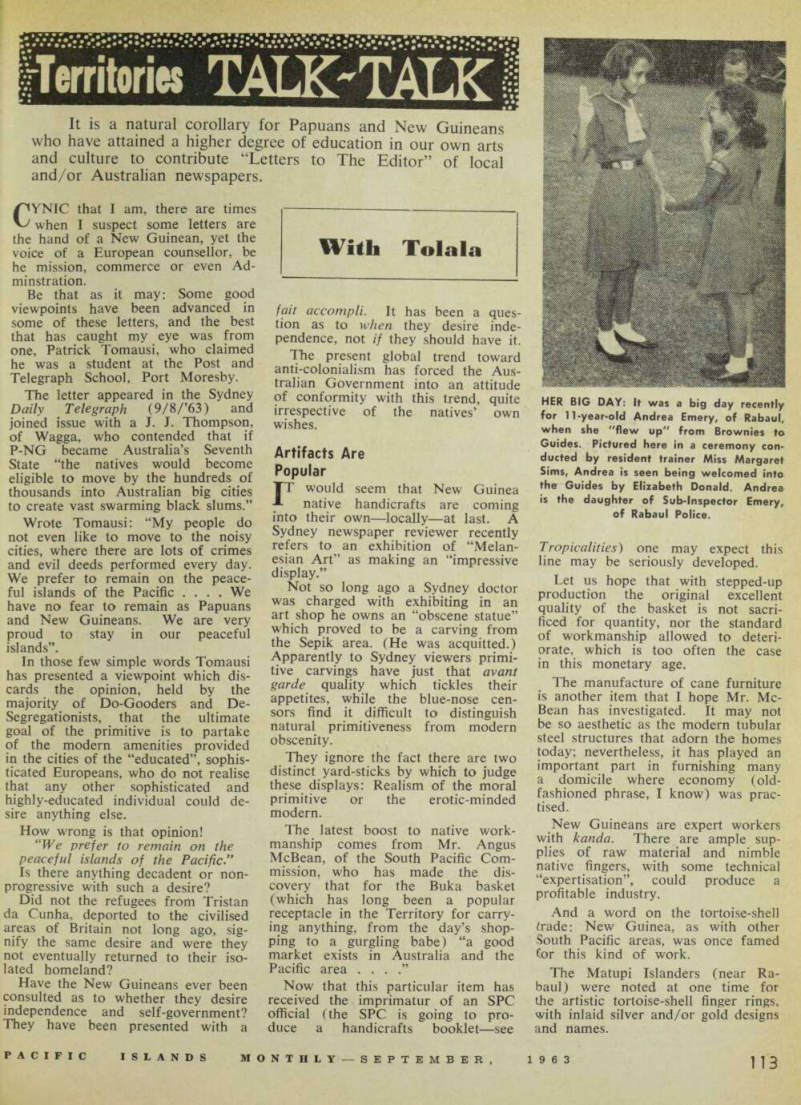
HER BIG DAY: It was a big day recently for 11-year-old Andrea Emery, of Rabaul, when she "flew up" from Brownies to Guides. Pictured here in a ceremony con ducted by resident trainer Miss Margaret Sims, Andrea is seen being welcomed Into the Guides by Elizabeth Donald. Andrea is the daughter of Sub-Inspector Emery, of Rabaul Police.
It was an art passed down to them by the first Samoan missionaries, who came to the Colony with Dr. George Brown and Benjamin Danks. This art later developed into the production of tortoise-shell cigarette cases, jewel boxes bracelets, paper knives and so forth.
The silver and gold was obtained from melted down coins—a preference being shown for British shillings, as the sliver content was higher than the German mark.
Mr. Mcßean probably didn’t see any tortoise-shell work else he would have appreciated the potential of such a line.
And what of the sea-shells (cleaned
with muriatic acid) for ash-trays, lamp shades and other ornaments? what of the ropes of iridescent „ beetle .i e gs for necklaces and dress trimmings? (one planter made a tid sum from supp F lyi a big sydney retailer with suppHef.) K \« . .
And what of certain native seeds — re d and black and blue—that made exotic-looking necklaces and lasted a lifetime?
Over to Mr. Mcßean to help find some new sources of revenue for New Guinea’s future economic stabi lity, and something different from the controversial, much publicised Sepik carvings.
Death of Two NG Oldtimers IT was a shock when I read of Ernie Britten’s death. I first met up with him in Rabaul following the Nakanai massacre in 1926, when he was one of the survivors of that ill-fated prospecting venture.
Afterwards, and for many years, he was in charge of the Administra tion labour compound in Rabaul, taking over from Harry Darby, who had resigned from that job to seek his fortune on the Morobe goldfields.
The name “Masta Darby” was a title which Ernie bore for many a year, conferred on him by the Com pound labourers. Many a court case I listened to in Rabaul when Ernie was court interpreter.
He had a fluent knowledge of Pidgin-English, as spoken by many of the various tribes. In post-War 11 years he did good work in the Native Affairs Dept, as District Of ficer, Magistrate and Adviser before he retired. Ernie was a man of whom I have never heard an unkind word spoken. He was a fine char acter and leaves a host of friends. [lncidentally, NG oldtimer J. M.
Bourke, now of Nambour, Queens land, writes to say that Jack Thurston was not a survivor of the Nakanor massacre, as stated in August PIM, p. 129. He says Jack Thurston was not among the party attacked. The two survivors were Ernie Britten and “Blue” Nicholls. Nicholls, too, is dead.] It was from his son, Hallen Evans who is secretary of the Retired Offi cers’ Association of P-NG, that I heard of the death of his father, H.
Bielby Evans, who died on July 19.
Bielby Evans, who was born at Semaphore, SA, in 1888, was edu cated at St. Peter’s College, Adelaide, and subsequently qualified as an accountant and secretary and prac tised some time in Sydney before go ing to New Guinea in 1921 as chief accountant for the Expropriation Board. After a short period there he resigned to establish a private practice in Rabaul. Later he en gaged in trading in Buka, returning to Australia before World War 11.
Hungry Moresby
PERHAPS that is not quite a fair charge to lay against the Port itself—as a port, though actually in pre-war days it was never anything else but a dry, unbeautiful seaport, acting as a facade for government control.
Since the amalgamation, however, there has ever been a tendency to centralise the cogs of the Establish ment Machine in the old Papuan
capital. Primarily, one assumes, be cause it is Australian territory by its own rights, and not held under a trusteeship from the United Nations.
Some long-visioned legal eagle may have advanced some particular reason for this in the event of New Guinea reverting to native owner ship. It is not the usual custom for a tenant to make appreciable amounts of capital expenditure on property of which he has a tenancy for an unknown period.
It’s somewhat surprising that these Afro-Asian members of the UN,
when having their annual “pick” at Australia over its NG report, have not raised the question of this pro nounced centralisation of government buildings in Port Moresby which utilises so much of the oft-vaunted millions of pounds’ annual grant “for native welfare.”
The grant was recently described to an AAP-Reuter correspondent by a senior Administration official, when commenting on the latest £25.25 mil lion grant for P-NG, as “manna from heaven—a terrific uplift to the Territory.”
There is little wonder that such a well-informed Terri torian as lan Downs, when giving evidence at the higher education inquiries, made a strong plea for the establishment of a university at Goroka.
“It is a fact,” lan Downs said, “that New Guineans felt that Papua, especially Port Moresby, had been allocated too great a proportion of budget monies in respect of the vast population difference.”
This is not the first time that this live wire MLC has referred to this disparity of budget expenditure, and I shall be very surprised if it is his last time.
He and all his other New Guinea colleagues have ample grounds upon which to base their protests—both from population and economic angles.
Mayhap a volte face may occur when the 1964 House of Assembly gets into action.
Postscript : lan Downs amplifies his remarks in a statement appear ing in The South Pacific Post, and pinpoints the situation admirably, referring to Port Moresby, inter alia, as a “white sepulchre dedicated to centralisation.”
It would now appear that the $64 question in P-NG is not so much centred on segregation and desegrega tion as centralisation and decentral isation.
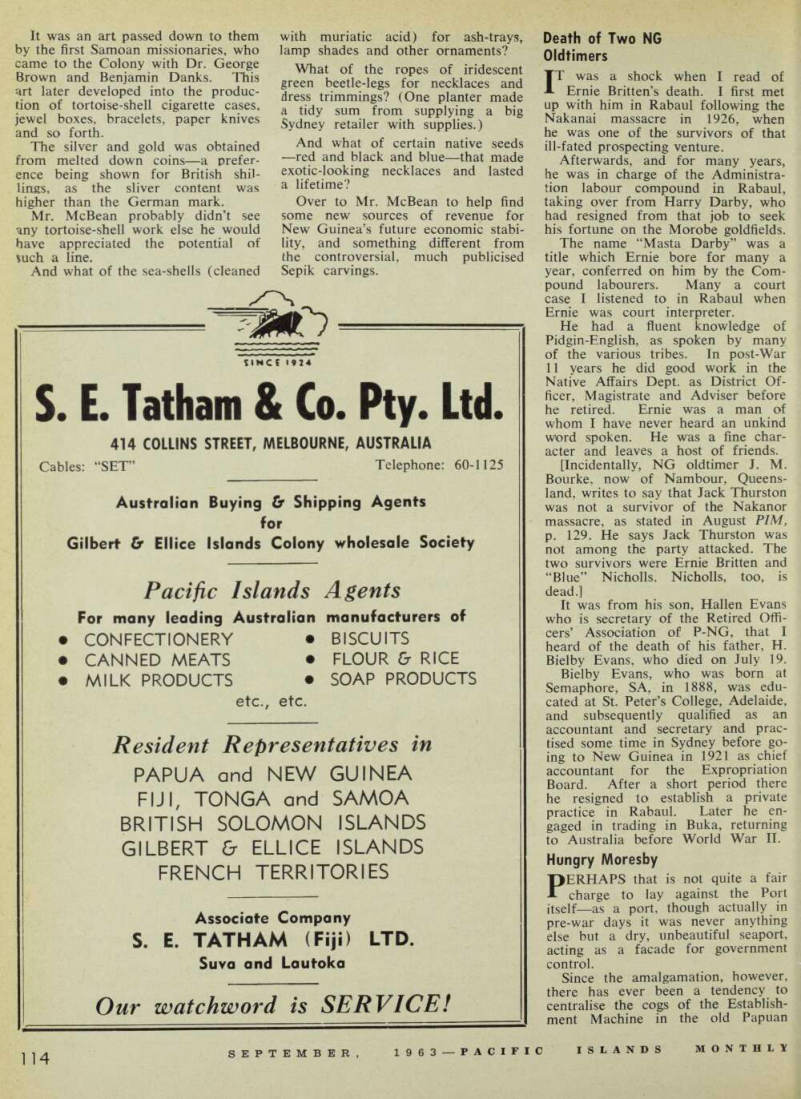
Tight Squeeze. It
was a tight squeeze on the Rabaul water front recently when four ships occupied the only two berths.
The ships (from left) were the "George Anson", '' Shinei Maru", "Chengtu" and "Nessbank".
"This picture," our correspondent says, "illustrates the need for more berthage at Rabaul."