Cruising Yachts
pp. 97-107 · Read in the full issue
Pacific Shipping And
Work Begins On New
Bp Ship
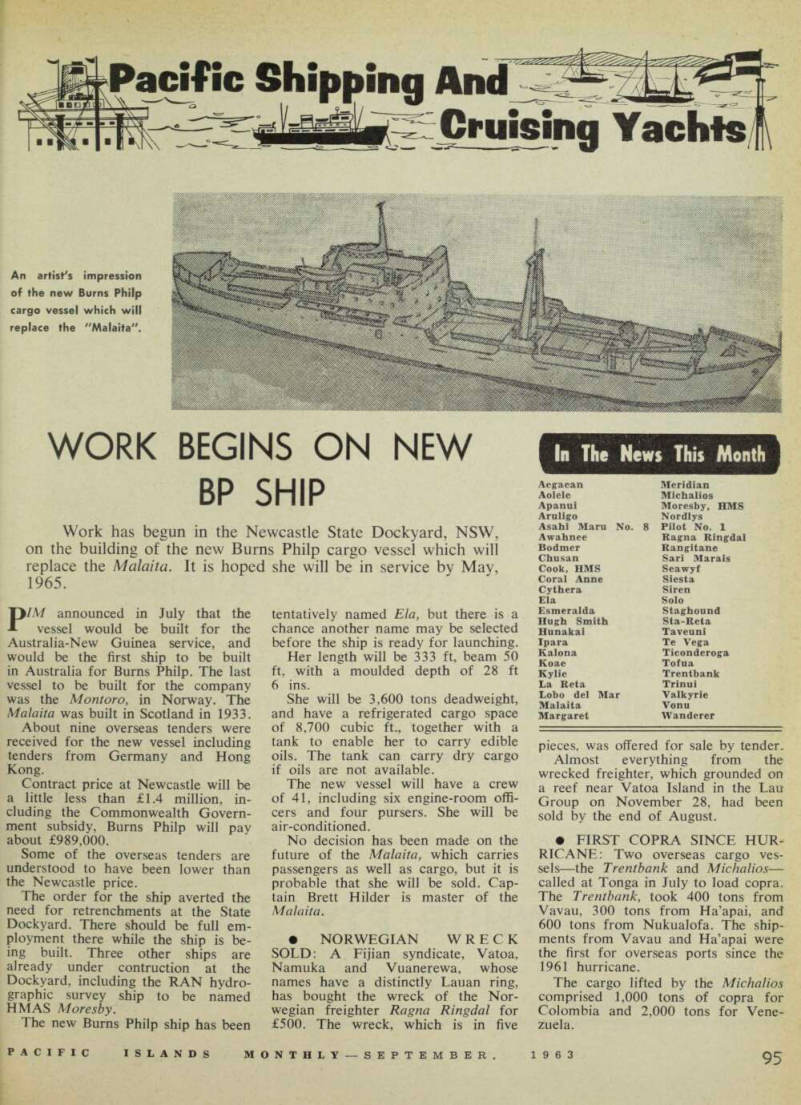
Work has begun in the Newcastle State Dockyard, NSW, on the building of the new Burns Philp cargo vessel which will replace the Malaita. It is hoped she will be in service by May, 1965.
PIM announced in July that the vessel would be built for the Australia-New Guinea service, and would be the first ship to be built in Australia for Burns Philp. The last vessel to be built for the company was the Montoro, in Norway. The Malaita was built in Scotland in 1933.
About nine overseas tenders were received for the new vessel including tenders from Germany and Hong Kong.
Contract price at Newcastle will be a little less than £1.4 million, in cluding the Commonwealth Govern ment subsidy. Burns Philp will pay about £989,000.
Some of the overseas tenders are understood to have been lower than the Newcastle price.
The order for the ship averted the need for retrenchments at the State Dockyard. There should be full em ployment there while the ship is be ing built. Three other ships are already under contruction at the Dockyard, including the RAN hydro graphic survey ship to be named HMAS Moresby.
The new Bums Philp ship has been
tentatively named Ela, but there is a chance another name may be selected before the ship is ready for launching.
Her length will be 333 ft, beam 50 ft, with a moulded depth of 28 ft 6 ins.
She will be 3,600 tons deadweight, and have a refrigerated cargo space of 8,700 cubic ft., together with a tank to enable her to carry edible oils. The tank can carry dry cargo if oils are not available.
The new vessel will have a crew of 41, including six engine-room offi cers and four pursers. She will be air-conditioned.
No decision has been made on the future of the Malaita, which carries passengers as well as cargo, but it is probable that she will be sold. Cap tain Brett Hilder is master of the Malaita.
• Norwegian Wreck
SOLD: A Fijian syndicate, Vatoa, Namuka and Vuanerewa, whose names have a distinctly Lauan ring, has bought the wreck of the Nor wegian freighter Ragna Ringdal for £5OO. The wreck, which is in five
pieces, was offered for sale by tender.
Almost everything from the wrecked freighter, which grounded on a reef near Vatoa Island in the Lau Group on November 28, had been sold by the end of August.
• First Copra Since Hur
RICANE: Two overseas cargo ves sels—the Trentbank and Michalios— called at Tonga in July to load copra.
The Trentbank, took 400 tons from Vavau, 300 tons from Ha’apai, and 600 tons from Nukualofa. The ship ments from Vavau and Ha’apai were the first for overseas ports since the 1961 hurricane.
The cargo lifted by the Michalios comprised 1,000 tons of copra for Colombia and 2,000 tons for Vene zuela.
An artist's impression of the new Burns Philp cargo vessel which will replace the "Malaita".
• GAY REGATTA: Bikenibeu, in the Gilbert Islands, was a scene of gaiety and activity on the afternoon of July 20 when the second annual regatta was held. Speedboats, sailing boats and the extremely swift Gil bertese outrigger canoes took part.
The Marine Superintendent, Captain G. Douglas, judged the events.
The 40 members of a Betio brass band, in royal blue tunics and white sulus, cruised up and down in a launch, playing music for the sports.
An interesting feature was the op portunity for comparison between conventional sailing dinghies and sail ing canoes. It was well known that Gilbertese sailing canoes had a re markable turn of speed, but it was thought that the complicated man oeuvre of going about would lose them any contest on a triangular course such as the one at Bikenibeu.
However, although not participat ing in the same races, the time for the canoes over the course indicated that even on a triangular course, the canoes had an edge on conventional craft. • UP FOR SALE: Tenders were called in July for the purchase of the
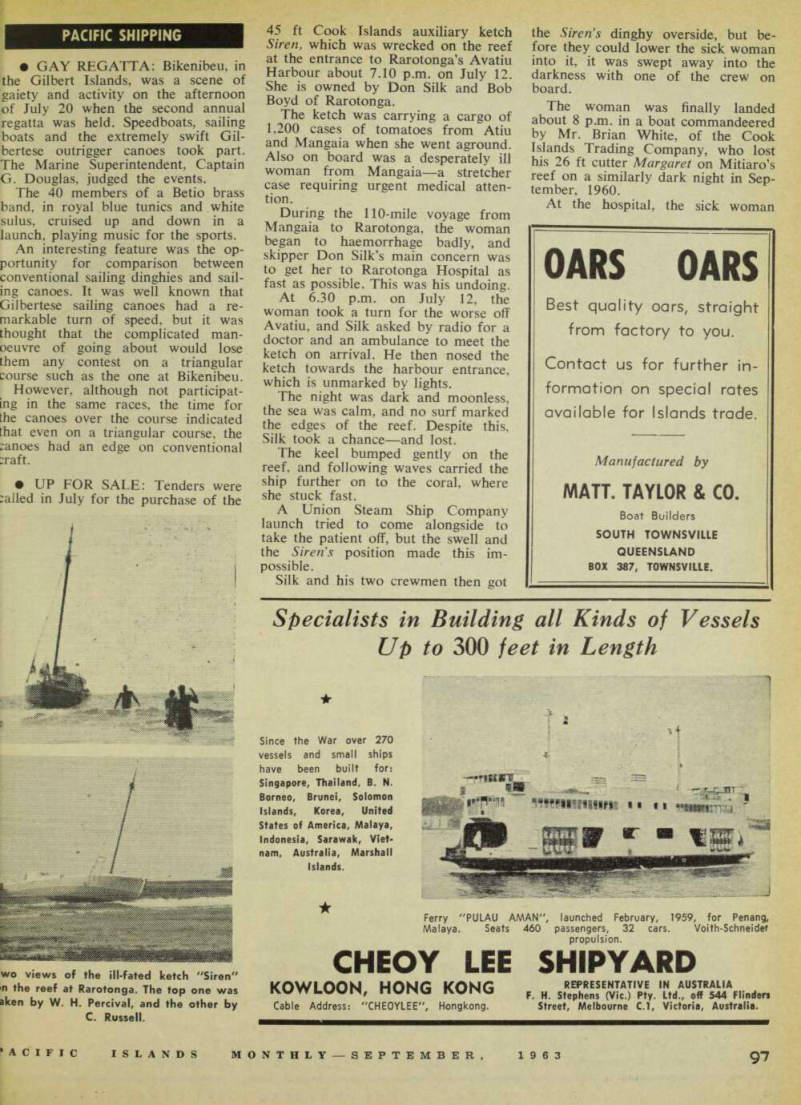
45 ft Cook Islands auxiliary ketch Siren, which was wrecked on the reef at the entrance to Rarotonga’s Avatiu Harbour about 7.10 p.m. on July 12.
She is owned by Don Silk and Bob Boyd of Rarotonga.
The ketch was carrying a cargo of 1,200 cases of tomatoes from Atiu and Mangaia when she went aground.
Also on board was a desperately ill woman from Mangaia—a stretcher case requiring urgent medical atten tion.
During the 110-mile voyage from Mangaia to Rarotonga, the woman began to haemorrhage badly, and skipper Don Silk’s main concern was to get her to Rarotonga Hospital as fast as possible. This was his undoing.
At 6.30 p.m. on July 12, the woman took a turn for the worse off Avatiu, and Silk asked by radio for a doctor and an ambulance to meet the ketch on arrival. He then nosed the ketch towards the harbour entrance, which is unmarked by lights.
The night was dark and moonless, the sea was calm, and no surf marked the edges of the reef. Despite this, Silk took a chance—and lost.
The keel bumped gently on the reef, and following waves carried the ship further on to the coral, where she stuck fast.
A Union Steam Ship Company launch tried to come alongside to take the patient off, but the swell and the Siren’s position made this im possible.
Silk and his two crewmen then got
the Siren’s dinghy overside, but be fore they could lower the sick woman into it, it was swept away into the darkness with one of the crew on board.
The woman was finally landed about 8 p.m. in a boat commandeered by Mr. Brian White, of the Cook Islands Trading Company, who lost his 26 ft cutter Margaret on Mitiaro’s reef on a similarly dark night in Sep tember, 1960.
At the hospital, the sick woman
[?]wo views of the ill-fated ketch "Siren" [?]n the reef at Rarotonga. The top one was [?]aken by W. H. Percival, and the other by C. Russell.
was given blood transfusions, and three days later was reported to be off the dangerously ill list.
Willie Tuara, the crew member who had been swept away in the dinghy, ended up on the reef. He escaped injury, but the dinghy was smashed.
Next morning an attempt was made to tranship the Siren’s cargo to lighters, but this proved to be im possible and the cases of tomatoes had to be floated from the wreck.
Empty 44-gallon drums were placed in the Siren’s hold and engine room to give buoyancy, then two tugs of the Union Steam Ship Company attempted to tow her off. The at tempts failed as the tugs were too small for the job.
The only other vessels in port, the Taveuni and Apanui, were both capable of doing the job, but both, unfortunately, were out of action.
An inspection of the Siren’s hull two days after the grounding showed that the keel had been torn off and the hull extensively damaged. She was then looked on as a “write-off” and soon afterwards was put up for sale by tender, as is and where is.
Her owners had insured her for a small sum.
The Siren was built by Charles Whippy, of Fiji, and was originally owned by a Captain Grey, of Fiji, In 1951 she was chartered from Captain Grey by a syndicate interested in using her for inter-Cook Islands trading voyages.
She arrived at Rarotonga in March, 1951, and was wrecked several months later on Rarotonga’s reef, less than a mile from the spot where she now lies.
She was then bought by a Rarotongan group and for many years she lay badly damaged outside Mr.
D. C. Brown’s store on Avarua’s waterfront.
Early in 1961, visiting yachtsmen Don Silk and Bob Boyd bought the vessel, and after several months of very hard work, they got her ready for sea.
Two days before the Siren was wrecked again, the Cook Islands News announced that Mesrs. Silk and Boyd would take delivery in February or March next year of a new vessel which is being built for them in Hong Kong.
The ship is one of three new classi-
fled vessels for the inter-Cook Islands trade. From next year, they will be the only ones permitted to operate in the Cook Islands under the ship ping policy adopted by the Cook Islands Assembly last year ( PIM, Nov. 1962, p. 111), Licences for the other two vessels have been granted to A. B. Donald Ltd. and Mr. D. C. Brown. Donald’s vessel is expected to be delivered in November. Mr. Brown’s was expected August.
Donald’s vessel has been bought in Holland. She has an overall length of 1115 ft and a beam of 20.7 ft - Her speed, laden > is given as eight knots.
Mr. Brown’s ship is the MV Bod mer, which was built in 1952 and has cabin accommodation for 15. Her net tonnage is 135, overall length 126 ft, beam 25 ft, and speed nine knots.
The vessel was in Jamaica in June.
DRIFTER: A group of natives has lodged a claim for £2,000 for salvaging the 25 ft. launch "Coral Anne" which drifted 500 miles from Samara! to the Duke of York Group recently (see p. 101). The "Coral Anne" is seen here tied up at Rabaul after her long drift.
• Bottle’S Long Drift: A
bottle dropped into the sea off the Galapagos Islands from the Chilean Navy cadet vessel Esmeralda on April 19, 1962, was washed up recently on the eastern coast of Waya Lailai, Yasawas, Fiji, about 4,500 miles away.
A note in Spanish in the bottle said the finder would “earn the gratitude and appreciation of all mariners for his assistance in a study of ocean cur rents” by notifying the Chilean War Department of Navigation and Hy drography of the discovery.
The finder was Epeli Lailai, a fisherman, of Namara Village, Waya Lailai, who took the note and bottle to the Lautoka office of The Fiji Times. The Fiji Times has written to the Chilean authorities about the dis covery. • FIJI CRUISE: The 22,000-ton New Zealand Shipping Co. liner Rangitane will visit Suva and Lau toka in the course of a Pacific cruise from Auckland at the end of the year. She is due at Lautoka early on December 27, and is scheduled to leave the same day for Suva.
Lautoka people, encouraged by the success of the visit of the P and O- Orient liner Chusan on July 30, im mediately set in train proposals to have the Rangitane stay longer so that passengers could cruise to the nearby Malolos and Yasawas. They asked the company to have the Suva overnight stay cut out on December £B, and allow the ship to remain at -autoka for the night on December 11. The present schedule is for the Rangitane to stay at Suva overnight m December 28 and 29.
• Natives Claim Salvage:
\ group of natives has initiated a ’laim for £2,000 for salvage of the -5 ft launch Coral Anne, which Lifted on a reef in the Duke of York slands near Rabaul in late July.
A spokesman for the Public Solici or’s office, which is acting on behalf if the natives, said in Rabaul later hat the salvage claim had been made »y four natives on behalf of “a num ►er of others”.
He said the claim would be served n the Administration’s Receiver of Vrecks in Rabaul, who was in charge if the vessel until the matter was leared up.
The Coral Anne was found at lsland, Duke of York jroup, after drifting from her moor
ings at Samarai about 500 miles awa y- Some copper sheeting lost on the reef there was apparently the only damage. See photograph p. 99.
• Pleasure Cruise: La Reta,
an Auckland-owned pleasure craft, arrived at Suva on July 26 for a cruise in Fiji waters. On board for the cruise were the owner-skipper, Mr. C.
I. Millar, an Auckland shipping manager, and 10 passengers.
Soon after her arrival at Suva, La Reta made a cruise to Kadavu, and returned a few days later for refuelling, etc., before taking off for the Lau Group,
La Reta is a Fairmile which has 10 two-berth cabins. She is powered by two eight-cylinder Gardner en gines, which give her a cruising speed of 11 to 12 knots. Mr. Miller bought her from a Cook Islands company.
E Sailiing Again: The 100-
ton Japanese fishing ship Asahi Maru No. 8 which went on a reef near Sigatoka, Fiji, 18 months ago, sailed again on July 21—from a Sigatoka lagoon to Suva. Now owned by a syndicate headed by Mr. Barry Philp, the Asahi Maru No. 8 is for sale, Two prospective overseas buyers are interested.
Captain Stan Brown, owner of the
Maroro, was in command of the Asahi Maru No. 8 on her 70-mile voyage from Sigatoka. Mr. Philp also made the voyage, and stood forward proudly puffing at a cigar as the ship made her way up Suva Harbour to a berth.
• For The Solomons: Two
additions to the Protectorate fleet are expected to be delivered to the Solo mons in October or November. They are the Aruligo, a 38 ft launch, and :he Vonu, a 66 ft landing craft. The iruligo will have two Thorneycroft mgines, a speed of 15 knots, and will )e capable of carrying 12 deck pas lengers. The Vonu is being built at he Thames Barge Works. She will lave two Gardner engines and will >e able to carry a cargo of 40 tons leadweight.
• New Survey Ship: The
loyal Australian Navy’s new survey hip, HMAS Moresby, which cost £2 nillion, will be launched at the New castle State Dockyard on September HMAS Moresby, of 2,300 tons, is he RAN’s first ship designed pecially for survey work, and will
rank among the most advanced ves sels of her kind in the world.
Moresby is due to be completed and commissioned in March. Her sur vey work will begin almost imme diately.
• Tenders Called For
WRECK: Burns Philp (South Sea) Co. Ltd., of Apia, called tenders in August for the purchase of its cutter Aolele which ran aground on the reef at Swains Island, American Samoa, on July 23. ( PIM, Aug. p. 8.) The Aolele was returning to Apia from Fakaofo, in the Tokelaus, when she went aground at about 3.30 a.m. with Captain John Jones and a crew of nine. Captain Jones reported that visibility was bad because of heavy rain. The captain and crew got safely ashore at daylight.
The Apia Harbour Master, Captain H. Moors, and Mr. August Hansell, of Burns Philp, left for Swains Island in the new pilot vessel Pilot No. 1 that night and brought the crew back to Apia. Captain Moors was reported as saying that any salvage job on the Aolele would be expensive and un certain.
It was later announced that the successful tenderer for the Aolele was James P. Curry Shipping Service.
• Oceanography In The
GILBERTS: Undercurrents in the Gilberts (ocean type, not political) have been creating great interest lately. Aboard HMS Cook during her recent survey cruise in GEIC waters was oceanographer Dick Stroup, of America’s Johns Hopkins University, investigating the Cromwell Current which flows to the east with its core about 100 metres below the west ward-flowing South Equatorial Cur rent.
Mr. Stroup has a particular interest in the undercurrent, having taken part in some of the earliest investigations
when its existence was established by the US Fish and Wildlife Service vessel Hugh Smith several years ago.
HMS Cook visited Tarawa from July 11 to 15.
• Boat Lost: An Rnzaf
flying boat from Fiji made an un successful search in mid-August for a 17 ft. sailing boat, with seven people aboard, which failed to make the 28-mile crossing from Manihiki to Rakahanga in the Northern Cook Islands.
• Deep Water Wharves
-Or Western Samoa: Western
Samoa’s Harbour Advisory Commit ee decided in late July that wharves ;hould be at Asau, Savaii, and at tfatautu, in Apia.
The decision was taken after con ultation with Mr. R. B. Gittins, enior vice-president of the Merritt ffiapman Scott Corporation, of New fork. The Matautu-Pilot Point site vas chosen for Apia because it will »e the cheapest to build, and the Vsau decision follows the recom aendation of a United Nations eco lomic report {PIM, June, p. 33).
Plans envisage the building of a omplete town at Asau. At Apia 12 cres of land will be reclaimed for 600 ft. wharf to accommodate two hips of the size of the Tofua. r Mr. Gittins is now back in New arranging finance from a New r ork bank and preparing final plans Dr submission to the Samoan Gov ernment, probably within two months, inancial arrangements are expected ) be based on a loan repayable ver 25 years.
"Koae", 30 ft. ketch from Seattle, which has been in Suva recently.
Photo: Stan Whippy.