Beautiful Tanna’s Fiery Volcano
pp. 79-81 · Read in the full issue
Pacific Islands Monthly
Magazine Section
Beautiful Tanna’s Fiery Volcano Turned On 4 The 9 For Tourists
By Beverly Barwick.
“This trip is highly recommended by many very enthusiastic volcano climbers.” So ran the bulletin announcing to the passengers, outward bound from Sydney aboard the Polynesia, that theirs for the taking (at £l2 down) was the chance to fly from Vila to the island of Tanna in the New Hebrides and climb to the summit of Yasur, the Fiery Crown of the Pacific.
HAVING “done” Vesuvius some 20 years ago we obviously could claim membership, not enthusiastic membership, of the volcano-climbing fraternity and we hastened to book one of the seven places in the Drover aircraft scheduled for the excursion.
Tanna, we were assured, was the most beautiful island in the New Hebrides, the volcano was active (a fig for your extinct jobs) but could be relied upon to keep its exuberance within decent bounds. All told, it would, the purser promised, be a most memorable day.
It started early. At 7 a.m. the querulous squeak of a toy horn was warning all would-be volcano climbers that the ship’s launch was about to leave for the Vila landing stage. Ten minutes later our party of seven, having scornfully shaken off those fellow passengers who were merely going muu-muu hunting in the Vila shops, was speeding by car to the Vila airport.
This proved to be a paddock in semi-jungle with a couple of sheds, in front of which stood a small plane that a couple of natives were polish ing perfunctorily. They broke off to shoo away a calf browsing on the run-way. When the pilot arrived, he shook hands all round, bundled us aboard and we were winging south to Tanna.
The blurb advertising the trip had promised low-flying over Erromanga Island and outlying atolls, thus con juring up visions, in Technicolor, of a South Sea island paradise being unrolled like a carpet beneath the plane’s wings. But this day the New Hebrides Airways’ Drover was play ing hide-and-seek with low clouds and not till we were nearing Tanna, over an hour’s journey away, was there
much to rival the interest of the ancient French magazines tucked into the seat backs.
And then, with wings seemingly skimming the palm tops, the plane was nosing its way impudently over the island, soaring over the steep, rounded hills, swooping down into valleys to glimpse the shining ribbon of a stream or to peek into a native village—pandanus huts set neatly on a checkerboard of greens and reddish brown carved out of jungle so dense that it looked solid. It seemed as if it would serve, if need be, as a landing strip.
That proved unnecessary. There was a lane among the trees, insignicant as a parting would be in the woolly hair of a Tanna islander, and we were landing.
“Yes, it’s a real, sporting strip” the pilot said when someone remarked that there would have been barely a handspan between the wing tips and the grudging belts of jungle, Our guide for Operation Volcano was waiting on the airstrip with two battered Land-Rovers. But first, morn ing coffee (home-grown, home roasted) at his bungalow, set in an exotic garden on the edge of a pic ture postcard bay—hibiscus hedges, palm trees, a white schooner riding a turquoise sea that frothed in white frills on the sands, Already we were prepared to ac cept Tanna’s claim as the most beau tiful of the New Hebrides islands; the long drive through the jungle con firmed it. The switch-back road went tunnelling through a fantastic forest.
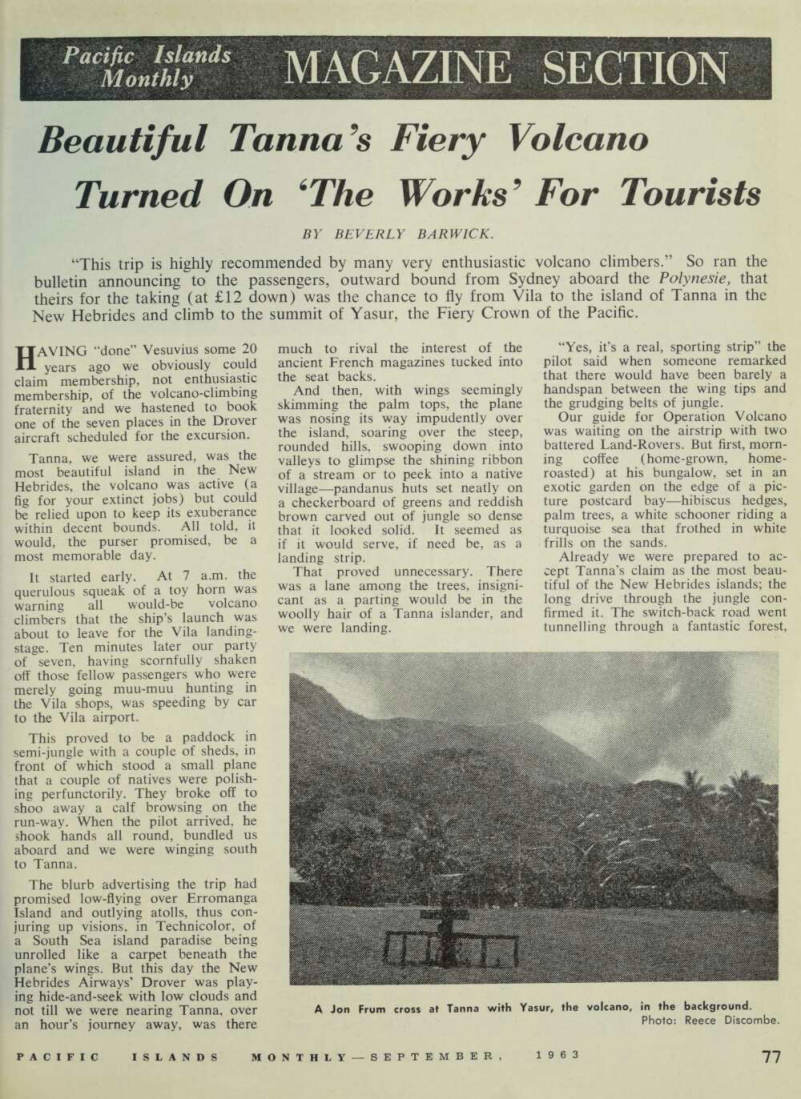
A Jon Frum cross at Tanna with Yasur, the volcano, in the background.
Photo: Reece Discombe.
an exuberant, riotous tangle of green punctuated by the scarlet of hibiscus, the blue of wild ageratum, the mauve or pink of orchids, and striped always by the red-brown of the erratic, jolt ing track.
Long-legged coconut and banana palms, pineapples and papaws, breadfruit trees and yams with their absurd gargantuan leaves, the more modest-growing cocoa and coffee bushes—all growing wild, irrepres sible, their fruits there for the pick ing. Impossible, surely, to starve on Tanna?
Poor Fishermen And beyond the jungle, a tropical sea hardly less profligate in its offer ings. Though, perhaps because the land provides them with such an abundance of foods, the Tanna islan ders are poor fishermen.
To encourage them, Lake Siwi at the foot of the volcano is being stocked with fast-growing fish from South Africa; we saw ample evidence of it later in the tiny corpses stranded in the black ashy sand of the sur rounding flats which flood in the wet season.
For the most part, the natives of Tanna live off the jungle or small holdings of their own.
“We strive for years and acquire expensive ulcers to achieve the sort of life that is theirs from birth.” our guide remarked.
But if only a small proportion of the Tannese hold regular, boss-obey ing jobs, some 1,200 of them are in the airline business, each with a £1 share in the aircraft that had brought us to the island.
For like so many of the South Sea islands that have felt the bewildering impact of Western materialism, Tan na has had its cargo cult troubles; when some of the followers of “Jon Frum”, the Messiah who is to usher in the Golden Age on Tanna, an nounced they wanted an aeroplane like the white men, they were told they could have one—for the price of £1 a head.
The little Drover they now count as theirs; its comings and goings are watched with proprietorial pride and, should an overnight stop at Tanna be necessary, some of the owners go on guard duty, sleeping by the air craft.
As in any properly conducted busi ness, the operations and finances of
the company are duly reported back to the shareholders, usually at the kava-drinking ceremonies; these, be ing warmly commended by Jon Frum, take place nearly every night, thus offering a convenient venue for all business dealings. The more so since kava has a mildly sedative effect, unlike the wine which, since the beginning of this year, has been allowed for sale to the islanders.
Kava Ceremonies In Tanna the kava is still prepared in the most primitive way—by chew ing the roots of the plant, and spitting the fibres into a palm-leaf strainer through which water is poured into a coconut shell. The drinking parties are strictly for men only; even the grounds where they are held are taboo to women who must use the detour path that discreetly skirts each kava-clearing.
The kava ceremonies were origin ally banned by the missionaries but when, about 1940, the bizarre religion that is Tanna’s version of the cargo cult swept the island, one of the chief laws accredited to the mysterious Jon Frum was that they should be re sumed. (Another edict was that the Tannese must not go to church and a third, less easily explicable, that they must get rid of the white man’s money since Jon Frum would bring his own coinage when he came with his cargo of riches).
In Tanna the cult reached its climax when the United States set up a huge base on Santo to the north, but long after the American manna of material riches had ceased, with the war’s end, to rain down from the skies, the Jon Frum movement per sisted, with sporadic outbreaks of tur bulence. Today it has lost its explo
sive quality but it is still far from dead. Red Jon Frum crosses still dot the island.
The road to the volcano ran past several of these symbolic crosses.
One, flanked with votive offerings of fresh cut flowers, was set behind a red-painted fence on a cleared bank not far from a giant banyan tree whose tangle of boughs and hanging roots sheltered a ceremonial kava ground.
A few hundred yards further on was a cluster of native huts where a group of boys, aged perhaps from four to 10, were parading, their faces painted in a ferocious pattern of red and black and white. Save for a belt with a sporran of grasses and an arm band of grass streamers above the elbow, they were naked; each one gripped a knife. It savoured of anti climax when they grouped them selves, grinning broadly, to be photo graphed.
Seclusion They had, it was explained, just completed the several weeks’ seclu sion demanded in the circumcision ceremony and were about to be handed back to their mothers. These were waiting by their huts a discreet distance away; at our approach there was a startled flutter of multi coloured grass skirts and the women, shyer than their sons, disappeared into the trees.
Soon we were getting our first sight of Yasur which, we learnt, was oblig ing with the best display of volcanic wrath the island had seen in months.
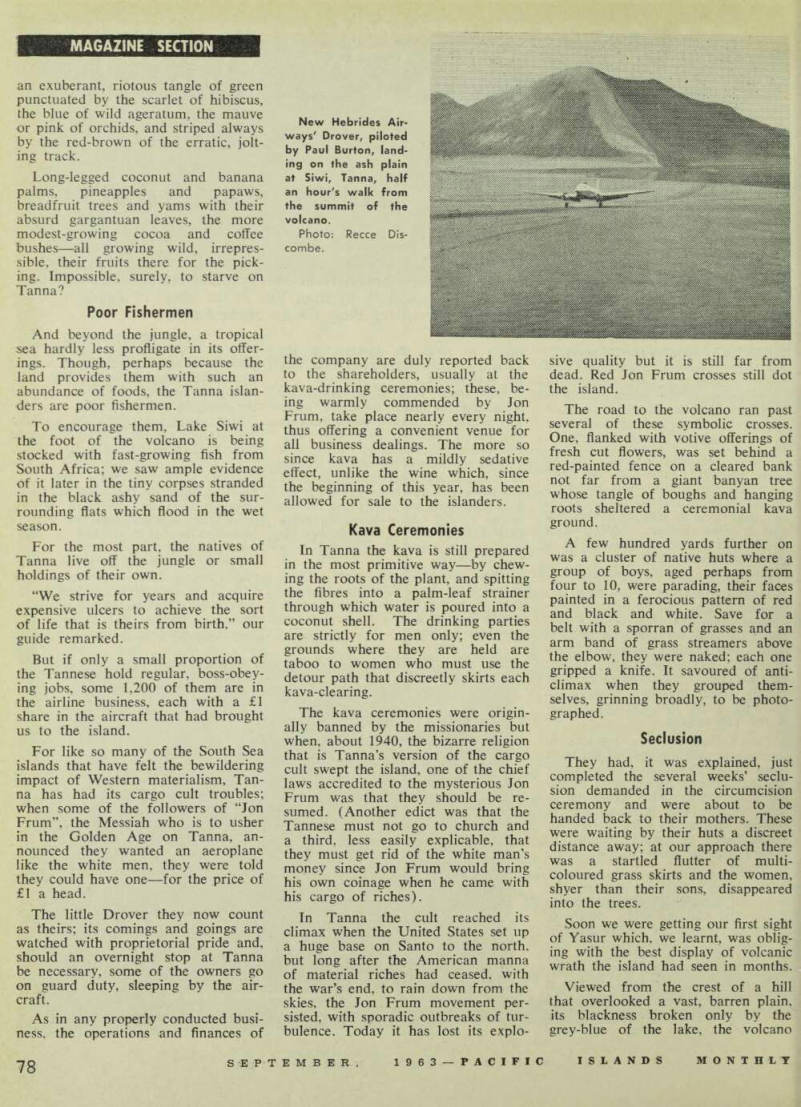
Viewed from the crest of a hill that overlooked a vast, barren plain, its blackness broken only by the grey-blue of the lake, the volcano
New Hebrides Air ways' Drover, piloted by Paul Burton, land ing on the ash plain at Siwi, Tanna, half an hour's walk from the summit of the volcano.
Photo: Recce Dis combe.
looked unimpressive a squat, rounded hump topped with a mush room of yellowish smoke.
But when the road, twisting and falling sharply, suddenly broke free of the tangled bush and we were speeding across that Sahara-like waste, Yasur presented a most for midable spectacle. Even above the car’s engine we could hear its wrath ful rumblings and as we drew near we could distinguish, in the billows of sulphurous smoke, the gobs and streamers of lava vomited at each eruption.
Solidifying in mid air the lava crashed down on the hump’s slope as rocks. They fell, we were assured, quite slowly; there would be plenty of time to dodge.
Thus comforted, five out of the original seven volcano climbers em barked on the steep, 1,000 ft ascent.
Over a deeply crevassed mixture of ash and boulders, our route skirted the line, as precise as if ruled, where the vegetation ended, though here and there an orchid thrust a courageous pink head up through the black wastes.
About three-quarters way up, a narrow plateau, on the leeward side of the falling lava, provided a camp ing ground. In a slow drizzle of fall ing ash that muddied the wine and speckled the ham and rolls, we ate our lunch and embroidered the hair raising tales to be told back on the ship of hardships bravely borne and hazards narrowly dodged.
Then, hoping there might not prove to be foundation for these epics, we started on the last leg of the climb.
By now Yasur’s bad temper had mounted to fury; the rumblings and belchings were almost non-stop. Even so, none of us were prepared for the horrific spectacle that greeted us when at last we peered down into the crater. A sheer drop of 600 feet and, there at the bottom, a glower of red, swelling in colour and size to explode with a roar that echoed round the crater and sent shock waves flickering through the ochre-stained smoke above.
With each gigantic belch, lumps and ribbons of lava were hurled up from the depths. Most of them, tossed up almost vertically, fell back into the crater to crash crazily back down into that monstrous, glaring maw but some, hurled higher and more obliquely, cleared the rim to cascade down the outside slopes, on the far side, fortunately, from where we stood.
Molten Core This opposite wall of the crater was a jagged, leprous-white precipice, the rest a menacing black with spirals of smoke snaking up from fissures and vents in the walls above that red molten core.
An inferno, beggaring a Dante’s imagination. And inhabited, the natives say, by an army of 5,000 red soldiers, waiting ready to come to the aid of Jon Frum.
His cross is planted on Yasur’s highest peak and the stronghold of his cult is in a village in the jungle that fringes the barren hills, sullen red and brown and black, beyond the wastes at the crater base.
There on the flats our Drover was waiting as we slithered down the slope. She would, we had been promised, fly low over the crater on the homeward journey. The pilot was apologetic. Once, on a comparatively quiet day, the plane had been hurled far out to sea before he could regain control; in view of Yasur’s present mood, a crater flight would be in advisable.
We could not agree more.
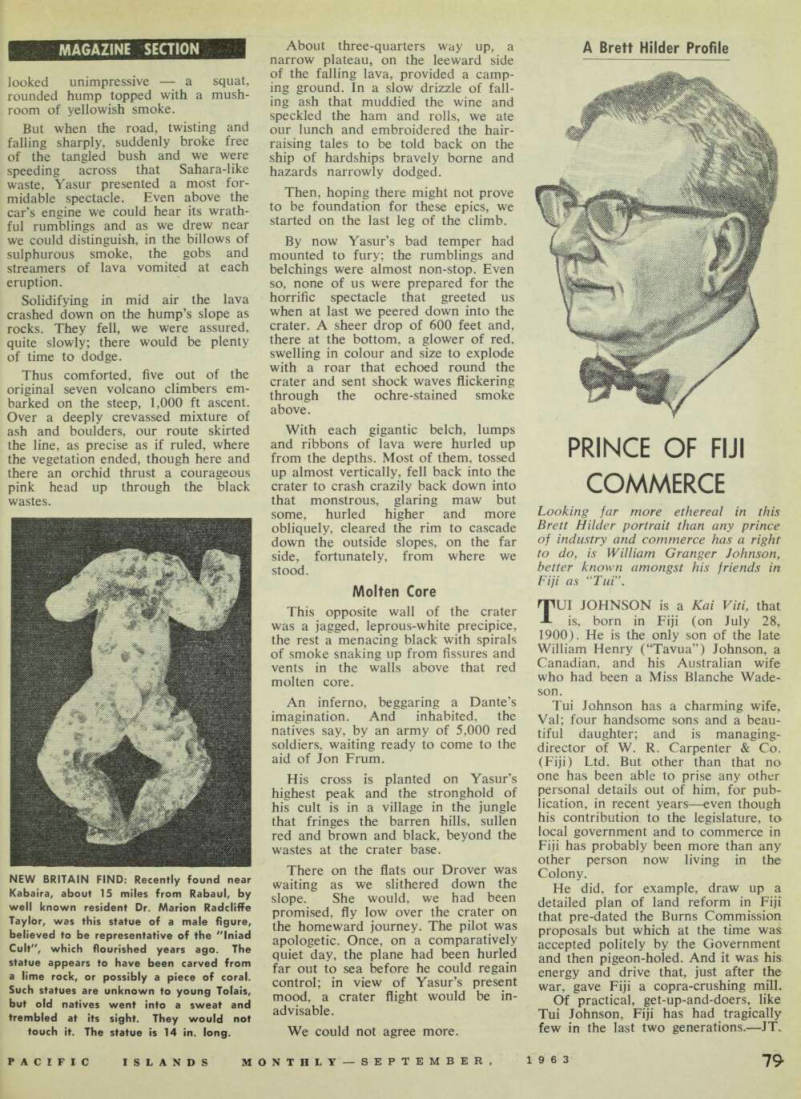
NEW BRITAIN FIND: Recently found near Kabaira, about 15 miles from Rabaul, by well known resident Dr. Marion Radcliffe Taylor, was this statue of a male figure, believed to be representative of the "Iniad Cult", which flourished years ago. The statue appears to have been carved from a lime rock, or possibly a piece of coral.
Such statues are unknown to young Tolais, but old natives went into a sweat and trembled at its sight. They would not touch it. The statue is 14 in. long.