South Pacific Commission
pp. 59-61 · Read in the full issue

Greater Voice For Islanders In South Pacific Commission
Special to Pacific Islands Monthly The five member Governments of the South Pacific Com mission are shortly expected to agree formally to a re arrangement of SPC functions to give an important new voice to Islands people.
THIS will be done by re-organising the Research Council and insti tuting an additional body called the Regional Council. The Regional Council will be composed of dele gates elected by Islands legislatures, which means a big proportion of dele gates would be indigenous people, and this proportion can be expected to grow. The Council may meet every year.
The new plan is one of many pro posals which have emerged from round-table talks in London of the member nations —Britain, the US, France, Australia and New Zealand.
The main purpose of the talks was to discuss the entry to the SPC of Wes tern Samoa to replace the Nether lands which withdrew last year fol lowing the loss of West New Guinea.
But the talks developed into a review conference of SPC activities, and the proposals are likely to be as vital as any of those made in the first formal review conference held in Canberra in 1957.
No announcements have been made about the London talks, or even that the talks were held, but the five member nations were represented by senior delegates experienced in Pacific affairs, able to discuss the various proposals with authority.
London was selected as the meeting place because of its convenience.
Earlier in the year it had been sug gested the conference be held in Wel lington.
At the London talks it was pro
posed that Western Samoa be ad mitted to the SPC as a full member, and firm plans for this are expected to be put before the next session of the SPC, to be held in Noumea in October (F/M, Aug. p. 6).
A Samoan "First"
Samoa became an independent state in January, 1962, and thus she will be the first Pacific territory to have emerged from colonialism and become one of the “Big Six” govern ments responsible for the financing and direction of the South Pacific Commission.
Although the Kingdom of Tonga sends delegates to the South Pacific Conferences, which are held every three years, and receives visits from SPC officials, she has never been in vited to become a member. Her in terests there are looked after by Britain.
Western Samoa is not technically a member of the British Common wealth, nor is she a member of the UN, although she benefits by UN agencies and is a member of WHO.
Other proposals made at the Lon don talks will also be put before the Noumea session, notably a new for mula of financial contributions to the UN.
Under the present formula, Aus tralia puts in 30 per cent., France and the United States 121 per cent, each and the others each 15 per cent. Since the Netherlands’ withdrawal, tem porary adjustments have been made.
The London meeting tentatively agreed on a new arrangement which would set Australia’s contributions at 32 per cent., the United States at 20 per cent., Britain at 17 per cent.. New Zealand and France at 14 per cent, and Western Samoa at 3 per cent.
The United States has been anxious for some time to give a greater pro portion than 12i per cent., because it has stated that the original figure was set when its only interest in the Commission was through American Samoa. Since then the US Trust Ter ritory of Micronesia has benefited from SPC activities.
The US has also been anxious to
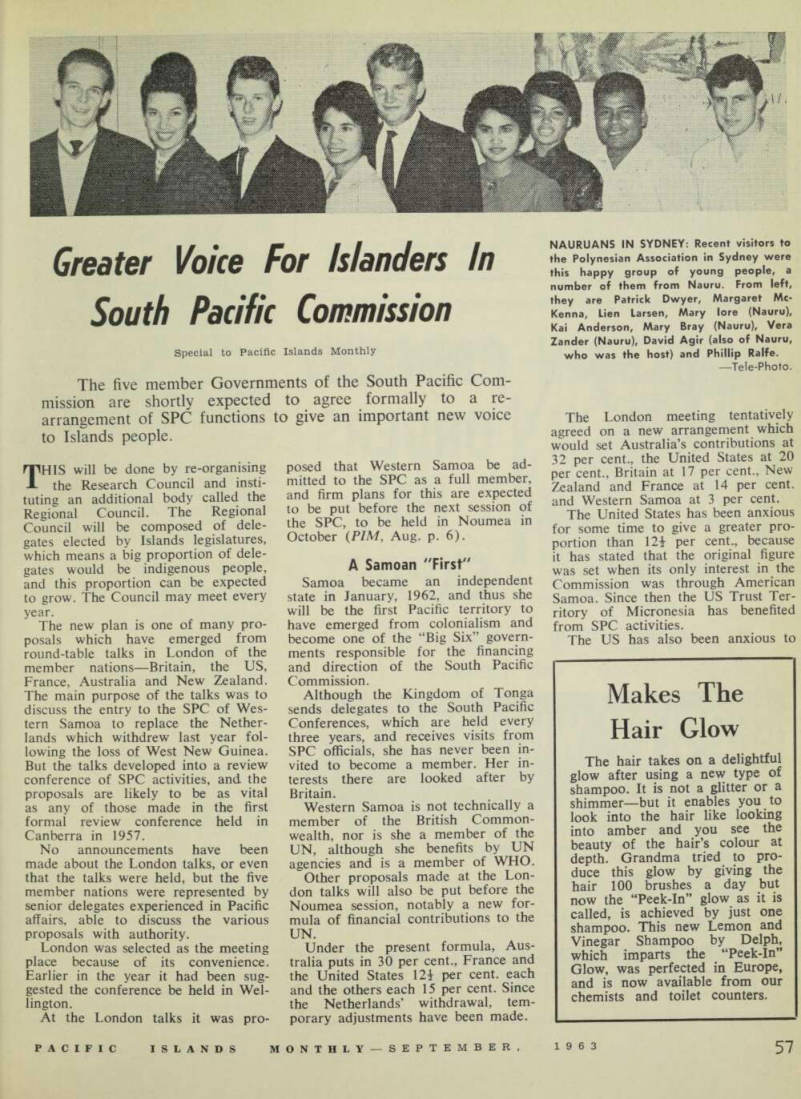
NAURUANS IN SYDNEY; Recent visitors to the Polynesian Association in Sydney were this happy group of young people, a number of them from Nauru. From left, they are Patrick Dwyer, Margaret Mc- Kenna, Lien Larsen, Mary lore (Nauru), Kai Anderson, Mary Bray (Nauru), Vera Zander (Nauru), David Agir (also of Nauru, who was the host) and Phillip Ralfe. —Tele-Photo.
find a formula which will allow it to help the South Pacific financially in other ways, but it has been step ping carefully on this.
Its view is that the South Pacific is open to Communist interference just the same as are many other parts of the world, and that a strong, pro gressive and contented South Seas is the best defence against Communism.
US Plans The US Secretary for the Interior, Mr. Stewart Udall, who is responsible for administering the US Trust Terri tory and American Samoa, made this clear during news interviews he gave during the last South Pacific Con ference at Pago Pago last year. He said the difficulty was to know just how America could help, and that he was “open to suggestions”.
Mr. Udall said America naturally preferred to make its proposals through the SPC. He added that he thought the best possibility might be through some kind of exchange and study programme, using American money.
The American view was discussed at the London talks. Congress would have to approve some of the pro posals made there and it is not known whether this particular facet of the talks will be discussed at the October conference in Noumea.
Conference to Remain The London talks also made an im portant decision on the South Pacific Conferences, which first began in 1950.
They are to be continued.
There had been suggestions made earlier that the conferences should be cut out, or at least organised in a different way.
At the last two conferences, in Rabaul and Pago, there has been criticism by some delegates behind scenes that the conference agenda was in a strait-jacket because it had to be decided two or three years ahead.
People were not allowed to bring up topical subjects on the conference room floor because of this strict agenda.
At Pago the Netherlands New Guinea delegates attempted to intro duce the subject of Indonesian atti tudes to West New Guinea (Dutch men at that time were being killed in clashes with Indonesian para troopers in West New Guinea) but the chairman, properly, silenced the move.
The ruling was accepted, but be hind scenes many delegates said they failed to see why such important mat-
ters should not be discussed if con ference members wanted them dis cussed.
There was a common feeling that the South Pacific Conferences would not continue to be a useful meeting ground and an ideas exchange for South Pacific people while the agenda continued to be set years ahead and kept rigid.
Undoubtedly this problem could be eased if the SPC decided to allow new items to be raised from the floor of the conferences, but it is most un likely this step will be taken. General attitude of SPC members is that such a forum could be a political em barrassment to any of the Pacific member governments, either directly or through references made to other governments. The SPC under its charter must not involve itself in politics.
Regional Council
However the proposal for estab lishing a Regional Council, which would have indigenous members, would give the Islanders opportunity to raise general matters and to have a much bigger voice in Pacific affairs.
Decisions taken at South Pacific Conferences would be referred back to the new Council before finally be ing discussed by the full Commission.
And with Western Samoa a full mem ber of the Commission the Islanders would thus be having a direct say in all SPC activities.
It is not planned that the Research Council be abolished but its form would be changed considerably..
Rather than meet in full conference,
its members would be available to supply technical information and ad vice to the Commission.
Streamlined The new proposals discussed in London are undoubtedly the begin ning of a move to streamline the Commission; a move which was first mooted in Pago last year (PIM, Aug. 1962, p. 17).
Dean Knowles Ryerson, the con ference chairman, said then that he hoped the SPC could soon turn in its old model, “useful as it has been”, for a modern one, “using the high octane fuels of Islands enthu
siasm, ideals and eagerness”. He wanted more frequent meetings and more responsibility for Islanders.
The proposals for a Regional Council were put forward by Britair and New Zealand 18 months ago and have been discussed in detail since.
No decision was taken in the Lon don talks in July about where the next South Pacific Conference should be held, but there is a possibility il will be in Papeete. Following the Rabaul conference in 1959 the Netherlands invited the conference to meet next in Hollandia, but in the meantime of course Hollandia has been taken over by the Indonesians and renamed Kota Baru.
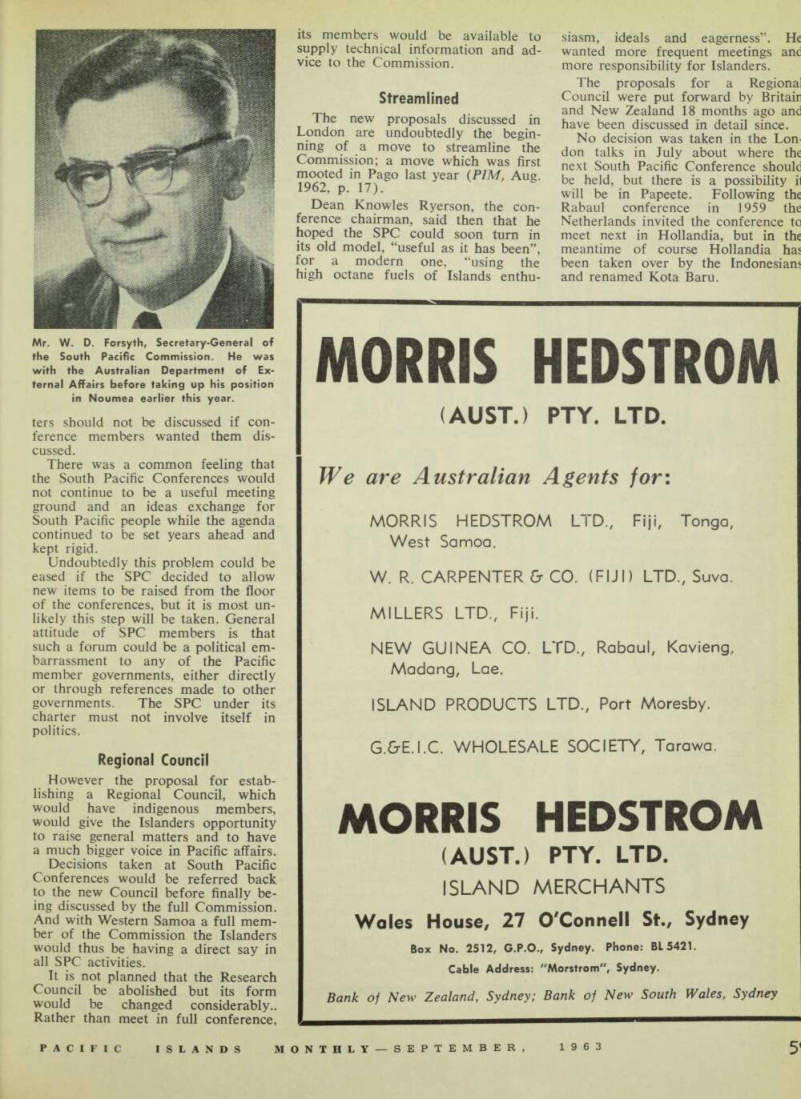
Mr. W. D. Forsyth, Secretary-General of the South Pacific Commission. He was with the Australian Department of Ex ternal Affairs before taking up his position in Noumea earlier this year.