Wellington Angry
pp. 23-24 · Read in the full issue
Over Allegations On Cook Islands
Allegations made to the United Nations that New Zea land was seeking to frustrate the political aspirations of the Cook Islanders caused plenty of justi fiable irritation in Government circles in Wellington in August.
THE allegations were made in peti tions from two European residents in the Cook Group to the UN’s 24-nation Special Committee on Colonialism.
The petitioners are Mr. Julian Dashwood, of Mauke, who is a mem ber of the Cook Islands Legislative Assembly, and Mr. Ronald Syme, of Rarotonga, an author of books for boys.
Mr. Dashwood said in his petition that he had lived in the Cook Islands with his Polynesian wife for the past quarter-century and was the only European in the Assembly represent ing a native constituency.
Referring to “an apparent lack of jrgency” on New Zealand’s part to 3ring the Islands to self-rule, he said hat no country, “however benevolent md paternal its rule, has a right to ;xercise indefinite control over mother, and it is only too easy, hrough ‘reserved areas’ and other nethods to introduce an effective : orm of neo-colonialism.”
He said the situation was not helped )y the “apathetic attitude” of the slanders themselves, “for whose ilmost total ignorance concerning in lependence one must surely hold the
Vdministration responsible”.
Mr. Dashwood added: “The con sent alignment of NZ’s foreign and nilitary policy with that of the American State Department may very veil not necessarily prove to be con istently in the interest of these slands.”
Charming and Deserving
Mr. Syme asked in his petition that he UN committee “spare a thought or these very charming and deserv ng Polynesians of the Cook Islands.”
“They have no one to speak for hem,” he said, “are debarred from :nowledge of the outside world, and ire at present very poorly equipped, •y circumstances utterly beyond their control, to face the advent of self [overnment.”
Mr, Syme added that the “so alled Legislative Assembly” was
merely a “face-saving gesture” and “an intimidated puppet organisation” set up to convey the impression that NZ intended to comply with the UN’s declaration on the independ ence of colonial countries and peoples.
News of the petitions of Messrs.
Dashwood and Syme brought a vehement protest from NZ’s Prime Minister, Mr. Holyoake, who said the suggestion that NZ was seeking to frustrate the Cook Islanders’ political aspirations was the opposite of the truth.
Constitutional development, he said, had been proceeding steadily in the Cook Islands for more than 15 years and the NZ Government had stressed that it was anxious to give the islanders as much self-government as they wanted.
Mr. Holyoake went on: “The Cook Islands Legislative Assembly, the great majority of whose members are elected on universal suffrage, was asked last year for its views on the constitutional status of the territory.
“In a unanimous resolution, passed in the absence of the official members, it made clear that full independence was not the goal of the people of the Cook Islands.
“The Assembly did, however, ask the NZ Government to give the islands the fullest possible internal self-government, while at the same time preserving for the Cook Islands people their present status as New Zealanders.
“Detailed proposals for introduc ing full internal self-government were
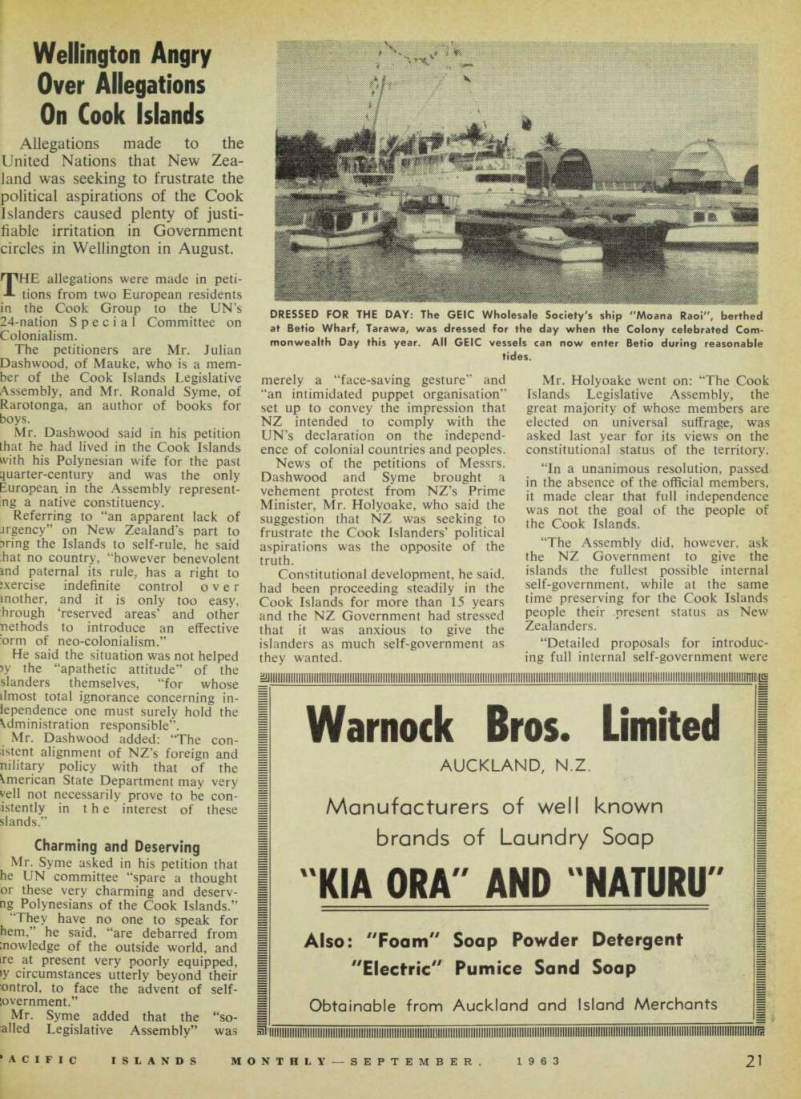
DRESSED FOR THE DAY: The GEIC Wholesale Society's ship "Moana Raoi", berthed at Betio Wharf, Tarawa, was dressed for the day when the Colony celebrated Com monwealth Day this year. All GEIC vessels can now enter Betio during reasonable tides.
laid before the Assembly at the be ginning of its current session and, at the Assembly’s request, the Govern ment has arranged for a team of con stitutional experts to go to Rarotonga to help it formulate its own views.”
Mr. Holyoake said the constitu tional experts were Mr. J. B. Wright, NZ’s High Commissioner in Western Samoa; Dr. C. C. Aikman, Professor of constitutional law at Victoria Uni versity, Wellington; and Dr. J. W.
Davidson, professor of Pacific history at the Australian National University, Canberra. (They left for Rarotonga in late August).
Mr. Holyoake added: “The Gov ernment’s whole policy towards NZ’s island territories is to encourage and enable them to stand on their own
feet as much as possibe, while con tinuing to give them all the help they need, and maintaining for as long as they wish their association with NZ.”
Other comments provoked by the petition to the United Nations in cluded an editorial in the Wellington newspaper, Dominion, and an article by Auckland Star reporter Noel Holmes, who recently published a series of critical articles on the Cook Islands ( PIM, Aug., p. 59) after an extensive tour of the Group.
The Dominion said NZ had no need to be bustled or embarrassed by her record in the Cook Islands, but that, with the “march of strident nationalism” in Africa and Asia, it would have to expect increasing in
terest in the Cook Islands from “noisy anti-colonial protagonists.
“Nobody would pretend that NZ has always discharged her obligations as well as she might,” the newspaper said. But it added that since World War II sincere and earnest efforts had been made to advance the Cook Islanders’ welfare and to facilitate political development. The cost of these efforts to NZ taxpayers last year had been nearly £750,000.
Holmes said in his article that in dependence was the last thing the Cook Islanders wanted and that if they did get it, the Group would undoubtedly become bankrupt over night.
Holmes added that the two petitioners to the UN, Messrs. Dash wood and Syme, were both leftists— Mr. Dashwood being “an extreme leftist” and Mr. Syme “somewhat leftist politically.”