Face Plenty Of Problems
pp. 10-11 · Read in the full issue
West New Guineans In Exile Face Plenty Of Problems
From a Correspondent in The Hague Former West New Guinea leaders in exile in the Nether lands are optimistic that in 1969 they will return to a free and independent West New Guinea. But not many people share their optimism—least of all the Netherlands Government.
THE leaders have formed themselves into the Papuan National p ron t—an organisation rather mindful of the exiled organisation set up by the South Moluccans following the Indonesian revolution. In Hoiland there is a little of the same sympathy and support for the National Front as there was for the South Moluccan organisation, but none of it comes from the Government.
In an effort to improve relations with Indonesia the Netherlands Goveminent is being careful to avoid association with the Papuans in Holland. The Papuans get the same social aid as any other resident in the Netherlands in need of it, but nothing else. , ... and Filamon Jufuway were in the day they are in the shadows, of no fU rNeth^^ o rto get out of New Guinea was supported by the great majority of the Dutch at home. Very few felt the candle was worth fighting for.
The fact that the Government had promised self-determination to the people of New Guinea is now of
little account to the average Dutch man—and if he thinks about it at all he would agree that Indonesia probably has no intention of keeping its promise to provide a free act of determination” in West New Guinea by 1969. y ix _. Don t Know The Facts Lack of information, rather than i ac k G f principles, is probably the main reason for this general atti tude of “couldn’t care” in Holland, Although the Papuan leaders in exi e have rea ii se( j their confidence Jn the Government was misplaced, they are still genuinely hopeful of a success f u i re turn to an independent New Guinea> an( j the activities of the Front will be continued. tetter to the Aus • d bv as vice-chairman .appealedl forassist SS sar y- TTiey said that in Kota Baru Papuans were being forced to sign a document saying they were against a plebiscite for self-determination, Many Papuans had already been put in gaol.
The former leaders said that t rob the Papuans of their guardiar the Indonesians had shipped the ei tire force of Papuan Volunteers froi New Guinea to Borneo “where the were being forced to help the Inch nesians in their mischievous activity against the British and Malayans They added: “It is not only we that are menace by Indonesia’s lust for power. W know, Papuans feigning sympath for Indonesia have been told si that Indonesia cherishes the idea < one united ‘lrian,’ of one united Ii donesia from Sabang to Samarai.
“Our flag and our national anthei have been suppressed; the Ne Guinea Council of freely electe members was sent home. Indee* only half a month of Indonesian ru is enough to teach us that we sha need the support of friends for tl realisations of the rights granted i us for 1969. As we cannot spe£
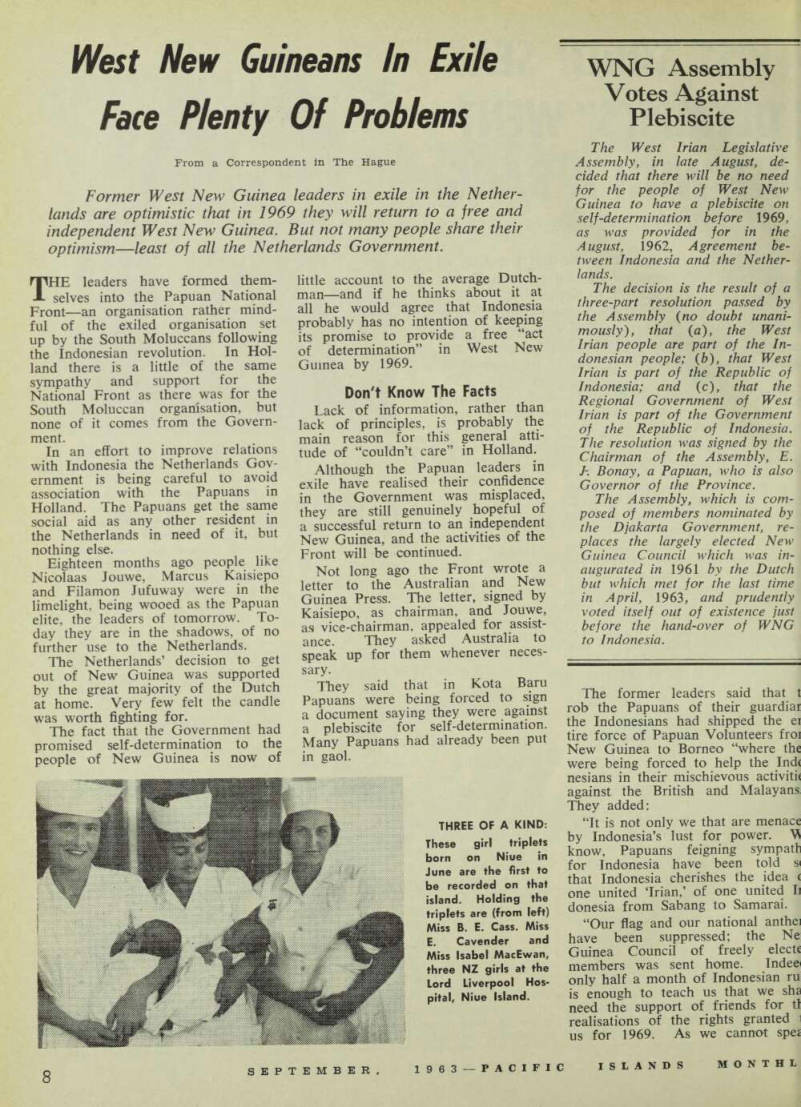
Three Of A Kind;
These girl triplets born on Niue in June are the first to be recorded on that island. Holding the triplets are (from left) Miss B. E. Cass. Miss E. Cavender and Miss Isabel Mac Ewan, three NZ girls at the Lord Liverpool Hos pital, Niue Island.
for ourselves we ask Australia to do so for us.”
The Papuan leaders in exile are not the only former West New Guinea citizens with problems in The Hague. Many students have had worse difficulties.
Both the Government and various missions had been providing scholar ships for West New Guinea students attending secondary schools and universities in Holland, and money for their support continued to be provided during the time the UN was in control in West New Guinea.
But since May the Government has cut off its support. It told the students bluntly they had to return to West New Guinea.
Indonesian consular officials in The Hague were even more blunt. The Indonesian Charge d’Affaires, Dr.
Mohammed Sharif, said the students should keep in mind that if they later applied for government posi tions in Indonesian territory using a Dutch diploma, they would be con sidered “pro-Dutch”—the Indonesian Government would, however, let them continue their studies in Indo nesia.
Back home in West New Guinea the Indonesians also put pressure on many of the parents of the students to advise their children to cease their studies and return.
The Dutch Reformed Church took the same view as the Dutch Gov ernment and the Indonesians, and withdrew financial support from students, hoping thereby to force
them into a “favourable decision” to return home.
In contrast, the Roman Catholic Church announced it would allow its students to decide their own future without pressure.
The result has been that many students bowed to necessity and re turned to West New Guinea or have gone to Indonesia. A small group has accepted the risks of completing studies in Holland. They are mak ing do by scraping up financial support from foster parents, the church, the Papuan National Front, and anybody else in sympathy with their plight.
Some former residents of West New Guinea lucky enough not to be students or Papuan leaders are better off. Most have been helped with accommodation, and permanent pub lic servants have been placed on half-pay for five years and given a re-furnishing allowance. Their pen sion rights have been guaranteed.
Temporary public servants received on arrival in Holland two months of their salary in a lump sum, but were given no other help apart from accommodation.
Private people who left shops and offices in New Guinea have received no compensation for any goods or property left behind, or for their loss of income.
Fortunately business is booming in Holland and jobs are not scarce, but many of these people are finding it difficult to adapt themselves to European living again.
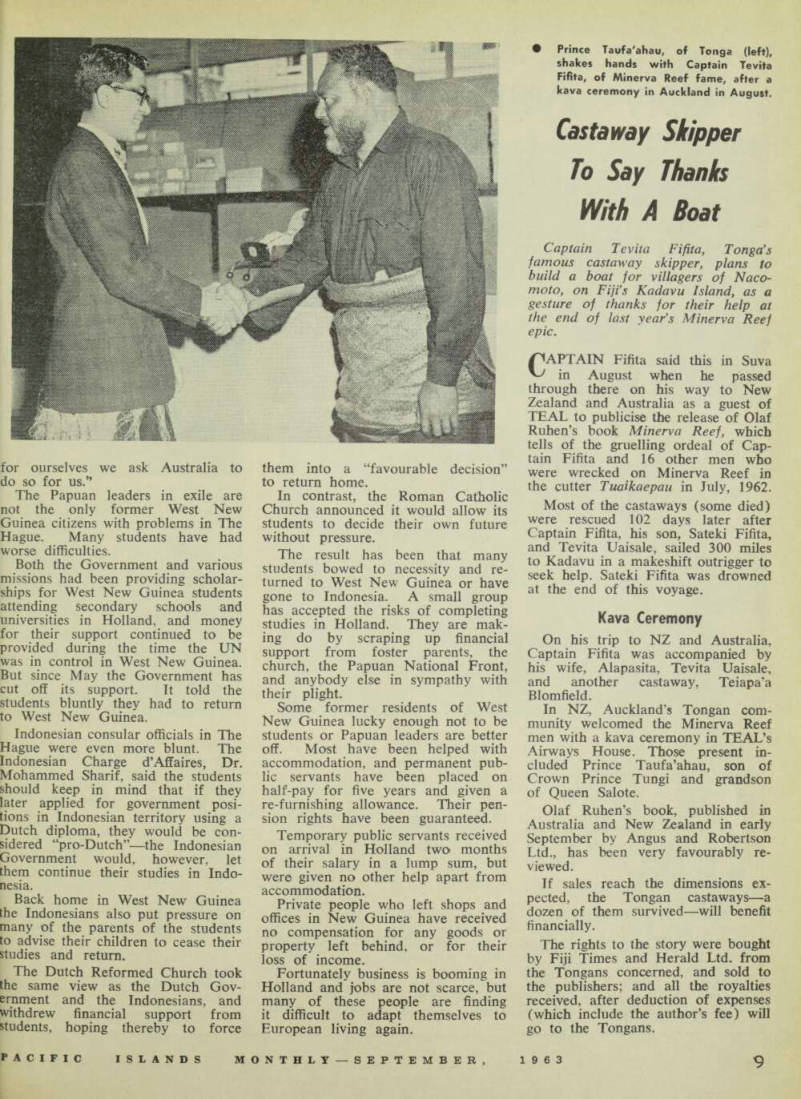
Prince Taufa'ahau, of Tonga (left), shakes hands with Captain Tevita Fifita, of Minerva Reef fame, after a kava ceremony in Auckland in August.