Some New
p. 97 · Read in the full issue
Fiction
ustralian author Jon Clear> recently, on a television in iew, that an Australian er, to keep an international ence, must write inter nally. His latest novel
?sis of the Night apparently
ritten on that theory.
E action of the novel takes place in Burma against a background ■evolutionary Dacoits and the lied politics of that country; 5 his cast includes a London ty doctor, a British Consul, an ralian priest, an American nurse, rmese doctor and a part-Chinese ne fatale. There are also a couple ndians (from India), here and . You certainly couldn’t get any more international, so fashionably correct: One of chief characters is dying of :r; and there is much scul ping about Catholicism, ilf the characters in novels are ; of cancer these days, where they just decently faded off mysterious, unnamed maladies.
Jon Cleary shows every sign of ving Grahame Green and Mor /est along the primrose path of siastical ardour. It is a wonder the Hierarchy doesn’t excom cate the lot of them—not be ; religion (like cancer), is not a of life but because they threaten ake a novelist’s gimmick of then on. iart from these strictures, this is .q. novel, with some reasonably characterisation, a lot of im ibilities and a surprise twist to dot which climaxes with a tiger The title (although he doesn’t ;o) comes from William Blake’s s: Figer, tiger, burning bright [n the forests of the night . . . e mystery remains, however, Cleary thinks this book would d more to an international nee than, for example, his Sun ers, which was totally Australian probably the most natural and ing story this author has ever ;n. It was so highly thought of lationally that an overseas film •any produced it in Australia an international cast.
Rests Of The Night. Collins.
ALSO international in background is Francis Clifford’s The Green Fields of Eden, and in it, also, the main character is dying of cancer.
The whole novel covers a couple of weeks in the lives of an incurably ill Englishman, a bullfighter and his motherly mistress, a professional assassin and his girl-friend, and a political refugee, all brought together on a small Spanish island off the coast of Africa. All the things that might happen when such a collection converge on the same poverty stricken, sun-bleached village do hap pen and the merit of the novel lies in its description of the chemical reaction of one character against an other. This is particularly so of the dying Englishman who, as the review writers have it, “finds himself”.
More exactly, he loses himself and forgets his cancerous stomach momentarily in taking a last hand in the affairs of the living.
(The Green Fields Of Eden.
Hodder & Stoughton. 18/9.)
Erle Stanley Gardner, Ac
cording to his public relations consultants, “just tries to write what people want”. To do it he employs seven typists, barks out his stories on to a dictating machine, sometimes 10,000 words of them before break fast, and works on up to four stories at the same time. We feel that this must sometimes be confusing to Mr.
Gardner and certainly it frequently is to his readers.
The latest opus extruded from his literary sausage factory (The Case of the Lucky Loser ) is standard in that it has a beginning in Perry Mason’s office, ends in court, and has all the regular characters. Apart from that you would probably need some sort of electronic computer to distinguish it from the other Perry Mason cases turned out by Erie Stanley since he took to mass production methods.
(The Case Of The Lucky Loser.
Published by Heinemann. 17/-.) EXPATRIATE Australian writer Michael Noonan, now of the UK, makes a living out of writing radio and television scripts and plays,, out of children’s books and an occa sional adult novel about children.
The December Boys, is the second novel and has something of a Nor man Lindsay flavour about it.
For the purpose of his latest exer cise, Noonan forsakes the affluent society of Australia in the 1960’s and returns to the Depression 1930’s to launch his gaggle of boys (presumed to have been born in December), from a country orphanage into the delights of a summer beach holiday.
Their environment, the odd adult world and strange new stirrings in themselves are seen through their in quisitive eyes. (THE DECEMBER BOYS. Heinemann. 22/6.) Thrillers that owe nothing to the sausage-machine technique but are also good novels on which thought and writing skill have been expended are getting to be the ex ception. But two recent productions that live up to requirements are After the Fine Weather, by Michael Gil bert; and The Pin Men, by Roger East.
Neither ranges further afield than Europe; After the Fine Weather is a novel of suspense and political in trigue in a small district of Austria where neo-Nazism raises its head and a young British vice-consul’s younger sister unfortunately is too observant for her own good.
The Pin Men is another episode in the life of scientist/detective Jack Mors, a Computer Age character that Roger East invented for his first thriller Kingston Black.
(After The Fine Weather; And
THE PIN MEN. Hodder & Stoughton. 20/- each.)
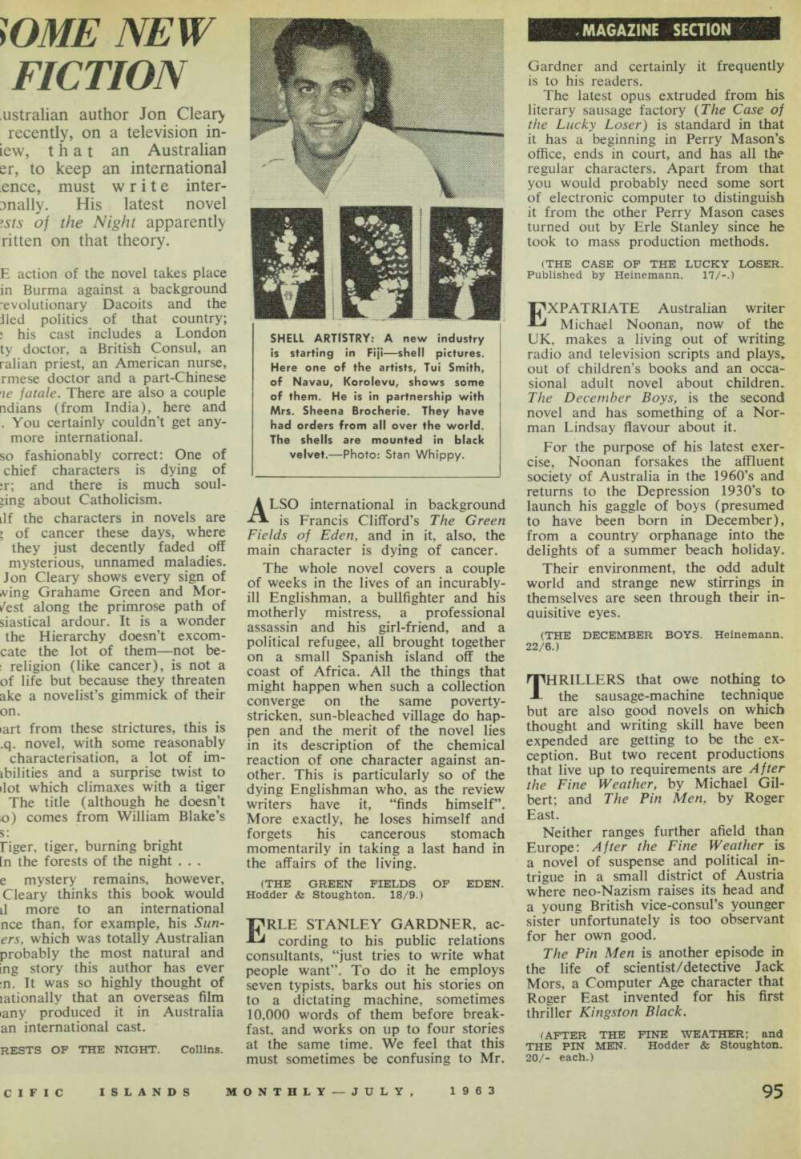
SHELL ARTISTRY: A new industry is starting in Fiji—shell pictures.
Here one of the artists, Tui Smith, of Navau, Korolevu, shows some of them. He is in partnership with Mrs. Sheena Brocherie. They have had orders from all over the world.
The shells are mounted in black velvet. Photo: Stan Whippy.