Pacific Students
pp. 93-94 · Read in the full issue
The Month S New Reading
Two Books Of Note For Pacific Students
With Judy Tudor
For serious students of the Pacific, the month has pro- :ed two books of note: The late Professor Edwin. Grant rrows account of the artistic life of an atoll people ( Flower My Ear); and, on the practical side, the Auckland Unisity Geography Department’s report on land use and agriture in Western Samoa (Western Samoa: Land, Life and • u • rj, . , v . v ' ' riculture in Tropical Polynesia) .
late Edwin Grant Burrows, rofessor of Anthropology at :cticut University, spent seven is on Ifaluk Atoll, Caroline s, in 1948 and three months in 1953. Flower in My Ear, bed shortly after his death, is sult of the two visits. uk is a typical low atoll about ty between Truk and Yap and 350 miles south of Guam. It f particular interest to anthrosts as it had never been served resident missionary and theretoe 250 inhabitants could be as being reasonably untouched ;stern religious influences. rows has already written scienjports on what he found there npany with a fellow anthropobut the present work is a more live volume, devoted primarily arts of the people of Ifaluk.
Because they live on a true atoll and are limited to a land area of about a half square mile, their raw material for any aspect of life is limited. Their self expression has de veloped mostly in the oral arts— music, poetry, dancing, prose narra tion and oratory—all to what Bur rows considered a high degree and over half of this large book is taken up with his translations of their songs, ancient and modern, that cover most aspects of life, Burrows’ notes on the verses and songs, plus the songs themselves make it possible to piece together a very good picture of these atoll dwellers and their history, Religiously they may have been free of the taint of Westernism; but like the rest of the Caroline Islanders, they have felt the back-wash of their complicated history—small though it
might have been on isolated Ifaluk Atoll. In less than 75 years four foreign nations have governed the Carolines: Spain, Germany, Japan and the United States. * Much more severely practical is the book produced by James W. Fox and Professor K. B. Cumberland which they call by the cumbersome title of Western Samoa — Land, Life and Agriculture in Tropical Poly nesia.
This large volume, which probably could be called a report more than something more literary, is neverthe less interesting, to the historian as well as to the agriculturalist, as it gives the history of the beginning of the plantation industry in Wes tern Samoa —an industry whose mantle has fallen now almost exclu sively on the Trust Estates Corpora tion.
The volume is the outcome of a research project carried out by the Department of Geography, Univer sity of Auckland, NZ, shortly be fore independence in Western Samoa and was designed as part of a blue print for later agricultural and land development in a country where population growth is rapid and out stripping development.
Plantation agriculture in Western Samoa, the authors state, owes its foundations to German initiative and enterprise. Although this has now been absent for 50 years, the form and character of plantations there have changed very little (increased production from Western Samoa com ing now from village enterprises rather than the plantation system) The first German plantations were established in Samoa as long ago as 1865—Mulifanua, which is still the largest plantation in the country was planted up by Theodore Weber for Godeffroy & Sons which later was taken over and consolidated by the German DH & PG—the so-called Long-Handled Firm whose influence was strong also in New Guinea.
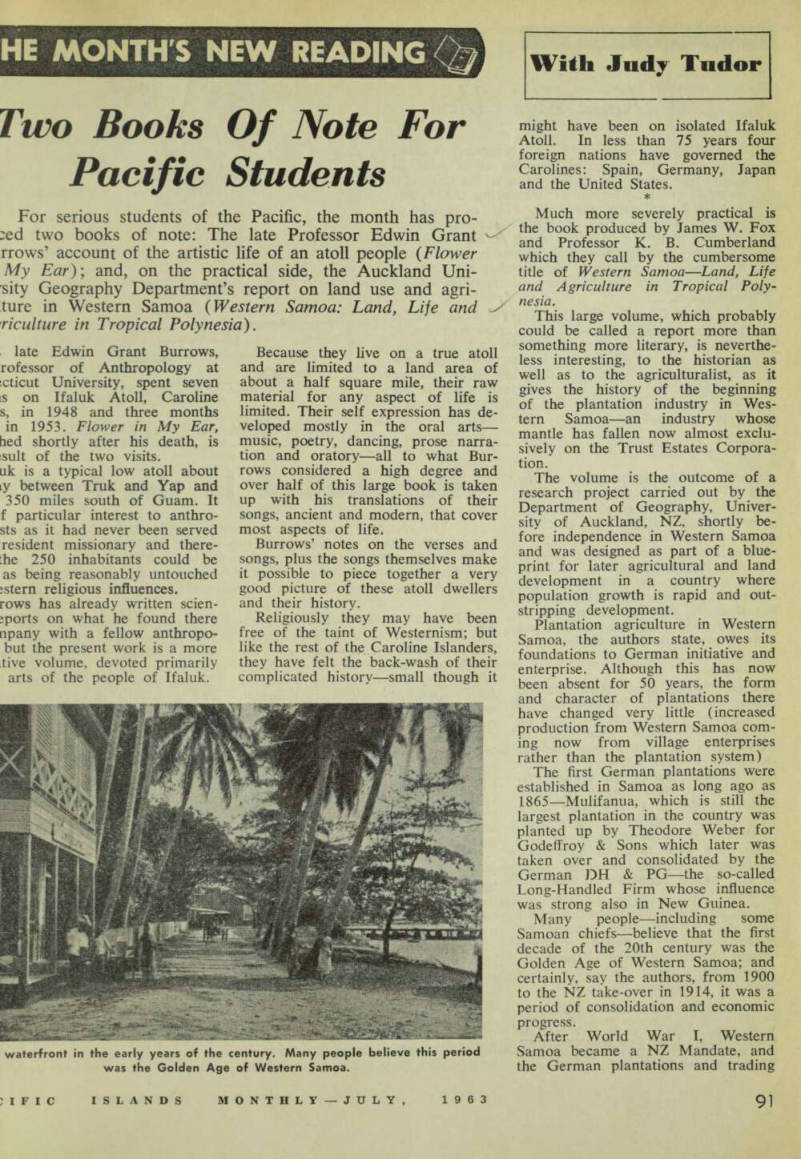
Many people—including some Samoan chiefs —believe that the first decade of the 20th century was the Golden Age of Western Samoa; and certainly, say the authors, from 1900 to the NZ take-over in 1914, it was a period of consolidation and economic progress.
After World War I, Western Samoa became a NZ Mandate, and the German plantations and trading
waterfront in the early years of the century. Many people believe this period was the Golden Age of Western Samoa.
stations, mainly the property of the DH & PG, were taken over by NZ as the NZ Reparation Estates—all at a time when all of them were reaching maximum production.
The total of the estates originally was 113,560 acres, some of it bush land, and over the years that NZ administered the estates (before giv ing them to the Samoan people as a gift in 1957), all but 32,000 acres were disposed of to relieve the grow ing pressure for land from the Samoans.
Even in their attentuated state the estates are still Big Business and as such probably not such an inspiring example to village enterprise as theorists would believe. Nonetheless, the authors don’t advocate the fur ther breaking up of the estates. To the contrary, they appear to think that it would be a very good thing if, instead of distributing the estates’ profits on non-productive social ser vices, they used them to buy more land and to increase the estates’ stake in the future economy of Western Samoa.
This analytical account of Samoan land use and agriculture, against the background of Samoan custom, should be of great value to those ad ministering Samoa today—if they have the good sense to use it. (FLOWER IN MY EAR. Published by University of Washington Press, Seattle 5, Washington, USA. $6.75. WESTERN
Samoa, Land Life And Agriculture
IN TROPICAL POLYNESIA. Published by Whitcombe and Tombs Ltd. NZ63/-,)