Abolished, Segregation
pp. 63-72 · Read in the full issue

The Breweries Battle for the Bar Trade
NG Drinking Has Created, Not Abolished, Segregation
A Review by R. W. Robson
The anti-discrimination forces, last year, gave the New Guinea natives freedom to drink for the first time. The irony of it is that they have done, in this, more than any other thing I have seen to emphasise racial discrimination and segregation in the Territory.
MAYBE, times and habits will change. But the fact is that in every licensed bar I visited in the Territory, the races were aligned, of their own free will, in separate sections.
There was no hostility anywhere.
They grinned at each other, when they met, and exchanged greetings.
But they will not drink together.
That is the social side, which is startling enough. Officialdom ought to be quite upset about it.
But on the economic side there is a bigger and, I think, uglier problem.
Ninety per cent, of these hotel drinkers are detribalised wage-earners.
None of these unskilled workers gets more than 40/- to 50/- per week.
There is only a big glassful of beer in the bottle for which they pay from 2/- to 2/9. On one pay-night in Lae
they seemed to consume each an average of eight or ten bottles.
Need anything more be said to emphasise the silliness of the economic side of native drinking?
A Medical Assistant of some ex perience stood beside me and watched the scene at one of the biggest hotels.
“This is a cruel thing they are ing to these people,” he said. “Or, rather, to the women and children.
Most of these boys tomorrow will be sodden and stupid, after their binge, and there will be trouble when their families ask for the usual money for food, and there is none. We have seen the effect, already. Women and children are drifting back to their villages—it is the only way they can eat.”
After touring the Territory, I ex pressed the foregoing views freely in Port Moresby, before leaving for home. But officialdom rejected them fiercely—l fear lam regarded as a shell-backed fuddy-duddy.
In their opinion, the new system is working well: The natives are happy, there has been no disorder or “molestations”, and the sellers of beer are carolling in their baths.
They ridicule the views of the older and more experienced residents that the introduction of liquor to these still-primitive folk will lead in evitably to bad social and economic trouble. . .
Much Amiable Drinking I entered New Guinea by the back door (at Rabaul, from the Solomons), and so began my inspection of native drinking in the Trust Territory’s parched and dusty ex-capital. My first contact was amusing.
He came out of the Ascot Hotel bar, in Rabaul, with a bottle in one hand, a glass in the other, and a
A Wet
Weekend For
Somebody?
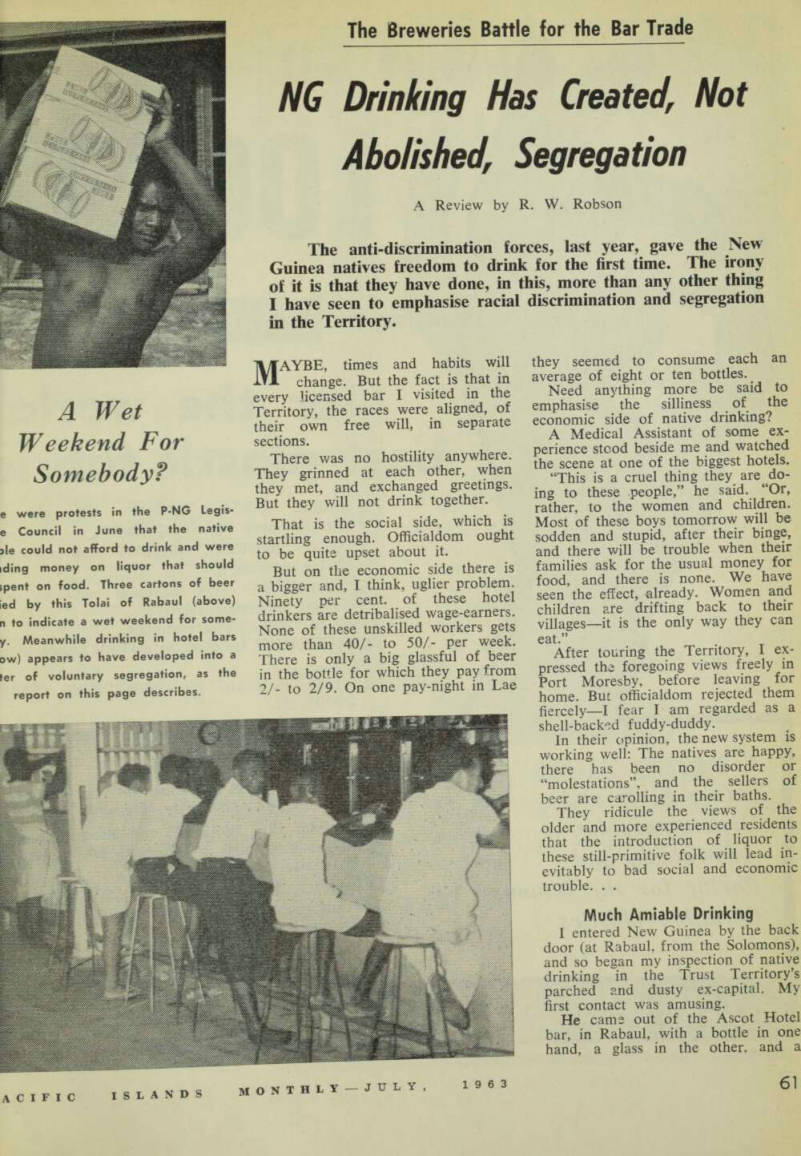
[?]e were protests in the P-NG Legis [?]e Council in June that the native [?]le could not afford to drink and were [?]ding money on liquor that should spent on food. Three cartons of beer ied by this Tolai of Rabaul (above) [?]n to indicate a wet weekend for some [?]y. Meanwhile drinking in hotel bars [?]ow) appears to have developed into a ter of voluntary segregation, as the report on this page describes.
grin on his face, and he weaved incertain way across to where I it the wheel of a car. e poured the beer. Some of it into the glass, and he tendered foaming stuff.
Vlasta,” he said. “Masta drink boi.” 40, no,” I said, waving it away.
Minister—me missionary—beer ?ood.” e took it quite well. “Meenit, nit,” he muttered, and staggered along the footpath, waving his le and offering a drink to his iw-Tolais. [y companion was amused; but il manageress Dorothy Stewart, had been standing talking to svas not. rhat glass he’s carrying oft he 's to the hotel,” she said, feroci y. ‘They think that when they a bottle they buy the tumbler veil.” hat was noon on Saturday, ives were drinking happily in all ctions —in the bar, out in the et. returned and inspected the scene 1.30 p.m.
Mostly Bare Feet 'he very big bar-room contained [east 40 natives, mostly in shorts singlets, mostly bare feet. They ;ed, laughed a great deal and nk beer, either from little squat ties which cost them 2/- to 2/9 h, or from thick glasses. Dozens e lined up at the bar, and it took weating European, and two lively ive barmen, all their time to *t the demand.
Xitside, on the footpath, were a re or two more natives, drinking r as if they liked it, and inclined yelp noisily. [here was no disorder. Some gave a smiling “Gooday masta”, but st ignored me, rhere were no natives m the big nge. I understood they could er if they were properly dressed, ; none came.
Fhree European men sat in the mge, sourly regarding the jolly ne in the bar, and listening to the :rry clang of the cash register.
It was the same across at the ismopolitan Hotel bar. The natives ink copiously, and in a gentlemanly iy. . .
The “Cosmo” has extensive lawns 3und it; and in dark corners, and :ked cosily under the hibiscus shes, those who had found the ew over-potent snored contentedly.
The high-minded brass of Port oresby had planned de-segregation. , far as Rabaul’s hotels are con-
led, the change had given segre on (voluntary) a sharper defini i than anything I had previously i here. n the morning of Saturday, June ve stood at the back of the Cecil tel, Lae, and stared unbelievingly the high pile of pint-size beer ties. They had materialised over ht.
Thousands of Bottles fhere were over 3,000 of them, we med officially. rhat’s a lot of beer, by any adard. It was consumed in the )lic bar by New Guinea natives ween 4 p.m. and 10 p.m. on pay r, Friday, May 31.
Fhe previous evening we had nessed a remarkable scene, repro ved there every pay-day, they said, e large public bar, the adjoining jtside” lounge, the little tables in ; outside shelters, the big tables in nearby pavilion—all were crowded th drinking New Guineans.
Four native barmen were ex mely busy—three selling the little ttles at 2/- each for the local brew, d a few pence more for the un ited stuff; and one carrying away e empties, and bringing in full rtons. It was a busy, happy, hilan is picture. , , , The gusto with which the boys vre putting the beer away would L ve done credit to any Shearers rms anywhere in Australia; and the •ensee and his team were lifting the scil Hotel and Guinea Brewery counts so far into “the black that ie could almost hear, in advance, ie purring of the shareholders.
There was a day, a year or so T O , when Hamac or Sangara or hoever was trying to keep a string f New Guinea hotels functioning noothly, was beset with bother, ince the Port Moresby idealists, in
anti-liquor forces have been busy in Territory since drinking was introduced he natives last year. This sign is on a Port Moresby bus.
■suance of their de-discrimination licies, permitted the native people drink in the bars, the whole ture has changed. The note- Iders sleep sweetly o’ nights, and ; Receiver soon may be looking itefully for a less exacting job.
One hard-faced New Guinean liceman stood outside, on the foot th, and stared through the windows the merriment within. Rollicking untrymen greeted him in a friendly ly, but he was very much on duty.
When two over-full lads—who, by s shape of their noses, belonged to ry different clans —began to argue rilly about their tambus or their others’ legitimacy, or something, e cop moved in quietly and effici itly, and the row immediately sub led. ‘That’s what they’ve got to watch,” id my friend. “As soon as a per mal squabble starts, they all take ies, quite irrespective of the merits ; the argument, and in three minutes s an all-in.”
He told me that that big riot near ae, in May, between the Butibums id’ the Finsches, was not the result [ drinking. A little dispute between vo gentlemen —in this case, quite jber stirred strong community ;elings, and they soon were all in with claws and teeth and clubs.
With these people, the issue at ake does not count —all that matters i the fight itself. We can but hope lat the “crash” education programme dll introduce different ideas into the ewly enlarged House of Assembly ext year.
I walked through this drinking ssembly of probably 300 natives, nd I did not see one European here. The whites were all m the nner bar and the inner lounge, ’here were no natives in there. For ocial purposes, they just do not mix.
This was the case in every hotel bar I inspected in the Territory.
In Goroka, where the Europeans live coolly and behave with great discretion—the effect, I presume, of a heavy injection of ex-District Officer planters—there was the same reluctance to mix. ... , , * i Highlanders Don t Drink The white men lined the hotel’s new saloon bar in a proper fashion, A“—£' »»
is iz
So, with two old I went around to drink in Goroka’s “other bar”. There were 15 to 18 mixed natives there, all enjoying the beer f rom the pint-sized bottles (which naturally cost more up there than on the coas t), and talking animatedly, The bar was under the control of a grim, tattooed Goroka native who could whip the top o ff a bottle with one s b c k movement, and stop a quarrel with one short word.
P JiV .TffS
John Gunther, who sponsored a new Liquor Ordinance in June.
gin, but we could not break jugh their reserve. identified a couple of High- Jers, a Tolai, a tough-looking :imen from Papua, a Sepik. Beer y have brought them together, even the foaming brews of New inea could not break down the riers imposed by their 700 dif ;nt languages. we left, the merry clamour se again in the outer bar. The ites are no more wanted in the cks’ section than are the blacks the inner sanctums where whites ak. fhey nearly all are coastal peoples 0 fill these licensed bars. Gener i, the Highlands tribes show no ;rest in beer. iome enterprising merchants sent plane-load of bottled beer to the mnt Hagen show. A very large •portion intended for native con nption went back into store.
PM Drinkers Have Bad Habits Fhe over-all picture in Port jresby was similar —bars and beer -dens provided for each race in all ee hotels; no compulsion on her class to go into designated LCes —but a very definite, self-im sed segregation. 1 heard, in Port Moresby, two
sharp criticism I had not heard in the other towns: • The natives in the PM bars react to liquor in primitive fashion— they vomit and urinate in around the bars, to the outspoken disgust of the hotel attendants. • There is more hooliganism among drunken natives in PM than in other places, and European women are strongly advised not to travel alone after dark.
Suppliers in a Keen War The Administration may seem in different to the economic side of native drinking—but its blind eye is not turned to the Customs.
Within six months, the consump tion of canned (imported) beer had increased 50 per cent.
Thereupon, Administration in creased the duty from 7/6 to 9/6 per gallon. That left the local pro ducts (South Pacific brewery, at Port Moresby, owned by Malayan Breweries Ltd., and Guinea Brewery, at Lae, owned by local people) at a big advantage; and in May and June they were going after the native trade with great energy.
Guinea Brewery produced a small, squat bottle, which was retailed at 2/-; but South Pacific was counter ing in May with a new pack, carry ing slightly more liquor, at a slightly
tween them reall J y Un was he or ar both directly and through the retailers.
It was noticeable that the wellknown cans in which Victoria Better travels seemed fewer in numbers overwhelmed by the heaps of SP and GB empties. But the Victorians were not taking it lying down: in June, an executive from Melbourne rfs ™. the Territory, examining battlefield strategies. laverns and Canteens
fadr/* 16 clB m ? Under which neater drinking C ffilhe® f h r ° Ylded f for native S ’ the sha P e of canteens w’/f 6 strongly criticised y e ected (non-official) members.
A Mr. lan Downs reminded the Administration that the commission which approved native drinking had emphasised that facilities for drink mg should not be provided in places where facilities did not exist; and the provision of taverns and canteens seemed to run counter to that advice
The elected members made thes points; . T 0 ° ™ uch money, in relation t their daily wages, already was bein spent on liquor by natives.
The hotel system of distribute liquor could be policed; but that wa not practicable in the cases of taverns A widespread tavern and canteei system would take liquor trade from licensed hotels, and increasi the latter’s difficulties in providini amenities for travellers.
Native taverns could become dis reputable places.
The present system wanted mg up, because already it permitted grave nuisances and offensive be haviour. This should be done before canteens and taverns were provided, The provision that natives could purchase spirits, to be taken away for consumption, was undesirable, indefensible and dangerous.
The bill’s sponsor, Assistant Ad ministrator Dr. John Gunther, said the elected members’ criticism had been helpful. Most of the objections had been provided for in a series of amendments. The canteen and tavern system would be strictly regulated. I One presumes that the tavern andl canteen drinkers will also imbibe on their own.
Mr. lan Downs, an elected member of th[?] Legislative Council was against new li qu [?] outlets being provided.