Controversial Bill
pp. 57-59 · Read in the full issue
On Discrimination introduced In P-NG
By R. W. Robson
Having listened in at a num • of sittings of the P-NG gislative Council in June, I ne away with the impression it the P-NG Administration 5 become a little hysterical and balanced on the subject of
Lscrimination”.
LECTED members said at this session that half the official s being introduced actually were scriminatory against Europeans”, fhe Administration’s reaction to 5 was disclosed in its resentment of icism; and in the introduction of Discriminatory Practices Bill, ely one of the most extraordinary asures ever seen in Pacific Islands Fhe bill’s sponsor, Assistant Ad listrator Dr. Gunther, admitted ,t “the single act that triggered the >d for this bill was a refusal to ve a well-educated, well-dressed, 11-mannered native person in a e”. Nobody would argue that this id of discrimination —or any kind s objectionable, but the bill pro les heavy fines or imprisonment for yr person guilty of “discrimination, tier of an adverse or preferential id, against or in favour of a person group, for reasons of race or our.” It will be a very difficult law police.
Here are some of the offences; • Setting aside any part of pre ses, vessel, aircraft, or vehicle for ; exclusive use of people of a par ular race or colour; • Failure to attend to persons in . order in which they approach, dng to their race or colour; • Selling goods at different prices persons of different races, • Conduct which distinguishes be een persons of different race or lour.
Persons who act in “an insulting, ovocative or offensive manner to irds a person of a different race or lour as such”, or who incite such haviour, may be gaoled for two onths. ... And there are various her provisions to the same effect.
This measure, destined probably to to go down as a product of hysteria, was condemned in strong terms by the non-official elected members, none of whom supported discrimin atory practices but all of whom felt the bill was the wrong way of tack ling them.
Mr. Lloyd Hurrell: “This dreadful piece of legislation . . . will perpetu ate the thing it is trying to eradicate ... a blundering, stupid piece of legislation. . . .”
Mr. J. L. Chipper: “Inept legisla tion ... we will laugh and joke about it in the future.”
Apparently because they feared that they might go on record as ad-
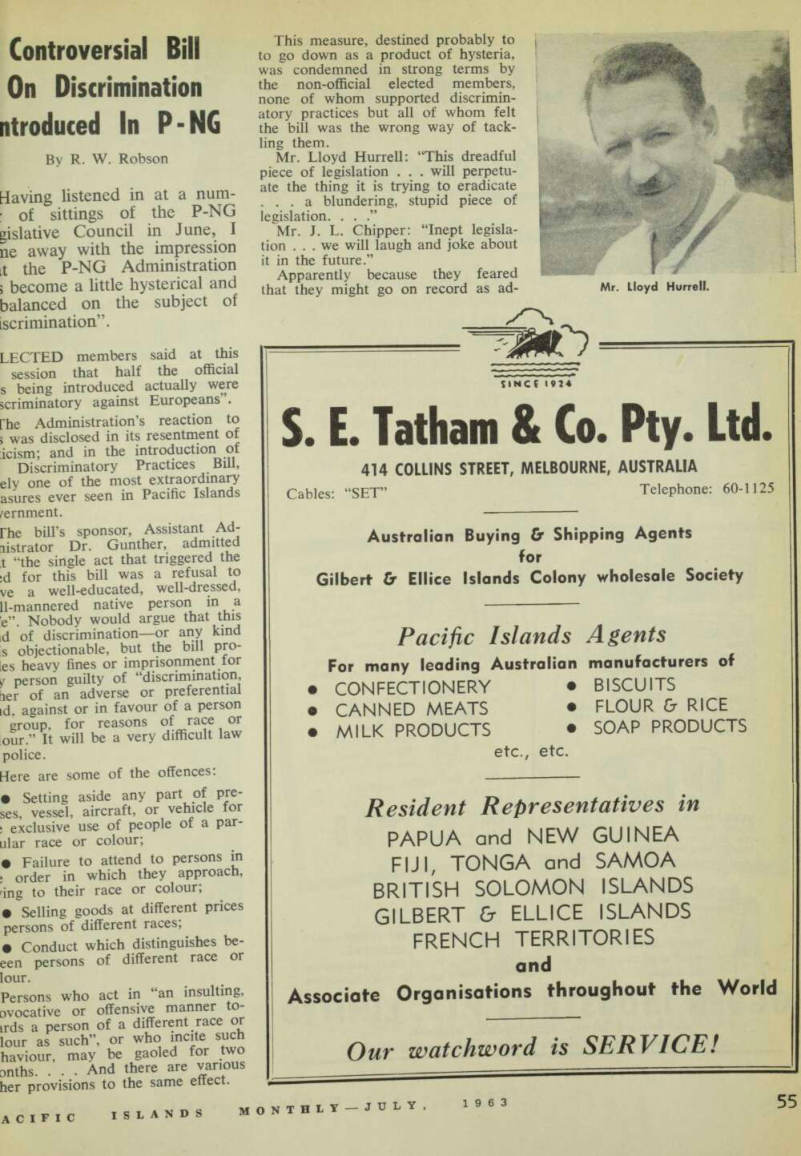
Mr. Lloyd Hurrell.
vocates of discrimination, the cril of the measure would not vote agai it, and it passed into law on voices.
On the subject of discriminate members during the session poin out that there was anti-white discri mation in the new liquor laws, in 1 way in which the Public Solicitor v encouraged to assist the natives pursuing demands of various kir against the whites, even in the w m which Mr. Hasluck’s new Pap and New Guinea Bill, recently in t Commonwealth Parliament, gave t new native local government counc power to raise revenue by local taj tion.
Anti-Self-Government
. An interesting feature of disci sions on self-government was the i sentment expressed by native mer bers against UN pressure towar independence”.
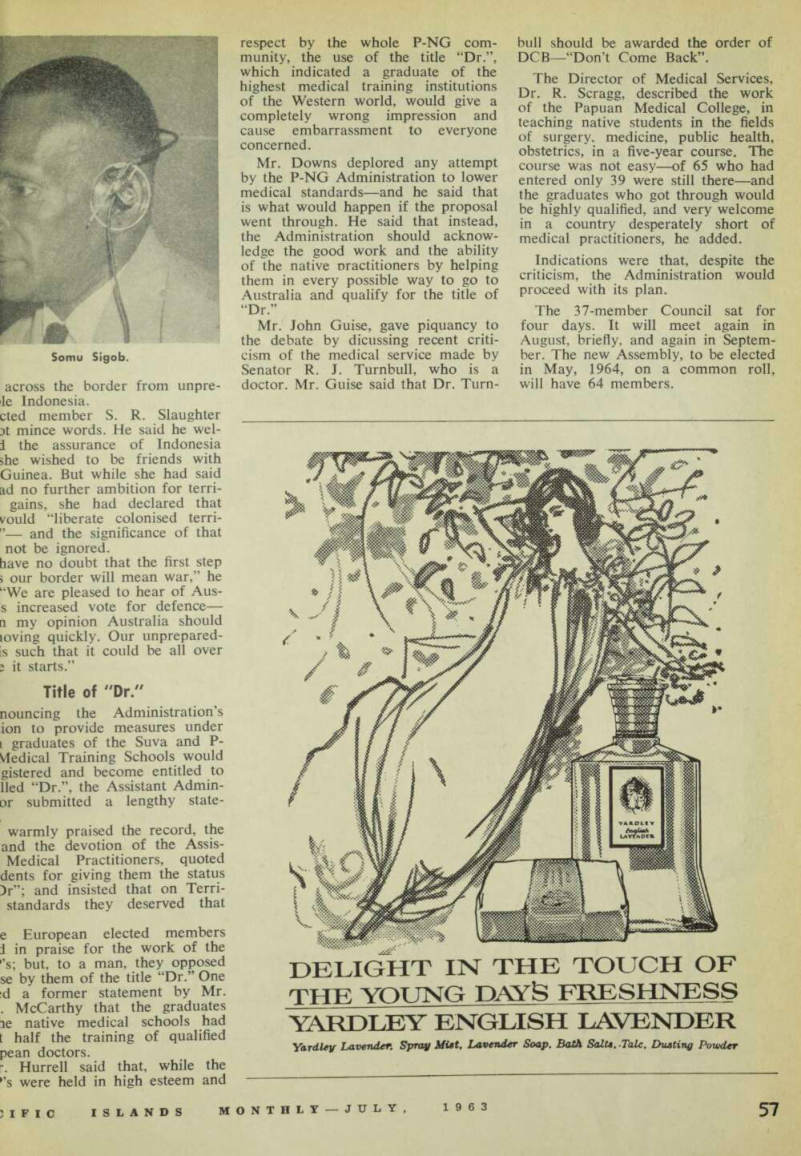
Somu Sigob was outspoken. T 1 country, he said, wanted educatio roads and finance before indepe: dei l Ce ‘, UNO ’ he rem inded them, hz said that Australia could not st£ long m New Guinea.
“I say that talk is no good,” t declared.
Bonjui said: “I am sick of all th talk about self-government. Th people are not ready even to thin about self-government.”
Indonesia
Some measures before the Coun cil naturally brought expression o the general fear of what now ma 1
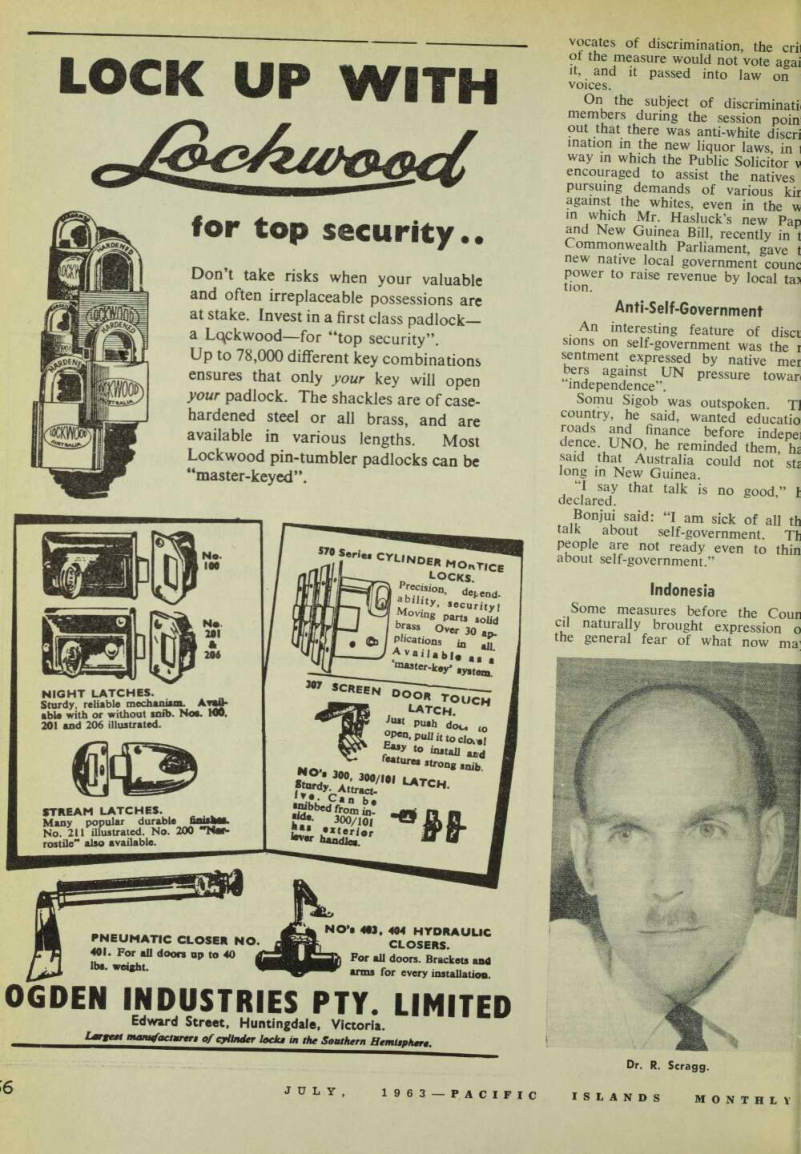
Dr. R. Scragg.
across the border from unpre le Indonesia. cted member S. R. Slaughter 3t mince words. He said he wel i the assurance of Indonesia she wished to be friends with Guinea. But while she had said ad no further ambition for terri gains, she had declared that vould “liberate colonised terri ” and the significance of that not be ignored. have no doubt that the first step s our border will mean war,” he “We are pleased to hear of Aus s increased vote for defence — ti my opinion Australia should loving quickly. Our unprepared is such that it could be all over ; it starts.”
Title of "Dr." nouncing the Administration’s ion to provide measures under i graduates of the Suva and P- Vledical Training Schools would gistered and become entitled to lied “Dr.”, the Assistant Admin or submitted a lengthy state warmly praised the record, the and the devotion of the Assis- Medical Practitioners, quoted dents for giving them the status Dr”; and insisted that on Terri standards they deserved that e European elected members 1 in praise for the work of the ’’s; but, to a man, they opposed se by them of the title “Dr.” One ;d a former statement by Mr. . McCarthy that the graduates le native medical schools had t half the training of qualified pean doctors. -. Hurrell said that, while the r s were held in high esteem and
respect by the whole P-NG com munity, the use of the title “Dr.”, which indicated a graduate of the highest medical training institutions of the Western world, would give a completely wrong impression and cause embarrassment to everyone concerned.
Mr. Downs deplored any attempt by the P-NG Administration to lower medical standards—and he said that is what would happen if the proposal went through. He said that instead, the Administration should acknow ledge the good work and the ability of the native practitioners by helping them in every possible way to go to Australia and qualify for the title of “Dr.”
Mr. John Guise, gave piquancy to the debate by dicussing recent criti cism of the medical service made by Senator R. J. Turnbull, who is a doctor. Mr. Guise said that Dr. Turn
bull should be awarded the order of DCB—“Don’t Come Back”.
The Director of Medical Services, Dr. R. Scragg, described the work of the Papuan Medical College, in teaching native students in the fields of surgery, medicine, public health, obstetrics, in a five-year course. The course was not easy—of 65 who had entered only 39 were still there—and the graduates who got through would be highly qualified, and very welcome in a country desperately short of medical practitioners, he added.
Indications were that, despite the criticism, the Administration would proceed with its plan.
The 37-member Council sat for four days. It will meet again in August, briefly, and again in Septem ber. The new Assembly, to be elected in May, 1964, on a common roll, will have 64 members.
Somu Sigob.