Disillusioned
pp. 47-53 · Read in the full issue
Indonesians Face
A Ng Problem
Prom a Special Correspondent recently returned from Kota Baru.
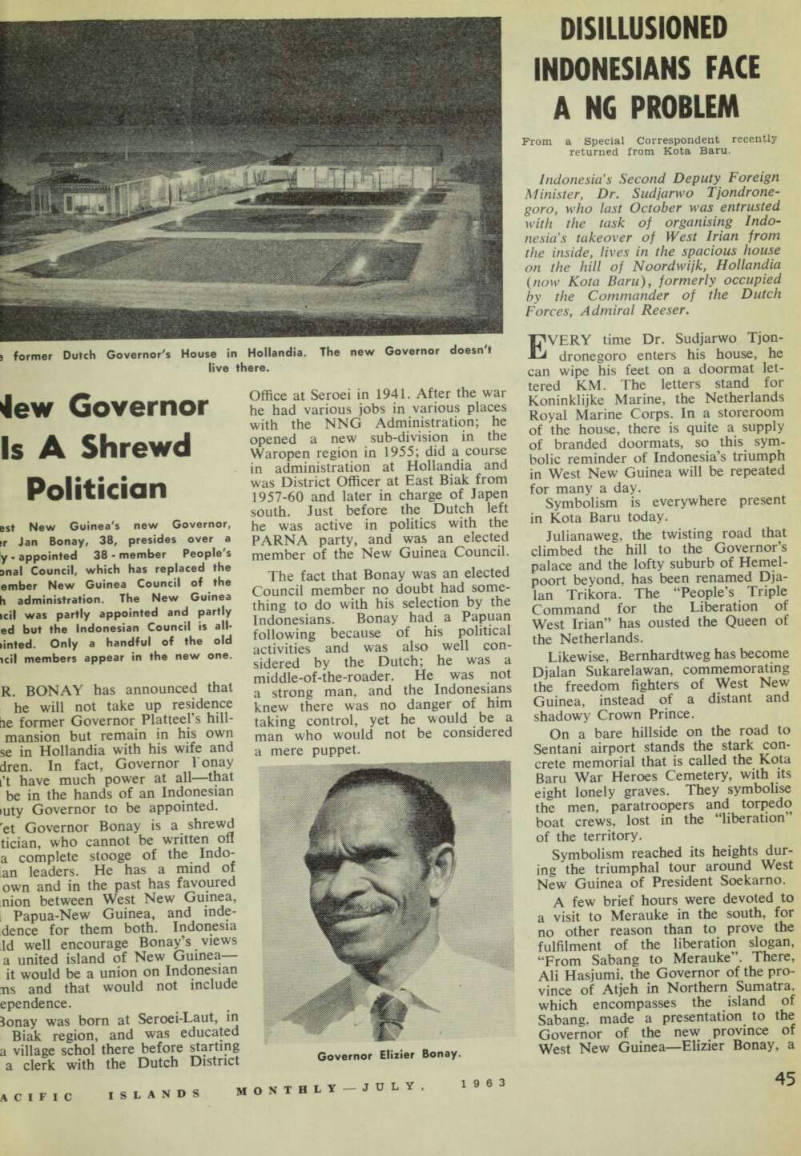
Indonesia’s Second Deputy Foreign Minister, Dr. Sudjarwo Tjondrone goro, who last October was entrusted with the task of organising Indo nesia’s takeover of West Irian from the inside, lives in the spacious house on the hill of Noordwijk, Hollandia (now Kota Baru), formerly occupied by the Commander of the Dutch Forces, Admiral Reeser.
EVERY time Dr. Sudjarwo Tjon dronegoro enters his house, he can wipe his feet on a doormat let tered KM. The letters stand for Koninklijke Marine, the Netherlands Royal Marine Corps. In a storeroom of the house, there is quite a supply of branded doormats, so this sym bolic reminder of Indonesia’s triumph in West New Guinea will be repeated for many a day.
Symbolism is everywhere present in Kota Baru today.
Julianaweg, the twisting road that climbed the hill to the Governor’s palace and the lofty suburb of Hemel poort beyond, has been renamed Dja lan Trikora. The “People’s Triple Command for the Liberation of West Irian” has ousted the Queen of the Netherlands.
Likewise, Bernhardtweg has become Djalan Sukarelawan, commemorating the freedom fighters of West New Guinea, instead of a distant and shadowy Crown Prince.
On a bare hillside on the road to Sentani airport stands the stark con crete memorial that is called the Kota Baru War Heroes Cemetery, with its eight lonely graves. They symbolise the men, paratroopers and torpedo boat crews, lost in the “liberation” of the territory.
Symbolism reached its heights dur ing the triumphal tour around West New Guinea of President Soekarno.
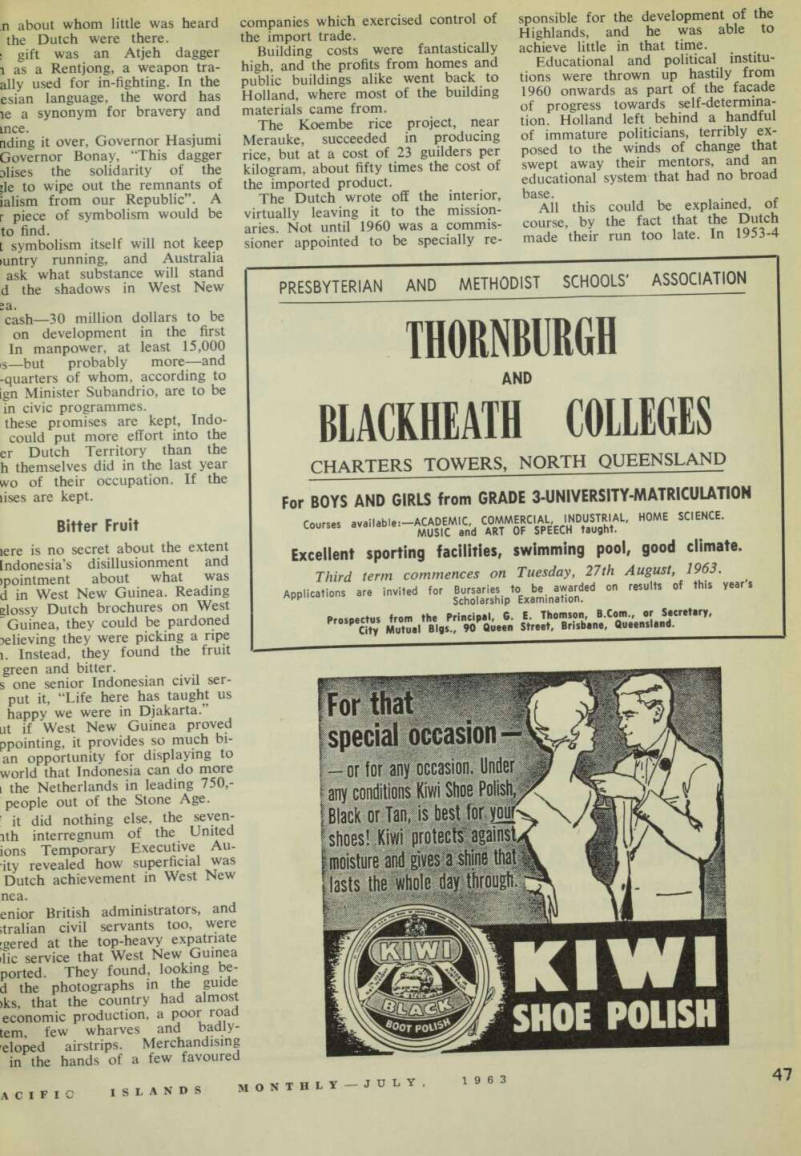
A few brief hours were devoted to a visit to Merauke in the south, for no other reason than to prove the fulfilment of the liberation slogan, “From Sabang to Merauke”. There, Ali Hasjumi, the Governor of the pro vince of Atjeh in Northern Sumatra, which encompasses the island of Sabang, made a presentation to the Governor of the new province of West New Guinea —Elizier Bonay, a
,n about whom little was heard ( the Dutch were there. * gift was an Atjeh dagger i as a Rentjong, a weapon tra ally used for in-fighting. In the esian language, the word has ie a synonym for bravery and mce. tiding it over, Governor Hasjumi Governor Bonay, “This dagger alises the solidarity of the ;le to wipe out the remnants of ialism from our Republic”. A r piece of symbolism would be to find. t symbolism itself will not keep aintry running, and Australia ask what substance will stand d the shadows in West New sa. cash—30 million dollars to be on development in the first In manpower, at least 15,000 i S —but probably more^ —and -quarters of whom, according to ign Minister Subandrio, are to be in civic programmes, these promises are kept, Indo could put more effort into the er Dutch Territory than the h themselves did in the last year wo of their occupation. If the uses are kept.
Bitter Fruit iere is no secret about the extent Indonesia’s disillusionment and ipointment about what was d in West New Guinea. Reading glossy Dutch brochures on West Guinea, they could be pardoned relieving they were picking a ripe i. Instead, they found the fruit green and bitter. s one senior Indonesian civil ser put it, “Life here has taught us happy we were in Djakarta.” at if West New Guinea proved ppointing, it provides so much bi an opportunity for displaying to world that Indonesia can do more l the Netherlands in leading 750,people out of the Stone Age. : it did nothing else, the seven th interregnum of the United ions Temporary Executive Au ity revealed how superficial was Dutch achievement in West New nea. enior British administrators, and itralian civil servants too, were f gered at the top-heavy expatriate •lie service that West New Guinea ported. They found, looking be d the photographs in the guide >ks, that the country had almost economic production, a P 00^ 1 "*?, tern, few wharves and badiy reloped airstrips. Merchandising in the hands of a few favoured
companies which exercised control of the import trade.
Building costs were fantastically high, and the profits from homes and public buildings alike went back to Holland, where most of the building materials came from. .
The Koembe rice project, near Merauke, succeeded in producing rice, but at a cost of 23 guilders per kilogram, about fifty times the cost of the imported product.
The Dutch wrote off the interior, virtually leaving it to the missionaries. Not until 1960 was a commissioner appointed to be specially re-
sponsible for the Highlands and he was able achieve little in that time.
Educational and political. tions were thrown up hastily trom 1960 onwards as part * of P thfnd a hanSul tion. Holland !eft behmd a handtui of immature po 1 *® ia change y t h a t posed to the swept away their me n t° r s a educational system that had no broad base explained, of All this could be expiamea course, by the fact that me uuicn made their run too late, n
re was absolutely nothing of any ue in West New Guinea, apart m what had been left over by the icrican Army. fhe Dutch development of the last r years was extraordinary but it 5 still far from reaching the *e where it could gather any mo ntum of its own. fhe political facade was still noth but a facade, although some of seeds of a Papuan nationalism I certainly been sown, as the In lesians will find out.
Whether Indonesia does or does ; in the future achieve the spec ular success she so obviously 3es for in West New Guinea, de opments there are going to have 3rofound effect on the conduct of stralia’s administration in Papua 1 New Guinea. [f, in a few years time, Indo »ia can point to spectacular de opments, either real, or contrived, her province next door, Australia 1 need to watch out. President skarno’s words in Kota Baru may jve to have had an ominous ring . . we would fight to liberate Aus lia herself, were she to be occu :d by a colonialist power.” Aus lian’s definition of colonialism mid probably differ from those cur it in Indonesia.
Perhaps it was coincidence that istralia’s Minister for Territories, r. Hasluck, spoke out against new ncepts of colonialism at the end of j first week of Indonesian rule in est New Guinea.
“It seems to me that colonialism aches its utmost depth when a
parent authority, disregarding the wishes of a dependent people, decides and declares exactly what should happen to them,” he said.
“Yet, by a queer paradox, this is precisely the course which is being advocated in the world today by so many of those governments and those critics who cry out most loudly against colonialism.
“The paternalism of the colonial powers of the past is a mild self interest compared with the active and arrogant disregard of the will of de pendent peoples that appears in the new imperialism that is at work in so many parts of the world today.”
He went on to say . . .
“. . , in the British traditions of
Parliamentary democracy, the ques tion of the powers a legislature can exercise is of more importance than it is in those countries which have an authoritarian tradition.
“In such countries, the require ments of what they call democracy are satisfied by having a large repre sentative assembly, even if that assembly has limited powers and functions, and even if its members are chosen by a method which leaves the voter a limited range of choice, or takes little account of the popular will.
“We ourselves only judge the character of a legislature after asking how it is chosen, and what powers it can exercise.”
Perhaps it was chance that this
Sydney Visitors
These two attractive Island girls, Joanne Pamatatau, of Mauke, Cook Islands (left), and Miss Louisa Crowley, of Apia, Samoa, attended a recent gathering of the Poly nesian Association of Sydney. —Tele-photos.
:h came just five days after the ring-in of the 38 appointed and bly obedient members of the new esentative Council of West New ea (to replace the New Guinea icil, which was dissolved), istralia, in administering her Guinea territories, must fight for mch time as possible to provide alid foundation for true self mination for the people. Yet she : hasten in her task. She must, in t, walk a tightrope in New lea.