Viet Repatriation
pp. 15-16 · Read in the full issue
Temporary Hitch In Viet Repatriation
The first shipload of 550 Viet namese from New Caledonia to North (Communist) Vietnam under the resumed repatriation scheme was expected to leave Noumea in late June or early July in the British liner Eastern Queen.
THE Eastern Queen arrived in Noumea on June 10, but the Vietnamese refused to board the vessel until their embarkation was supervised by a mission from North Vietnam.
A message received in Noumea in mid-June from the International Red Cross said that a North Vietnam mis sion would arrive in Noumea on June 27.
Meanwhile, a woman member of the French Red Cross arrived as an embarkation supervisor, and a South Vietnam “consul”, who had opened an office and propaganda bureau in Noumea several weeks earlier, re turned to Saigon “to confer with his
government”.
His departure was apparently moti vated by the expected arrival of the North Vietnam mission, and he was expected to be away for about a week.
Unlike the three previous occasions
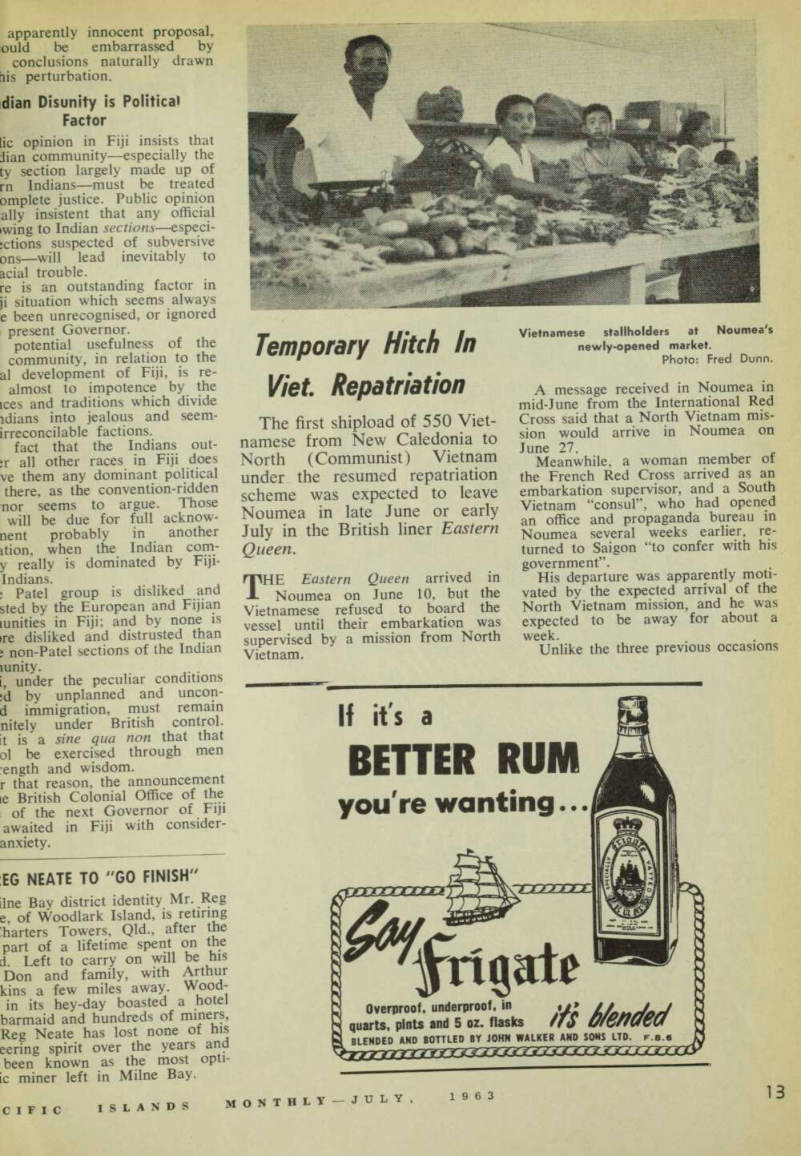
Vietnamese stallholders at Noumea's
newly-opened market.
Photo: Fred Dunn.
m 1960 and 1961 when the Eastern Queen repatriated Vietnamese from New Caledonia after they had had frantic buying sprees for suitcases, bicycles, etc., this time they have given virtually no sign of their im minent departure.
The Vietnamese were brought into New Caledonia as labourers on five year indentures before the war. When war broke out their repatriation be came impossible; and after the war political and diplomatic difficulties prevented their repatriation until 1960 The Eastern Queen then made three voyages to Haiphong, but new diplo
matic difficulties caused a fourth voyage to be cancelled.
On the fourth voyage, the Eastern Queen was to have repatriated a ship load of Vietnamese from the New Hebrides, who were also brought out before the war.
This time the Eastern Queen will lift about 550 Vietnamese from New Caledonia and the New Hebrides on alternate voyages. About 2,000 in each territory have elected to go.
This will leave only 100 or so in the New Hebrides, but something like 2,000 in New Caledonia.