Need For Community Balance
pp. 11-15 · Read in the full issue

Embarrasses Fiji's Governor
By a Staff Writer
Incidents and develop ments in Fiji in recent months have not created conditions for a happy re tirement by the Governor, Sir Kenneth Maddocks, KCMG, whose term ends in
September.
IT was his bad luck that Sir Kenneth’s introduction to Governorship, in 1958-59, was clouded over by grave industrial and economic troubles, caused by the strike of cane-sugar growers, for the unseemly prolonga tion of which a section of Indian politicians, led or influenced by a lawyer, Mr. A. D. Patel, was gener ally blamed.
And it is the irony of fate that, as the Governor gets ready for de parture, one of the administrative headaches he must leave for his suc cessor is the mischief-making possi bilities of a group of Indians, led by the same Mr. Patel, in the new Legis lative Council.
This Governor is responsible for a change in the constitution of the Legislative Council. But it was not his fault that under the re-arranged voting system the Indian population chose, among their four elected repre sentatives, Messrs. A. D. Patel, Koya and Madhaven, whose careers as strike-leaders and politicians have given them —unjustly or not—a repu tation, in some eyes, as anti-European and anti-CSR company.
The 38-member Fiji Legislative Council is now constituted thus:
Speaker \
Ex-officio Members .. • • £
Official Members 16 European — Elected 4 Nominated • • 2 6 Fijian— Elected 4 Elected by Council of Chiefs ... 2 D Indian — Elected 4 Nominated 2 o
A block of three anti-European Indians in a Council of 38 could not have done much harm. But when the Governor (carrying out his obligation to complete the Council by nominat ing a further two representatives of Indians and of Europeans) appointed two more Indians of what has been called the extremist group, the Gover nor’s choice was widely criticised and condemned.
High officialdom defended the Governor’s nominations by arguing that he had to be guided by the Indian electors’ inclinations as dis closed at the ballot boxes, and that he was not aware, anyway, that these were followers of Mr. Patel.
But critics strongly contested this viewpoint. They insisted that Messrs.
Patel, Koya and Madhaven actually represent a minority of Indian voters, and that the two nominated Indians had fought openly during the election for the candidature of Patel, Koya and Madhaven.
A Potential Trouble-Spot This was confirmed, soon after, by a naive public announcement by one of the nominees, to the effect that they now formed in the Council what he called “a strong team” of five, to fight for what they believed to be Indian interests.
The critics also say that the Gover nor was specifically warned that his selections, before he nominated them, were “Patel men”.
This development has given offence
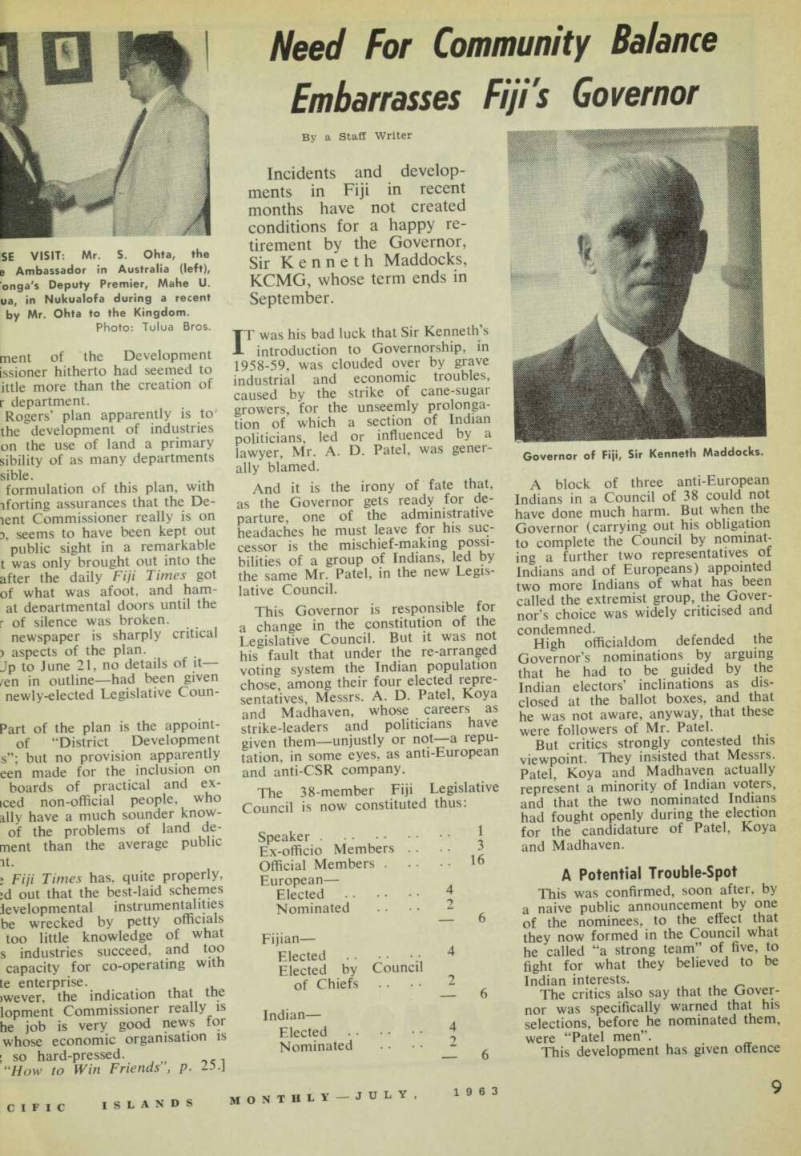
Governor of Fiji, Sir Kenneth Maddocks.
ither two communities —Fijian ropean—who, on past history, confidence in the Patel group, a potential trouble-spot which ave been avoided. 5 are many able men who lave been nominated in place two chosen by the Governor, ect of the Governor’s action the majority of Fiji Indians ive only one representative in jncil. now has entered a period of lie improvement. Much of this attributed to the stabilising in of the Sugar Control Board, creation of which the retiring or can be given much credit, the outspoken opinion of most in Fiji is that, if the mischief ; propensities of the Indian y group are not countered by overnmental action, much of momic good recently achieved be undermined.
Unfortunate Incident impression has been ned by an unfortunate incident y June. 5 expected a UN committee scuss the condition of Fiji; and Iji Times suggested that, as two most prominent members of jian community (Ratu George au, highest-ranking Fiji chief, atu Penaia Ganilau, who got :ond-highest popular Fijian vote ’s history) were in the United on a US Department of State hey might meet the committee, jtline the attitude of the Fijian unity towards Fiji’s constitu and political future, i perfectly reasonable propo apparently gave offence to Fiji s t governmental authorities, and as made plain, in no uncertain o the editor of The Fiji Times. vas assumed by the latter that the Governor’s opinion that, if entatives of the indigenous race to go before the committee, so should representatives of the numerous immigrant race, the face of it, that represented t of the de-colonisation policies j British Colonial Office, which goes too far in its attempts to ate the goodwill of subject races, o avoid giving offence to sensi people. That way of thinking ly has brought disaster to some ti colonies; and, in the peculiar nstances of Fiji, it will, if per in, surely bring disaster to Fiji That, at any rate, is an opinion ally held in Fiji; and if the rnor was perturbed by The Fiji
(next page, please)
apparently innocent proposal, ould be embarrassed by conclusions naturally drawn dis perturbation. dian Disunity is Political Factor lie opinion in Fiji insists that dian community—especially the ty section largely made up of rn Indians —must be treated omplete justice. Public opinion ally insistent that any official ►wing to Indian sections—especi ;ctions suspected of subversive □ns—will lead inevitably to acial trouble. re is an outstanding factor in ji situation which seems always e been unrecognised, or ignored present Governor, potential usefulness of the community, in relation to the al development of Fiji, is re almost to impotence by the ices and traditions which divide idians into jealous and seem irreconcilable factions. fact that the Indians out tr all other races in Fiji does ve them any dominant political there, as the convention-ridden nor seems to argue. Those will be due for full acknow nent probably in another ition, when the Indian com y really is dominated by Fiji- Indians, 5 Patel group is disliked and sted by the European and Fijian [unities in Fiji; and by none is ►re disliked and distrusted than j non-Patel sections of the Indian mnity. i, under the peculiar conditions •d by unplanned and uncon d immigration, must remain nitely under British control, it is a sine qua non that that ol be exercised through men ength and wisdom, r that reason, the announcement ic British Colonial Office of the of the next Governor of Fiji awaited in Fiji with consider anxiety.