w Commercial Body
pp. 7-8 · Read in the full issue
Will Play Big Part In New Hebrides' Future
The New Hebrides Chamber of Commerce, Industry and riculture, the first partly-elected advisory body to be created :e the Anglo-French Condominium was established in the Dup in 1906, held its inaugural meeting in Vila on June 14.
creation of the Chamber is ossibly the most important step e development of the New ies for more than half a y. It will probably lead to the shment of an elected Legisla ouncil.
Chamber will advise the i and French Resident Commis s on the economic development e Group; it has authority to t proposals to the Administra dthout being asked; and it will insulted by the Administration any economic measure affect e territory is adopted.
Chamber is thus likely to greater influence than the Ad- Council (the Condominium’s t representative body), which et up in 1958 and which meets once a year. The Advisory :il members are all appointed. i Chamber has 20 members — Europeans and eight natives.
Eight of the Europeans were elected.
The rest were nominated by the two Resident Commissioners, Mr. A. M.
Wilkie (British) and Mr. M.
Delauney (French).
In a joint speech at the inaugural meeting of the Chamber, the Resident Commissioners made it clear that they were working towards the creation of an elected Legislative Council.
They said: “Although the time will come when there will be a constitu tional body with elected members in the New Hebrides, it is perhaps a good thing that the first elected body should be an economic and not a political one as acquaintance with the realities of commercial, industrial and agricultural affairs will render pos sible a more accurate and deeper appreciation of the situation.
“In a developing territory, a body which represents the various economic activities is absolutely necessary to in form and advise the Administration
regarding the best measures to take to ensure the growth indispensable to economic and social progress.
“We thought it preferable to make this body a public institution with financial independence representing impartially the various branches of the economy of the Group. We hope that one day the Chamber of Com merce will be solely composed of elected members.”
The Resident Commissioners said that the Chamber should advise and inform them on all economic ques tions concerning the territory. This meant that the Administration would provide the Chamber with “compre hensive documentation” and that the Chamber would normally be con sulted whenever industry, commerce and agriculture were affected by an economic measure.
They said the Chamber should also submit proposals on increasing the prosperity of the Group. It could therefore give advice to them on any problems within its sphere without first being consulted by the Adminis tation.
The Chamber could also engage in “certain works” and the operation of services of economic value for the territory. This meant that the Ad ministration would be able to devolve part of its responsibilities on the Chamber.
“Thus, for example, the grading of produce could be the first task with which it could be entrusted,” the Resident Commissioners said.
“It is by no means impossible that the Chamber could later operate the Vila wharf.” (This wharf has not yet been built.) “Finally, and very important, the Chamber may enter into relations with similar organisations elsewhere throughout the world.
“It should make the New Hebrides
NGAN ELECTIONS. The people of Tonga on May 27, went to the polling [?]oths to elect seven candidates out of 49 in the Legislative Assembly for 1963- The others are nobles, who have their own system of election. Everybody [?]er the age of 16 may vote for the seven. Here, at one polling booth in Nuku [?]fa, electors press forward to receive their ballot papers. Queen Salote opened the new session on June 13. Photo: Tulua Bros.
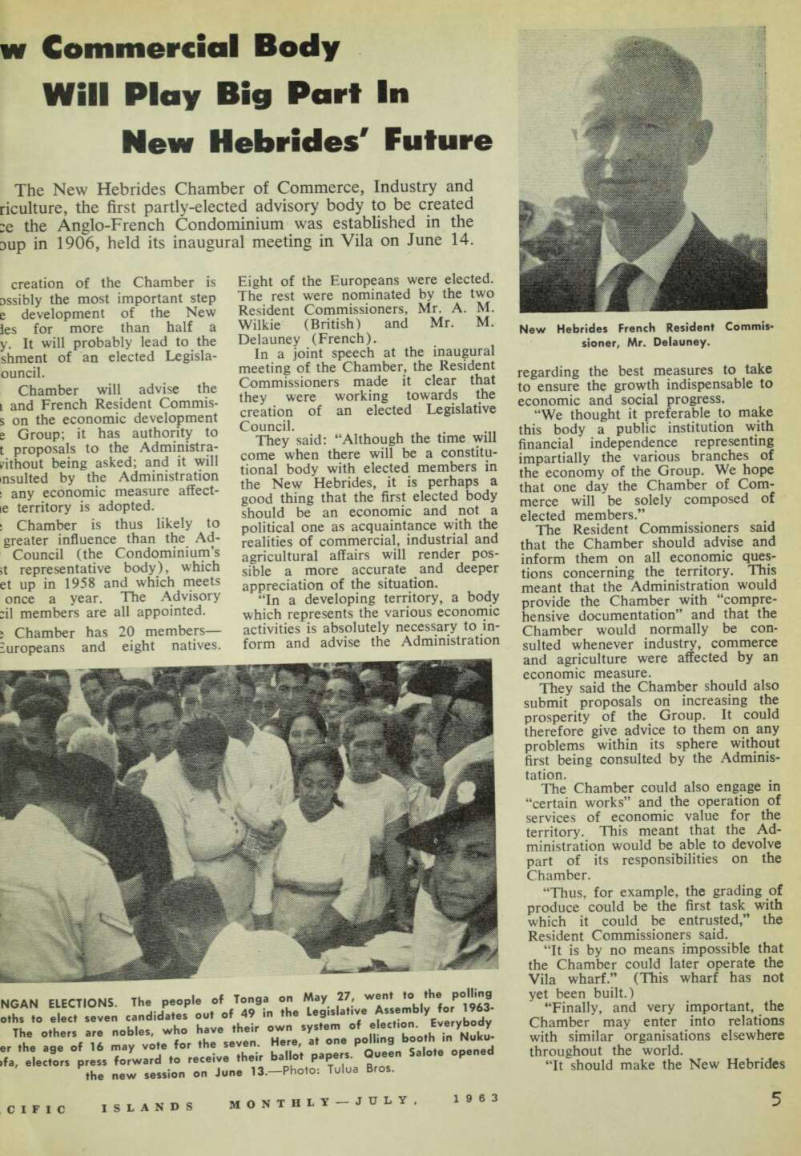
New Hebrides French Resident Commis sioner, Mr. Delauney.
and its possibilities better known overseas, it should seek for new out lets and should endeavour to create new commercial exchanges and to intensify those which already exist.
“We have said that the establish ment of an economic body before that of a truly political one appeared to us desirable.
“World history has abundantly Proved during the last few years that the two fields are intimately con nected and that good policies are possible only if there is good finance —in other words, only if there are stable economic conditions and if the expansion of the territory is proceeding smoothly.
“The efforts which you (the Chamber) can make in this direction will be of the utmost importance. All Government measures have some economic repercussions. Similarly, any change in the economic situation can induce the Administration to re consider its policies. You ought on every occasion to examine the inter play of these factors and to propose to us new solutions.”
Members The eight elected European mem bers of the Chamber (elected from a restricted nominal roll) are Messrs G - ' d f? Granges, H. Russet, J. Ratard and K. Solway (agricultural section), and J. Chauveau, L. Leca, G. Meyer and J. Stegler (commerce and in dustry section).
The four nominated European members are Messrs. D. J. Gubbay and J. Villemont (commerce and in dustry section) and P. Lutgen and G. Seagoe (agriculture section). The nominated native members are Leyhe,
Carlo, Kalsakau, Tipoloamata, To’
Ati, Garae and Frank.
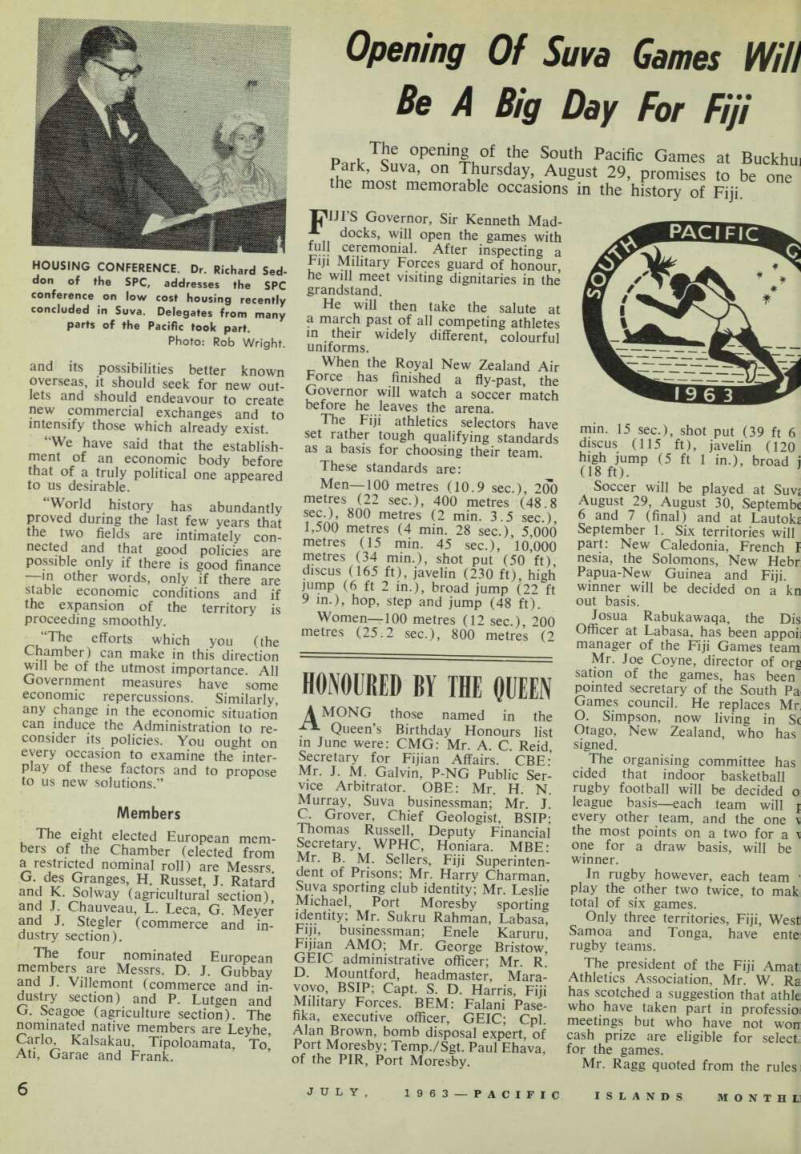
HOUSING CONFERENCE. Dr. Richard Sed don of the SPC, addresses the SPC conference on low cost housing recently concluded in Suva. Delegates from many parts of the Pacific took part.
Photos Rob Wright.